

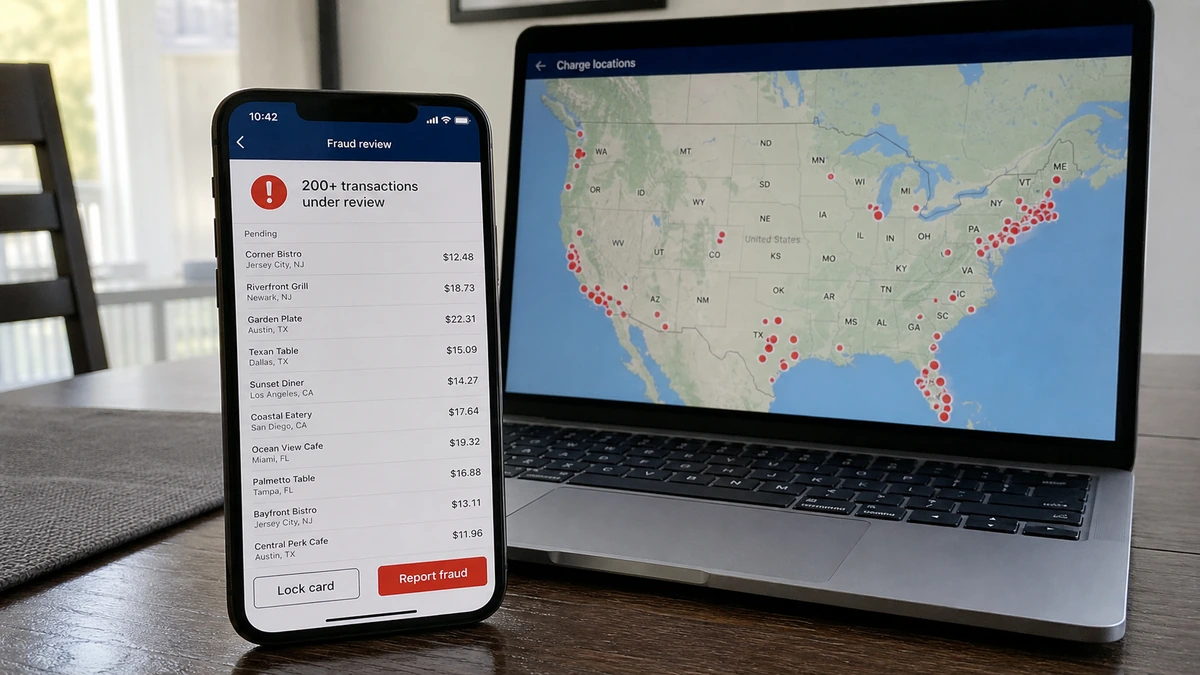
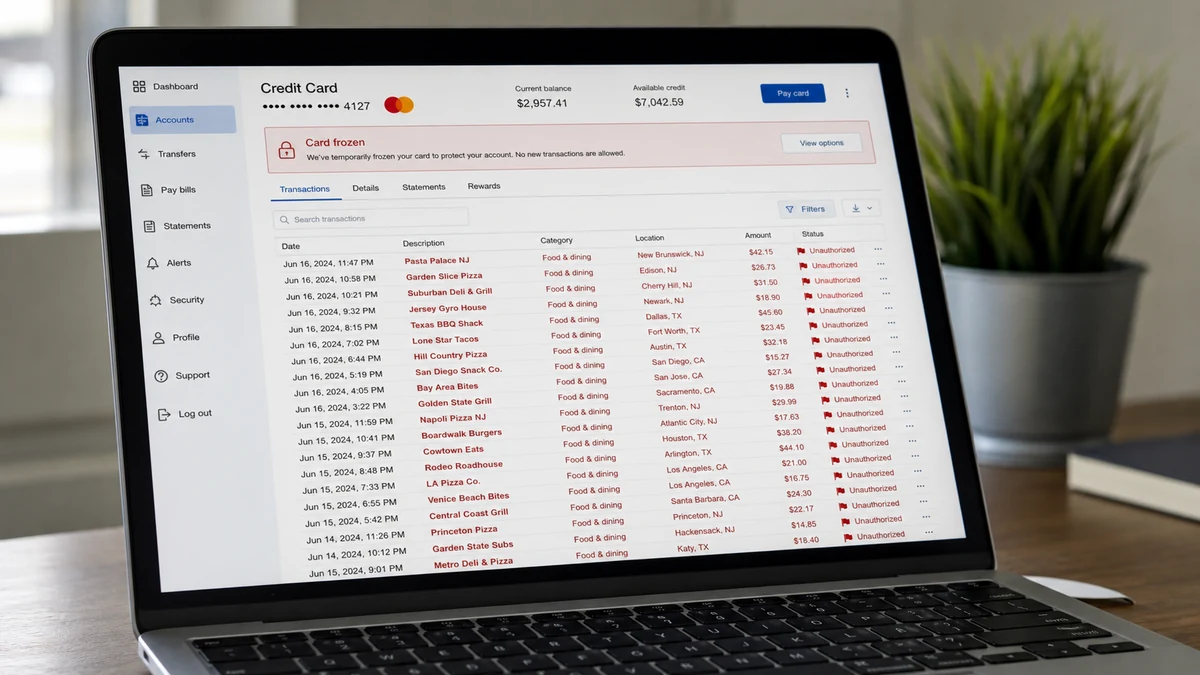
More than 200 food charges landed on one credit card in three days. Around 30 named the same restaurant chain, but the locations stretched from New Jersey to Texas and California.
This was not one thief ordering an impossible number of meals. The geography points to something far more useful to criminals than the physical card.
Overview
One payment credential appears to have traveled nationwide
A family discovered more than 200 disputed charges on their grandparents’ credit card. About 30 appeared to involve Applebee’s, with restaurant locations scattered across several states during a three-day period.
Other food businesses appeared as well, along with a charge associated with Perth Zoo. The cardholders did not recognize the purchases, and the travel pattern could not fit ordinary use.
The physical card may never have gone anywhere. A stolen number, stored payment account, digital wallet token, or food-delivery login can be used remotely by many people at once.
Meals are fast, local, and difficult to recover
A criminal can order food for personal use, sell discounted meals to local customers, test whether a card still works, or exploit refunds and rewards. Several motives can exist inside the same burst.
Food disappears quickly after delivery or pickup. Unlike a laptop shipment, there may be no valuable object left for a bank or merchant to recover days later.
The public account does not reveal who placed the orders or which method produced value. It gives the visible pattern, while the useful device, account, delivery, and authorization records remain with the businesses involved.
Mixed bank decisions did not make the other charges legitimate
The issuer reportedly accepted some transactions as fraud while other charges at similar merchants remained unresolved or were not classified the same way.
Banks score each transaction separately. Two charges with the same restaurant name may have different devices, wallet tokens, account histories, delivery records, or authentication data.
The warning signs across the full cluster were unusually strong:
- More than 200 transactions appeared within a short period.
- Locations spanned states the cardholders could not visit in three days.
- Many charges repeated at one restaurant chain.
- Other unrelated food merchants used the same card.
- An overseas attraction added another geographic inconsistency.
- The cardholders did not authorize or benefit from the orders.
- Similar charges received inconsistent early dispute decisions.
- The volume was far beyond an accidental duplicate charge.
Why Anyone Would Buy 200 Meals
The simplest explanation is that several people used the same stolen credential. Card details can be sold or shared, allowing buyers in different cities to place orders until the issuer blocks them.
There is also a small underground business model built around discounted orders. A customer pays an order broker less than menu price. The broker uses stolen payment details and keeps the customer’s real payment.
The person eating the meal may be told that the discount comes from coupons, rewards, or an employee connection. That does not make the transaction lawful, but it explains how an order can reach an ordinary address.
Some charges may be tests. A quick low-value authorization shows whether the card is active and whether additional verification appears before criminals attempt more valuable purchases elsewhere.
Repeated use at one chain can reflect familiarity with its ordering system, broad national coverage, weak account controls, or a stored card inside one compromised login. It does not prove the restaurant organized the fraud.
The Perth Zoo descriptor may represent a separate participant, a test, or a merchant label that needs clarification. A line on a statement cannot explain the intent behind the charge.
How the 200 Food Orders Card Scam Works
Step 1: Card or ordering-account access is obtained
A criminal gets the card number, expiry date, security code, billing details, digital token, or login to an account where the payment method is already stored.
The exposure may come from phishing, malware, a breached account, a malicious extension, a skimmer, or someone with access to the details. This case does not identify the original route.
Step 2: A small order checks whether it works
A food purchase produces an answer quickly. Approval shows that the credential is active and reveals whether the bank demands a code or rejects the device.
A working credential becomes more valuable. A failed one can be discarded without the cost and attention attached to a large attempted purchase.
Step 3: Access is shared or sold
One person can distribute the card details or compromised account to several buyers, resellers, or local order brokers. That creates charges in places one thief could never visit.
The package may include a billing address, phone number, account cookie, or delivery login to help transactions pass automated checks.
Step 4: Remote ordering hides the physical distance
Restaurant apps, websites, delivery services, digital wallets, and stored-value accounts all support card-not-present purchases. The meal can be delivered, collected, or redirected without the plastic card.
Different merchants and franchises apply different checks. One order passing does not mean every following attempt will succeed.
Step 5: Volume grows before the block takes effect
Many users can produce hundreds of attempts in a short window. Small transactions may also attract less immediate attention than a single electronics purchase.
Some authorizations decline while others settle. Notification settings, processing delays, and how quickly the family contacts the issuer determine how long the window stays open.
Step 6: Food, resale, and refunds turn access into value
Some users simply consume the order. Others collect real payment from a customer for a discounted meal while the stolen card covers the merchant charge.
A separate route may involve refunds or loyalty balances. The visible statement does not show which method applied to each transaction.
Step 7: One event becomes hundreds of small disputes
The cardholder sees one obvious fraud episode. The issuer may process each charge with a separate merchant response and separate automated score.
A numbered master list and a written statement connecting the full cluster help prevent the case from becoming a pile of unrelated tickets.
The Statement Cannot Reveal the Access Route
The merchant description shows where the payment was processed, not how the credential escaped. The last store used legitimately is not automatically responsible for a later compromise.
Possible routes include a copied card page, reused delivery password, information-stealing malware, compromised retailer, digital wallet enrollment, family access, or a breach at another service.
The national spread suggests that access was not confined to one nearby person. It may have been shared, sold, or exposed through an account that multiple people could use.
Only the issuer, card network, restaurant platforms, delivery services, and investigators can connect private records such as IP addresses, devices, pickup names, and delivery destinations.
Our investigation of a stolen card used to build online accounts shows the same larger problem. Replacing the number blocks future charges, but infrastructure created with it may still exist.
The family should avoid naming a merchant as the breach point without evidence. A wrong conclusion can distract from the compromised email, wallet, or delivery account that still holds access.
Why the Bank May Treat Similar Charges Differently
Fraud systems examine the amount, time, device, merchant category, verification method, account history, wallet token, delivery information, and many other signals.
One restaurant may show a newly typed card. Another may show a stored credential used from an account with old activity. To an automated system, those transactions can look very different.
A familiar account is not always a safe account. If a delivery login was taken over, its history may help the criminal’s order appear legitimate.
An early decision can also be wrong or incomplete. Ask how to appeal, which documents supported a denial, and whether the investigator reviewed the impossible geography across the entire cluster.
The FTC guide to credit card disputes explains the federal billing-error process. Written notice generally should reach the designated address within 60 days after the first statement containing the error was sent.
Telephone and online reports are useful for speed, but follow the issuer’s formal instructions as well. Send the letter to the billing-dispute address, keep copies, and use trackable delivery.
Credit and Debit Cards Require Different Urgency
The account described here involved a credit card. That matters because credit and debit protections, deadlines, and immediate effects on household cash are different.
Credit card fraud usually reduces available credit while the dispute is investigated. Debit fraud removes money directly from a bank account and can interfere with rent, utilities, and other payments.
Anyone dealing with a debit card should contact the bank immediately rather than wait for the monthly statement. Liability rules can depend heavily on how quickly the issue is reported.
The FTC’s lost or stolen card guidance explains those timing differences. Account agreements and state rules may provide additional protection.
For either card type, request a replacement and ask whether digital-wallet tokens and automatic account-updater links tied to the old number will be terminated.
A new card does not secure the email, restaurant account, or device that may have exposed the first one. The route must be investigated separately.
Build One Dispute File for the Entire Burst
Download the full statement and transaction details before the online display changes. Create a list with date, time, amount, merchant descriptor, location, dispute status, and case number.
Group charges by brand and day while keeping every transaction individually numbered. The issuer may need separate identifiers even when all of them clearly belong together.
Write a short declaration stating that the cardholders did not authorize, receive, or benefit from the orders and that the geographic pattern was impossible.
Avoid guessing about the thief. Facts about possession of the card, travel, household access, and the first alert are more useful than an unsupported theory.
Ask whether transactions used the raw card number, a stored credential, chip, contactless payment, 3-D Secure, or a digital wallet token. Those details can point toward the account that needs recovery.
Keep a call log with dates, representative names, promises, escalation numbers, and deadlines. Follow verbal conversations with secure messages or written correspondence.
Checks That Can Stop the Access From Returning
Review every digital wallet attached to the card. Remove unfamiliar devices and ask the issuer to revoke tokens created before the replacement.
Search email for restaurant receipts, delivery confirmations, password resets, new-device alerts, and deleted-message notices. Check trash and forwarding rules in case an intruder hid order messages.
Open each real restaurant and delivery account independently. Remove stored cards, sign out other sessions, choose unique passwords, and enable multifactor authentication where available.
Tell the issuer if you remember entering a one-time code on a payment page. The Visa Click to Pay phishing pattern shows how a real code can enroll a payment credential for someone else.
Continue reviewing statements after the replacement arrives. Delayed settlements and credits may post later, and each unauthorized charge should eventually match a reversal or final decision.
Contact merchants through official channels. Ask them to preserve order, pickup, delivery, device, and refund records, even if they can release those details only to the issuer or police.
Company, Address, and Fulfillment Checks
The named merchants were not automatically responsible
Restaurant and attraction names may identify where stolen credentials were used. The statement alone does not establish that any merchant stole or distributed the card data.
Statement cities may not be delivery locations
A descriptor can show a franchise office, processor, or online platform. The actual pickup or delivery address may exist only inside transaction records.
The original compromise remains unidentified
No public evidence points to a particular phishing site, retailer breach, malicious app, insider, or lost card. The family should secure every plausible account while the issuer investigates.
Fulfillment records may connect the cluster
Order accounts, pickup names, delivery addresses, phone numbers, devices, and refund destinations can reveal common actors. Preservation requests matter because retention periods differ.
What to Do if You Have Fallen Victim to This Scam
- Freeze and replace the card. Ask the issuer to stop new authorizations, wallet tokens, and updater links tied to the compromised number.
- List every unauthorized transaction. Do not assume hundreds of charges will be grouped automatically.
- Submit a formal written dispute. Use the designated billing address and meet the applicable deadline.
- Appeal inconsistent decisions. Request the evidence supporting any charge that the issuer treats as authorized.
- Secure linked accounts. Change unique passwords for email, restaurants, delivery services, wallets, and banking; revoke unknown sessions.
- Enable low-value alerts. Small test charges should trigger immediate notification on the replacement card.
- Contact merchants officially. Request preservation of order, pickup, delivery, device, and refund records.
- Report broader identity theft. Use IdentityTheft.gov and contact police if required for merchant or issuer records.
- Review credit reports. Freeze the files if wider personal information may have been exposed.
- Run a full Malwarebytes scan. This can find stealers or malicious extensions on devices used for payments.
- Use AdGuard after cleanup. It can block many phishing and malicious advertising routes, but it cannot reverse card charges.
- Watch the replacement account. Delayed transactions or an unresolved compromised service may create more alerts.
- Ignore paid recovery offers. Do not pay anyone claiming secret access to a bank or card network.
Frequently Asked Questions
How can one card create orders across the country?
The credentials, wallet token, or delivery-account login can be shared and used remotely by multiple people. The physical card does not need to travel.
Why would criminals spend stolen money on food?
Meals are fast and difficult to recover. Orders can also be resold at a discount or used to test whether a payment credential works.
Does a repeated restaurant name mean the chain caused it?
No. It may show where the stolen payment was used. Separate evidence would be needed to identify where the original compromise occurred.
Why did the bank accept some disputes but not others?
Each transaction may have different device, account, wallet, or merchant evidence. Ask for the reasons and appeal every incorrect decision.
Should the family call every restaurant?
Start with the issuer and each merchant’s official fraud or customer-care channel. A central team can often preserve records more consistently.
Will replacing the card solve everything?
It should stop the old number, but compromised email, delivery accounts, wallets, or devices must also be secured so the route does not persist.
The Bottom Line
The 200 food orders point to payment access that could be distributed and used remotely before the issuer shut it down. The plastic card was only one possible part of the story.
Treat the burst as one connected incident. Freeze the card, secure every linked account, document each charge, use the formal dispute process, and demand transaction-level evidence for anything the issuer refuses to remove.

Join the discussion
0 commentsShare your experience or ask a question about this article.
Discussion
Start the conversation
Have a question or something useful to share? Add the first comment.