

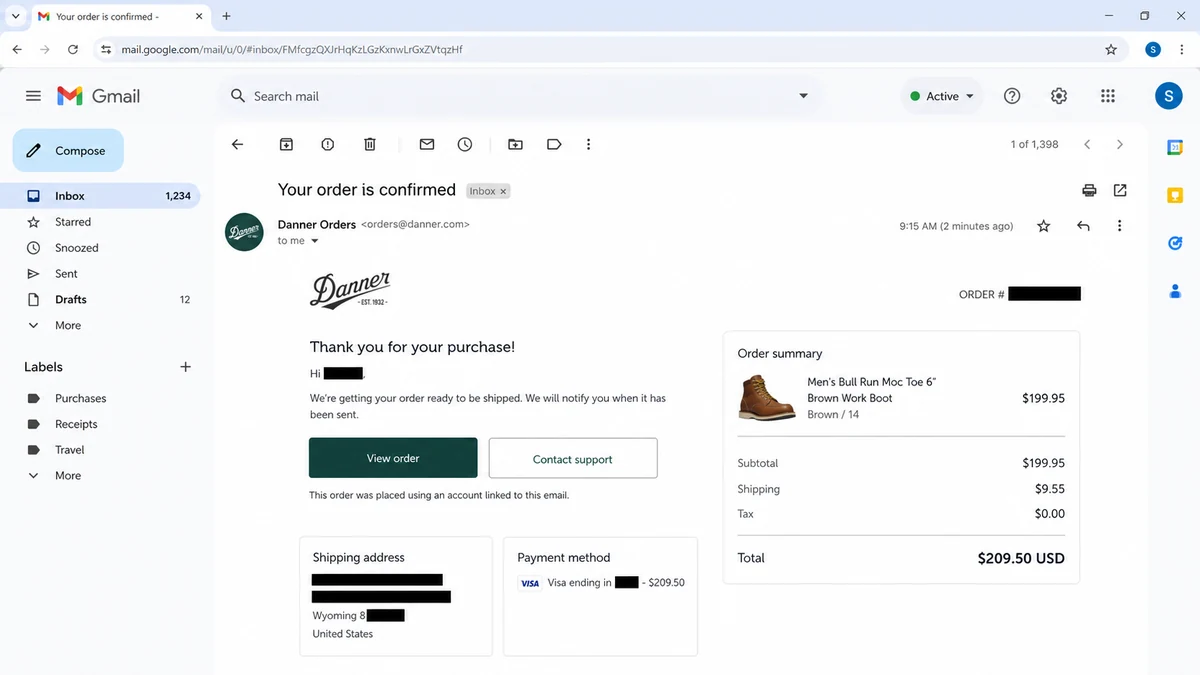
The order was almost comically specific: $209.50 for men’s size 14 Danner boots, shipped to an address in Wyoming.
The debit-card owner was a woman in Massachusetts who wore size 8, still had her physical card, and had never created the retail account.
Overview
The confirmation exposed a genuine unauthorized order
The cardholder received what appeared to be a real Danner confirmation for $209.50. The product was a men’s size 14 boot heading to Wyoming.
She lived in Massachusetts, wore size 8, and had not purchased anything from Danner. Her name, email, phone number, and debit card had reportedly been used.
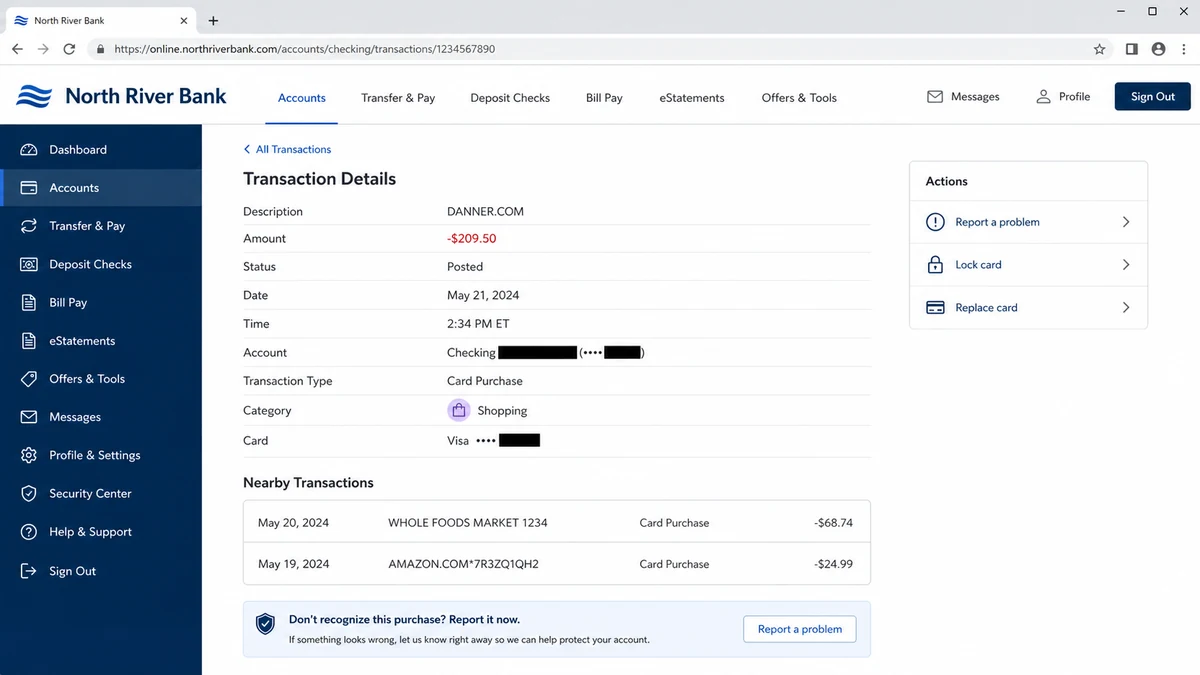
This was more than a fake order email asking her to click. A real retail account existed under her address, and the bank showed a corresponding debit.
The billing address was nearby but wrong
The order used a billing address reportedly located about half a mile from the cardholder’s real home. That small difference felt more mysterious than a completely foreign address.
It could reflect incomplete stolen data, an autofill error, a correct ZIP code paired with the wrong street, or information assembled from public records.
The mismatch does not prove a neighbor was responsible. Online card fraud often combines accurate and inaccurate fields collected from several places.
The Wyoming resident was not identified as the buyer
Public records appeared to connect the destination to an elderly woman. That does not show who placed the order or who intended to collect the package.
Criminals may use reshippers, package mules, short-term rentals, vacant properties, or ordinary homes where delivery can be intercepted.
The main facts and warnings were:
- A real-looking Danner confirmation arrived without a purchase.
- The product and destination did not match the cardholder.
- A $209.50 debit appeared in the bank account.
- An unknown person created a retail account using the victim’s email.
- The order contained the victim’s name, phone, and card information.
- The billing address was close to the home but incorrect.
- The shipping address was in another state.
- The order moved too quickly to stop before shipping.
This Was Not a Fake Danner Store
Danner is a legitimate boot manufacturer and retailer. The report describes someone using stolen payment and identity information inside a real store.
That differs from websites that copy Danner branding and advertise impossible clearance prices. In those cases, the merchant website itself is an imitation.
Here, the real confirmation helped the cardholder discover the fraud. The merchant was the place where stolen details were spent, not automatically the place they were stolen.
Danner can flag the account, preserve order records, and try to stop shipment. The bank handles the unauthorized debit and replacement card.
MalwareTips has separately covered fake Danner clearance sales and the DannerUSA imitation store. Those are different schemes.
Merchants can also lose the product, shipping cost, and chargeback fees in card-not-present fraud. A statement name alone does not identify the original compromise.
How the Stolen Debit Card Order Scam Works
Step 1: Payment and identity details are obtained
The thief acquires a card number, expiry date, security code, name, email, phone, and partial address information.
Possible routes include phishing, malware, account takeover, skimming, a breached service, or criminal resale. This order does not reveal which one occurred.
Step 2: A retail account is opened in the victim’s name
The criminal registers at a legitimate store using the cardholder’s email. An account can make checkout easier and store the order history.
The borrowed email also aligns the customer profile with the payment name. Unless the inbox is compromised, it sends a confirmation directly to the victim.
Step 3: Resellable merchandise is selected
Work boots are durable, recognizable, and easy to ship or resell. The unusual size may have been requested by an end customer or simply available.
Why size 14 was chosen is less important than the unauthorized payment. Product trivia should not distract from containment.
Step 4: Billing data is adjusted for checkout
The thief may enter an address with the correct city or ZIP code but a different street. Merchants evaluate several signals rather than rejecting every imperfect match.
An approval does not prove the address matched completely. The issuer can explain which verification method was recorded.
Step 5: The order goes to a usable address
The destination may be a parcel mule, vacant property, short-term rental, forwarding service, locker, or home where the package can be intercepted.
The resident and the person collecting the boots may be completely different. The address belongs with the merchant, carrier, bank, and police.
Step 6: Fast fulfillment limits cancellation
Retail orders can reach the warehouse quickly. Danner’s support guidance describes a very short window for changes or cancellation.
The cardholder reportedly changed the retail password and called the merchant, but the shipment had progressed too far to cancel. The bank dispute still remained valid.
Step 7: The working card is tried elsewhere
A successful $209.50 order tells the thief that the credentials work. More retail purchases, small tests, and digital charges may follow.
Replacing the card is essential. Canceling one order would not erase stolen details already copied into other accounts.
Why a Wrong Billing Address Can Still Pass
Many people assume an online transaction fails unless every address character matches the bank. Real authorization systems are more flexible.
Address Verification Service can return separate results for the street and postal code. A merchant chooses whether to approve, review, or decline each combination.
Security code, IP address, device reputation, account age, shipping speed, order value, and past fraud patterns may also influence the decision.
A nearby address may preserve the right city and ZIP while using an incorrect street. It may also be a simple error in a stolen record.
Ask the issuer whether the transaction used the card number, physical card, mobile wallet, or network token and which authentication was recorded.
Do not use the mismatch to identify a suspect. Transaction data carries more weight than reverse-address search results.
What Danner Can Do and What the Bank Must Do
Danner can locate the order, flag the account, preserve login and delivery records, and request a carrier intercept when timing allows.
The merchant may not release another customer’s device and shipping data directly. It can preserve those records for the issuer or law enforcement.
The bank handles the unauthorized electronic transfer claim. The cardholder should state clearly that the physical card remains in possession and the purchase was never authorized.
The CFPB explains that banks generally have ten business days to investigate an unauthorized bank transaction, subject to the rules and facts.
Debit-card timing matters because money leaves the account. Report immediately even when the physical card was not lost.
The person who described this case said the bank refunded the amount. That outcome is useful but cannot guarantee the result of another dispute.
Do Not Investigate the Wyoming Address Yourself
A delivery address is evidence, not an invitation. Public records can be outdated, incomplete, or tied to a property owner who does not receive packages there.
The resident may be an innocent person, mule victim, landlord, or someone whose porch was selected for interception.
Calling or visiting can alert the thief, interfere with a package intercept, endanger the cardholder, or accuse a vulnerable person wrongly.
Give the address and tracking number to Danner, the carrier, bank, and police. Ask the merchant whether it can reroute the shipment.
If an unexpected package arrives at your own home, do not hand it to a stranger claiming a mistake. Contact the carrier through its official number.
Keep a timeline of discovery, bank calls, merchant contact, shipment status, and refund. It is more useful than speculation about the destination.
Why the Email Account Matters
The thief may have simply typed the victim’s email. Another possibility is that the mailbox was accessed so confirmations could be deleted.
Review sign-ins, forwarding rules, filters, trash, recovery methods, and connected applications. Search for other welcome messages and password resets.
If the Danner password was reused, change it everywhere. If it was unique and the inbox shows no unknown access, registration alone does not prove mailbox takeover.
Save the original confirmation with headers. They can show the sending system and precise delivery time.
Do not click cancellation links until the sender is verified. Criminals also send fake purchase notices to steal bank logins.
When uncertain, type danner.com or use the official Danner support page.
Evidence Worth Requesting
Ask the bank whether the authorization was card-not-present and whether the raw card number or a wallet token was used.
Ask about address verification, security-code results, 3-D Secure, and any authentication challenge. The bank may not disclose every fraud score.
Request written confirmation of the dispute, provisional credit, deadline, and any affidavit. Keep every document submitted.
Ask Danner to preserve account creation time, login IP, device data, shipping changes, and support history for investigators.
If the email contains tracking, provide it immediately. An intercept may protect the merchant even while the bank handles the cardholder’s loss.
Monitor digital wallets and buy-now-pay-later accounts attached to the same email. Stolen identity data can create a new payment route after card replacement.
Do not rely on the bank app’s merchant map to locate the buyer. That location may represent the retailer or processor, not the device.
What the Size 14 Detail Can Actually Tell You
An unusual size may help Danner locate the order quickly, especially when combined with the exact amount, date, email, and shipping state.
It does not identify the thief. The boots may have been purchased for resale, for another customer, or because that size was available.
Include the model, size, color, order number, and tracking details in the merchant report. Specific product data helps preserve the right fulfillment record.
Do not search social media for people in Wyoming who wear large boots. That kind of guess can expose innocent people and distract from transaction evidence.
The memorable product should help organize the case, not turn it into amateur detective work. Banks and merchants have stronger records than public profiles.
Company, Address, and Fulfillment Checks
Danner was the legitimate merchant being used
The report describes an unauthorized order at a real retailer. It does not allege that Danner intentionally charged the victim or sold nonexistent merchandise.
The nearby billing address identified no suspect
A slightly wrong address could reflect partial stolen data. The bank’s authentication record is more reliable than assumptions about nearby residents.
The Wyoming address did not prove resident involvement
The person ordering, the listed resident, and the person expecting to collect the parcel may all be different.
Real merchandise can fulfill a fraudulent order
The boots may have shipped even though the payment was unauthorized. Merchant fulfillment and the cardholder’s debit dispute are parallel issues.
What to Do if You Have Fallen Victim to This Scam
- Lock the debit card immediately. Use the bank app or number on the card and request a replacement.
- Report the transaction as unauthorized. State that you still possess the card and did not place or benefit from the order.
- Contact Danner officially. Provide the order number and request cancellation, account flagging, or a carrier intercept.
- Preserve evidence. Save headers, account pages, bank entry, order details, addresses, tracking, and support conversations.
- Secure the email account. Change its password, enable multifactor authentication, remove unknown sessions, and inspect rules.
- Search for other unauthorized accounts. Look for welcome emails, password resets, shipping notices, and card tests.
- Use an identity-theft plan if needed. Visit IdentityTheft.gov and consider credit freezes.
- Run a full Malwarebytes scan. Do this if credentials were entered on a suspicious page or a file was installed.
- Use AdGuard after cleanup. It can block many phishing pages, but it cannot replace the bank dispute.
- Do not confront the recipient address. Let the merchant, carrier, and investigators handle delivery evidence.
- Monitor the replacement card. Watch for small tests and new accounts using the same email.
- Reject recovery offers. No stranger can guarantee a card refund or package recovery for an advance fee.
Frequently Asked Questions
Does this mean Danner was hacked?
No. The order shows stolen details were used at Danner, not where those details were originally obtained.
How did the wrong billing address pass?
Checkout decisions use partial address matches and other signals. Ask the issuer what address and authentication result was recorded.
Why did the thief use the victim’s email?
It can make the customer profile resemble the cardholder. It also creates the risk of an immediate confirmation alert.
Is the Wyoming resident the scammer?
There is no proof. The address may belong to an innocent person, mule, landlord, or location selected for interception.
Can the bank refund a debit purchase?
Unauthorized electronic transfers have protections, but facts and timing matter. Report immediately and follow the bank’s written process.
Should the checking account be closed?
The bank may first replace the card. It can recommend a new account if routing details, online banking, or repeated debits are compromised.
The Bottom Line
The size 14 boots were memorable, but the fraud did not require an exotic explanation. Someone used a real cardholder’s details to order real merchandise from a real retailer.
Replace the card, dispute the debit, secure the email, alert Danner, and leave the Wyoming address to investigators. The strange product is a clue, not a reason to accuse the wrong person.

Join the discussion
0 commentsShare your experience or ask a question about this article.
Discussion
Start the conversation
Have a question or something useful to share? Add the first comment.