

A stained countertop becomes new in one swipe. Scratches vanish from a car panel, cloudy headlights turn clear, and tarnished metal shines without effort. The viral surface restoration polish scam compresses every satisfying cleaning video into one irresistible promise.
The demonstration looks like proof because the result happens in front of you. Yet the camera can hide far more than a paragraph of fine print, and the cheap white-label product at checkout may have little connection to the transformation on screen.
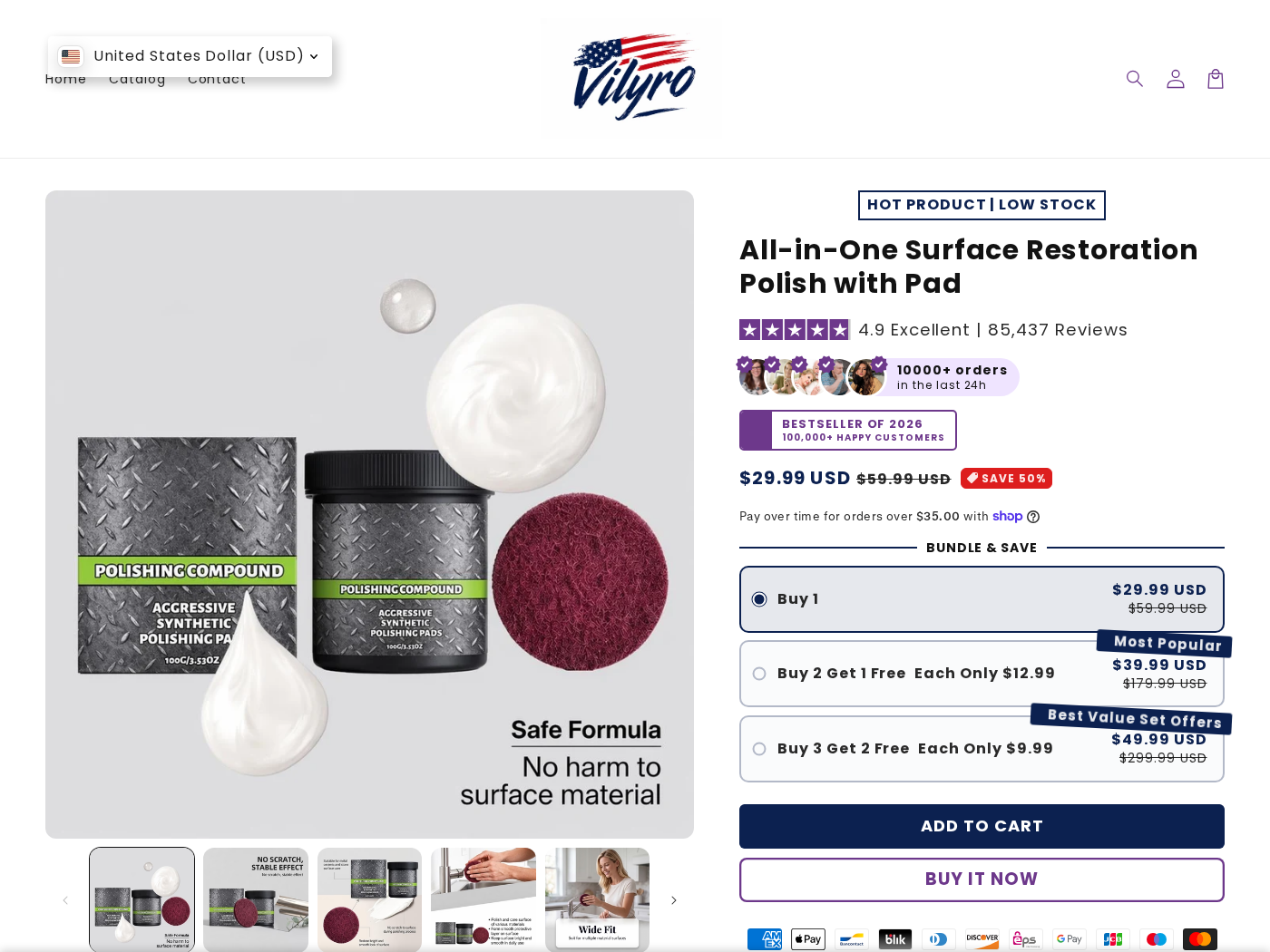
Current stores sell an All-in-One Surface Restoration Polish with nearly identical photos, pads, and claims. One Vilyro page displayed a $29.99 entry price, a 4.9 rating, more than 85,000 claimed reviews, and a message saying over 10,000 orders were placed in 24 hours.
Those numbers are meant to replace careful comparison. When a new store claims a customer base larger than many established household brands, buyers should look for independent evidence, dated review history, and a clear company identity rather than accepting the counter as fact.
The same generic product imagery appears across unrelated storefronts and major marketplaces at much lower prices. That does not prove every jar is identical, but it strongly suggests a white-label item whose marketing, price, and branding can be changed without changing the underlying product.
Overview
The demonstration is engineered for certainty
The ad shows one smooth pass dividing a damaged surface from a restored one. It may claim to remove scratches, oxidation, water marks, fading, grease, or tarnish from cars, wood, stone, metal, leather, and appliances. A product that supposedly fixes everything leaves little room for the limits that real restoration work has.
Lighting, wet surfaces, cuts, filters, reversed footage, hidden preparation, and different camera angles can create a dramatic before-and-after result. Generative video adds another option: the surface itself can change while the hand and polishing pad continue moving. A pleasing clip is not a controlled product test.
A generic item receives a premium story
Listings for similar polish kits appear on numerous stores under different names, often using the same container, applicator pad, and product photos. Marketplace versions have appeared around $9 to $12 while direct-response pages ask much more through bundle pricing.
A reseller can legitimately price a generic item however it chooses. The deceptive part begins when the seller invents performance, scarcity, independent testing, or review volume that buyers cannot verify. Premium marketing does not convert an inexpensive abrasive or coating into professional restoration.
The refund policy carries the real risk
The seller may promise a 30-day guarantee, yet require unopened or unused condition, pre-approval, customer-paid international postage, or a return address disclosed only after support responds. A consumable polish is difficult to evaluate without opening it, so that condition can make the guarantee less useful than it sounds.
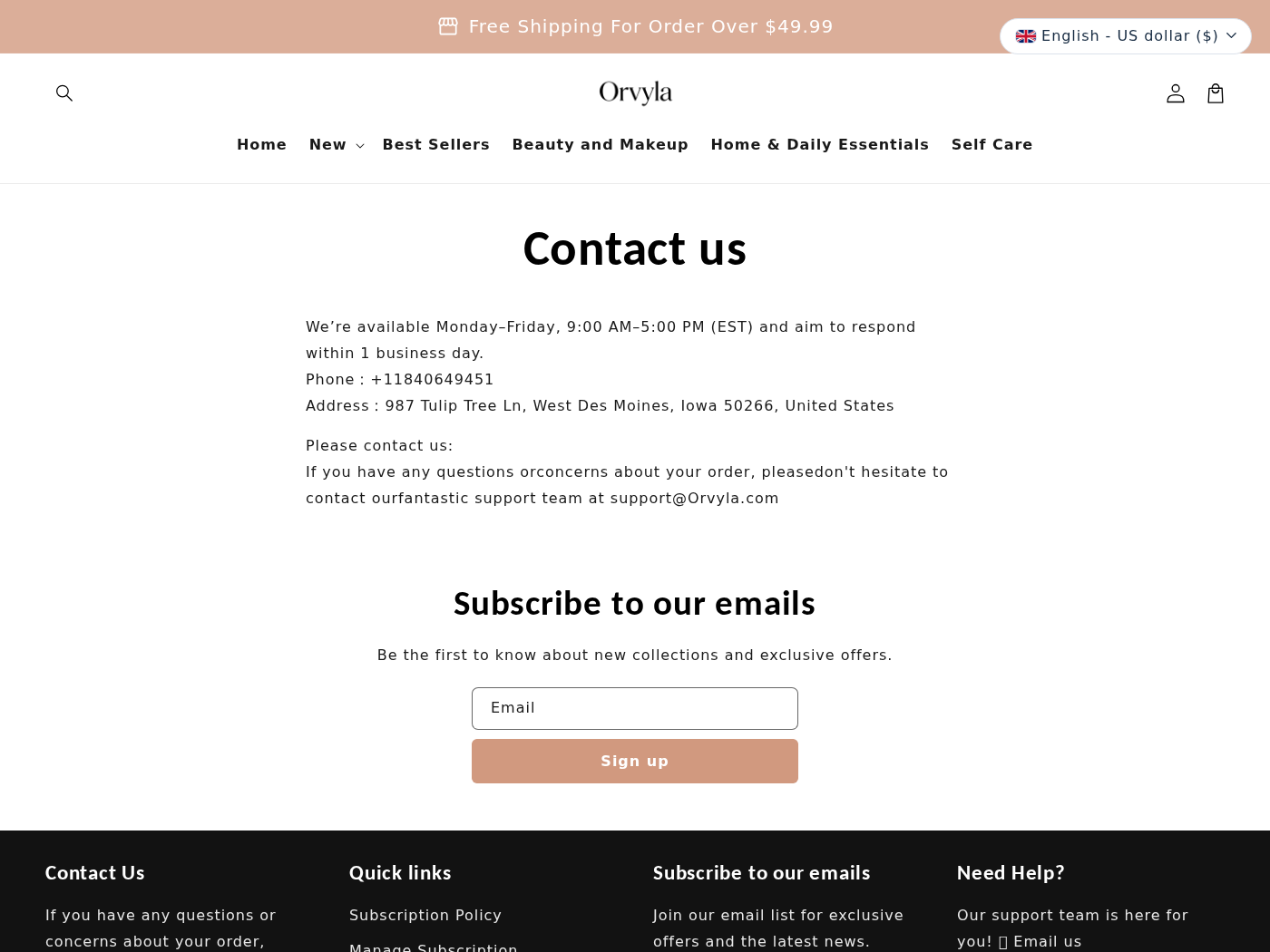
Orvyla, one store connected with promotions for this type of product, lists a West Des Moines residential address and says orders may ship from warehouses in the USA, Asia, the UK, or Australia. Its policies say orders cannot be canceled once placed and may arrive in separate parcels.
That is a very different picture from a local product demonstration.
- A short social video shows an implausibly perfect one-swipe transformation.
- The click opens a single-product store with huge ratings and fast-moving counters.
- The same generic product and imagery appear under many unrelated store names.
- Bundle prices make a low-cost item look like a premium restoration system.
- Shipping and return terms create more risk than the polished advertisement admits.
Why One-Swipe Restoration Videos Are So Convincing
Restoration videos are unusually powerful because the result is visual and immediate. A viewer does not need to understand an ingredient or trust a technical chart. The line between dull and glossy seems to provide its own evidence.
Real surfaces are more complicated. A cleaner may remove residue, a compound may reduce the appearance of shallow scratches, a filler may temporarily mask defects, and a coating may add shine. None of those actions repairs deep damage across every material.
The ad avoids that distinction by combining different problems into the word restoration. A cloudy headlight, scratched clear coat, oxidized metal, greasy tile, and damaged wood finish require different methods. A safe product for one may stain, haze, soften, or scratch another.
The satisfying movement also distracts from the store. Viewers keep watching the pad instead of asking who owns the domain, when it was created, whether the review count is possible, where the package ships from, and what happens after the jar is opened.
A useful test is to search a screenshot rather than the product name. If identical photographs appear across many unrelated shops at radically different prices, the brand story is probably less unique than the advertisement suggests.
What the Storefront and Policy Trail Reveals
The Vilyro listing uses large social-proof numbers, a 4.9 score, and urgent order activity while offering bundle discounts. Similar listings on other stores describe the product as safe for nearly any surface and capable of handling scratches, oxidation, tarnish, and stains with little effort.
The repeated imagery matters because it shows how quickly sellers can relabel the item. A negative review attached to one name does not follow the next name. The marketing can claim a new formula while using the same photographs and generic applicator.
Orvyla's contact page lists +1 1840649451, support@Orvyla.com, and 987 Tulip Tree Lane, West Des Moines, Iowa. Public property records and real-estate listings describe that address as a single-family home. A residential address can belong to a lawful small business, but it is not evidence of a factory, laboratory, or large customer-service operation.
Orvyla's shipping policy says fulfillment may come from the USA, Asia, the UK, or Australia depending on stock. It also says orders cannot be canceled after placement and that separate items may arrive in different parcels. Buyers expecting a local shipment should understand that possibility before paying.
Its refund material places return postage on the customer and provides a return address after approval. One policy also says a chargeback made without prior communication can void refund eligibility. Consumers retain whatever dispute rights their card agreement and law provide, regardless of intimidating website wording.
How the Surface Restoration Polish Scam Works
Step 1: A perfect restoration clip creates the desire
The ad selects a familiar frustration, such as a scratched car, burned pan, stained counter, or faded table. One swipe produces a mirror finish, and the clip loops before the viewer can inspect texture, lighting, or continuity.
Comments may be limited, hidden, or filled with enthusiastic questions. That removes the normal context where real users might compare results or identify that the footage belongs to another product.
Step 2: Editing and AI remove real-world limits
A cut can switch to a prepared surface, water can create temporary shine, and color grading can deepen contrast. In generated or heavily altered footage, scratches can disappear without any physical repair.
Look at reflections, pad shape, grain direction, fingers, labels, and the edge of the treated area. Objects that warp or details that change between frames are stronger evidence than the narrator's confident description.
Step 3: The click opens a disposable-looking storefront
The landing page is built around one product and repeats the demonstration, ratings, countdowns, and guarantees. It may claim tens of thousands of reviews while offering little information about the legal company or the age of the brand.
Buttons and pop-ups keep the buyer inside the funnel. External testing, independent review platforms, and material-specific safety data are rarely given the same prominence as the Buy Now button.
Step 4: A generic product is framed as proprietary
The bottle may be described as an exclusive nano formula, professional technology, or breakthrough compound even when identical packaging appears on multiple unrelated sites. The seller's label becomes the main difference.
Reverse image search, marketplace search, and exact phrase search can expose the reuse. Similarity is not absolute proof of identical contents, but it is enough to question claims of a unique invention.
Step 5: Bundles and fake scarcity increase the total
A single unit is shown as poor value while two, three, or more units receive free shipping or a large discount. Timers reset, stock messages remain unchanged, and recent-purchase pop-ups appear continuously.
Check the actual cart because some stores preselect a larger bundle or add shipping protection. Remove unwanted extras and screenshot the final total before authorizing payment.
Step 6: The product cannot match the edited expectation
A customer may receive a small jar of polish that adds temporary gloss, cleans light residue, or does little at all. Deep scratches, missing finish, burned material, and corrosion cannot be reversed by the kind of effortless wipe shown in the ad.
Test any unknown product on a hidden area while following the label. Stop if the material changes color, becomes hazy, softens, or develops new scratches. Do not use a universal claim as permission to ignore the surface manufacturer's guidance.
Step 7: Return friction protects the campaign
Once opened, the customer may face arguments about condition, approval, postage, or the correct warehouse. International return shipping can approach the value of the item, making a nominal guarantee economically pointless.
While one store handles complaints, a new store can run the same video and generic images. Search the advertising story and visual assets, not only the label printed on the jar.
Company, Address, and Fulfillment Checks
A house is not a restoration laboratory
The listed Orvyla address is shown publicly as a residential property. That does not prove no lawful business uses it, but it directly conflicts with the impression of a large product-development and fulfillment operation created by the page.
Ask for the legal entity, registration jurisdiction, and responsible importer or manufacturer. If support provides only the same brand name and home address, accountability remains weak.
The phone and email must survive a real test
Call before buying and ask where the exact polish will ship from, whether the selected order contains any renewal, and what return address applies. Send the same questions by email so there is a written record.
A number that never answers, a mailbox that sends only scripts, or support that cannot name the legal seller is a strong reason to leave. Attractive product videos do not compensate for unreachable service.
Fulfillment can move between countries
Orvyla says stock may ship from warehouses across several regions, including Asia. That can explain long tracking gaps, split packages, and a return destination different from the contact address.
Shipping from Asia is not itself a scam and does not prove manufacture in China. The problem is when a local-looking storefront hides the likely route until after purchase or makes international return costs the buyer's responsibility.
Unknown chemicals can damage property or health
A surface treatment should identify ingredients or hazards when appropriate, give material limitations, and explain ventilation, skin, and eye precautions. Generic claims such as safe formula do not answer those questions.
Avoid using an unknown polish on food-contact surfaces, children's items, valuable furniture, screens, unsealed stone, or automotive finishes without reliable compatibility guidance. A cheap product can become expensive if it damages the surface it promised to restore.
What a Real Product Test Would Need to Show
A trustworthy demonstration would identify the exact material and damage, show the unopened product, keep the camera continuous, use consistent lighting, reveal the surface after it dries, and disclose any prior cleaning or sanding. It would also show where the product does not work.
The viral clips do the opposite. They compress preparation and curing into seconds, hide the formula, and treat shine as proof of repair. A wet or coated scratch can temporarily reflect less light without the underlying damage being removed.
Independent testing should compare the generic item with ordinary cleaner, water, and established polish under the same conditions. Until that exists, huge review counters and cinematic transformations are marketing evidence, not performance evidence.
The practical decision is simple. If the product is generic, buy only from a seller with a verifiable identity, clear local returns, and payment protection. Never risk a valuable surface because a social clip made uncertainty invisible.
Warning Signs to Watch For
- Scratches, oxidation, stains, and tarnish disappear in one uninterrupted-looking swipe.
- The product claims to work safely on almost every material.
- Review and order counts are enormous but cannot be independently verified.
- The same images appear on unrelated stores at much lower prices.
- The store provides a residential address instead of a disclosed company location.
- Shipping may originate from several countries despite a local-looking storefront.
- Orders cannot be canceled after placement.
- Returns require approval and customer-paid shipping to an undisclosed destination.
The polish does not need to be completely useless for the campaign to be deceptive. An ordinary cleaner or coating can still be sold through fabricated demonstrations, impossible review numbers, misleading scarcity, and a return process designed to wear buyers down.
What to Do if You Have Fallen Victim to This Scam
- Save the ad, order page, and receipt. Take screenshots of the viral surface restoration polish advertisement, the page that made the promise, every price shown at checkout, the confirmation email, and the package label. Save the page address and the date. These records help your bank understand what was represented before the seller changes or removes the funnel.
- Check the exact amount and merchant name. Compare the final card charge with the total you knowingly approved. Write down the merchant descriptor exactly as it appears, because it may not match the brand in the advertisement. Check pending and posted transactions for extra bundles, add-ons, foreign fees, or a second charge you did not expect.
- Contact the seller in writing. Ask the store that processed the order to cancel any unshipped order, recurring plan, or future renewal and request a refund under the policy that applied on the purchase date. Email is better than relying only on a call because it creates a timestamped record. Keep the full conversation, case number, and any return authorization.
- Do not mail a return to an unverified address. A package sent to the wrong warehouse may be rejected and the seller may claim it was never received. Ask for the authorized return location in writing, use tracked shipping, photograph the contents and label, and retain the delivery record. Follow the stated deadline while also documenting any delay caused by support.
- Call your card issuer if the charge is wrong. Explain whether the problem is an unauthorized charge, an amount different from the checkout, goods not delivered, goods materially different from the advertisement, or a canceled renewal that continued. Ask about the dispute deadline and whether the issuer should block future charges from the same merchant descriptor.
- Watch for follow-up billing. Review statements for several months. A canceled card does not always cancel an underlying agreement, so send a written cancellation as well and ask the issuer how recurring payment updates are handled. Report every unfamiliar charge promptly instead of waiting for several renewals to accumulate.
- Secure accounts if you reused a password. Change any reused password, beginning with your email and payment accounts, and enable multi-factor authentication. If you downloaded a file, browser extension, or remote-support tool during the purchase, remove it and run a full scan with Malwarebytes. A normal product checkout should not require remote access to your device.
- Reduce exposure to the same advertising network. Report the ad to the social platform and use AdGuard to reduce malicious advertising, trackers, pop-ups, and repeat redirects. An ad blocker is not a substitute for judgment, but it can remove part of the infrastructure that repeatedly pushes deceptive advertorials to the same audience.
- Report the campaign. File a report with the FTC at ReportFraud.ftc.gov and with your state attorney general or national consumer-protection authority. Include the ad account, website, merchant descriptor, support details, amounts, and dates. Reports are more useful when they describe the path from the first ad to the final charge.
Frequently Asked Questions
Can one polish really restore every surface?
No single polish can safely repair every kind of damage on paint, clear coat, glass, stone, wood, leather, plastic, metal, and appliances. Products may clean, add gloss, fill shallow defects, or reduce the appearance of fine scratches. Deep damage and missing finish require material-specific repair.
How can I tell whether the demonstration is AI-generated?
Slow the video and inspect reflections, hands, labels, grain, shadows, and the boundary between treated areas. Look for warping, changing scratches, discontinuous liquid, or a result that appears before the pad passes. Even when AI is not used, cuts, wetting, filters, and hidden preparation can make a demo misleading.
Why do identical products appear under different names?
Generic manufacturers and wholesalers sell products that many stores can brand. That practice is common and not automatically dishonest. It becomes concerning when each reseller claims a unique invention, invents huge review totals, or uses demonstration footage that does not show the item being delivered.
Does a residential business address prove fraud?
No. Small legitimate businesses sometimes operate from homes. It does mean the address should not be interpreted as a factory, laboratory, or major service center. Verify the legal entity and manufacturing information separately, especially when the store presents itself as a large international brand.
What should I do before putting the polish on a car or countertop?
Read the complete label, identify compatibility warnings, and test a tiny hidden area. Use ventilation and protection appropriate to the ingredients. Do not use an unknown treatment on valuable, porous, coated, food-contact, or safety-critical surfaces simply because the advertisement calls it universal.
Can I dispute the charge if the store rejects my refund?
Your options depend on the facts, card agreement, and local law. Save the ad, product description, checkout, policy, support messages, return tracking, and photos of what arrived. Tell the issuer precisely whether the product was not delivered, materially different, defective, or charged in an amount you did not approve.
The Bottom Line
The surface restoration polish scam turns an edited visual trick into apparent proof, then attaches that proof to a generic item, inflated social signals, bundle pricing, and a fragile return path.
Do not judge a restoration product by the most satisfying second of its advertisement. Verify the seller, reverse-search the images, compare the generic item, read the shipping and return rules, and protect the surface before testing anything. A real finish should not depend on a fake demo.

Join the discussion
0 commentsShare your experience or ask a question about this article.
Discussion
Start the conversation
Have a question or something useful to share? Add the first comment.