

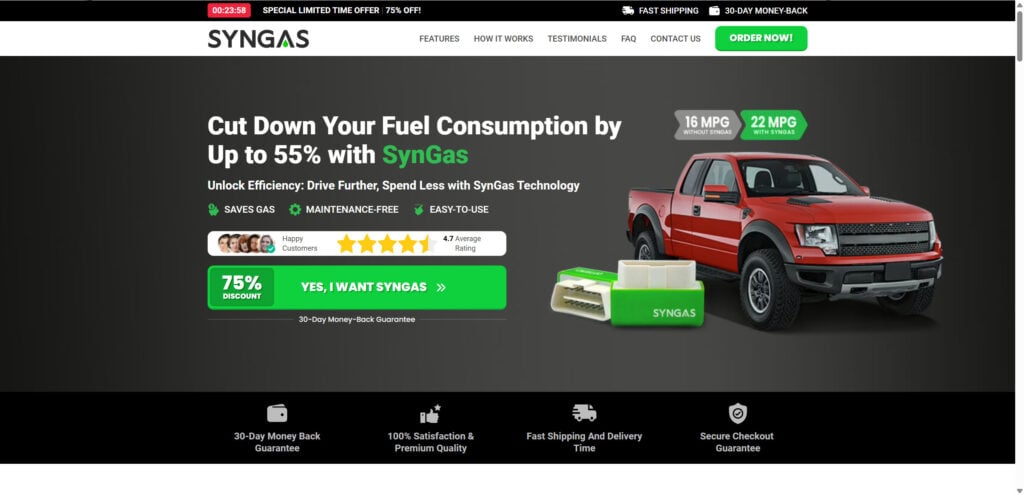
SynGas is marketed as a plug-and-play device that promises to reduce fuel consumption by up to 55%, improve engine performance, and save money on every drive.
It plugs into your car’s OBD2 port and claims to “optimize” fuel usage after a short calibration period.
The reality is much simpler.
This is not new technology. It’s the same type of product that has been circulating online for years under different names, with the same exaggerated claims and the same disappointing results.
Scam Overview
What SynGas Claims to Do
SynGas is sold as a smart fuel-saving device that:
- Reduces fuel consumption by up to 55%
- Improves engine efficiency
- Enhances ECU performance
- Works on all cars after 1996
- Installs in seconds
The pitch is designed to sound simple and risk-free.
Plug it in. Drive normally. Save money.
No mechanic. No upgrades. No effort.
Why These Claims Don’t Hold Up
There is no credible evidence that a small plug-in device can dramatically improve fuel efficiency across all vehicles.
Modern cars already optimize fuel consumption through advanced ECU systems designed by manufacturers.
If a simple external device could improve fuel efficiency by 30% to 55%, car manufacturers would already be using it.
They are not.
The Real Pattern Behind SynGas
SynGas follows a well-known scam formula that has been used for years:
- New brand name
- Same generic device
- Same fuel-saving claims
- Same marketing structure
Previously, these devices have appeared under names like:
- EcoOBD2
- Nitro OBD2
- Fuel Shark
- Fuel Saver Pro
SynGas is simply the latest version.
The Drop-Shipping Reality
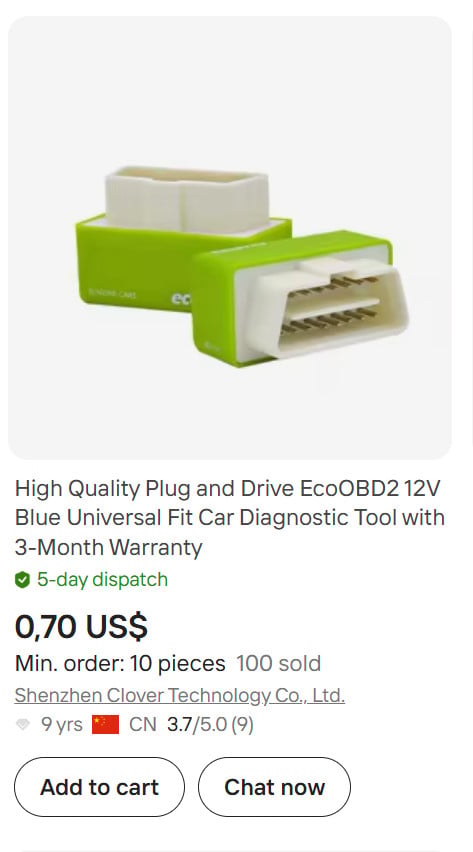
The device shown on the SynGas website closely matches generic products sold in bulk from China.
Typical wholesale pricing:
- Around $0.50 to $3 per unit
- Sold as “EcoOBD2” or similar
Yet online stores sell it for:
- $30
- $50
- Even $70+ with “discounts”
This is classic drop-shipping:
- Cheap product
- Heavy markup
- Aggressive marketing
Fake Authority and “Expert Reviews”
SynGas relies heavily on “review-style” pages that:
- Look like independent tests
- Show high ratings like 4.7/5
- Include “customer testimonials”
- Recommend buying immediately
But these pages:
- Are part of the sales funnel
- Contain affiliate links
- Earn commission on every sale
They are not independent.
They are marketing.
Red Flags on the Sales Page
Several warning signs appear immediately:
- Countdown timers creating urgency
- “75% discount” offers
- Claims of limited stock
- Generic customer photos
- No real company transparency
These are classic conversion tactics, not signs of a reliable product.
The Biggest Red Flag: Unrealistic Fuel Savings
The core claim is the most important problem.
“Up to 55% fuel savings”
That is not realistic.
Even small improvements in fuel efficiency require:
- Engine redesign
- Software tuning
- Mechanical upgrades
A $20 plug-in device cannot achieve this.
How The Scam Works
1. You See a High-Impact Ad
It starts with ads on:
- TikTok
- YouTube
- Websites
The message is always the same:
- Fuel is expensive
- This device saves you money
- Limited-time discount
The goal is emotional:
Make you feel like you’re losing money by not buying it.
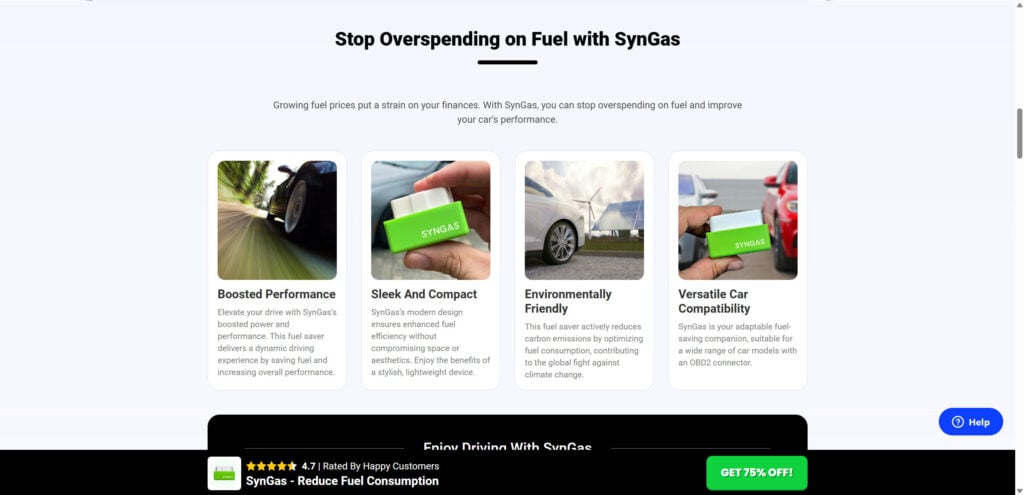
2. You Land on a Persuasive Sales Page
The page is designed to convert quickly.
It includes:
- Bold savings claims
- Clean product images
- “Scientific” explanations
- Star ratings and testimonials
Everything is structured to build trust fast.
3. Technical Language Creates False Credibility
The product description uses terms like:
- ECU optimization
- Fuel mapping
- Real-time adjustments
- Calibration process
This sounds advanced.
But it is vague and unverified.
It gives the illusion of technology without proof.
4. Urgency Pushes You to Buy
You are pressured with:
- Countdown timers
- “Only today” discounts
- Limited stock warnings
This reduces critical thinking.
The faster you buy, the less you question.
5. You Place the Order
After purchase:
- The product is shipped from China
- Delivery can take days or weeks
- Packaging often looks generic
The device itself is usually:
- Very small
- Lightweight
- Cheap plastic
6. The Device Does Nothing
After installing it:
- No noticeable fuel savings
- No performance change
- No measurable difference
The device often does little or nothing beyond basic signaling.
7. The “Calibration Excuse”
If you question it, you’ll see explanations like:
- “Drive 150–200 miles first”
- “It needs time to learn your car”
- “Results vary by vehicle”
This delays complaints and refunds.
8. Refund Becomes Difficult
The site promises a 30-day guarantee.
In reality, you must:
- Contact support
- Wait for response
- Receive return instructions
- Ship the product back
Common issues:
- Slow replies
- Complicated instructions
- Return shipping costs
In many cases:
- Returns must be sent to China
- Shipping costs are high
- Refunds become impractical
9. Strange Fulfillment Issues
Some buyers report:
- Receiving multiple units
- Being charged for bundles
- Confusing order details
This adds more frustration and cost.
10. The Brand Disappears and Reappears
After complaints increase:
- The website may disappear
- Ads stop running
- A new brand appears
Same product.
Different name.
Cycle repeats.
What To Do If You Have Fallen Victim to This Scam
1. Act Immediately
Do not wait.
The refund window is limited.
Start the process as soon as possible.
2. Contact the Seller
Request a refund clearly:
- Ask for return instructions
- Keep all communication in writing
- Take screenshots
3. Avoid Delays
Do not accept responses like:
- “Wait for calibration”
- “Try it longer”
These are delay tactics.
4. Use Chargeback Options
If the seller is unresponsive:
- Contact your bank or card issuer
- Open a dispute
- Provide evidence
If you used PayPal:
- Open a case immediately
5. Evaluate Return Costs
Before sending the item back:
- Check shipping cost
- Compare with refund value
In some cases:
- A chargeback is more effective
6. Monitor Your Payments
Check for:
- Extra charges
- Duplicate transactions
- Unexpected subscriptions
Report anything suspicious immediately.
7. Share Your Experience
Help others avoid the same issue:
- Leave a factual review
- Report the ad platform
- Warn others online
8. Learn the Pattern
Be cautious of products that:
- Promise huge savings
- Require no effort
- Use heavy discounts
- Appear under new brand names
The Bottom Line
SynGas is not a breakthrough fuel-saving device.
It fits a long-established pattern of:
- Rebranded products
- Exaggerated claims
- Drop-shipping operations
- Difficult refunds
There is no credible evidence it can reduce fuel consumption in any meaningful way.
The safest decision is simple: Avoid it.
If you already purchased one, act quickly to recover your money and document everything. This is not innovation.
Frequently Asked Questions
Is SynGas a legit fuel-saving device?
No. SynGas shows the same warning signs seen in many rebranded “fuel saver” gadgets sold online. It makes exaggerated claims about reducing fuel consumption, but there is no credible evidence that this small plug-in device can meaningfully improve MPG.
Does SynGas really reduce fuel consumption by 55%?
No realistic evidence supports that claim. A tiny OBD2 plug-in device is not going to cut fuel use by 55%. Claims like this are designed to attract buyers, not reflect real-world performance.
How does SynGas claim to work?
SynGas claims that it plugs into your car’s OBD2 port, connects with the ECU, and “optimizes” fuel use after a short calibration period. This sounds technical, but the explanation is vague and does not prove the product actually works.
Is SynGas just another version of EcoOBD2 or similar devices?
Yes, that is what it appears to be. SynGas looks like the latest name in a long line of nearly identical fuel saver gadgets sold under different brands. The product design, claims, and marketing style closely match older versions like EcoOBD2, Nitro OBD2, and similar devices.
Why do websites selling SynGas look convincing?
These sites are built to convert quickly. They often use:
- Countdown timers
- Large discount offers
- Star ratings
- Customer testimonials
- Review-style pages
- Technical language that sounds impressive
All of this is meant to build trust fast and push people into buying before they research the product properly.
Is SynGas a dropshipping product?
In many cases, yes, it appears to be. Devices like this are often sourced very cheaply from suppliers in China and resold at heavily inflated prices through aggressive online ads and sales funnels.
Why do some people say SynGas does nothing?
Because that is often the real experience. Many buyers report no noticeable change in fuel consumption, engine performance, or driving experience after installing similar devices. In practical terms, the product often appears useless.
Why is the refund process so frustrating?
Because the “money-back guarantee” can be much harder in practice than it looks on the sales page. Buyers may have to:
- Contact support first
- Wait for return instructions
- Pay return shipping
- Ship the item back internationally
If the return address is in China, the shipping cost can make the refund pointless.
Do people really receive more than one unit even if they ordered one?
Some buyers report that happening with products in this category. They may receive multiple units, confusing bundle shipments, or order quantities they did not expect. That is one more reason to review your invoice and payment details carefully.
Is SynGas safe to plug into a car?
That is hard to guarantee. Even if the device does not immediately damage a vehicle, there is still no good reason to trust a cheap, generic plug-in gadget making unrealistic claims about ECU optimization. It is better not to use questionable products like this at all.
Can an OBD2 device actually improve MPG?
Some professional tuning tools and real diagnostic devices can interact with vehicle systems, but that is very different from a cheap consumer gadget claiming massive fuel savings with no proper setup or proven testing. SynGas falls into the second category.
What should I do if I bought SynGas?
You should act quickly:
- Save all order details and screenshots
- Contact the seller and request a refund
- Keep communication in writing
- Check whether your bank or payment provider offers dispute options
- Watch for extra charges or duplicate shipments
Should I trust SynGas reviews online?
Be careful. Many “review” pages for products like this are actually part of the marketing funnel. They may use affiliate links and earn money from each sale, which means they are not truly independent.
What is the biggest red flag with SynGas?
The biggest red flag is the promise itself. Any product claiming that a small plug-in gadget can reduce fuel consumption by up to 55% with no real proof should be treated with extreme skepticism.
What is the bottom line on SynGas?
SynGas does not look like a legitimate fuel-saving breakthrough. It looks like another rebranded fuel saver scam built around exaggerated claims, cheap drop-shipped hardware, and difficult refunds. The safest choice is to avoid it.









Stay well clear of this scam, my friend fell for it. When you order the fuel saver they add on a lifetime warranty als tire inflator and radar detector, he saw this immediately and tried to cancel and was told items already shipped. He got in touch with his bank and cancelled but be warned this is an absolute scam.
That sequence is worth spelling out for other readers, because it is a deliberate structure and your friend did nothing careless. The extras are added by post-purchase upsell pages – a warranty, a tyre inflator, a radar detector – each on a separate screen where the decline option is small grey text and the accept button is large. Being told the items had “already shipped” minutes later is a stock answer; nothing had shipped, and it is said to move you past the cancellation window.
So tell him to stop dealing with them and ring his card issuer. Every item he did not knowingly buy should be disputed as unauthorised, the original as not as described, and the same call should include revoking the merchant’s recurring authorisation and issuing a new card number – warranties in particular are frequently set up as recurring charges. He generally has up to 120 days per charge.
Anything that does arrive and was never ordered is legally his to keep under the FTC’s unordered-merchandise rules, so no restocking fee and no return postage. And on the device itself: the cigarette-lighter socket carries power only and has no connection to the engine control unit, so nothing plugged into it can alter fuel consumption at all. reportfraud.ftc.gov is worth five minutes, since forced upsells and false cancellation refusals are exactly what they act on.
Very informative. I know now why I should not buy this or any other similar gadget. Thanks!
Excellent!!!
Thank you – glad it was useful.
Glad it was useful. The general rule for that whole category, if it helps: if the device plugs into a cigarette-lighter socket, it has power and nothing else – no data connection to the engine control unit – so it cannot change fuelling, emissions or economy no matter what the packaging claims. The same goes for magnets on fuel lines and “chip” boxes on the intake sensor.
If you want better mileage for free, tyre pressures, removing roof bars and easing off ten miles an hour will each do more than any of these have ever done in a controlled test.
Cette arnaque est particulièrement bien ficelée. Il existe une quantité impressionnante de sites, apparemment indépendants, qui font la promotion de ce dispositif. Ceci s’ajoute, aux éléments que vous mentionnez. Il faut avouer qu’ils sont vraiment forts, et surtout, qu’ils savent créer un sentiment d’urgence, et de crédibilité. C’est de pire en pire, et cela nécessite de réfléchir sérieusement, avant de tomber dans le panneau.
Vous avez mis le doigt sur l’élément le plus efficace du dispositif : cette multitude de sites “indépendants” n’en est pas une. Ce sont des pages d’affiliés, souvent générées en série à partir du texte marketing du vendeur, qui touchent une commission sur chaque vente. C’est pour cela qu’elles se ressemblent, qu’elles emploient les mêmes tournures et qu’elles arrivent avant les avis honnêtes dans les résultats de recherche : personne n’est payé pour écrire qu’un produit ne fonctionne pas. Le vendeur ne construit donc pas un seul argumentaire, mais une apparence de consensus – et c’est précisément ce qui fait céder les gens prudents.
Sur l’urgence, elle est entièrement fabriquée : le compte à rebours se réinitialise si vous rechargez la page, et le “stock limité” n’existe pas. Un réflexe simple et efficace : rechercher le nom du produit avec le mot “arnaque” ou “plainte” plutôt que “avis”, et vérifier la date de création du domaine avec un WHOIS – un site créé il y a six semaines qui vend une “invention révolutionnaire”, cela suffit à conclure.
Si vous avez payé, contactez votre banque pour une opposition ou un remboursement (produit non conforme), et demandez la révocation de l’autorisation de prélèvement récurrent ainsi qu’une nouvelle carte, car ces paiements reviennent souvent un mois plus tard. En France, vous pouvez signaler l’arnaque sur la plateforme Thésée du ministère de l’Intérieur, ainsi qu’auprès de la DGCCRF via SignalConso, et signaler la publicité sur la plateforme où vous l’avez vue.
Et un dernier point sur ce type d’appareil : une prise allume-cigare ne transporte que du courant, sans aucune liaison avec le calculateur moteur. Rien de ce qui s’y branche ne peut modifier la consommation de carburant.
Weird webpage rendering. In FAQ section, there are NO questions readable, just a small vertical black bar where each Question should be. (Running latest MS Edge browser on Win 11.)
Thanks for reporting it – that is a rendering bug on our side rather than anything sinister, and the description is precise enough to be useful. Black vertical bars where the questions should be usually means the accordion headings are collapsing to zero width, so the text is there in the page but not painted; a custom font failing to load, or our styles conflicting with Edge’s handling of the details element, are the usual culprits.
We will look at it. In the meantime, two workarounds: pressing Ctrl+F and searching for a word from the question often forces the browser to reveal the text, and using Edge’s Immersive Reader – the book icon in the address bar, or F9 – strips our styling and shows the content as plain text. Zooming out one step sometimes fixes it too.
If you can tell me whether it happens with an extension disabled, or in a private window, that would help narrow it down – an ad blocker occasionally hides elements it mistakes for banners.