

A screen that says you “won” a Temu $1,500 reward sounds like a cash windfall. The large number appears first, while words such as coupon bundle, purchase threshold, referral, eligibility, and expiry can be much less prominent.
There are two issues to separate. Temu runs real promotions inside its official app, but a promotional value is not necessarily cash or a single gift card. Criminals also copy these offers on unrelated websites to steal information and payments.
Overview
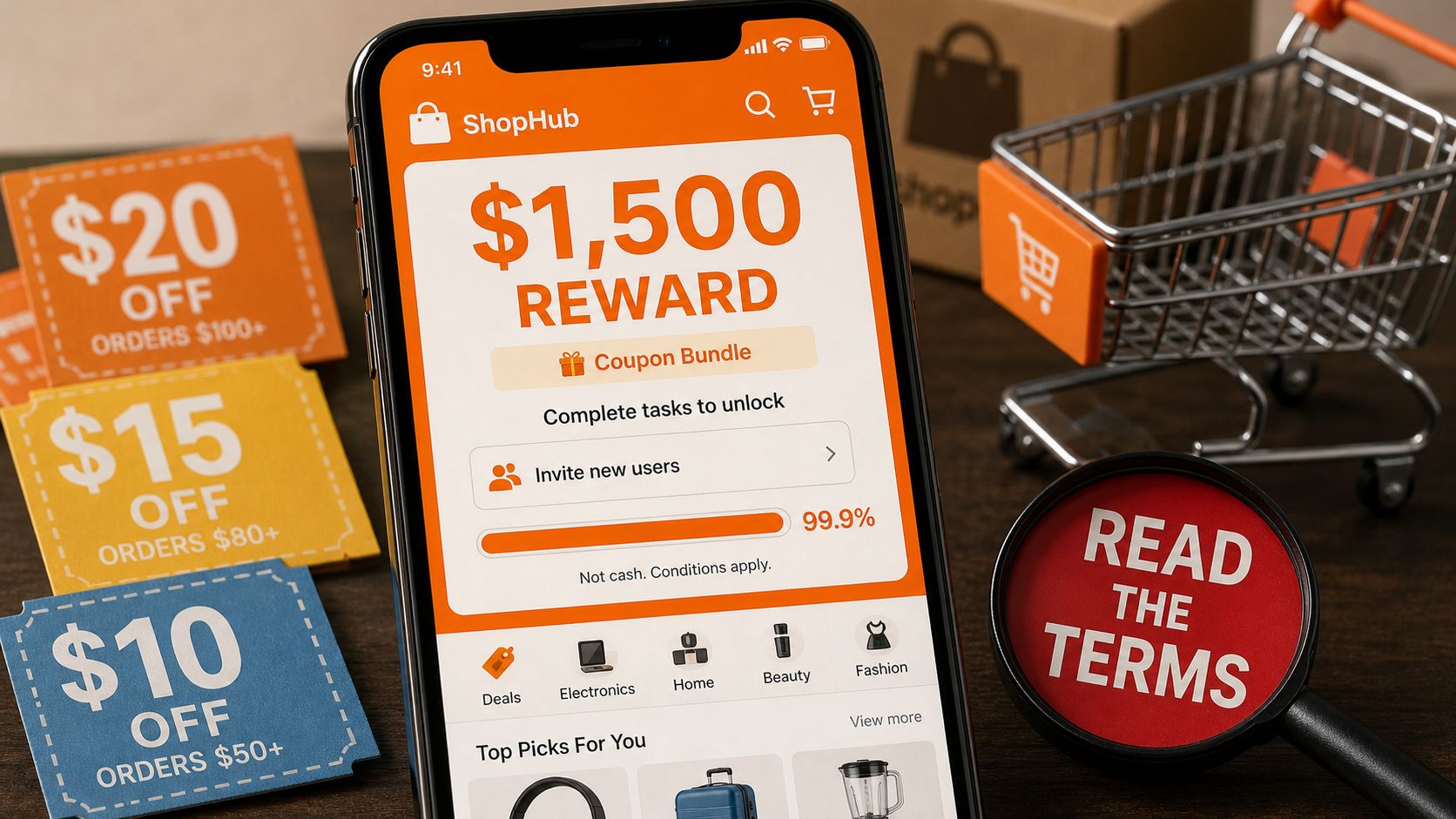
The Temu $1,500 reward should not be understood as an automatic $1,500 cash payment. Depending on the screen, country, account, and campaign, the figure may refer to a bundle of coupons, a task-based promotion, shopping credits, discounted items, or a referral activity with detailed conditions.
A coupon bundle divides the advertised value across multiple coupons. Each coupon can require a separate minimum order, expire quickly, apply only to eligible items, and be limited to one use. Unlocking the full headline value may therefore require spending far more than expected across several purchases.
A task-based promotion can require the user to browse products, place qualifying orders, return to a special activity page, claim rewards within a time window, or invite other people. Progress displayed as coins, energy, points, or percentages does not guarantee that the final reward will be easy to obtain.
Official Temu promotions are governed by activity-specific rules. Temu’s published rules for one coupon-bundle campaign, for example, state that rewards may not be redeemed for cash, coupon conditions can vary, participation can be limited, and the sponsor may modify or suspend a program.
That means the official promotion can be real while the shopper’s first interpretation is wrong. A person may honestly feel misled if a “$1,500 reward” turns out to be discounts that require additional spending instead of money that can be withdrawn.
A separate and more dangerous problem appears outside the official app. Social posts, text messages, pop-ups, influencer comments, and ads can send people to third-party pages claiming to offer a $1,500 Temu gift card. Those pages may be affiliate funnels or outright phishing sites.
The distinction matters. An official in-app promotion can be complicated and unattractive without being identity theft. A random website asking for a Temu password or card number to release a prize can be a direct scam.
What the in-app promotion may display
Congratulations. You unlocked a $1,500 reward.
Complete the remaining tasks before the countdown ends.
Invite new users, place a qualifying order, and return to the activity page to claim your coupon bundle.
Conditions and eligibility rules apply.
The exact wording and mechanics can differ from one account to another. Promotions are often personalized, regional, temporary, and presented through multiple game-like formats.
Do not rely on a screenshot shared online as proof that your account will receive the same coupons or requirements. Read the rules attached to the activity currently open in your own official app.
What a fake third-party reward message may say
Your Temu $1,500 gift card is waiting
You were selected from today’s visitors. Complete a short survey and pay a $2 verification fee to receive your digital reward.
Offer expires in 10 minutes.
This is not the same as an in-app coupon game. A third-party page has no reason to request a Temu password, full payment card, bank login, security code, or app download to “verify” a gift card.
Common variations of the offer or message
- “Spin to win a $1,500 Temu reward”
- “$1,500 coupon bundle unlocked”
- “Complete one order to claim free gifts”
- “Invite friends before the timer reaches zero”
- “Only 0.1 coins remain to receive your prize”
- “Get 100% credit back after purchase”
- “Your free items are reserved for 10 minutes”
- “Exclusive $1,500 Temu gift card for survey participants”
- “Pay $2 shipping to release your reward”
- “Download this verification app to bypass the referral requirement”
- “Share your invitation link with five new users”
- “Your reward was revoked after a return or canceled order”
What $1,500 may actually represent
A coupon bundle is a collection of discounts. A simplified example could include several coupons such as $10 off $50, $20 off $100, or $50 off $250. Adding their maximum values can produce a large headline, but each discount requires another qualifying purchase.
Temu credit is different from cash. It may be usable toward eligible purchases inside the platform but not transferable to a bank account. Credits can also be subject to the specific activity’s rules.
Free gifts may require a qualifying order, an activity claim, new-user invitations, or completion before a deadline. Product availability, shipping, taxes, and account eligibility can also matter.
Referral progress can be expressed through points or fractions. Near-complete progress creates a powerful incentive to keep sharing, but the shopper should not assume the remaining step will have the same value as earlier steps.
A third-party reward may have no genuine connection to Temu. Its only purpose can be to collect leads, generate affiliate commissions, enroll users in trials, or steal information.
Questions to answer before spending
- Does the promotion appear inside the official Temu app or on
temu.com? - Does “$1,500” mean cash, account credit, coupon face value, or possible discounts?
- How many orders are required to use all coupons?
- What is the minimum spend for each coupon?
- When does each reward expire?
- Can the reward be withdrawn or transferred?
- Are new-user referrals required?
- What happens if a qualifying order is canceled or returned?
- Can the activity rules or reward change?
- Would you make the purchase without the game or countdown?
How The Operation Works
1. A large number creates an instant winning feeling
The promotion opens with a wheel, gift box, countdown, or animated reveal. The screen emphasizes $1,500 before the user has read what kind of value the number represents.
That first emotional moment matters. Once someone feels ownership of a reward, losing it can feel like losing money they already possess, even if no cash was ever awarded.
2. The reward is described with broad language
Words such as reward, bonus, value, savings, coupon bundle, credit, and free gifts can appear close together. They are not interchangeable.
A shopper who sees “reward” may imagine withdrawable funds. The terms may define the same item as coupons that only reduce future orders. The practical value depends on whether the person planned to spend enough to use them.
3. Easy early tasks build commitment
The first steps can be simple: tap a box, browse a product, select gifts, or share a link. Progress rises quickly and gives the impression that completion is close.
Each action invests time and attention. When later tasks become harder, abandoning the activity feels wasteful, which encourages the user to continue.
4. A purchase or referral condition appears
The user may be asked to place a qualifying order, invite friends, or bring new customers to the app. A referral from an existing user may count differently from a brand-new account, and eligibility can depend on device, location, and campaign rules.
The request can also create social pressure. Friends receive repeated invitation links because the participant believes only one more signup is needed before time expires.
5. Progress becomes granular near the finish
Some reward games use smaller units as the user approaches completion. A large early increase can become fractions of a point or coin. The change does not necessarily mean the system malfunctioned, but it can make the remaining effort hard to predict.
A progress bar at 99.9% is psychologically powerful. It does not tell the user how many eligible purchases or referrals are actually required unless the rules explain that calculation.
6. Countdown pressure affects shopping decisions
A short timer encourages users to place orders before comparing prices, reading return terms, or calculating how much they must spend to use the coupons.
Consumers should treat a countdown as marketing, not as a reason to skip basic checks. A discount that requires an unnecessary purchase is not a saving.
7. The reward can arrive as multiple restrictions
After completion, the shopper may receive several coupons rather than one $1,500 balance. Each coupon can have its own minimum purchase, expiry date, category limit, and stacking rule.
Someone who uses only two coupons may receive a small fraction of the advertised total value. The unused portion is not money owed to the shopper.
8. Fake websites copy the successful formula
Criminals know that people have seen real shopping games. They create a similar orange page, display a wheel or gift box, and claim that every visitor won a high-value card.
The fake flow can start with harmless survey questions, then request personal details, a $1 or $2 fee, a Temu login, or completion of unrelated sponsor deals.
9. Affiliate funnels keep moving the prize
A third-party site may be paid whenever a visitor downloads an app, requests a quote, or starts a trial. The promised reward encourages completion, but each page introduces another condition.
Trials can convert into subscriptions, and personal information can be shared with marketing partners. The operator earns money from the actions even when the visitor never receives the advertised prize.
10. Phishing copies use payment and account data
A card entered for “verification” can be tested or charged. A Temu password can expose saved addresses, order history, account credit, and payment methods, especially if the same password is used elsewhere.
The fake page may redirect to the real Temu site after submission. That final redirect does not undo the theft. It can simply make the victim believe the page had a temporary error.
How to decide whether the deal is worthwhile
Ignore the headline value for a moment. Add the purchases you must make, subtract only discounts you can realistically use, and include time spent on referrals and tasks.
If you need to spend $500 on items you did not plan to buy to use a collection of coupons, the bundle did not give you $1,500. It persuaded you to spend $500.
Take screenshots of the offer and rules before placing an order. Promotional pages can change, and a saved record helps customer support understand what your account displayed.
Never use a tool, modified app, or “human verification” download that claims it can bypass referrals. Such downloads are not shortcuts to the official reward and can introduce malware or account theft.
What To Do If You Joined the $1,500 Reward
- Pause before making another purchase. Do not spend more simply because a timer or progress bar says the reward is almost complete. Decide whether the next order makes sense without the promotion.
- Read the activity-specific rules. Open the promotion from your account inside the official app. Identify the reward type, minimum spend, expiry, referral criteria, and effect of returns or cancellations.
- Calculate usable value. List each coupon and its threshold. Count only coupons you would use on planned purchases before they expire.
- Save evidence. Capture the headline, tasks, progress, coupon details, countdown, order requirements, and confirmation pages. Keep order emails and support conversations.
- Cancel unwanted orders within the available window. Use the official order page and review whether cancellation affects gifts or credits. Do not place a second order merely to protect the first reward.
- Contact official support from the app. Ask what the $1,500 figure represents and why a task or reward did not register. Avoid phone numbers or support accounts posted in comments.
- Revoke suspicious app permissions. If a third-party “verification” app was installed, remove it, review device permissions, and run a security scan.
- Change the password if it was entered outside Temu. Use a unique password, sign out unfamiliar sessions, and change reused credentials on other services.
- Contact the card issuer if a third-party site received payment data. Explain that the card was entered on a deceptive reward page. Ask about replacement, transaction monitoring, and disputes.
- Report fake advertisements. Report the post to the social platform and the impersonation to Temu. Include the destination URL and screenshots, not just the display name.
If the promotion was inside the official app and you simply decided the conditions were not worthwhile, you do not need to “finish” it. Leave the activity, avoid unnecessary purchases, and use only coupons that support shopping you already intended to do.
If you joined through a random website, assume the risk is different. Monitor the email address and phone number for targeted spam, check the card for small test charges, and be alert to callers who know you were looking for a Temu reward.
The Bottom Line
A Temu $1,500 reward is not automatically $1,500 in cash. In an official promotion, the number may represent conditional coupon value, credits, free gifts, or a task-based activity whose real benefit depends on spending thresholds, referrals, eligibility, and deadlines.
That does not make every in-app offer fake, but it does make the terms more important than the headline. Treat external $1,500 gift-card pages as a separate risk. Never provide a password, card, security code, or verification fee through an unrelated link. If the promotion encourages spending you did not plan, the safest reward may be walking away.

Join the discussion
0 commentsShare your experience or ask a question about this article.
Discussion
Start the conversation
Have a question or something useful to share? Add the first comment.