


TEXITcoin sold mining packages from $995 to $8,955, and in February 2026 Texas regulators ordered the company to stop offering them there, alleging unregistered securities.
Nine months on, a judge has heard four days of testimony, the company says it sells again outside Texas, and a proposed decision is not due until January.
Overview
What the Texas order alleges
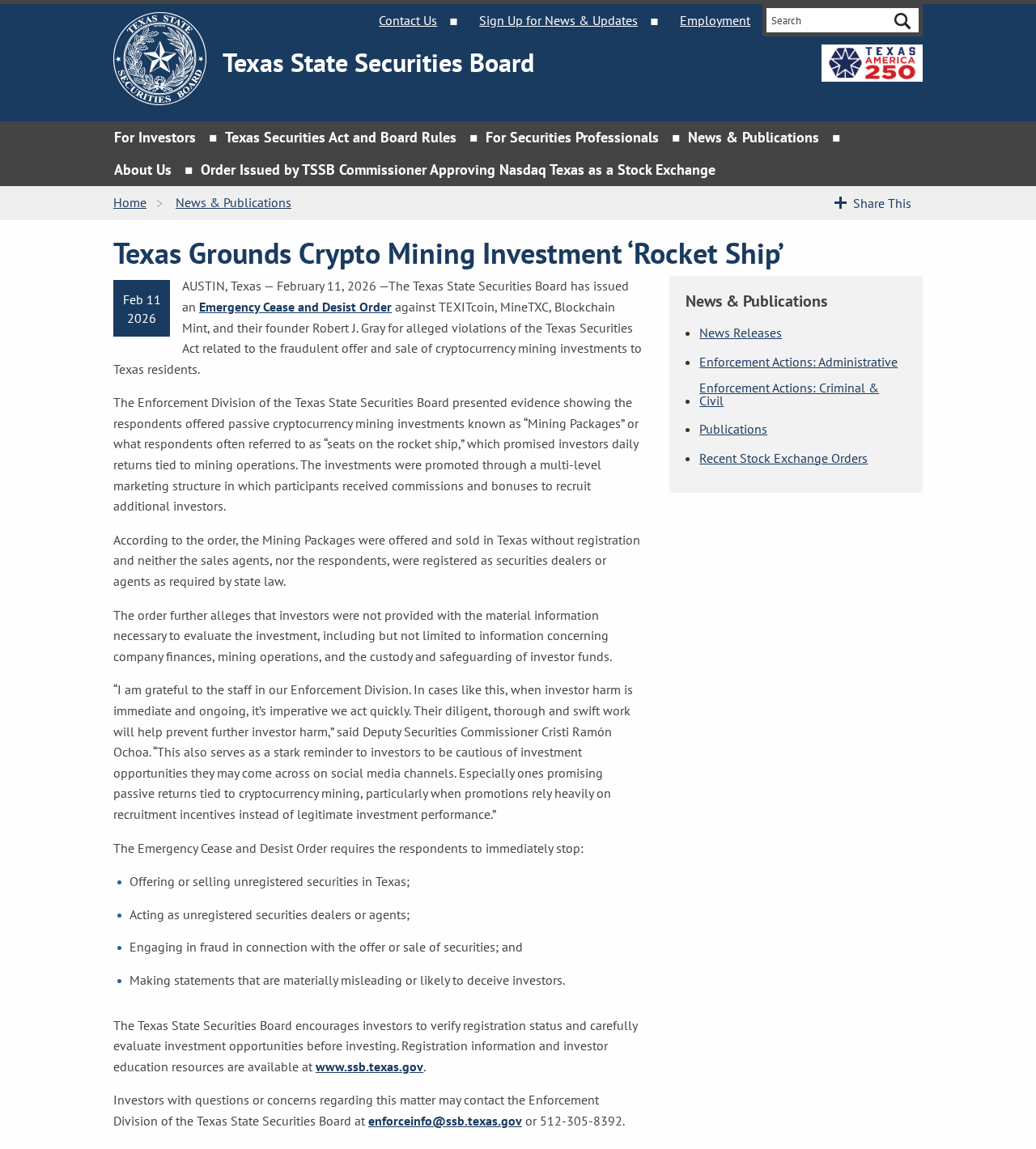
Order ENF-26-CDO-1893, issued February 11, 2026, alleges that TEXITcoin, MineTXC, Blockchain Mint and founder Robert J. Gray sold unregistered securities and failed to disclose material facts to buyers.
The order targets the Mining Packages, which sold a share of mining power that paid out daily in TXC, plus commissions for recruiting new buyers.
It tells the respondents to stop offering unregistered securities in Texas, acting as unregistered dealers or agents, engaging in fraud, and making misleading statements.
What the company says
TEXITcoin and Gray deny every allegation and say a mining package is a one-time purchase of hash power, a commodity, not a share in a business.
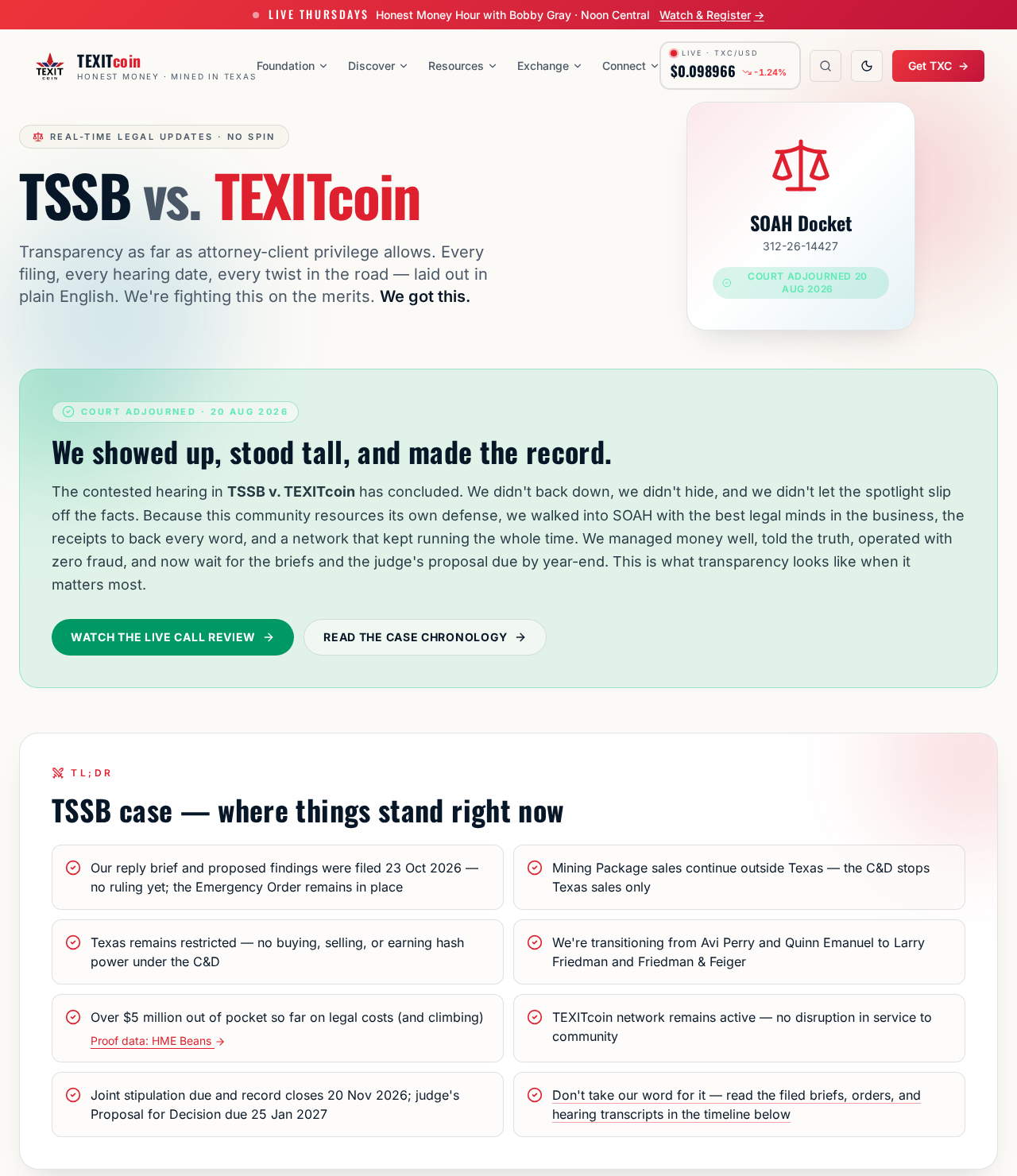
The company says it halted sales everywhere on February 12, resumed them outside Texas on August 23, and bars Texas residents from buying or earning hash power.
What nobody has decided yet
We found no ruling on the merits, and the company says the emergency order stays in place while the case continues.
The record closes November 20, and the judge’s proposed decision is due January 25, 2027, which is a proposal and not a final order.
Here is where the evidence stands:
- Verified by us: the full text of the order, the judge’s October 19 scheduling order, and the company’s current pages, prices, pay plan and public ledger.
- Not found: any published ruling, any order to repay buyers, or any court finding that the sales were fraudulent.
- Not verified: the company’s sales and member figures, who owns the entities, and how much buyers earned or lost.
Our advice is not to buy a mining package or recruit anyone while the case is open, and to read the response section below if you already did.
What the Texas Order Alleges
The order is signed by Deputy Securities Commissioner Cristi Ramón Ochoa and issued as an emergency cease and desist order under Section 4007.104 of the Texas Securities Act.
It names TEXITcoin, MineTXC, Blockchain Mint and Robert J. Gray, and states that Gray is the founder of all three entities.
The order describes MineTXC as TEXITcoin’s mining partner and Blockchain Mint as its coin-making partner and marketing arm.
It says the packages were pitched as passive, quoting the line “seat on the rocket ship, and now you can simply sit back and enjoy the ride.”
It lists three packages: Single at $995 for 100 megahash, Triple at $2,985 for 300 and Builder at $8,955 for 900.
Buyers could also pay by paper check made out to Danager Resources, mailed to a processing address in McKinney, Texas.
The order alleges buyers were not told who owns that payee, how it relates to the sellers or what safeguards protect the money.
The binary pay plan paid $1,000 for every three points matched on each of two teams, with a cap of $3,000 a week, according to the order.
Commissions could be taken in USDC, TEXITcoin or extra mining power, and a bonus called 1-2-Free added 100 megahash for every three buyers a member sponsored.
The sellers promoted all of this across Texas, the United States and abroad, the order says, using radio, billboards, sponsorships, YouTube, Facebook and X.
Its fraud allegations rest on omissions: buyers were not told about MineTXC’s finances, who manages its mining sites, or how outages and hardware failures are handled.
The order also alleges the sellers touted Gray’s experience without disclosing the 2013 Chapter 11 bankruptcy of his company, Mulligan Mint.
That case, number 13-34728 in the Northern District of Texas, was later converted to Chapter 7 and closed around March 2021, according to the order.
The order says none of the three entities, nor Danager Resources, is registered with the Texas Secretary of State or authorized to do business in Texas.
It adds that neither the respondents nor their sales agents were registered as securities dealers or agents, as state law requires.
The notice section lets the respondents ask for a hearing, and says an order nobody contests becomes final and cannot be appealed.
It also warns that knowingly violating the order is a criminal offense, which is a warning to the respondents and not a criminal charge.
What Has Happened Since February
The Securities Board announced the order the same day, with Ochoa warning about passive crypto-mining returns that rely heavily on recruitment incentives.
By the company’s own timeline, it paused all new package sales on February 12 and asked for a hearing on February 20.
The contested case was then docketed at the State Office of Administrative Hearings as number 312-26-14427.
In July, Judge Katerina DeAngelo declined to decide the case on paper because the securities and fraud questions depend on disputed facts, Texas Public Radio reported.
The hearing opened August 17, and Texas Public Radio reported that a Board lawyer called the packages passive investments while the respondents’ lawyer called them a commodity purchase.
The company’s legal page says sales resumed on August 23 and that Texas stays closed, which matches the join page described below.
Both sides filed post-hearing briefs on October 9, 115 pages for the Board and 86 for the respondents.
The judge’s October 19 order, which the company hosts as a PDF, sets the remaining schedule and gives each side six questions to answer.
Her first two questions concern refunds: whether the Board can order them in an emergency-order case at all, and which amount a refund would cover.
She notes that the hearing notice sought each buyer’s principal minus payouts for purchases since September 1, 2019, while the Board’s brief seeks the full amount paid.
She also asks what the Board must prove for fraud by omission, and whether harm is measured when the order issued or at the hearing.
A last question asks what weight March 2026 SEC guidance on crypto assets deserves, which the respondents cite and the Board’s brief does not address.
None of this is a ruling, but it shows where the judge sees open legal ground: refunds, fraud by omission and the federal guidance.
The parties must file a joint list of undisputed facts by November 20, when the record closes, and the proposed decision is due January 25, 2027.
A proposed decision is not a final order, and we found no published date for a final one.
What the Company Says in Its Defense
The respondents’ position is that a package buys mining capacity, not a stake in a business, so the Texas Securities Act does not apply to it.
The company’s Not an Investment page walks through the Howey test, the federal yardstick for investment contracts, and concedes only that money changes hands.
It argues the other three parts fail: no pooled fortunes, no expected profit and no dependence on the efforts of others.
The same page says buyers own their hash power, the company only runs the pool, and over 200 machines have shipped.
Texas Public Radio reported that the respondents’ lawyer likened a package to buying gold in advance from a mining company: a commodity, with no ownership in MineTXC.
The company’s legal page says the Board’s investigator acknowledged no allegation of embezzlement or undelivered coins, but we could not check that against hearing transcripts.
That matters because the order’s fraud allegations concern omissions, not missing money, and the judge has asked the Board what it must prove for such a claim.
The Board’s answer, as Texas Public Radio summarized it, is that buyers never controlled mining equipment and that calling an offering mining does not exempt it.
The Not an Investment page also says commissions are paid out of package sales, and the dashboard shows a payout rate of commissions divided by sales.
That proves nothing about legality, but it means commissions are funded by package purchases.
What the Packages Look Like Today
The texitcoin.org homepage lists no package prices or referral plan and links to a Legal Updates page, where the company argues its case.
The packages are sold through minetxc.com, which forwards its join page to a mineHME site at mine.honest.money.
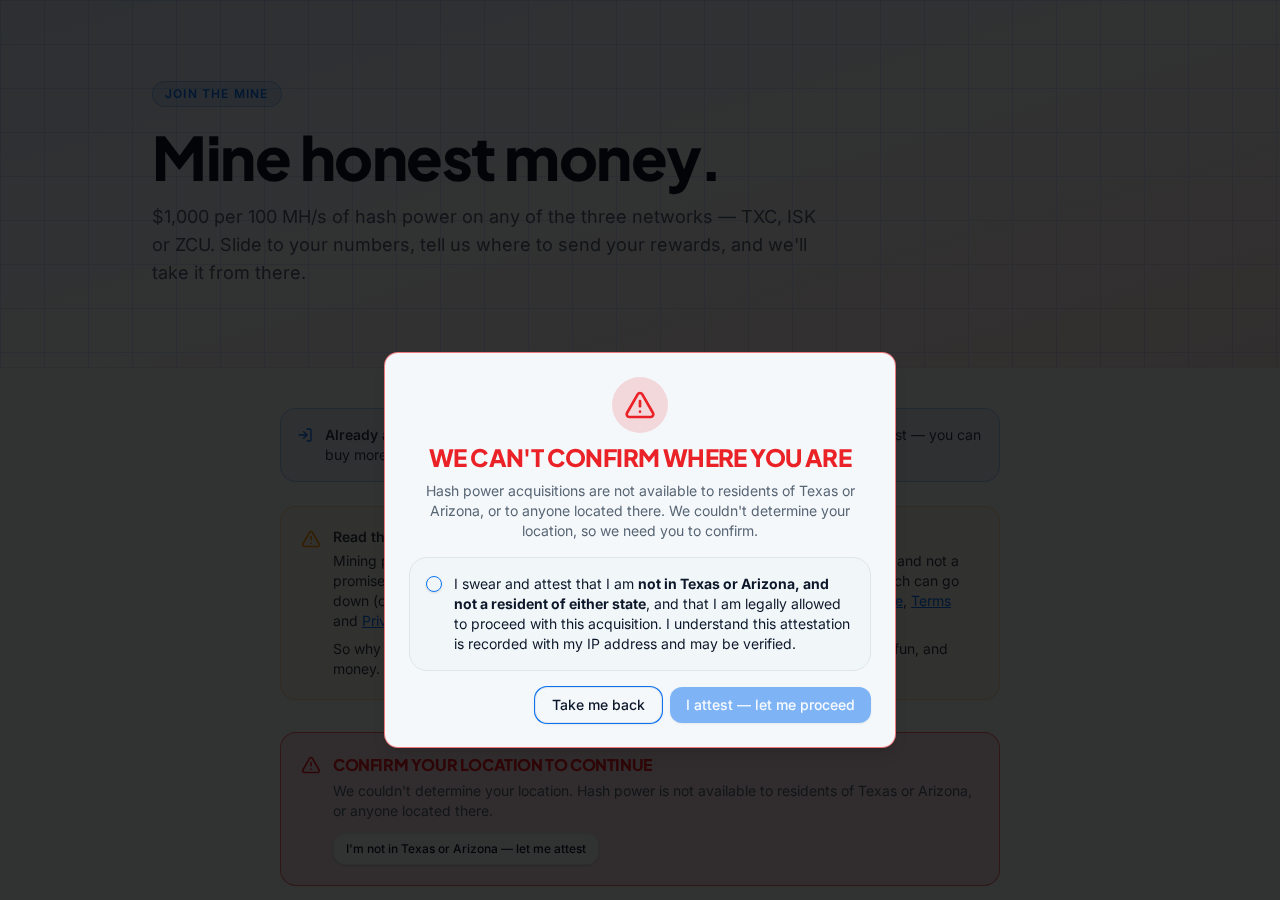
That page offers $1,000 per 100 MH/s of hash power on any of three networks: TXC, ISK or ZCU.
A combo promotion doubles the hash if you buy the same amount in all three coins, according to the page.
Because it could not place our capture, the join page showed a window saying hash power is unavailable to residents of Texas or Arizona.
The window asks visitors to swear they are in neither state and says the attestation is recorded with an IP address. We clicked nothing and entered nothing.
The Terms, updated in August 2026, say a purchase is generally final once a package is activated and hash power is allocated to the pool.
The Risk Statement is blunt that TXC can fall to near zero and that more network hash power means the same hash earns less.
The price ticker on the company’s legal page showed $0.098966 per TXC at capture, a figure we could not check independently.
What the Company’s Ledger Shows
The company’s proof page leads to a ledger called Beans, which promises to show everything the Honest Money Ecosystem takes in and pays out.
For April 6, 2024 to October 15, 2026, it lists $155,366,931 in paid sales across 71,841 sales and $58,459,961 in approved commissions.
Those totals cover all sources, including the Iskander cooperative, not only TEXITcoin packages, and the page says approved commissions are not confirmation of payout.
By our arithmetic, approved commissions equal about 38% of paid sales.
The minetxc.com home page shows 47,727 active miners and $147,858,220 in lifetime sales, both company figures we could not verify.
The February order quoted the same site claiming more than $147 million raised and about $65 million paid in commissions.
The spending breakdown lists $12,733,108 under mining and $12,716,611 under promotion, though we could not audit how the ledger classifies machines and power.
By the ledger’s own categories, the $58,459,961 in commissions is more than four times the mining figure.
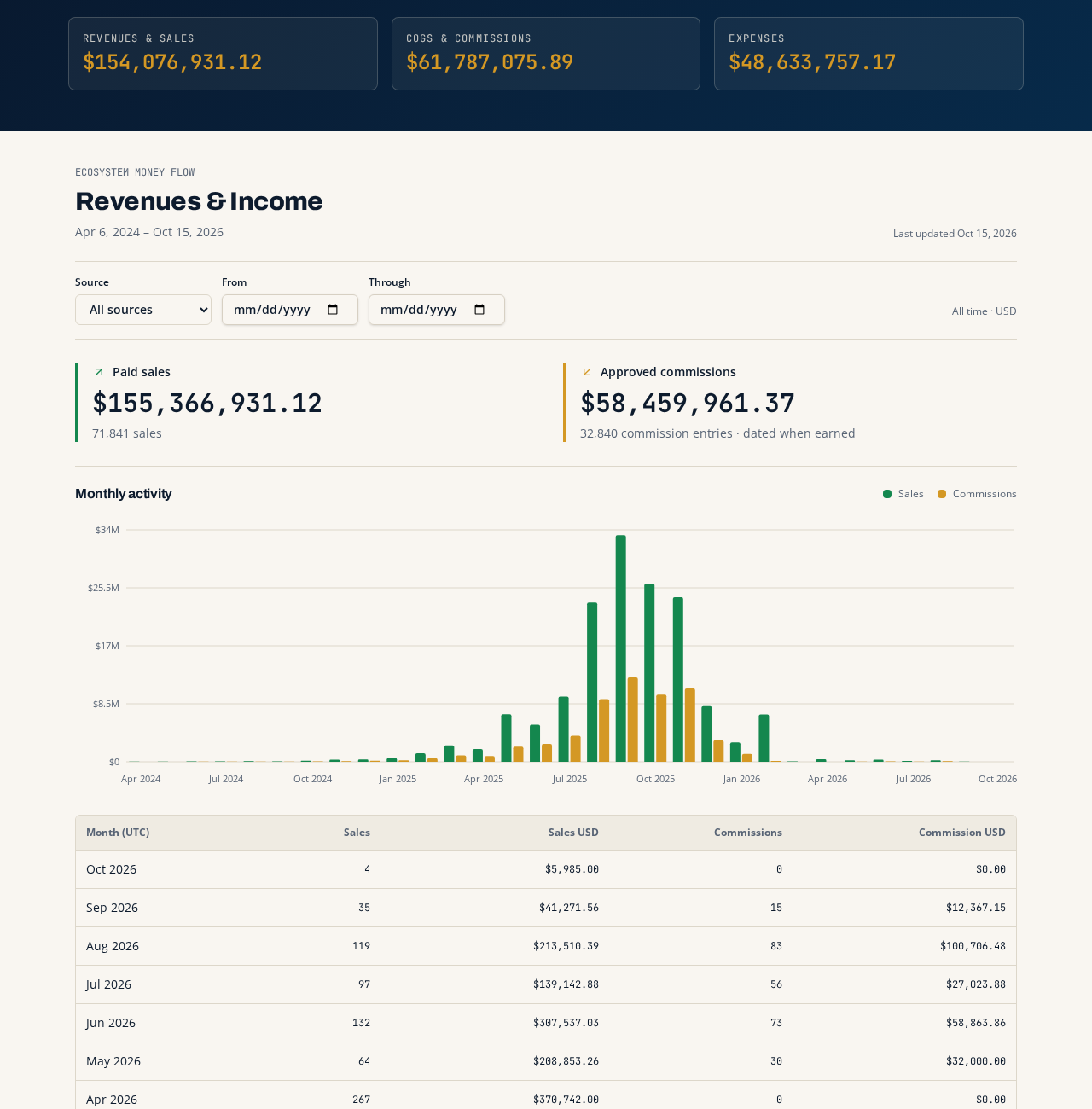
Monthly sales were $24,123,175 in November 2025 and $8,152,460 in December, then $2,834,240 in January and $6,936,607 in February.
They then stayed between $41,272 and $370,742 a month from March to September, but the rows combine all sources, so we cannot say how much was TEXITcoin.
The chart shows monthly sales peaking above $30 million around September 2025, when our earlier review appeared.
How the Mining Package Pitch Works
Step 1: Buy hash power from $1,000
The pay plan page says one seat is 100 MH/s, $1,000 is the minimum purchase, and the maximum purchase is 10,000 MH/s.
It promises no hardware, no electric bill and no hosting contract, and says your share of daily output is your hash divided by the mine’s total hash.
Step 2: Receive a daily share of the mine’s output
Every day the mine’s output is split across every seat, and the dashboard warns that each seat earns a smaller slice as more hash power is sold.
A buyer’s return therefore depends on the coin’s price, the network’s difficulty and how much hash the company sells, most of which the buyer cannot influence.
Step 3: Sponsor buyers to unlock commissions
The binary board gives each member a Pay Leg and an Overflow Leg, and matched points on both sides pay commissions.
A separate 1-2-Free bonus gives you free hash of 100 MH/s for every third miner you personally sponsor, doubled inside your first 30 days.
Step 4: Climb nine levels by buying and sponsoring
Levels 1 to 3 repeat the weekly tiers of $1,000, $2,000 and $3,000 that the February order described.
Levels 4 to 9 raise the weekly ceiling in steps to $30,000, a ceiling the order did not describe.
Each level pays only if you hold its Commission Potential, which the page defines as paid purchases plus personally sponsored purchases.
Higher levels add requirements such as personal hash, TSD holdings, qualified leaders below you and minimum downline value.
A purchase-to-level option lets you start at Level 2 by buying $10,000 of hash and at Level 7 by buying $250,000.
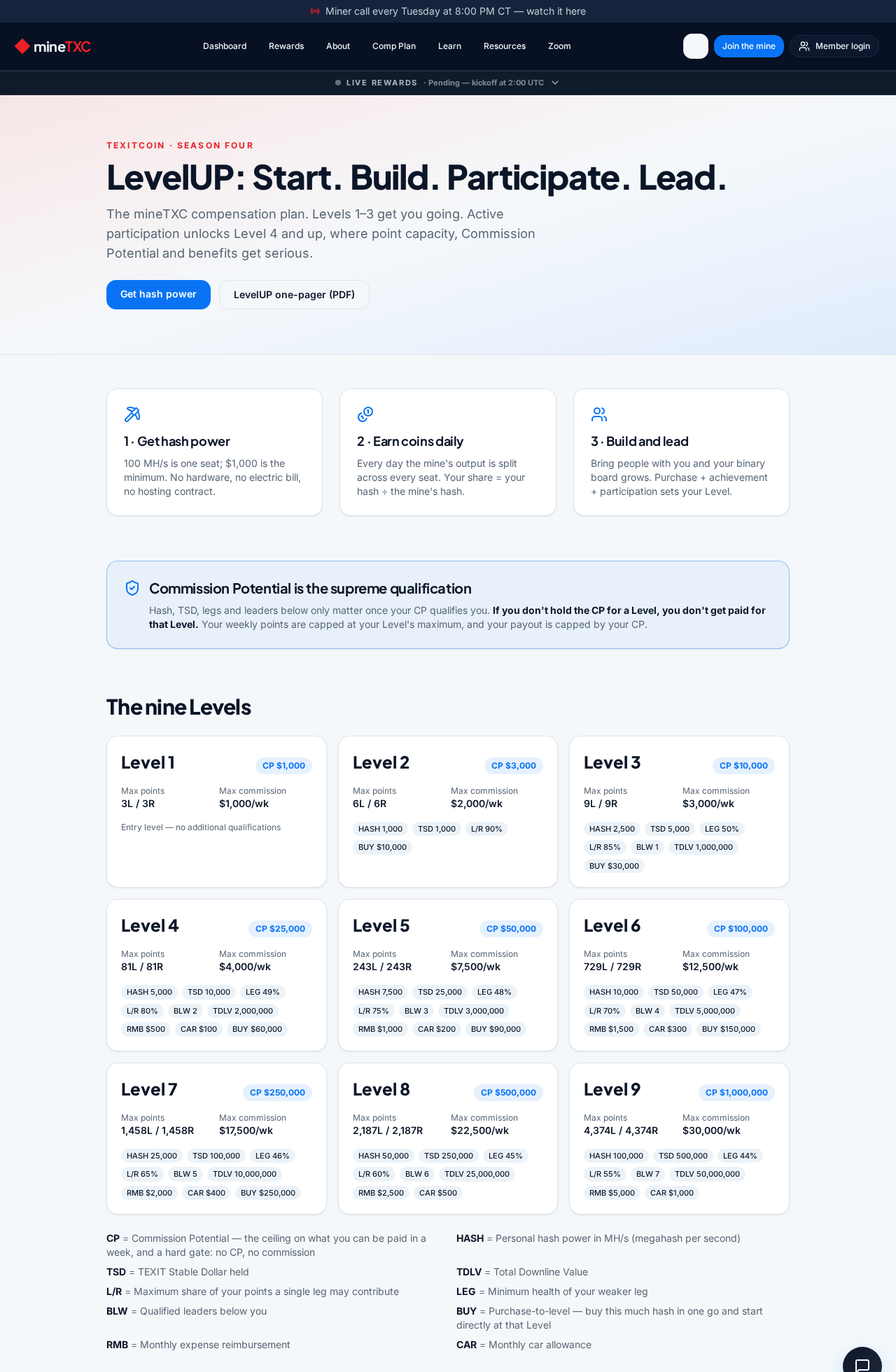
Level 9 also lists a $5,000 monthly expense reimbursement and a $1,000 monthly car allowance.
The page also offers a one-time $1,000,000 bonus for building a million-megahash organization.
Step 5: Commissions arrive in TSD
The page says all commissions are paid in TSD, which its legend describes as a TEXIT stable-value balance, and higher levels require holding a set amount.
The pages we read do not explain what backs TSD or how to cash it out, so treat a commission balance as unproven until you can withdraw it.
Step 6: The purchase is final
The Terms say a purchase is generally final once hash power is allocated, and we found no refund or cooling-off window on the pages we read.
The Board has asked the judge to authorize refunds, but the request is undecided, and the judge has asked whether the Board has that power.
Who Is Behind TEXITcoin and MineTXC?
The names in the Texas order
The order names TEXITcoin, MineTXC and Blockchain Mint as respondents and Robert J. Gray as the founder of all three.
The company’s About page lists Gray as founder, then names owners, an executive team and managers, so the project does not hide who runs it.
The Board’s brief, as the judge’s order describes it, argues buyers were not told that the names used in the offering were all Gray.
Our earlier TexitCoin.org review, written before the order, covers the founder’s earlier ventures, which we do not repeat here.
Where the money and the mines are
The ledger’s profit disclosure says what remains after costs goes to retained earnings and to Gray, whose estimated compensation it puts at about $6 million.
It calls that roughly 4% of revenue and a historical estimate, not a live calculation or an audited figure.
The order lists McKinney, Texas addresses for serving the respondents and a McKinney address for paper checks, but gives no address for any mine.
The mineHME pages list mines in McKinney, Mansfield, Victoria and Conroe and invite visitors to inspect them, though we did not verify any site.
The company says over 200 machines have shipped to buyers, while the order says investors never receive mining hardware or control over it.
Both can be true for different buyers, and the hearing record is where the judge will weigh them.
Domains and the Honest Money network
Registration data shows minetxc.com was registered on April 16, 2024, and blockchainmint.com on July 3, 2016, both through Amazon Registrar.
A domain date tells us when a name was bought, not when a business began or who runs it.
Our lookups for texitcoin.org and honest.money returned no registration data, and all four sites resolve to the same IP address.
A shared address suggests shared hosting, and it proves nothing about common ownership.
The pages tie TEXITcoin to two sister networks, Iskander Coin and Zero Chill, and the pay plan stacks bonuses for members who earn on two or three of them.
Arizona’s securities regulator has separately challenged the Iskander cooperative’s mining seats, a case we covered in our Iskander network article.
What we could not confirm
We could not confirm who owns the three entities, what Danager Resources is, or whether any holds a Texas registration, since we did not search the state registers.
We also could not verify the company’s sales, member and machine figures, the condition of its mines, or what backs TSD.
We found no criminal complaint against the company or Gray in the sources we could read, but we did not search court dockets, so that is no clearance.
What to Do If You Bought a Package or Were Invited to Join
-
Add no money. A pending case, a final-sale term and a pay plan that depends on purchases are reasons to pause before any top-up.
-
Stop recruiting. The order alleges the sales agents were unregistered dealers, so ask a securities lawyer about your own exposure before you invite anyone.
-
Save your records. Keep order confirmations, payment proof, wallet addresses, daily reward history, the pitch you received and dated screenshots of the pay plan.
-
Ask in writing. Request your full account history and the company’s refund position, quote the Terms, and keep every reply as evidence.
-
Check your payment method. Card issuers set dispute deadlines, often 60 days from the statement, while crypto and checks are harder to reverse; see the FTC’s dispute guidance.
-
Tell the regulators. The Texas State Securities Board’s Enforcement Division takes questions on this matter at enforceinfo@ssb.texas.gov or 512-305-8392, and you can file at ReportFraud.ftc.gov.
-
Ask the FTC’s questions. Ask current members what they earned last year after expenses and how much came from recruiting, as the FTC advises.
-
Guard your wallet. Never share seed phrases, ignore recovery services that charge upfront, and report crypto losses with transaction hashes to the FBI’s IC3.
Frequently Asked Questions
Is TEXITcoin a scam or a pyramid scheme?
Not decided: Texas alleges unregistered securities and fraud by omission, the company denies it, and no ruling has been published.
What does the Texas order actually stop?
It orders the respondents to stop unregistered securities offers in Texas, acting as unregistered dealers, fraud and misleading statements, but it does not repay anyone.
Can I still buy a mining package?
The company says it sells outside Texas, and the join page asks you to swear you are not in Texas or Arizona; we did not test checkout.
Is the TXC coin itself a security?
The order’s legal conclusion is about the Mining Packages, and Texas Public Radio reported that a Board lawyer said the central issue is the packages, not the coin.
When will the case be decided?
The record closes November 20 and a proposed decision is due January 25, 2027; a proposal is not final, and we found no date for a final order.
Can I get my money back?
Not as of right: the Terms call purchases generally final, and refunds are something the Board asked the judge to authorize, which is undecided.
The Bottom Line
Do not buy a TEXITcoin mining package or recruit others while the Texas case is open, because purchases are final and the pay plan rewards buying and sponsoring.
To see how this ends, follow the Board’s news page and the judge’s proposed decision, and be wary of any promoter who says the case is already won.
If you already bought, save your records, add nothing, stop recruiting and report your experience to the Board or the FTC, since no ruling guarantees repayment.

Join the discussion
0 commentsShare your experience or ask a question about this article.
Discussion
Start the conversation
Have a question or something useful to share? Add the first comment.