


A mining business can sound more reassuring when you’re offered membership, voting rights, and a place in the operation rather than another speculative coin.
That’s the appeal behind Iskander Network’s mining Seats. Before treating one as a foothold in crypto mining, it’s worth understanding what your contribution actually buys.
Overview
The offer is a cooperative membership tied to mining
The Arizona case concerns Iskander Digital Mining Cooperative, or IDMC, and membership units marketed as mining Seats. It isn’t simply a complaint about a cryptocurrency’s price.
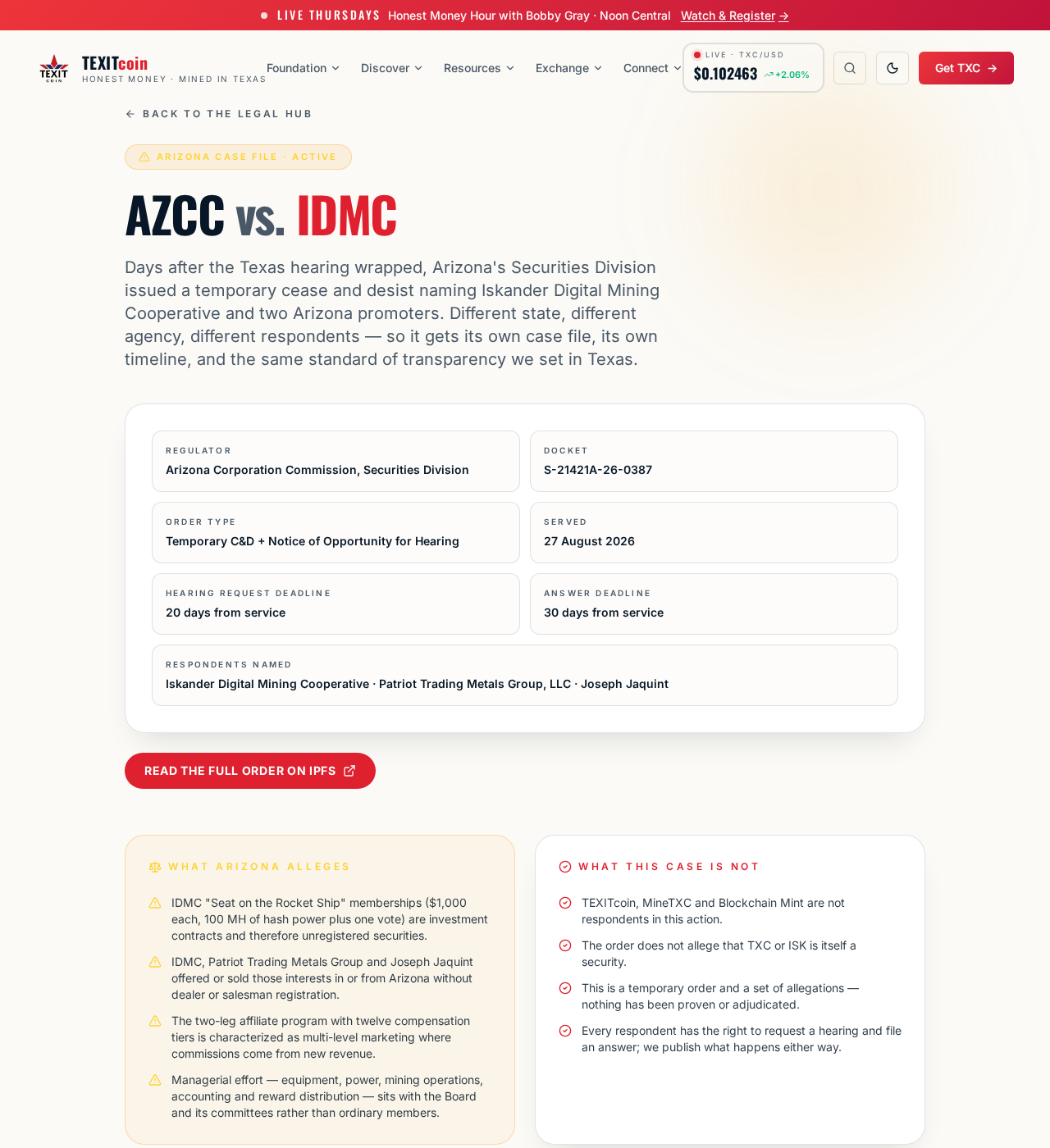
The August 24, 2026, order describes a $1,000 minimum capital contribution per Seat, supposedly associated with 100 megahash of mining power and one vote.
The cooperative pools contributions and operates mining assets collectively. A member isn’t buying a particular machine to take home or independently control.
Arizona challenged the way those interests were offered
The Arizona Corporation Commission’s Securities Division alleged that the Seats were unregistered investment contracts offered through unregistered dealers or salespeople in or from Arizona.
Its action was a temporary cease-and-desist order with hearing rights, not a criminal conviction. The official indexed docket lists a hearing request and an answer.
The related TEXITcoin legal page also acknowledges the temporary Arizona case. Its response emphasizes that the allegations haven’t been adjudicated.
The important distinctions before buying a Seat
- A member vote doesn’t mean personal control over mining equipment or daily operations.
- The stated mining allocation doesn’t guarantee a fixed cash return.
- ISK rewards and money you can withdraw or spend aren’t interchangeable concepts.
- Referral compensation is separate from whatever the mining operation earns.
- Arizona’s requested penalties and restitution aren’t the same as an awarded payment.
These issues deserve answers before another contribution, not after you’re relying on rewards to recover money already committed.
What Arizona’s Temporary Order Actually Says
The disputed investment is the Seat
The case is docket S-21421A-26-0387. The central question is how membership interests were offered and sold, including the economic reliance on other people’s managerial work.
That is narrower than declaring every cryptocurrency named in the documents unlawful. The related operator’s response likewise distinguishes the membership offering from the coins themselves.
The original Arizona order describes the capital structure, rewards, referral program, and activities reserved to the cooperative’s management.
Those details matter because the substance of an arrangement can differ from its label. Calling someone an active member doesn’t answer who actually runs the business.
The case hasn’t become a final judgment by default
The order provides a hearing process. The official indexed docket lists a September 11 hearing request and a September 25 answer and procedural hearing order.
The original temporary order says a requested hearing can keep it effective until a decision unless otherwise ordered. It doesn’t simply disappear when a calendar period passes.
Nor does the request for restitution mean participants have already been awarded refunds. The requested remedies and the Commission’s eventual decision must be kept separate.
For a buyer, a pending case isn’t a reassuring clearance. It means the disputed registration and offering issues should not be waved away as settled.
Why Membership Doesn’t Necessarily Mean Control
Your vote isn’t a key to a mining machine
The order describes a seven-manager board overseeing operations and finances, with the essential work handled by management and committees under its direction.
That work includes equipment selection, electricity arrangements, mining, accounting, and reward distribution. These decisions determine whether an operation earns anything available to members.
Ordinary members may vote on specified matters without controlling those day-to-day decisions. Both can be true at once: participation rights exist, and operational dependence remains.
If a presentation promises ownership, ask what you could actually direct, inspect, sell, or recover. A broad feeling of belonging isn’t an answer.
Committee work isn’t the same as running the operation
The Division’s allegations address mandatory committee participation and explain why that requirement didn’t, in its view, give ordinary members essential managerial authority.
Attending meetings or helping promote a project can take real effort. That effort doesn’t necessarily let you choose equipment, negotiate power costs, or control distributions.
The distinction becomes practical when you disagree with management. Can you stop an expenditure, access the underlying accounts, or remove your allocated hardware?
Before joining, the governing documents should answer those questions. Don’t assume a membership title gives powers that the actual agreement reserves to someone else.
How the Iskander Mining Seat Offer Works
Step 1: A contribution buys participation in the cooperative
The order describes each $1,000 contribution as purchasing a Seat. It also identifies a separate, one-time nonrefundable membership fee set by the board.
February promotions cited in the order used a $995 Seat price. If you saw that older figure, don’t assume it covers the later $1,000 contribution and separate fee.
Ask for the complete amount applicable to your offer, including the separate fee. A promotional headline and the amount leaving your account may answer different questions.
Also establish whether you’re contributing capital, buying equipment, or purchasing a service. The written agreement, rather than the invitation’s wording, should explain your rights.
Step 2: Contributions support collectively held mining assets
IDMC’s described model pools money for mining equipment, infrastructure, facilities, and electricity arrangements. The assets belong collectively to the cooperative, not individually to each Seat holder.
That creates a different risk from owning and operating your own machine. You depend on the organization to acquire assets, maintain them, and account for their use.
A claim of 100 megahash describes an allocation of computational work. It doesn’t identify a specific device you own or promise a particular daily profit.
Ask how allocations are measured, what operating costs are deducted, and what happens when equipment fails or mining becomes less profitable.
Step 3: Management performs the work that generates rewards
The Division emphasized the board’s role in selecting and deploying equipment, obtaining power, conducting mining, and calculating what members receive.
Members therefore rely on more than the existence of machines. They rely on purchasing decisions, operating discipline, accounting, and the rules for distributing whatever remains.
Seeing a facility or a photograph of hardware wouldn’t answer every one of those questions. An operating business can still offer interests subject to registration requirements.
The relevant reassurance would connect claimed mining activity to independently understandable costs and member distributions, not simply show that crypto mining is technically possible.
Step 4: Mining rewards appear as a digital asset
The order describes advertised ISK rewards delivered to digital wallets on IDMC’s platform. A reward balance needs to be understood on its own terms.
How many units you receive, what they can be exchanged for, and whether you can transfer them are separate questions. A displayed account value doesn’t answer them.
Before treating rewards as income, account for liquidity, conversion costs, transfer restrictions, and price changes. Don’t assume a displayed valuation is an executable sale price.
If you already receive ISK rewards, keep records of what arrived, where it went, and any completed conversion. A quoted value and actual proceeds can differ.
Step 5: Referrals create a second earning proposition
Alongside mining rewards, the order describes a two-leg referral structure with twelve compensation tiers and qualification requirements tied to enrolling additional members.
The Division also cited the cooperative’s statement that commissions came from new revenue. That revenue source should not be confused with independently established mining profitability.
A member can therefore face two separate incentives: expect mining rewards and bring others into the membership structure. Recruitment earnings don’t validate the underlying investment.
Don’t invite friends to solve your own return problem. If you can’t clearly explain the permissions, costs, custody, and risks, passing along the pitch spreads that uncertainty.
Cooperative Identity, Management, and Access to Your Capital
IDMC is the entity to identify in the agreement
The order identifies IDMC as a Wyoming decentralized unincorporated nonprofit association, often shortened to DUNA. It identifies Robert J. Gray, known as Bobby Gray, as founder.
That organizational label doesn’t establish investment authorization. Check which entity signs your agreement and receives your contribution rather than treating related project names as interchangeable.
Patriot Trading Metals Group and Joseph Jaquint are also named in the Arizona action. Match the role of anyone promoting your enrollment to the agreement you’re signing.
Mining locations don’t establish your ownership rights
A project’s facilities can matter to operating capacity. They don’t tell you whether your capital account gives you a claim to any identified machine.
The described collective ownership makes the agreement especially important. Ask what happens to your interest if the cooperative dissolves, loses equipment, or changes its mining strategy.
Keep a copy of the version you accepted. A later website explanation may not match the terms that governed your contribution.
Promoters and management answer different questions
A promoter may explain enrollment or help someone join. That doesn’t necessarily make the promoter the person responsible for the cooperative’s accounts or capital-return decisions.
Direct a written request to the responsible legal entity as well as keeping the promoter’s communications. Record who answered, in what capacity, and with what commitment.
There’s no need to disclose a wallet recovery phrase or exchange password to request an account explanation. Keep those credentials private.
Capital contributions aren’t ordinary retail returns
A cooling-off promise for an online product shouldn’t be assumed to apply to a cooperative contribution. Your agreement and applicable rights need their own assessment.
Separate the nonrefundable membership fee described in the order from the treatment of contributed capital. One clause doesn’t automatically explain every amount you paid.
If the answer is unclear or your request is refused, preserve the wording and seek independent advice. Don’t add capital merely to become eligible to exit.
What to Do If You Bought Iskander Mining Seats
-
Stop further contributions while you assess your position. Don’t buy additional Seats to average down, protect an earlier contribution, or satisfy a promoter’s new target.
Pause referral activity too. Separating the decision from a community sales conversation gives you room to examine the actual agreement.
-
Collect your membership documents and payment records. Save the agreement, risk disclosures, fee schedule, capital-account statements, Seat count, reward history, and the version of any promotion you received.
Record the payment date, amount, currency, recipient, and method. Keep original files rather than relying only on access to a member portal.
-
Ask for an account reconciliation in writing. Separate contributed capital, membership fees, mining rewards, referral compensation, withdrawals, and any deductions.
A single balance can hide important differences between those categories. Ask what each figure represents and which amount, if any, is available to return.
-
Make any capital-return request specific. Identify the agreement, payment, requested outcome, and relevant provision. Keep the response and any promised processing date.
If a new fee or additional purchase is demanded, don’t assume it’s necessary. Get the explanation in writing before considering any further payment.
-
Speak promptly with your payment provider. Explain the actual transaction and concerns accurately. Ask what documentation, investigation process, or dispute deadline applies to that payment method.
Available options differ for checks, transfers, cards, and crypto. The FTC’s payment-response guidance is a starting point, not a guarantee of reimbursement.
-
Use the correct Arizona case information. Refer to docket S-21421A-26-0387 when contacting the Commission through its official channels about this offering.
Explain your own experience, including where you were approached and who supplied the instructions. Don’t present allegations about unrelated projects as your personal knowledge.
-
Get independent advice if the amount or your role is significant. A qualified adviser can help you understand the agreement, possible claims, and any responsibilities arising from promotion.
Don’t rely only on the person who earned or expected compensation from your enrollment. Their interests may differ from yours.
-
Protect the records and reject recovery guarantees. Keep private keys and authentication codes to yourself, and be wary of anyone promising to recover funds for an upfront payment.
For crypto transactions, preserve the network, destination address, and transaction hash. The FBI’s cryptocurrency reporting guidance explains why those details matter.
Frequently Asked Questions
What does an Iskander mining Seat supposedly provide?
The Arizona order describes a $1,000 contribution associated with 100 megahash and one vote. That isn’t personal ownership of a specified machine or a guaranteed cash return.
Why did Arizona act against the offering?
The Division alleged that the membership interests were unregistered investment contracts offered through unregistered dealers or salespeople in or from Arizona. Those are the specific allegations addressed here.
Is the cease-and-desist order permanent?
The original order is temporary. The official indexed docket records a hearing request and answer, so it shouldn’t be described as an automatically final judgment.
Does being a DUNA remove investment risk?
No. An organizational form doesn’t guarantee profits, safeguard a particular contribution, or resolve the registration questions raised in the Arizona case.
Are referral commissions proof that mining is profitable?
No. Referral compensation and mining results are separate. Payments associated with new memberships don’t establish how much the mining operation earns after its costs.
Has Arizona already awarded members their money back?
The temporary order requests further relief, including restitution. A request isn’t an award or a repayment schedule. Participants should document their own position without assuming recovery.
The Bottom Line
Do not put more money into this Iskander Seat offer or recruit others into it while the identified registration concerns remain unresolved.
Your money is pooled, management controls the mining, and a reward balance isn’t cash in your account. Arizona has also challenged how the Seats were sold.
If you already contributed, preserve your agreement and payment trail, request a written account explanation, and pursue independent payment-provider and regulatory guidance before sending anything else.

Join the discussion
0 commentsShare your experience or ask a question about this article.
Discussion
Start the conversation
Have a question or something useful to share? Add the first comment.