

The bargain arrives on time, in a real retailer’s packaging. The item works, tracking looks normal, and the seller asks for a positive review.
A triangulation scam can hide behind that apparently successful delivery. The question is not only whether the parcel arrived, but how the seller paid for it.
Overview
The seller takes one payment and finances fulfillment with another person’s card
In triangulation fraud, a deceptive seller accepts a buyer’s money, then orders the product from a separate legitimate merchant using stolen payment information.
The actual merchant ships a real order to the buyer. The seller keeps the payment collected while the unauthorized purchase creates a problem elsewhere in the chain.
Visa describes this mechanism in its retail fraud guidance. Authentic goods and ordinary delivery tracking can coexist with fraudulent funding.
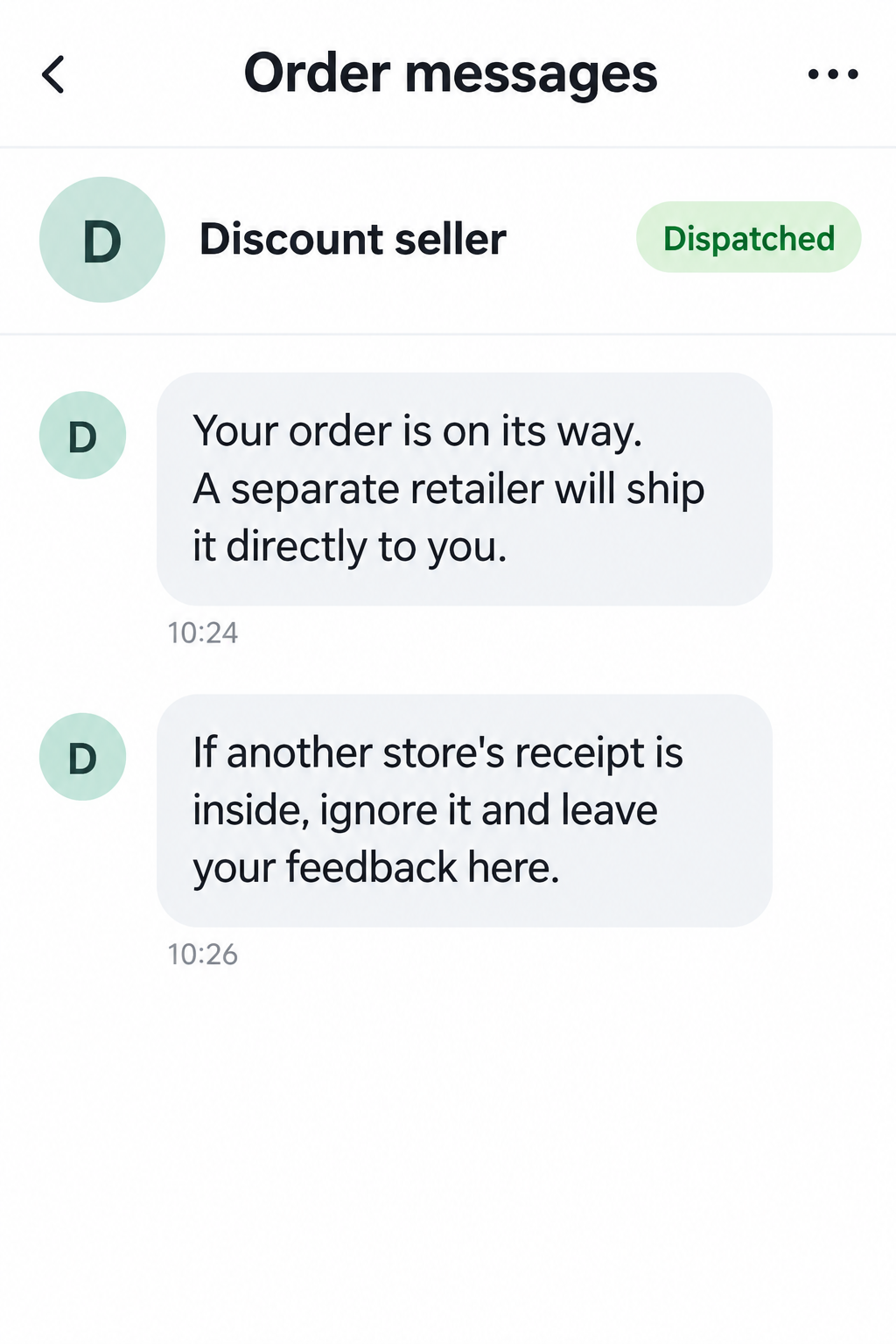
The marketplace messages shown here are fictional. Shipment from another retailer, a gift receipt, or a request for feedback is not conclusive evidence of this scheme.
Several innocent parties can see different parts of the same order
The buyer sees a paid bargain and a delivered item. The legitimate merchant sees an order and payment authorization. The cardholder sees a purchase they did not make.
Each person’s record can look internally understandable until those records are connected. That separation makes the fraud harder to recognize than a store that sends nothing.
The scheme has been described for years; this is not a newly captured storefront or a finding about every discounted marketplace listing.
Check the relationship between seller, payment, and fulfillment
- Keep the original listing, checkout receipt, and seller messages.
- Compare the seller you paid with the retailer supplying the goods.
- Treat requests to leave the marketplace’s payment system as serious warnings.
- Ask for an explanation of unfamiliar order or invoice details.
- Report suspected conduct without inventing a non-delivery claim.
- Do not send goods or another payment to a new contact without verification.
Legitimate resellers and third-party fulfillment exist. The defining problem is stolen-card funding and deception, not the mere presence of more than one company.
Why Receiving the Right Item Can Hide the Wrong Transaction
Delivery answers only the question you were expecting to ask
Most buyers worry about whether an unfamiliar seller will send the item. A prompt delivery resolves that concern and creates a reasonable sense of relief.
The buyer may then leave a good review, recommend the seller, or order again. Those reactions can strengthen the storefront before its funding trail is examined.
Visa’s December 2023 threat report discusses positive-feedback requests in triangulation operations. A successful shipment can become part of the seller’s credibility.
The lesson is not to mistrust every delivered bargain. It is to avoid treating one positive outcome as proof of every unseen part of the transaction.
The original retailer gives the parcel an authentic appearance
A familiar box, useful tracking link, or valid retail product can reassure the buyer. Those elements may be genuine because the fulfillment merchant is a legitimate business.
That business might not know the marketplace seller used stolen payment data. Its branding should not be treated as endorsement of the intermediary’s methods.
A gift designation or missing price can make the connection less obvious. Those features have innocent uses too, so preserve them as clues rather than automatic verdicts.
How the Triangulation Scam Works
Step 1: The intermediary attracts a buyer with a desirable offer
The seller advertises an item at a price that encourages a quick purchase. It may be an ordinary useful product rather than an extravagant or obviously impossible promise.
The listing can appear on a marketplace or independent storefront. A platform account, seller history, or positive feedback may supply additional reassurance.
Those signals deserve inspection, but none allows a buyer to see the payment data used later. The seller’s displayed stock does not establish ownership of inventory.
Before buying, read the seller’s identity, contact information, fulfillment explanation, and return arrangements. A vague offer can obscure which party will be responsible if questions arise.
Step 2: The buyer pays the seller through the offered channel
The buyer sends money for the advertised item. In the fraudulent arrangement, that payment is collected by the intermediary rather than the merchant that will fulfill the order.
An off-platform request can remove useful transaction records or protection. eBay’s seller-fraud guidance specifically warns about moving contact or payment outside its system.
Do not assume all transfers are unrecoverable or all card purchases are guaranteed safe. Recovery depends on the payment method, facts, applicable protections, and timing.
The safer habit is to keep the transaction within the legitimate platform’s permitted checkout and retain its complete order record.
Step 3: A separate retail order is placed using stolen payment information
The intermediary uses another person’s card details to buy the product from a genuine merchant. The shipping address is the address where the innocent buyer expects delivery.
The legitimate merchant may approve and dispatch that order without recognizing the connection. Approval at checkout is not final proof that the underlying card use was authorized.
The buyer usually cannot inspect this hidden funding step. Unexpected invoice information or a merchant inquiry may be the first indication that another transaction exists.
Do not try to obtain a stranger’s full card details to investigate. The merchant and payment providers should review sensitive funding information through their own processes.
Step 4: Real fulfillment makes the seller’s offer seem validated
The product arrives and the buyer can use it. A delivery record that appears to support the seller may actually document the legitimate merchant’s separate shipment.
A retail receipt might show an unfamiliar reference, account, or price. A gift receipt may show less. Keep the paperwork if anything about the relationship is unclear.
The seller may encourage quick feedback or dismiss the other retailer’s documentation. A refusal to explain conflicting records is more significant than the packaging mismatch alone.
Do not publish an accusation based only on a box. Ask through the marketplace and verify any unusual inquiry with the retailer named in the paperwork.
Step 5: The unauthorized payment creates a dispute elsewhere
The cardholder notices the charge and reports it. The issuer and fulfillment merchant can then investigate the retail order that used the stolen information.
The buyer’s shipping address may become relevant to that review. Receiving a parcel does not, by itself, establish that the buyer knowingly participated in fraud.
There is no universal outcome in which every buyer loses the goods, gets a refund, or faces a police visit. Preserve records and seek specific guidance.
The intermediary may disappear or introduce another collection request. Keep the original payment dispute separate from any new claim that money is needed to repair the order.
Trace the Seller, Fulfillment and Payment Trail
The seller you paid must explain its own role
Compare the storefront name, checkout payee, receipt, and return contact. Determine whether the seller clearly represented itself as a reseller, a retailer, or an authorized agent.
A brand name in a listing is not proof of a distribution agreement. Ask for a useful explanation without handing over more financial or identity information.
If a business uses several names, record the actual names rather than assuming shared criminal ownership. Payment processors and fulfillment contractors can create legitimate differences.
The fulfillment merchant is not automatically the intermediary
The store on the parcel may have sold a product in a separate transaction. It might not control the listing, payment you made, or seller communications.
When contacting that store, use its independently obtained support route and the order reference already available. Describe the mismatch and ask how to verify the inquiry.
A warehouse or dispatch address identifies a shipping stage, not necessarily the seller’s headquarters. Do not use that address alone to accuse an unrelated operator.
Two receipts can describe two different payments
Your receipt records the purchase from the intermediary. The retail paperwork may relate to the order that financed fulfillment. Their amounts and references can therefore differ.
Differences deserve clarification, but resale margins and legitimate gifts also exist. You need evidence of unauthorized funding or deception before assigning the triangulation label to a seller.
Keep cardholder information private if it appears unexpectedly. Share necessary evidence only with the genuine platform, merchant, issuer, or investigating authority through an appropriate channel.
Support and returns must follow the documented transaction
Ask which seller handles returns and what address applies. A stranger’s request to ship the item elsewhere may create a second loss rather than resolve the first order.
Do not send an item back to a retailer using a fabricated buyer identity. Explain the situation honestly and follow verified instructions from the relevant transaction provider.
Save shipping references and written decisions. They help distinguish a genuine return, a fraud investigation, and an unsupported demand from the intermediary.
Legitimate Reselling Is Not the Same as Triangulation Fraud
A different sender is a clue, not a complete accusation
Some sellers outsource storage, shipping, or product supply. A package coming from a separate business is compatible with those arrangements.
The problem arises when the purchase is funded with stolen payment data or the customer is deceived about material terms. Cheap pricing alone cannot prove that hidden step.
Look for an explanation that connects the listing, seller, payment, and shipment. A consistent documented relationship is more useful than guesses based on one unfamiliar receipt.
Buyer protection needs an accurate description of what happened
A delivery record can affect a platform’s assessment. Do not claim the parcel never arrived when your actual concern is suspected stolen-card fulfillment.
eBay’s Money Back Guarantee has eligibility rules and exclusions. Other platforms have their own processes; a report about a seller is not automatically a refund request.
Ask which route applies to your evidence and keep deadlines in view. Do not pursue duplicate reimbursements or alter your account of events to fit a standard form.
What to Do if You Have Fallen Victim to This Scam
-
Pause further dealings with the seller. Do not accept another bargain, extra payment, or off-platform instruction while the original funding trail is uncertain.
Save the listing, payment receipt, messages, tracking, and packaging records. Keep copies of changes or explanations already supplied rather than repeatedly reopening questionable links.
-
Report the actual concern to the marketplace. Explain that the item arrived but the fulfillment or payment records suggest a separate suspicious transaction.
Follow the platform’s conduct-reporting and order-resolution guidance where applicable. Reporting suspected seller behavior and seeking a particular refund are different requests.
-
Verify contact from the fulfillment retailer. Obtain its real support details independently. Use the order reference from the paperwork and describe the intermediary purchase.
Do not trust an incoming caller solely because they know the delivery address. Nor should you send card information to a contact the seller introduces as an investigator.
-
Ask your payment provider about available protection. Describe the purchase and evidence truthfully, including the fact of delivery. Keep the original amount and merchant description.
A platform or issuer may need information beyond a generic non-delivery form. Ask about the appropriate review and deadlines without assuming a particular outcome.
-
Handle goods only through verified instructions. Preserve records and avoid reselling or forwarding disputed items while a genuine inquiry is being clarified.
If a formal demand or legal issue arises, get independent advice appropriate to your location. An online article cannot decide ownership or liability for your specific transaction.
-
Protect your own information when there is separate exposure. Contact the issuer if your card was used without permission. Recover accounts through their actual providers if credentials were disclosed.
A package from another retailer does not prove your own card or device was compromised. Investigate the actual signs instead of assuming every participant suffered the same loss.
-
Support the investigation without exposing others. Keep relevant receipts private and provide necessary references to genuine support. Do not publish a third party’s payment details.
US consumers can report deceptive transactions through ReportFraud.ftc.gov. A report is useful evidence, not a promise of recovery or immediate enforcement.
-
Reject follow-up refund or correction demands. An unfamiliar caller may claim another payment, verification fee, or shipping charge will make the incident disappear.
Continue through the marketplace, merchant, and issuer contacts you verified. Check refunds in their actual records rather than trusting a screenshot from the intermediary.
Frequently Asked Questions
Can a scam seller deliver a genuine item?
Yes. Triangulation fraud uses a legitimate merchant for fulfillment while funding its purchase with stolen payment data. Authentic goods do not validate that separate payment.
Does a gift receipt prove triangulation?
No. Gift purchases and private reselling are legitimate possibilities. Treat unexpected paperwork as a reason to check the relationship, not as conclusive fraud evidence.
Is every dropshipping business involved in stolen-card purchases?
No. Outsourced supply or fulfillment is not the defining problem. Unauthorized payment information and deception distinguish the fraudulent mechanism from a legitimate seller arrangement.
Will police always confiscate the delivered item?
There is no universal result. Preserve records, verify genuine inquiries, and seek case-specific advice if a formal demand concerns the goods or transaction.
Should I report that the order never arrived to obtain a refund?
No. Explain what actually happened. A false non-delivery claim can undermine the review; ask the platform or issuer which process fits your evidence.
Who should investigate the stolen card used for fulfillment?
The affected cardholder, issuer, merchant, and relevant authorities have their own roles. An innocent purchaser should cooperate through verified channels without collecting or publishing another person’s card details.
The Bottom Line
A triangulation scam can produce the item you expected while hiding an unauthorized payment elsewhere. Delivery is evidence of shipment, not proof of honest funding.
Keep the seller, payment, and fulfillment records connected. If they do not make sense, report the facts accurately and follow verified support instructions without creating another transaction.








