

An unexpected email says you were nominated for a Trump Gold Card and can secure a privileged immigration path by paying $29,000. That is not an opportunity. It is an advance-fee scam.
The message borrows the U.S. Department of Commerce name, a real cabinet official and formal immigration language, then rushes the recipient toward two large payments that provide no legitimate status or benefit.
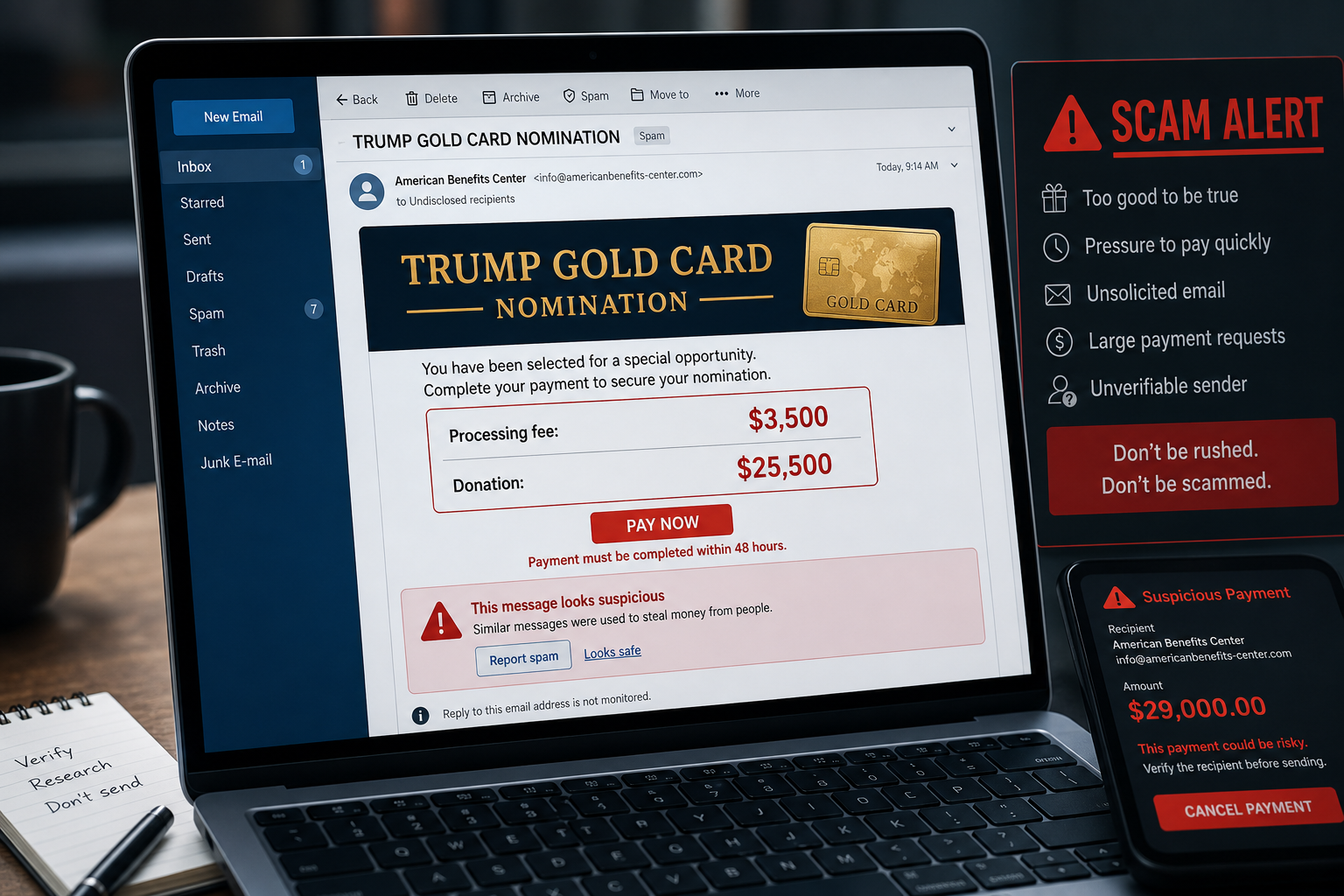
Trump Gold Card Nomination Email Scam Overview
The Trump Gold Card nomination email is a government-impersonation scam built around an expensive promise. The subject line may read “Immigration Nomination For Trump Gold Card”, while the body claims the recipient was selected by a special committee for a fast-track route to lawful permanent residence in the United States.
The sender presents the offer as selective and time-sensitive. It may describe an expedited path connected with EB-1 or EB-2 immigration categories, use official-sounding language and sign the message with the name of U.S. Commerce Secretary Howard Lutnick. Those details are meant to make a cold email feel like a formal government notice. The official whose name is used is not connected to the message.
The financial demand exposes the fraud. The email requests a non-refundable $3,500 processing fee and a supposedly voluntary donation of at least $25,500. Together, the first requested payments total $29,000. It may also mention a “standard donation” of $1,000,000 to make the lower amount appear more attainable or prestigious.
Real immigration decisions are not awarded through a surprise nomination email that asks a recipient to send a large fee and donation to an unverified party. A stranger cannot sell lawful permanent residence, guarantee a visa category or create a government selection by adding official names to a message. Paying the first amount is also unlikely to end the demands; advance-fee scammers commonly invent taxes, clearance charges and legal costs after a victim has already paid.
This warning concerns the fraudulent email and its payment instructions. It does not depend on whether a similarly named policy, proposal or public discussion exists. Scammers routinely borrow current political terms because recognition makes their story easier to believe. The only relevant question is whether the message, sender and payment request can be independently verified through official channels.
Anyone receiving this email should avoid replying, opening payment instructions or sending identity documents. Keep a copy for reporting, verify immigration matters through an official .gov website entered manually and speak with a licensed immigration attorney when professional advice is needed. No deadline inside the email should override those checks.
How the Trump Gold Card Email Scam Works
Step 1: A supposed nomination arrives without an application
The recipient is told that a committee selected or nominated them even though they never entered such a process. The surprise is framed as an honor, encouraging excitement before skepticism catches up.
A real agency should be able to identify the application, legal authority, case number and secure portal associated with a decision. Vague praise and an unexplained selection are not substitutes for those records.
Step 2: Government names create borrowed credibility
The email refers to the U.S. Department of Commerce and may use Howard Lutnick’s name as a signature. Scammers can type any official’s name into a message; doing so does not prove who sent it.
The actual sender domain, Reply-To address and payment beneficiary matter more than a logo or signature block. Even those technical details should be verified independently rather than through links or phone numbers supplied by the sender.
Step 3: Immigration language makes the promise feel specific
References to lawful permanent residence, expedited processing and EB-1 or EB-2 categories give the story a legal tone. The message may imply that paying will move the recipient to the front of a legitimate process.
Immigration eligibility is governed by law and documented procedures. A marketing-style email cannot create eligibility, waive required evidence or guarantee approval.
Step 4: The scam introduces a $3,500 processing fee
The first charge is labeled non-refundable, which prepares the victim to accept that the money cannot be recovered if the promised result never appears.
The label is chosen by the scammer. Calling a transfer a fee does not make it an official government charge, and the absence of a verifiable agency payment portal is a decisive warning.
Step 5: A $25,500 donation raises the total to $29,000
The donation is described as voluntary while being tied to the nomination or next step. That contradiction is deliberate: it sounds optional, yet the recipient is pressured to treat it as necessary.
Mentioning a much larger $1,000,000 standard donation can anchor expectations and make $25,500 seem like a discounted route. It is psychological pricing, not proof of a real immigration program.
Step 6: Urgency pushes the victim toward payment
The sender asks for immediate confirmation and warns that the selection is limited. The goal is to prevent the recipient from contacting an agency, attorney, bank or trusted relative.
Once money is sent, the same group may request passport scans, tax payments, background-check fees or banking details. Each new step increases both financial loss and identity-theft risk.
Red Flags That Expose the Fake Nomination
- You are supposedly selected for an immigration benefit you never applied for.
- The message combines a government-sounding processing fee with a private donation.
- The first requested payments total $29,000 and are called non-refundable.
- A real official’s name is used as decoration instead of providing a verifiable case record.
- The sender pressures you to confirm or pay before you can investigate.
- The promise suggests that money can guarantee or accelerate a legal immigration outcome.
- Payment instructions do not lead to a government portal reached independently through a .gov website.
One red flag is enough to stop and verify. Here, the unsolicited selection, enormous payment and unverifiable authority all point in the same direction: the email is designed to collect money, not process immigration.
What to Do If You Received the Email
- Do not reply, click payment links, call numbers in the message or open unexpected attachments.
- Do not send a passport, driver’s license, tax form, bank statement or proof of address.
- Visit the relevant U.S. government website by typing its address yourself; do not use the email’s links.
- Mark the message as phishing so the mail provider can block related campaigns.
- Preserve the sender address, full headers and payment instructions if you plan to file a report.
- Warn colleagues or relatives if the message reached a shared, business or family mailbox.
What to Do If You Paid or Shared Personal Information
Contact the bank, card issuer, wire service or cryptocurrency platform immediately. State clearly that the transaction resulted from impersonation fraud and ask whether it can be stopped, recalled or flagged. Speed matters, although recovery cannot be guaranteed.
- Change any password entered through the scam and sign out other sessions.
- Replace reused passwords on email, banking and government-service accounts.
- Enable multi-factor authentication, preferably with an authenticator app or security key.
- Place fraud alerts or credit freezes where available if identity documents were supplied.
- Watch bank, credit and email accounts for new payees, password resets or forwarding rules.
- Report the fraud to law enforcement and the appropriate government fraud-reporting service.
- Ignore anyone who promises guaranteed recovery for an upfront fee; recovery scams target recent victims.
If the sender has a passport copy or detailed biographical information, assume the material may be reused in other fraud. Keep records of reports and notify the issuing authority if replacement guidance is appropriate.
How to Verify a Government or Immigration Message Safely
Start from a known official website, not from the email. Locate the agency’s published telephone number or secure account portal and ask whether the case number and payment request exist. A search advertisement can also be fraudulent, so prefer an address you already know or one ending in the correct government domain.
A legitimate process should survive independent verification. If the sender objects to a check, insists on secrecy or changes the payment beneficiary, stop the conversation.
Frequently Asked Questions
Is the Trump Gold Card nomination email legitimate?
No. The email described here is an advance-fee scam. It uses government and immigration language to demand $3,500 plus at least $25,500 without a legitimate application or verifiable selection.
Can paying a donation secure U.S. permanent residence?
Not through an unsolicited email. Immigration benefits follow formal legal procedures; a private payment request cannot guarantee a visa category or permanent residence.
Why does the email use a real official’s name?
Identity borrowing makes a fabricated message look authoritative. A typed name, portrait or copied title is easy to reproduce and does not authenticate the sender.
The Bottom Line
The Trump Gold Card nomination email is not a shortcut into a government immigration program. It is a direct $29,000 advance-fee demand wrapped in political branding and official-sounding language.
Do not pay, do not send identity documents and do not let the email’s deadline control the decision. Verify through official channels that you reach independently, then report and delete the message.
Here are signs that this email is a scam, even though it looks like it comes from a company you know — and even uses the company’s logo in the header:- A generic greeting is used in place of a name (eg. “customer,” “account holder,” or “dear”).
- The sender’s email address is not associated with a legitimate domain name
- The email invites you to click on a link to resolve an issue. Most reputable organizations will not ask users to disclose sensitive information (e.g. credit card numbers) by clicking on a link.
- There is a time limit or uncharacteristic sense of urgency
- Poor grammar, spelling, and sentence structure may hint that an email is not from a reputable source.
