

The WBD Global Streaming job scam text is a fake recruitment message that claims to offer remote work, daily pay, paid training, and a large bonus after a short trial period.
The message looks simple, friendly, and low pressure at first. But behind the polished job offer is a common online employment scam designed to move victims away from normal communication channels and into a private chat where scammers can manipulate them.
This article explains how the scam works, why the message is suspicious, what the scammers are likely trying to do, and what steps you should take if you received or responded to one of these texts.
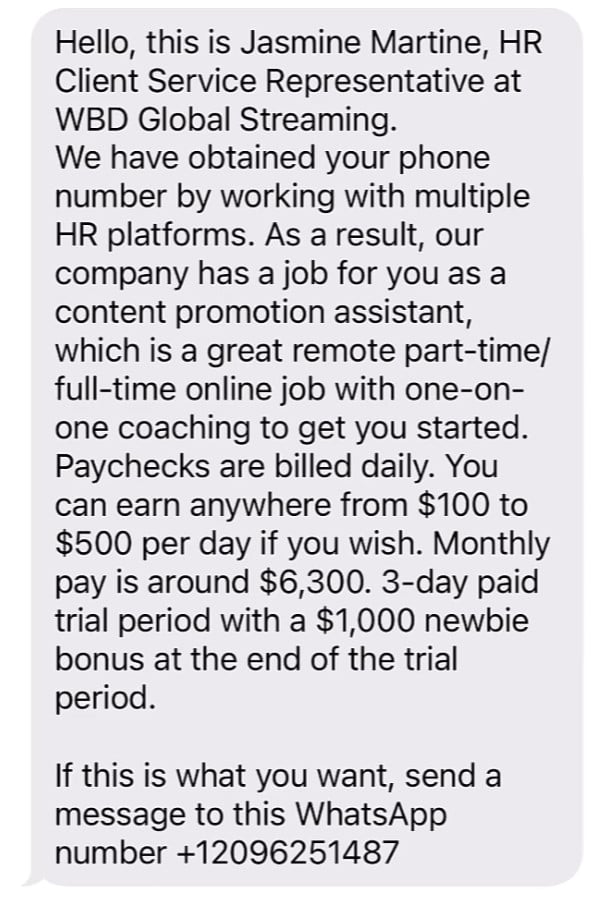
Scam Overview
The WBD Global Streaming job scam begins with an unsolicited text message from someone claiming to be an HR or client service representative. In the example shown, the sender introduces herself as “Jasmine Martine,” says she works for “WBD Global Streaming,” and claims the company obtained the recipient’s phone number through “multiple HR platforms.”
The message then presents a remote job opportunity as a “content promotion assistant.” It promises flexible part-time or full-time online work, one-on-one coaching, daily pay, and earnings between $100 and $500 per day. It also claims that monthly pay is around $6,300 and that new workers can receive a $1,000 bonus after a 3-day paid trial.
The final instruction is to contact a WhatsApp number.
That final step is important. Scammers often use text messages only as the first hook. Their real goal is to get the target onto WhatsApp, Telegram, Signal, or another private messaging app where they can continue the scam with fewer restrictions, less platform monitoring, and more direct psychological pressure.
At first glance, the message may look like a normal recruiter outreach. Many people are used to receiving job alerts, staffing messages, and remote work offers. The scam uses that familiarity to make the text feel believable.
But when you look closely, the warning signs are clear.
The job offer is vague. The company name sounds official, but the message does not include a real corporate email address, job posting link, recruiter profile, application portal, or verifiable hiring process. The sender does not explain what “content promotion assistant” means in practical terms. There is no mention of required experience, interview steps, employment documents, tax forms, or a formal contract.
Instead, the message focuses heavily on money.
That is one of the biggest red flags. Legitimate employers may mention salary ranges, but they do not usually promise easy daily earnings of $100 to $500 through a random text message. They also do not normally offer a $1,000 “newbie bonus” after only three days to someone they have never interviewed.
The scam is built around emotional triggers:
- Easy remote work
- Fast daily pay
- High income with little detail
- Flexible full-time or part-time options
- Paid trial period
- Coaching for beginners
- A bonus that creates excitement
- A quick move to WhatsApp
These details are not accidental. They are designed to make the opportunity feel low risk and high reward.
The fake job may be connected to a broader type of fraud known as a task scam or fake remote job scam. In these scams, victims are told they can earn money by completing simple online tasks such as liking videos, rating products, promoting content, reviewing media, clicking buttons, optimizing apps, or helping “boost” online platforms.
At first, the victim may even see small fake earnings appear inside a dashboard or chat system. Some scammers pay a tiny amount early in the process to build trust. Then the scam changes. The victim is asked to deposit money, recharge an account, pay a fee, unlock commissions, complete higher-value tasks, or cover a negative balance before withdrawing earnings.
That is where the damage begins.
The name “WBD Global Streaming” may be used to create a false connection to well-known entertainment, media, or streaming companies. Scammers often borrow words that sound corporate and familiar because they know people are more likely to trust a brand that resembles something legitimate.
This does not mean the real company is involved. In most cases, scammers simply abuse familiar names, abbreviations, or industry terms to make their fake job pitch sound credible.
A real employer will not hire you through a random text and then tell you to contact a WhatsApp number for a high-paying remote role. A real company will use official recruiting channels, proper documentation, secure application systems, and professional email domains.
The WBD Global Streaming job scam text is not a real job offer. It is a recruitment lure.
Its purpose is to get you interested, make you respond, and move you into a longer conversation where the scammer can extract money, personal information, or both.
How The Scam Works
1. The Scam Starts With an Unsolicited Text
The first contact usually comes through SMS, iMessage, WhatsApp, or another messaging platform. The message often starts with a friendly greeting and a professional-sounding introduction.
In this case, the scammer writes:
“Hello, this is Jasmine Martine, HR Client Service Representative at WBD Global Streaming.”
This creates a quick impression of legitimacy. The sender gives a name, a job title, and a company name. Many victims do not stop to verify whether any of those details are real.
The text then explains why the recipient is being contacted. It claims the company obtained the phone number through “multiple HR platforms.”
That line is meant to answer the obvious question: “How did they get my number?”
But the explanation is vague. It does not name the HR platforms. It does not mention a job board account, resume submission, or application history. It simply gives a broad answer that sounds plausible enough to keep the conversation moving.
This is a common scam technique. When scammers know a message might feel suspicious, they include a quick explanation to reduce doubt.
2. The Fake Job Is Described in Broad, Attractive Terms
The message claims the company has a job for the recipient as a “content promotion assistant.”
This job title is intentionally vague. It sounds modern and digital, but it does not explain much. A victim might imagine the work involves social media, streaming content, marketing, reviews, or simple online engagement.
That vagueness helps the scammer. If the job is not clearly defined, the scammer can later describe almost any task as part of the role.
Fake job scams often use titles such as:
- Content promotion assistant
- App optimization assistant
- Online order assistant
- Product review agent
- Data assistant
- Digital marketing assistant
- Streaming platform promoter
- Remote task specialist
- Media rating assistant
- E-commerce optimization worker
These titles sound professional, but they often hide the real structure of the scam.
The work is usually presented as easy, repetitive, and beginner-friendly. The scammer may say the victim only needs a phone, a few minutes per day, and a willingness to follow instructions.
That makes the offer attractive to people who need flexible income, are between jobs, want remote work, or are looking for a side hustle.
3. The Message Promises Unrealistic Pay
The WBD Global Streaming scam text promises earnings from $100 to $500 per day and around $6,300 per month.
This is one of the clearest warning signs.
Legitimate remote jobs can pay well, but real employers do not usually offer high daily pay to strangers through a text message without an application, interview, skill review, tax paperwork, or employment contract.
The promised pay is designed to trigger excitement. It makes the recipient think:
- “This could help with bills.”
- “Maybe I can do this part time.”
- “What if this is real?”
- “There is no harm in asking for more information.”
That last thought is what scammers rely on. They do not need the victim to fully believe the offer right away. They only need the victim to respond.
Once the conversation begins, the scammer has more opportunities to build trust.
4. The Fake Recruiter Uses a Trial Period and Bonus to Lower Resistance
The message claims there is a 3-day paid trial period with a $1,000 newbie bonus at the end.
This detail is especially manipulative.
A trial period makes the offer feel less risky. It suggests the recipient can test the job before committing. The $1,000 bonus creates a strong incentive to continue.
Scammers often use fake bonuses to keep victims engaged long enough to reach the payment stage of the scam. The victim may be told they are close to qualifying, but they need to complete a final task, deposit money, pay a fee, or upgrade an account before the bonus can be released.
The bonus becomes a trap. Once the victim believes they have earned it, they may be more willing to pay money to unlock it.
5. The Victim Is Moved to WhatsApp
The text instructs the recipient to message a WhatsApp number.
This is a major red flag.
Real recruiters may use phone calls, emails, video interviews, and applicant tracking systems. They do not normally direct random candidates to WhatsApp as the main hiring channel for a high-paying remote role.
Scammers prefer WhatsApp because it allows fast, direct communication. It also helps them avoid detection on platforms where job scams are more actively monitored.
Once the victim moves to WhatsApp, the scammer may send:
- A longer job explanation
- Fake company details
- Screenshots of fake earnings
- Testimonials from supposed workers
- Links to fake portals
- Instructions for completing tasks
- Payment or crypto wallet instructions
- Pressure to act quickly
The WhatsApp conversation also feels personal. The victim may think they are talking to a real recruiter or trainer. That one-on-one interaction is part of the manipulation.
6. The Scammer Explains the “Tasks”
After the victim responds, the scammer usually describes simple tasks. These may involve content promotion, streaming engagement, product ranking, app optimization, video liking, platform rating, or account boosting.
The scammer may claim the company works with streaming platforms, advertisers, merchants, or digital content providers. The victim is told that completing small actions helps improve visibility, rankings, traffic, or engagement.
The tasks may sound harmless, such as:
- Clicking a button
- Liking content
- Rating videos
- Submitting reviews
- Promoting streaming titles
- Completing sets of online tasks
- Confirming orders
- Boosting digital products
The victim may be shown a fake dashboard where earnings increase after each action. This makes the scam feel real because the numbers appear to grow.
But those earnings are not real wages. They are part of the illusion.
7. Small Early Payments May Be Used to Build Trust
Some job scammers send a small payment early in the process. It may be $5, $10, $20, or another modest amount. The purpose is not generosity. It is bait.
Once a victim receives a small payment, the scam suddenly feels more legitimate. The victim may think:
“They actually paid me, so it must be real.”
That trust can make the victim more likely to deposit a larger amount later.
This is how many task scams escalate. The scammer gives a small reward, then introduces larger tasks, bigger commissions, and supposed withdrawal rules.
The victim is slowly trained to believe that payments and deposits are part of the system.
8. The Scam Turns Into a Deposit or “Recharge” Scheme
At some point, the scammer tells the victim they need to deposit money.
The reason may vary. They might say the victim needs to:
- Recharge their work account
- Unlock a higher commission level
- Complete a task set
- Cover a negative balance
- Verify their account
- Pay taxes or processing fees
- Upgrade to VIP status
- Release the $1,000 bonus
- Withdraw accumulated earnings
- Finish the trial period
This is the core of the scam.
A real employer pays workers. It does not require workers to send money in order to receive wages.
If a job asks you to pay before you can get paid, that is a serious warning sign.
Scammers may request payment through cryptocurrency, Zelle, Cash App, gift cards, wire transfers, or other hard-to-reverse methods. They may also ask for screenshots as proof of payment.
Once the victim pays, the scammer often invents another problem. The account may still be locked. The withdrawal may fail. A tax fee may appear. A larger task may need to be completed.
The requests continue until the victim runs out of money or refuses to pay more.
9. Personal Information May Also Be Collected
Even if the victim does not send money, responding to the scam can still create risk.
The scammers may ask for personal details under the excuse of registration, payroll setup, tax processing, or identity verification.
They may request:
- Full name
- Address
- Date of birth
- Email address
- Bank details
- Payment app usernames
- Driver’s license photo
- Passport image
- Social Security number
- Selfie verification
- Screenshots of accounts
This information can be misused for identity theft, account takeover attempts, future phishing attacks, or opening accounts in the victim’s name.
Fake job scams are especially dangerous because people expect legitimate employers to ask for some personal information. Scammers exploit that expectation.
A real employer may eventually need tax and identity documents, but only after a legitimate hiring process through verified company channels. A stranger on WhatsApp should never receive sensitive documents.
10. The Victim Is Pressured to Keep Going
Once money is involved, scammers often use pressure tactics.
They may say the victim is close to finishing the task cycle. They may claim the account will be frozen if payment is not made quickly. They may warn that the bonus will expire. They may pretend a manager has approved a special exception.
Common pressure lines include:
- “You only need to complete one more task.”
- “Your withdrawal is pending.”
- “The system requires a recharge.”
- “You will lose your commission if you stop now.”
- “Your account has a negative balance.”
- “This is company policy.”
- “Everyone completes this step.”
- “You must pay today.”
These lines are designed to create panic and prevent clear thinking.
The scammer wants the victim focused on recovering the money already shown in the fake account. This is called sunk cost pressure. The more someone has already invested, the harder it becomes to walk away.
11. The Scammers Disappear or Keep Demanding More
Eventually, the victim realizes they cannot withdraw the promised money.
At that point, one of two things usually happens.
The scammers disappear, block the victim, and shut down the conversation.
Or they keep demanding more payments, claiming each new payment is the final requirement before withdrawal.
In some cases, victims are later contacted by a second scammer pretending to be a recovery agent, investigator, lawyer, or crypto tracing expert. That person claims they can recover the lost money for a fee.
This is another scam.
Legitimate recovery options exist, such as contacting your bank, card provider, payment app, or law enforcement. But anyone who randomly contacts you and promises guaranteed recovery for an upfront fee should not be trusted.
What To Do If You Have Fallen Victim to This Scam
1. Stop Communicating With the Scammer
Do not continue the conversation. Do not argue, explain, threaten, or ask for your money back through the same chat.
Scammers use continued communication to pressure victims into sending more money. They may pretend there is still a way to release your earnings, but that is usually another tactic to keep you paying.
Block the number after saving evidence.
2. Do Not Send More Money
If you already paid, the scammer may claim one more payment will fix the issue. Do not believe this.
Do not pay:
- Withdrawal fees
- Tax fees
- Account unlock fees
- Recharge amounts
- Verification deposits
- Bonus release fees
- Recovery fees
A real employer will not require these payments.
3. Save All Evidence
Before deleting anything, collect proof of what happened.
Save:
- Screenshots of text messages
- WhatsApp conversations
- Phone numbers used
- Names and fake recruiter identities
- Website links
- Payment receipts
- Crypto wallet addresses
- Bank transfer records
- Email addresses
- Fake dashboards
- Any instructions you received
This evidence can help banks, payment platforms, law enforcement, and fraud reporting agencies review your case.
4. Contact Your Bank or Payment Provider Immediately
If you sent money through a bank transfer, debit card, credit card, Zelle, Cash App, PayPal, Venmo, or another payment service, contact the provider as soon as possible.
Explain that you were targeted by a fake job scam.
Ask whether they can:
- Reverse or dispute the transaction
- Freeze pending transfers
- Block future payments
- Secure your account
- Issue a new card
- Monitor suspicious activity
Speed matters. Some transfers cannot be reversed, but reporting quickly gives you the best chance.
5. Secure Your Accounts
If you shared personal information, payment details, login credentials, or screenshots, assume your accounts may be at risk.
Take these steps:
- Change passwords for important accounts.
- Turn on two-factor authentication.
- Check email forwarding rules and recovery settings.
- Review bank and payment app activity.
- Remove unknown devices from your accounts.
- Watch for password reset emails you did not request.
- Use strong, unique passwords for each account.
Pay special attention to your email account. If scammers gain access to your email, they may use it to reset passwords for other services.
6. Report the Scam Text
Report the message to your phone carrier by forwarding the scam text to 7726 if you are in the United States. You can also report the WhatsApp account inside the app.
You should also consider reporting the scam to:
- The Federal Trade Commission at ReportFraud.ftc.gov
- The FBI Internet Crime Complaint Center at IC3.gov
- Your local police department
- Your state attorney general
- The platform used for payment
- The real company being impersonated, if applicable
Reports help authorities identify patterns, track scam infrastructure, and warn other people.
7. Place a Fraud Alert or Credit Freeze if You Shared Sensitive Information
If you shared your Social Security number, driver’s license, passport, banking details, or other sensitive personal information, take identity protection steps.
In the United States, you can place a fraud alert or credit freeze with the major credit bureaus. A credit freeze helps prevent new accounts from being opened in your name without extra verification.
Also monitor your credit reports and financial accounts for unfamiliar activity.
8. Watch Out for Recovery Scams
After a job scam, victims are often targeted again.
Someone may contact you claiming they can recover your lost money, trace the scammers, unlock crypto funds, or reverse a payment. They may ask for an upfront fee.
Be very careful. Most recovery messages are scams.
Do not trust anyone who:
- Guarantees recovery
- Requests payment before helping
- Contacts you out of nowhere
- Claims to be a hacker
- Asks for remote access to your device
- Wants your wallet seed phrase
- Says they have inside access to funds
Use official reporting channels and your financial institution instead.
9. Warn Others Who May Receive the Same Text
If you received this message, others probably did too. Warn friends, family members, coworkers, and online communities.
Many people respond to fake job texts because they are actively looking for work or extra income. A simple warning can prevent someone from losing money.
You can tell them:
- Do not contact the WhatsApp number.
- Do not send personal documents.
- Do not pay any fee to get paid.
- Verify jobs through official company websites only.
- Be skeptical of high-paying remote jobs sent by random text.
10. Use Safer Job Search Habits Going Forward
When reviewing remote job offers, slow down and verify before responding.
A legitimate job should usually include:
- A real company website
- An official job posting
- A professional email domain
- A clear job description
- A normal interview process
- Written employment terms
- No upfront payment requirement
- No pressure to move to WhatsApp immediately
Search the company name separately. Do not use only links sent by the recruiter. Visit the official website yourself and look for the careers page.
If the job is real, you should be able to verify it through official channels.
The Bottom Line
The WBD Global Streaming job scam text is not a legitimate employment offer. It is a fake remote job pitch built around vague work, unrealistic pay, a $1,000 bonus, and a request to continue on WhatsApp.
The message is designed to make people curious enough to respond. Once the conversation moves forward, the scam may turn into a task scam, deposit scheme, identity theft attempt, or payment fraud.
The safest response is simple: do not reply, do not contact the WhatsApp number, and do not share personal or financial information.
Real employers do not randomly text strangers with high-paying remote jobs and ask them to move to WhatsApp. If a job promises easy money, daily pay, and a large bonus with almost no details, treat it as suspicious until verified through official company channels.
FAQ: WBD Global Streaming Job Scam Texts
Is the WBD Global Streaming job text real?
No. The message has multiple signs of a fake job scam, including an unsolicited offer, vague job details, unrealistic pay, a $1,000 “newbie bonus,” and a request to continue on WhatsApp.
What is the WBD Global Streaming job scam?
It is a fake remote job text that pretends to offer work as a “content promotion assistant.” The goal is usually to move victims to WhatsApp, build trust, then steal money or personal information through a fake task-based job scheme.
Why did I receive this text?
Your number may have been scraped from data leaks, public profiles, job boards, marketing lists, or random bulk messaging tools. The claim that they got your number through “multiple HR platforms” is likely just a vague excuse.
Is WBD Global Streaming a real company?
The text uses a name that sounds corporate and streaming-related, but that does not make the job offer real. Scammers often use names that resemble legitimate media or entertainment brands to appear trustworthy.
Why do they ask me to message them on WhatsApp?
Scammers use WhatsApp because it is private, fast, and harder for job platforms or phone carriers to monitor. Once you move there, they can pressure you directly and send fake links, payment instructions, or screenshots of supposed earnings.
What happens if I reply?
Replying may lead to more messages from the scammer. They may explain the “job,” ask you to complete simple tasks, request personal information, or eventually tell you to deposit money before you can withdraw your fake earnings.
Can I really earn $100 to $500 per day from this job?
Almost certainly not. That income claim is bait. Fake job scams often promise high daily pay for easy remote tasks to make victims respond quickly without verifying the offer.
What should I do if I already sent money?
Stop communicating with the scammer, save all evidence, and contact your bank or payment provider immediately. Report the scam to your carrier, WhatsApp, the FTC, IC3, and local authorities if money or personal data was involved.
What if I shared my personal information?
Change passwords, enable two-factor authentication, monitor bank accounts, and consider placing a fraud alert or credit freeze if you shared sensitive documents or identity details.
How can I tell if a remote job text is a scam?
Be cautious if the message is unsolicited, promises unusually high pay, gives vague job details, asks you to use WhatsApp, offers a bonus before any real interview, or requires you to pay money to receive wages.








