

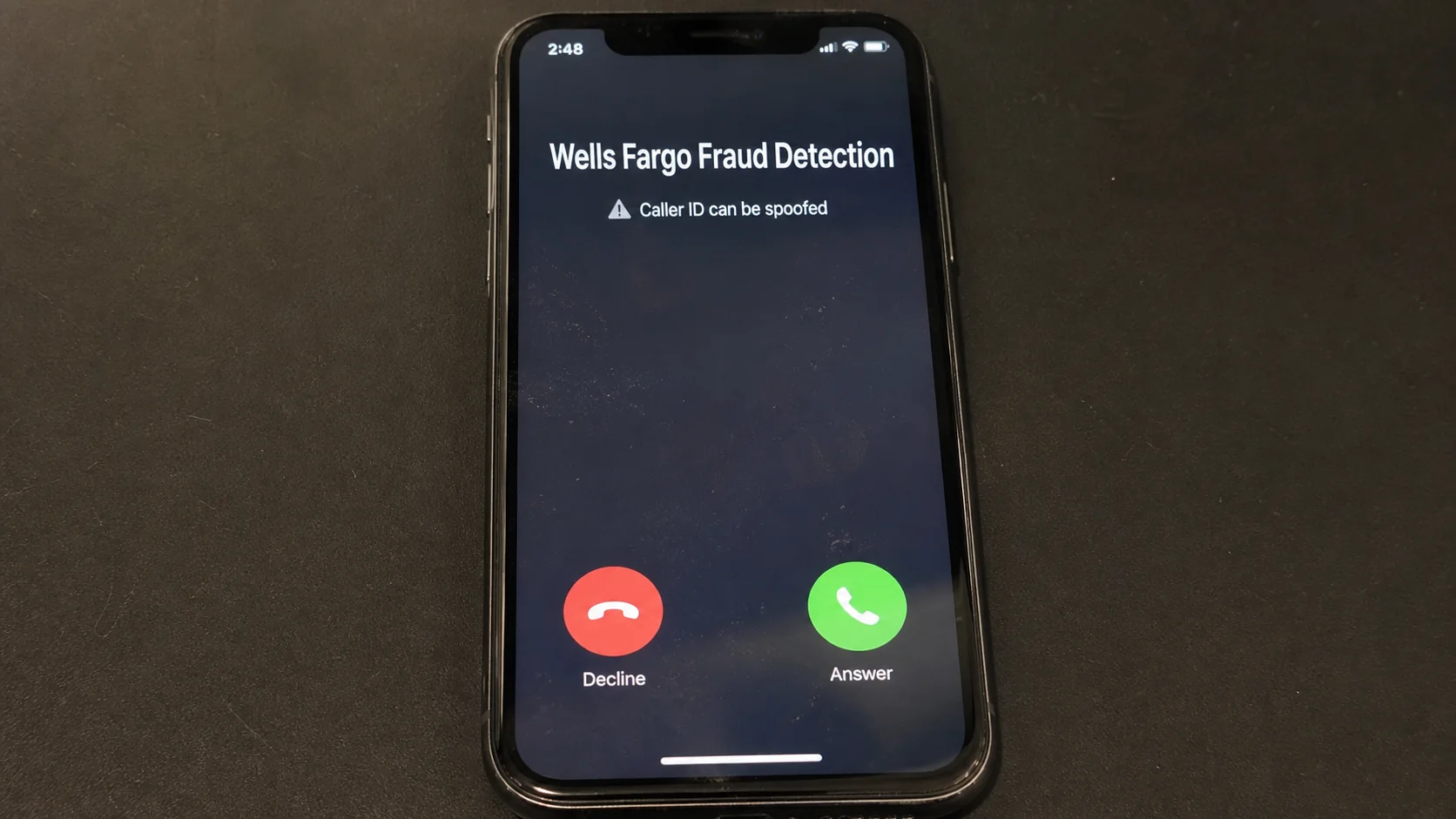
The call appears to answer questions only a real bank should know. The caller can name recent transactions, confirm personal details, and point to a Wells Fargo number glowing on the screen.
Then one instruction turns the reassuring conversation into something else. The moment that exposes the Wells Fargo scam call is easy to rationalize because every earlier detail feels genuine.
Overview
The caller arrives with enough real information to sound official
A recent consumer report described a call that appeared to come from Wells Fargo fraud detection. According to the account, the caller knew card information, recent transactions, and the victim’s home address. The conversation began with supposed attempts to use the victim’s card.
That knowledge is persuasive, but it is not proof of employment. Personal and transaction data can come from phishing, malware, compromised merchant accounts, stolen statements, prior support scams, data brokers, or breaches. Caller ID can also be spoofed to display a trusted bank name.
The victim is sent to a real branch to withdraw $5,000
The caller did not ask for gift cards or cryptocurrency. Instead, the victim was told to visit a Wells Fargo branch and withdraw $5,000 in cash from a teller. The scammer reportedly stayed on the call and warned that local bank employees might be involved in the supposed fraud.
That warning neutralized the safest source of help. If the victim questioned the withdrawal, any branch employee who challenged the story could be recast as part of the threat. Isolation is a stronger warning than the payment method itself.
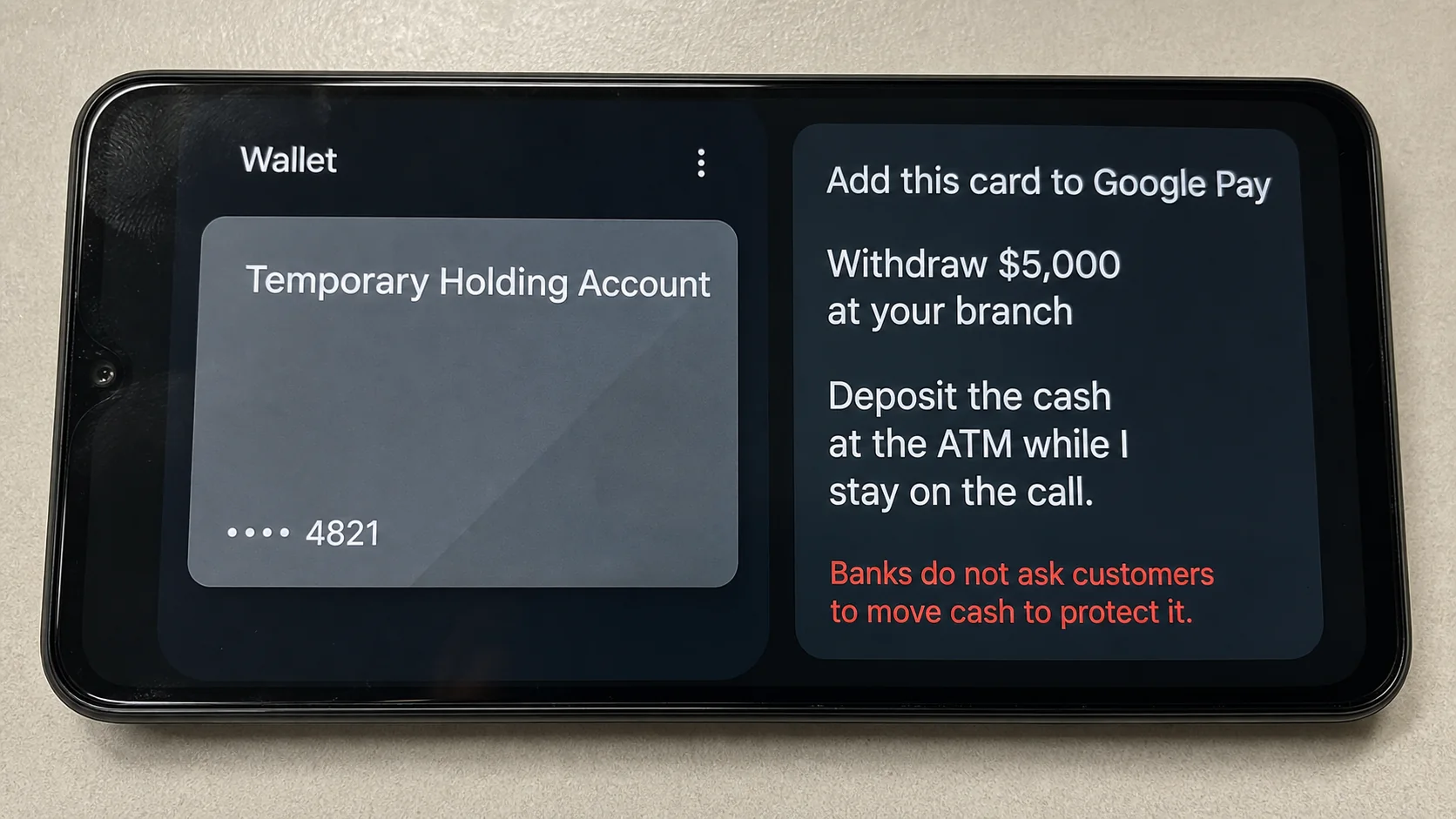
A card in Google Pay becomes a fake “temporary holding account”
The victim was instructed to add a new payment card to Google Pay and was told it represented a temporary holding account. At an ATM, the victim reportedly scanned that wallet card and deposited the withdrawn cash.
The caller later said the funds would be “reformatted” to the victim’s credentials and instructed the victim to remove the card.
There is no legitimate consumer banking process in which Wells Fargo protects funds by having a customer withdraw cash, add an unfamiliar card to a mobile wallet, and deposit money through that card. Wells Fargo explicitly says it will never ask customers to move money, withdraw cash, or send funds to “protect” an account.
The story is a firsthand consumer report, not an official finding about liability or reimbursement. The reported pattern nevertheless contains decisive scam signs:
- An unexpected fraud call relies on spoofed caller ID.
- The caller uses accurate personal details as proof of authority.
- The victim is told to remain on the line while taking action.
- Bank staff are described as possible insiders.
- The victim must withdraw a large amount of cash.
- An unfamiliar card is added to a mobile wallet.
- The phrase “temporary holding account” replaces normal account documentation.
- The caller promises to transform or restore the funds later.
The One Rule That Breaks the Entire Story
Wells Fargo’s own scam guidance is direct: the bank will never ask a customer to move or send money to anyone, including the customer, to reverse a transfer, receive a refund, protect funds, or fix a problem. It also says employees will not direct a customer to withdraw cash.
A real fraud team can freeze a card, replace it, restrict an account, investigate transactions, or make internal corrections. It does not need a customer to convert account funds into cash and then route that cash through a newly supplied payment card.
The phrase “temporary holding account” is designed to make an external destination sound like an internal bank tool. A legitimate account has an owner, institution, account agreement, disclosures, transaction history, and a way to access it independently. A nickname shown in a wallet proves none of those things.
Google Wallet stores supported payment cards for contactless transactions. Adding a card does not make it yours, does not create a Wells Fargo safeguard, and does not prove that the card is connected to your bank account. A wallet nickname can be chosen to make an unfamiliar card appear reassuring.
The ATM completes the illusion because it is a real banking machine. A victim may believe that any transaction accepted there must stay inside the bank. In reality, the destination depends on the card or account used to authenticate the deposit.
The safest response does not require analyzing every technical detail. If an unexpected caller tells you to withdraw, move, deposit, or send money for protection, end the call and contact the bank using the number on the back of your card or inside the official app.
How the Wells Fargo Fraud Call Scam Works
Step 1: The caller ID is made to look like Wells Fargo
The phone displays the bank name or a familiar support number. Spoofing changes what appears on the screen without proving where the call originated.
The operator may call at a stressful time, repeat the call, or transfer the victim between supposed departments. Hold music, case numbers, and professional language create the texture of a real support center.
Step 2: Real personal and transaction details establish trust
The caller mentions a home address, card digits, merchant name, recent purchase, or attempted charge. The victim concludes that only the bank could know those facts.
Scammers do not need a complete bank database. A few correct details can anchor a much larger invented story. They may also ask questions in a way that causes the victim to supply missing information while feeling that the caller already knew it.
Step 3: A hidden insider threat is invented
The caller claims that employees, branch staff, or another department may be involved. The victim is told not to mention the investigation, not to show the phone, and not to accept help.
This isolates the victim while creating an explanation for every contradiction. If a teller says the process is not legitimate, the scammer can say that reaction proves the teller is part of the case.
Step 4: The victim withdraws cash in person
The bank sees a customer requesting an authorized withdrawal. Unless the victim explains the call, branch staff may not know that an impersonator is directing the transaction in real time.
The scammer may coach the victim to say the cash is for a purchase, home project, or family matter. A cover story keeps the bank from identifying the withdrawal as possible exploitation.
Step 5: An unfamiliar card is added to the mobile wallet
The caller supplies card details and instructs the victim to add them to Google Pay or another wallet. A reassuring nickname such as “temporary holding account” is used to disguise ownership.
Card verification can make the process feel official. It only shows that the card was accepted for wallet use through whatever verification path the issuer allows. It does not confirm the caller’s identity or the victim’s ownership of the destination account.
Step 6: The cash is deposited through an ATM
The phone is tapped at a contactless ATM and the cash is accepted. The scammer stays on the line, supplies instructions, and prevents the victim from pausing to ask staff for help.
The money is now associated with the account represented by the wallet card. Once credited, it may be moved again, withdrawn, or split across other accounts.
Step 7: The card is removed and a restoration story begins
The caller says the deposit will be reformatted, secured, or returned under the victim’s credentials. Removing the unfamiliar card from the phone hides the most obvious clue and may make the wallet look normal again.
If the victim challenges the delay, the operator can request another fee, claim the investigation is confidential, or disappear. Any later contact promising recovery may be a second scam built from the same victim data.
Why Accurate Account Details Do Not Authenticate the Caller
Transaction alerts can leak through compromised email accounts, notification previews, malware, stolen mail, merchant breaches, or unauthorized online banking access. A scammer who knows one real purchase can use it to introduce several fake ones.
Card information also circulates outside banks. A merchant receipt may expose the last digits, while a stolen card record can include a name, address, expiration date, and phone number. Data brokers and breached accounts add background details that make the call sound researched.
The operator may use confirmation questions to collect new data. “You still live at this address, correct?” and “Was the charge on the card ending in 42?” invite the victim to correct or complete the record.
One-time codes are another trap. A real code may arrive from the bank because the scammer is attempting a login or card enrollment at that moment. The authenticity of the text message does not make the caller authentic.
Wells Fargo says it will not initiate contact and ask for an online banking password, PIN, Social Security number, or one-time access code. A caller who asks for any of them should be disconnected immediately.
The correct verification method is an independent call. End the conversation, wait long enough for the line to clear, and dial the number printed on the physical card. Do not use a number supplied by the caller or shown in a follow-up text.
Company, Address, and Fulfillment Checks
The company name on caller ID is not identity proof
Wells Fargo is a real bank, but the use of its name belongs to the impersonator in this story. Caller ID, a logo, and correct account details cannot replace an independently initiated connection to the bank.
Ask the caller for nothing and provide nothing. A real case should remain visible when you sign in through the official app or call the verified number yourself.
The branch address does not make the instructions legitimate
Sending a victim to a genuine Wells Fargo branch is a psychological tactic. It surrounds the withdrawal with real signs, staff, receipts, cameras, and bank equipment.
The location proves only where the cash was withdrawn. It does not validate the person who directed the withdrawal or the destination used later.
The wallet card identifies the destination account
Record the last digits, issuer, wallet enrollment notice, and any verification messages connected to the added card. Do not publish a full card number or attempt to use the card again.
Removing the card from the phone does not erase the underlying transaction. Google Wallet account records, device history, ATM receipts, and bank logs may help investigators trace what happened.
The ATM receipt is the critical transaction record
Preserve the receipt, ATM address, time, deposit amount, transaction identifier, and any screen photo. Ask the bank to retain surveillance and terminal logs as soon as possible because retention periods vary.
Describe the payment path precisely: cash withdrawn from one account, then deposited through an unfamiliar wallet card under an impersonator’s direction. That is clearer than calling the event only an unauthorized debit.
Why the Victim May Face a Difficult Claim
The consumer report said the initial claim was denied after ten business days. That outcome cannot be generalized to every case, and the report does not contain the bank’s complete investigation file.
Scam claims can be difficult when a customer personally authorizes a cash withdrawal and then performs the deposit. The bank may distinguish those actions from an account takeover that transfers money without the customer’s participation.
That distinction does not make the impersonation harmless. It explains why immediate reporting, precise documentation, and the right claim description matter. A cash-withdrawal scam can involve different facts and protections from ordinary card fraud.
Ask for the decision in writing, the reason used, and the evidence reviewed. Confirm whether the bank opened a scam claim, an ATM-deposit investigation, an account-takeover review, or another case type.
If important facts were missed, use the bank’s appeal or complaint process and supply the call log, ATM record, wallet-card information, police report, and timeline. You may also contact the appropriate consumer regulator or a qualified attorney for advice about your specific situation.
Build one timeline before making follow-up calls. Include when the impersonator called, which details were mentioned, when the branch withdrawal occurred, when the wallet card was added, and the exact ATM deposit time. A consistent chronology helps separate the scam from ordinary account activity.
Ask the mobile carrier for a call record and preserve voicemail without calling the displayed number back. The number may be spoofed, but the timing and duration can support the account of continuous coaching during the withdrawal and deposit.
Keep notes of every bank conversation, including the date, department, case number, and documents requested. Do not secretly record calls where local law prohibits it. Written follow-up reduces confusion when a case moves between fraud, claims, branch, and ATM teams.
Do not accept guarantees from a recovery agent who approaches you online. Real professionals do not need remote access, a crypto deposit, a gift card, or another payment to “unlock” stolen funds.
What to Do if You Have Fallen Victim to This Scam
- Call Wells Fargo immediately through a verified channel. Use the number on your card or the official app. Explain that an impersonator directed a cash withdrawal and ATM deposit through an unfamiliar wallet card.
- Return to the branch if it is safe to do so. Ask for a manager or fraud specialist. Provide the time and teller transaction so the bank can preserve records and identify the withdrawal.
- Save the wallet and ATM evidence. Capture the card’s last digits, enrollment messages, device list, ATM receipt, location, time, and amount. Do not expose full account details in public posts.
- Secure online banking and email. Change passwords from a trusted device, sign out other sessions, enable strong two-step verification, and review contact information, linked devices, cards, and payees.
- Check the device for unwanted access. Remove remote-control apps you did not install intentionally. If the caller had device access or sent a download, run a full Malwarebytes scan and review accessibility permissions.
- Reduce exposure to follow-up links. AdGuard can block many known phishing and malicious advertising domains. It cannot identify a convincing voice caller or reverse a cash deposit, so independent bank verification remains essential.
- File official reports. Report the incident to local police, the FTC, and the FBI’s IC3 when appropriate. Give investigators the full payment path instead of only the spoofed phone number.
- Request and review the bank’s written decision. Ask what claim type was opened, why it was accepted or denied, what appeal route exists, and which documents are still needed. Seek qualified legal or regulatory guidance for disputed rights.
Frequently Asked Questions
Can Wells Fargo call about real fraud?
A bank may contact customers about suspicious activity. The safe response is still to end an unexpected call and reconnect through the number on the card or official app before discussing the account.
Can a scammer make caller ID say Wells Fargo?
Yes. Wells Fargo warns that scammers can spoof its name or number. Caller ID shows a label chosen by the phone network; it does not authenticate the caller.
What is a temporary holding account?
In this scam, the phrase is invented to make an external destination sound protective. Wells Fargo says it will not ask customers to move money to protect or fix an account.
Why would the scammer send someone to a real bank branch?
The real branch makes the process feel legitimate and converts account funds into cash under the victim’s authorization. The caller then controls where that cash is deposited.
Does adding a card to Google Wallet prove it belongs to me?
No. A wallet can store a supported card after the required verification, but that does not prove you own the underlying account or that a bank asked you to add it.
Will the bank always return money lost this way?
No outcome can be promised. Rights and investigations depend on the account, transaction path, timing, evidence, and applicable law. Report immediately, document everything, and request the decision and appeal options in writing.
The Bottom Line
The Wells Fargo fraud call scam turns real bank locations and real payment technology into props. The caller ID, branch, Google Wallet card, and ATM can all be genuine while the story connecting them is false.
No bank needs you to withdraw cash and redeposit it to keep it safe. End the call, keep control of your phone and money, and verify the alert through a channel you chose yourself.








