


The website wexfordadvisory-ltd.com looks like a polished crypto trading firm, so we opened it, read its code and compared every claim with the public registers.
Our verdict is that you should not deposit. Spain’s securities regulator lists the domain as a clone, and the home page demands a 14% fee to release funds.
Overview
What the Site Offers
We found a single-page trading site that sells smart trading based on data, automatic signals and adaptive strategies across cryptocurrencies, stocks, ETFs and bonds.
Three account tiers are offered: Silver from $200, Gold from $1,500 and Platinum from $5,000. Every open trading account button leads to a separate login portal.
Lower on the same page sits a notice titled Payment Conditions and Fund Regularization, which asks for a 14% payment split into three commissions before funds are released.
What the Checks Found
The Spanish regulator, the CNMV, lists wexfordadvisory-ltd.com as a clone dated October 19, 2026, and adds that it has no link to a registered Spanish investment fund.
The domain was registered on September 10, 2026, and the home page file was last modified 28 minutes later.
Nothing on the page names a license, an address or a company number.
The lead form and the login portal talk to a server on a second domain that was registered 95 minutes before the first one.
Two other brands use the same setup.
What We Could and Could Not Verify
Here is where the evidence stands after our checks:
- Verified by us: the regulator’s entries, the registration dates, the 14% notice, the account prices, the form code and the shared back end.
- Not found: a company name that matches the site, any license, a street address, a phone number, an email address or any mention of the fund.
- Not verified: where deposits go, whether anyone has withdrawn money, and who operates the site. We did not register, log in, pay or submit any form.
Our advice is not to deposit anything and not to pay any fee to release funds, and the sections below cover anyone who already did.
The Spanish Warning and the Real Wexford
We began with the lead that matters most, so we opened the CNMV’s public search for warned companies and typed the word Wexford.
The search returned two entries. The older one is dated October 19, 2026 and names the address wexfordadvisory-ltd.com and the name Wexford Advisory Ltd, both marked as a clone.
Its comment line states that the entity has no relation to Advisory GPS European Equity, FI, a fund registered in Spain as a harmonised investment fund under number 6070.
The second entry is dated November 10, 2026 and covers a different address, market.wexford-advisory.limited, also marked as a clone.
Its comment line names a branch of the broker XTB as the real firm.
So the same trading name has been flagged twice in three weeks, on two unrelated domains, and each time the regulator points to a different real firm.
We then opened the regulator’s own record for the fund. It shows official number 6070, registration on June 26, 2026 and the ISIN code ES0182754004.
The record names CaixaBank Asset Management as the manager and Cecabank as the depositary, so the fund is a real product run by established Spanish institutions.
The fund was registered 76 days before the Wexford domain appeared, and our search of the site’s code found no mention of the fund, Spain, the CNMV or either institution.
That is a gap we cannot close from the website alone.
The regulator’s entry links the clone to the fund, but the fund’s name is not on the pages we read.
Whoever used the fund’s name did so somewhere else, perhaps in a call, a message or a brochure, and the CNMV’s search page is where the entries can be checked.
The licensed fund and the institutions behind it look like the party whose name was borrowed. Nothing we found suggests that they run or profit from this site.
What We Saw at the Front Door
We captured the home page and read its code as plain text, without running anything, to see what a visitor meets before signing up.
The page title and footer both read Wexford Advisory Limited. The footer adds the word Inc., so the name carries both a British and an American company suffix.
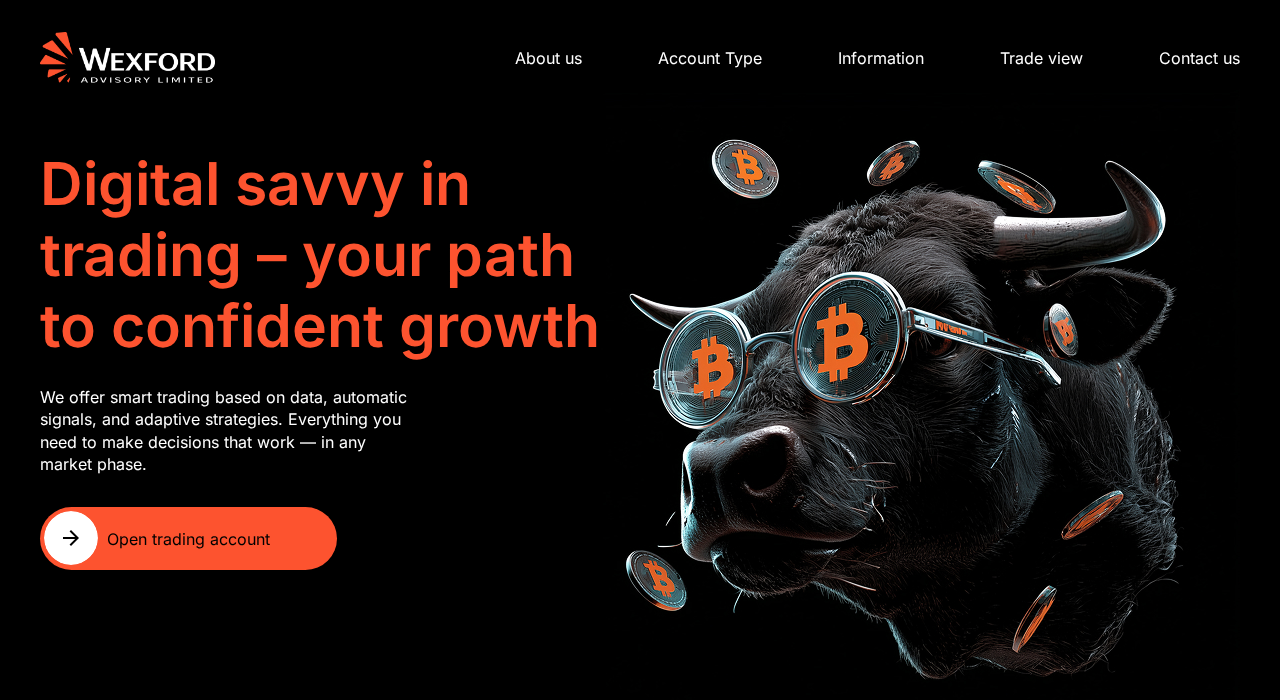
The headline promises digital savvy in trading and a path to confident growth. A black bull with Bitcoin glasses fills the right side of the screen.
The three feature cards promise data, not guesswork, adaptation to markets and 360 degree diversification. None of them gives a method, a track record or a risk warning.
We searched the page code for the words license, regulated, risk warning, address and registration number. None of them appears in the text a visitor can read.
The three account cards are the only concrete offer. Silver costs from $200 with a single listed feature, which is to start with minimal risk.
Gold, from $1,500, and Platinum, from $5,000, list the same three features: advanced tools, low spreads and high-volume trading.
Two tiers with identical features, priced 3.3 times apart, look like a nudge toward the larger deposit, since nothing explains what the extra $3,500 buys.
A table of six coins sits lower down.
In the code it reads live prices from a public exchange feed, and its Market cap column is fed with the number of trades, not a market value.
That number is then printed with the letter T after it, so the column can show a trade count as if it were trillions.
The error is small, but it tells us the page was assembled quickly from a template and nobody checked the finished numbers.
The 14% Fee on the Home Page
Between the account cards and the price table we found a block we had not expected, titled Payment Conditions and Fund Regularization.
It tells the reader that, as part of the processing of a file with CMC Markets, a full settlement of a 14% payment is needed, divided into three commissions.
The same block says the step is required to enable the complete release of the funds.
The three lines read 6% consulting fees, 4% banking service fees and 4$ exchange commissions.
The sum is 6 plus 4 plus 4, which gives 14%.
The last line is written with the $ sign, which is a typing slip, because $4 would not make the total 14%.
A small note limits the conditions to other types of projects and to clients who are not tax residents in Europe, such as those in the U.S. market.
We ran the numbers on the three tiers. On $200 the fee would be $28, on $1,500 it would be $210, and on $5,000 it would be $700.
On the largest tier that is $300 for consulting, $200 for banking and $200 for exchange, all due before the money is released.
The block also names CMC Markets, a firm that appears nowhere else on the site, and it talks about a file that a new visitor does not have.
That wording is the giveaway. The text is addressed to someone who already has money in a process, which means it is written for people who have been contacted before.
Regulated brokers disclose their charges in a fee schedule and take them from the account.
A demand to pay first so that your own money can be released is the pattern we associate with advance fee fraud.
We did not see how the notice is used in practice, so we cannot say who has been asked to pay it.
We can say that the page publishes it to every visitor.
A Site Built Within Half an Hour of Its Domain
We looked up the registration record of the domain in RDAP, the public registration database, and compared it with the file dates the web server reports.
The domain wexfordadvisory-ltd.com was registered on September 10, 2026 at 17:36 UTC through the registrar Tucows, and its name servers belong to Cloudflare.
The server reports that the home page was last modified at 18:04 UTC the same day.
That is 28 minutes after registration, which fits a site launched from a ready-made template.
The record is set to expire on September 10, 2027 and carries a lock against transfers and updates. The domain was 63 days old on the day of our checks.
The Internet Archive holds one snapshot from October 11, 2026.
It points to a script file with the same name as the one served today, and that name includes a content code, so the code has not changed since then.
The CNMV’s warning came 39 days after registration. The mail records for the domain point to a European mail host, so the operator set up email at once.
The calendar is the plainest check we ran. A firm that sells verified signals and stable long-term results had no track record to show on September 10, 2026.
The page offers no founding date, so the age is not a lie on the page. It is a fact a buyer of long-term trading services should weigh.
The Lead Form and the Shared Back End
The contact form at the bottom of the home page asks for a name, surname, email, country and phone number, and nothing else.
We read its code and did not submit it.
When a visitor presses send, the code posts those five fields to a server at simpl.pro-simp-pd.com, on a second domain that has no visible link to the brand.
The code also adds three fixed values that the visitor never sees: an amount of more 5000, a category label socarinvest and a message made of random characters.
So every contact is stored as a prospect with more than $5,000, whatever the visitor typed, and under a label that does not match the Wexford name.
The amount equals the entry price of the Platinum tier, which suggests that the form was built to feed a sales team with leads that look valuable.
We checked the second domain. RDAP shows that pro-simp-pd.com was registered on September 10, 2026 at 16:01 UTC, 95 minutes before wexfordadvisory-ltd.com, through the same registrar.
The same back end serves the login portal, so whoever registered the two domains did so within a single afternoon.
We then looked for other sites that call the same back-end domain. We found three, and we opened each one ourselves, reading the pages and their code as text.
The site monterra-capital-ltd.com was registered on November 4, 2026 through the same registrar.
Its home page carries the same headline, the same three account tiers and the same Binance price table.
Its form posts the same amount, the same socarinvest label and the same random message, and its login portal uses a subdomain of the same back-end domain.
The portal at portal.alpinainvestlimited.ltd serves the same Trading Platform page with the same stylesheet file and uses its own subdomain of that back-end domain.
Its public home page is a different design.
Monterra’s code contains no 14% notice, so that block is specific to the Wexford page, and its login portal key is spelled differently from its own domain name.
Shared code and a shared back end show a common setup. They do not prove that one person owns every site, and we draw no such conclusion.
Behind the Login Screen
We opened the login portal as a visitor would, read the page and its code as text and did not sign in, sign up or press any button.
The portal sits on a subdomain called panel and the page title is simply Trading Platform. The sign-in screen is headed WexfordAdvisory and asks for an email or mobile number.
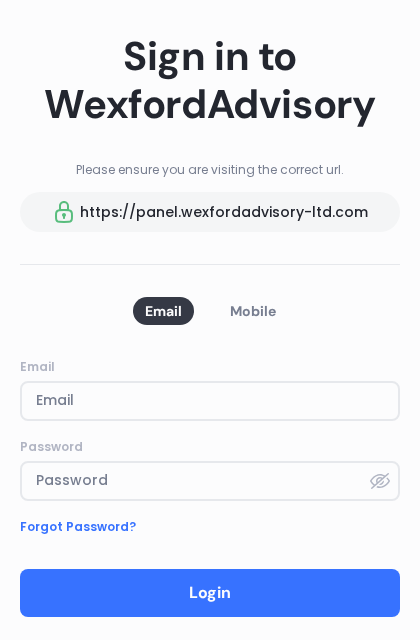
A line above the form tells visitors to make sure they are on the correct address.
That is advice any phishing kit could print, and it adds no proof of identity.
The portal code is a white-label application. A brand placeholder appears more than 200 times in its texts, and the interface ships in 21 languages.
The brand name WexfordAdvisory is only a setting that selects a logo folder. The same screen can be given another name in minutes, as the other two brands show.
The deposit code offers bank transfers with IBAN and SWIFT fields and crypto transfers with a deposit address and a QR code.
It also holds a message that reads: wallet for this deposit method is not set, please contact your agent or support team.
That string tells us the deposit wallet is assigned by a person, which fits a sales process run by agents and not an automated broker.
The withdrawal code holds a different message: withdrawal currently unavailable, please contact support. We could not see when a user would meet it, because the screens load only after login.
How the Wexford Advisory Pitch Works
Step 1: A polished page and a crypto look
The visitor lands on a dark page with orange headlines and a bull wearing Bitcoin glasses, which suggests technology and crypto expertise.
No license, address or company number is shown, so the page asks the visitor to trust the look.
Step 2: A contact form that creates a lead
The visitor is invited to open an account or leave a name, email, country and phone number.
Each submission is tagged as a prospect with more than $5,000, which gives a salesperson a reason to call.
Step 3: An agent takes over
From our reading of the portal code, deposit wallets and other settings are managed by an agent or by support, not by the visitor.
This is an inference from the portal’s own messages, since we did not log in or speak to anyone.
Step 4: A deposit by bank wire or crypto
The portal supports wire transfers and crypto deposits. A crypto transfer cannot be reversed once it is sent, and a wire is hard to recall after a few days.
The tiers start at $200 and rise to $5,000, which leaves room to ask for more after a small first payment.
Step 5: A fee before the money can leave
The home page already publishes a 14% settlement that must be paid to release funds, and the portal carries a withdrawal-unavailable message.
Together they fit a pattern in which a user who asks for money back is told to pay a fee first.
We did not see this happen, so it remains an inference.
Who Runs Wexford Advisory?
The company named in the documents
The page title, the logo and the footer name Wexford Advisory Limited, and the CNMV’s entry lists the clone as Wexford Advisory Ltd.
We looked for a company with that name.
The Companies House record for Wexford Advisory Limited shows number 13870799, incorporated on January 25, 2022, active, with a registered office in Ongar, Essex.
Its business code is 70229, management consultancy other than financial management, and it has filed accounts up to January 31, 2026.
We cannot tell whether this is the company that was imitated, or whether it knows about the site.
The name is the same, and nothing on the site gives a number we could match.
If it is the company in question, its own filing describes consultancy and not trading, so it is a victim of a borrowed name and not the operator.
Where the address and registration lead
The site gives no street address, phone number, email, registration number or license, so there is nothing on it that a registry could confirm or contradict.
We searched the financial register of the United Kingdom for a firm named wexford advisory on November 12, 2026, and it returned no results, which fits an unregulated site.
The only registration that matters is the one the CNMV shows for the fund, which lists the real manager and depositary, and none of that information appears on the clone.
The Ongar record is a plain company registration, and its business code describes consultancy, not investment services, so it gives no permission to hold client money.
Domain, platform and reviews
The domain is 63 days old, registered at Tucows and proxied by Cloudflare, with its mail records pointing to a European mail host.
The platform is a white-label portal with its own sibling brands, so the visible name is a skin on shared software.
We found no independent filing, registry entry or press article tied to this domain, and the page carries no tracking identifiers that would link it to other sites by itself.
Our link to the sister sites is the shared back-end domain and the identical form code, both of which we read directly.
What we could not confirm
We did not register, log in or pay, so we could not see the terms, the deposit addresses, the account statements or what happens when a user asks to withdraw.
We cannot say who operates the site, whether anyone has lost money, or whether the 14% notice has been used on anyone.
We did not contact the site or any of the firms named.
The third site that calls the same back-end domain could not be read because its server returned an error, and we did not work around it.
What to Do If You Contacted or Paid Wexford Advisory
-
Do not deposit. A site with no license, no address and a Spanish clone warning gives you nobody to hold responsible, so keep your money in a regulated account.
-
Never pay a release fee. A demand for 14% or any other upfront fee to free your own funds is a red flag, so stop paying and do not negotiate.
-
Check any firm yourself. Look the name up in your own regulator’s register and type the address by hand, because a clone can copy a logo and a company name.
-
Save the evidence. Keep screenshots, your account email, transaction hashes, wallet addresses, bank details and every message from anyone who called or wrote to you.
-
Call your bank at once. If you sent a wire, give the bank the transfer details and ask whether a recall is possible, since speed matters.
-
Dispute card payments. If a card was used, send your issuer a dispute letter as soon as you can and keep a copy.
-
Report it. File a report at ReportFraud.ftc.gov with the domain, the amounts and the payment details, and tell your national regulator too.
-
Ignore recovery offers. Anyone who contacts you offering to get your money back for a fee is running a second scam, so do not pay or share your documents.
Frequently Asked Questions
Is Wexford Advisory a scam?
We cannot prove what its operators intend, but a clone warning, a release fee and a missing company make it unsafe, and we would not trust it with money.
Is wexfordadvisory-ltd.com the UK company Wexford Advisory Limited?
We found a registered company with that exact name, but the site gives no number, address or license, so we cannot link the two.
Is the Advisory GPS European Equity fund involved?
The regulator’s entry names it as the real product the clone is unrelated to. It is a registered Spanish fund, and nothing suggests that it runs this site.
Should I pay the 14% to release my funds?
No. A genuine broker takes charges from the account and discloses them, so a demand to pay before you can withdraw is a warning sign.
Does the site share its setup with other sites?
Yes. Its form and login portal use a back-end domain that two other brands also use, and one of them has the same page design, plans and form code.
Where can I report it?
Report it to the fraud agency in your country, to your bank or card issuer, and to the CNMV in Spain, whose warning list names the domain.
The Bottom Line
Do not deposit at Wexford Advisory, leave your details on its form or pay any release fee. The domain is two months old and shows no license.
If you want to trade, choose a firm listed on your own regulator’s register and open its website by typing the address yourself, not through a link or a call.
If you already paid, stop paying, save every transaction detail, contact your bank or card issuer at once, report the domain and ignore recovery offers.

Join the discussion
0 commentsShare your experience or ask a question about this article.
Discussion
Start the conversation
Have a question or something useful to share? Add the first comment.