

“Three easy steps to make $500 per day” is the kind of promise that arrives at exactly the right moment for someone who needs flexible income. It replaces the messiness of a real job search with a clean page, a simple button, and an apparently immediate path to cash.
WorkATM.org used that promise while presenting itself as a work-from-home opportunity. The offer deserved scrutiny not because remote work is unusual, but because extraordinary daily income was promoted without the verifiable employer, duties, evidence, and compensation terms a real opportunity should provide.
Overview
What WorkATM.org claimed
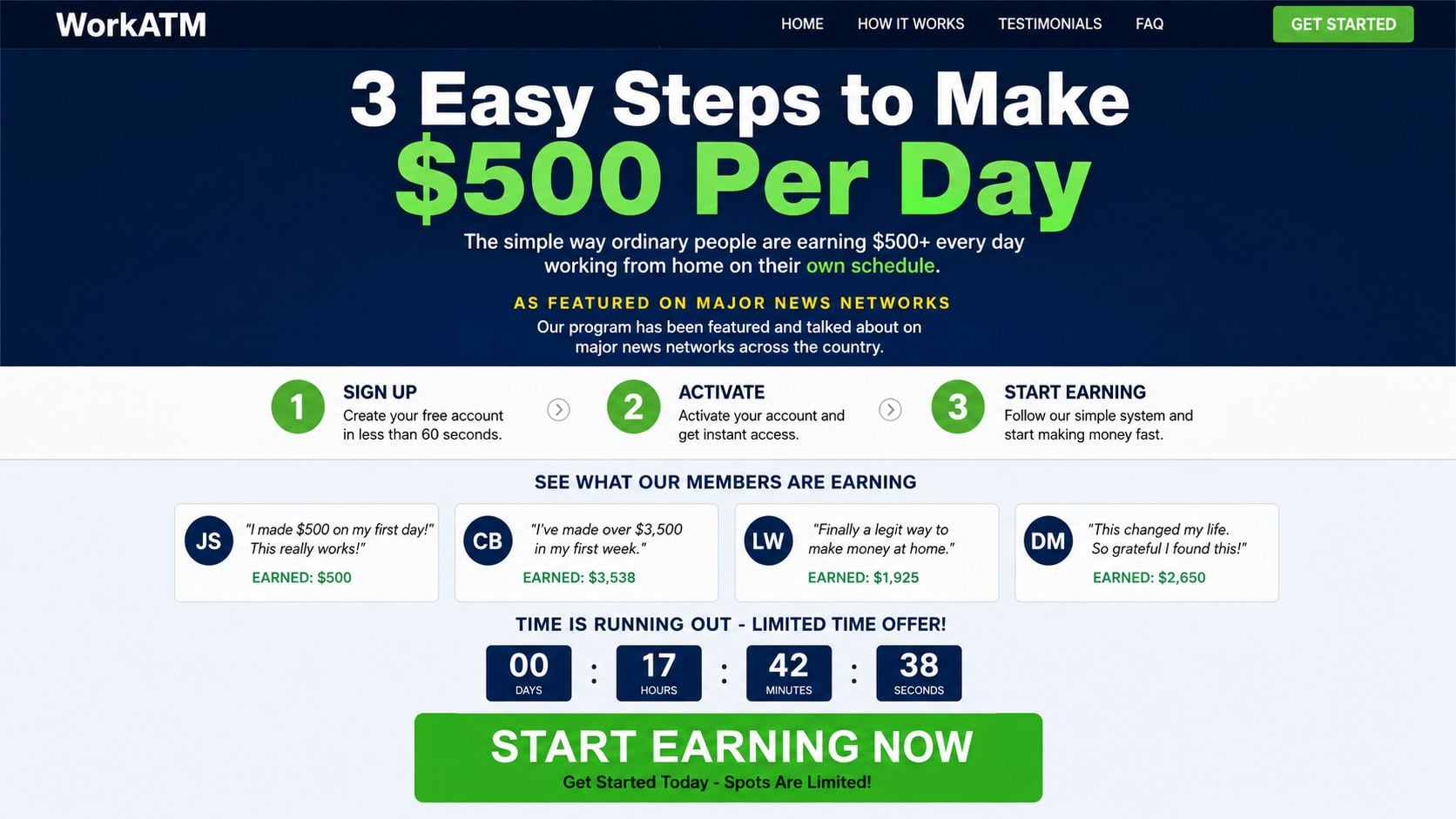
The site was reported in 2021 for promoting a “three easy steps” system that supposedly allowed users to make $500 per day. The presentation emphasized the income outcome while leaving the underlying work and business model difficult to verify.
It also reportedly claimed to have been featured through major news organizations. Investigators could not locate the supporting article or video coverage that would validate those prominent media references.
- A large daily income for minimal effort
- Vague steps instead of a defined job
- Unsupported “featured on” media claims
- Pressure to join before understanding the business
- No reliable proof that ordinary users receive the advertised earnings
Why the old domain still matters
Websites can expire, change content, redirect, or disappear. That does not erase the lessons from the campaign, and it does not mean a newly active page using the same name is connected to the original operator.
Scam templates are routinely rebuilt under new domains. The valuable question is not whether one old page currently loads, but whether the offer in front of you provides a verifiable company, real work, lawful compensation, and a withdrawal method that does not require your money.
What similar money-making schemes want
A questionable earnings site may monetize registrations, referrals, advertising views, surveys, paid upgrades, or the sale of user data. A more aggressive version creates fake earnings and later demands a deposit to release them.
The FTC warns about task scams that display growing commissions inside an app even though the numbers are fictional. Victims may receive a small early payment before being told to deposit their own money, often in cryptocurrency, to unlock more tasks or withdraw the balance.
How the WorkATM.org Scam Works
Step 1: A high-income headline earns the click
The offer leads with $500 per day rather than a job title, employer, skills, hours, or deliverables. It may arrive through a social post, search result, display ad, email, or referral from someone hoping to qualify for their own reward.
The amount is specific enough to feel measurable and large enough to inspire immediate interest. “Three easy steps” removes the expectation of an interview, training, or specialized experience.
A legitimate role can advertise competitive pay, but it can also explain why the work creates enough value to support that pay. An income promise without an economic explanation is a warning, not an opportunity.
Step 2: Familiar media names manufacture trust
A page may say it was featured on well-known television networks, news sites, or business publications. Those names borrow authority even when no outlet reviewed or endorsed the program.
Logos and text are simple to copy. Verification requires an article on the publisher’s real domain, an identifiable author, a publication date, and content that actually discusses the same company.
A generic television segment about remote work does not validate every website that later places a network name on its landing page. The reference must be specific and authentic.
Step 3: Registration collects personal information
The visitor is asked for a name, email address, phone number, location, and password to view the opportunity. Later forms may request age, tax details, identification, or payment information.
Those details have value before the user earns anything. They can support marketing lists, targeted phishing, identity theft, or account attacks when a password is reused.
Real employers also collect personal data, but they identify themselves, explain the role, conduct a hiring process, and provide privacy and employment documentation before requesting sensitive onboarding information.
Step 4: Simple activity creates an earnings illusion
A participant may be asked to share referral links, complete surveys, click offers, watch advertisements, rate products, or perform repetitive tasks. A dashboard assigns a value to each action and displays a growing balance.
The visible total is not proof of money. Until funds can be withdrawn without extra conditions, the dashboard is merely a number controlled by the website operator.
Some platforms make the first tasks effortless so users become invested. The time already spent and the impressive balance then encourage them to complete increasingly intrusive or expensive requirements.
Step 5: Withdrawal introduces a new obstacle
When the user tries to cash out, the rules may change. The site can demand more referrals, a higher membership level, identity verification, a tax deposit, processing fee, or a minimum activity threshold that was not clear at signup.
Each completed condition may reveal another one. The target keeps working or paying because the displayed balance now feels like money they already own.
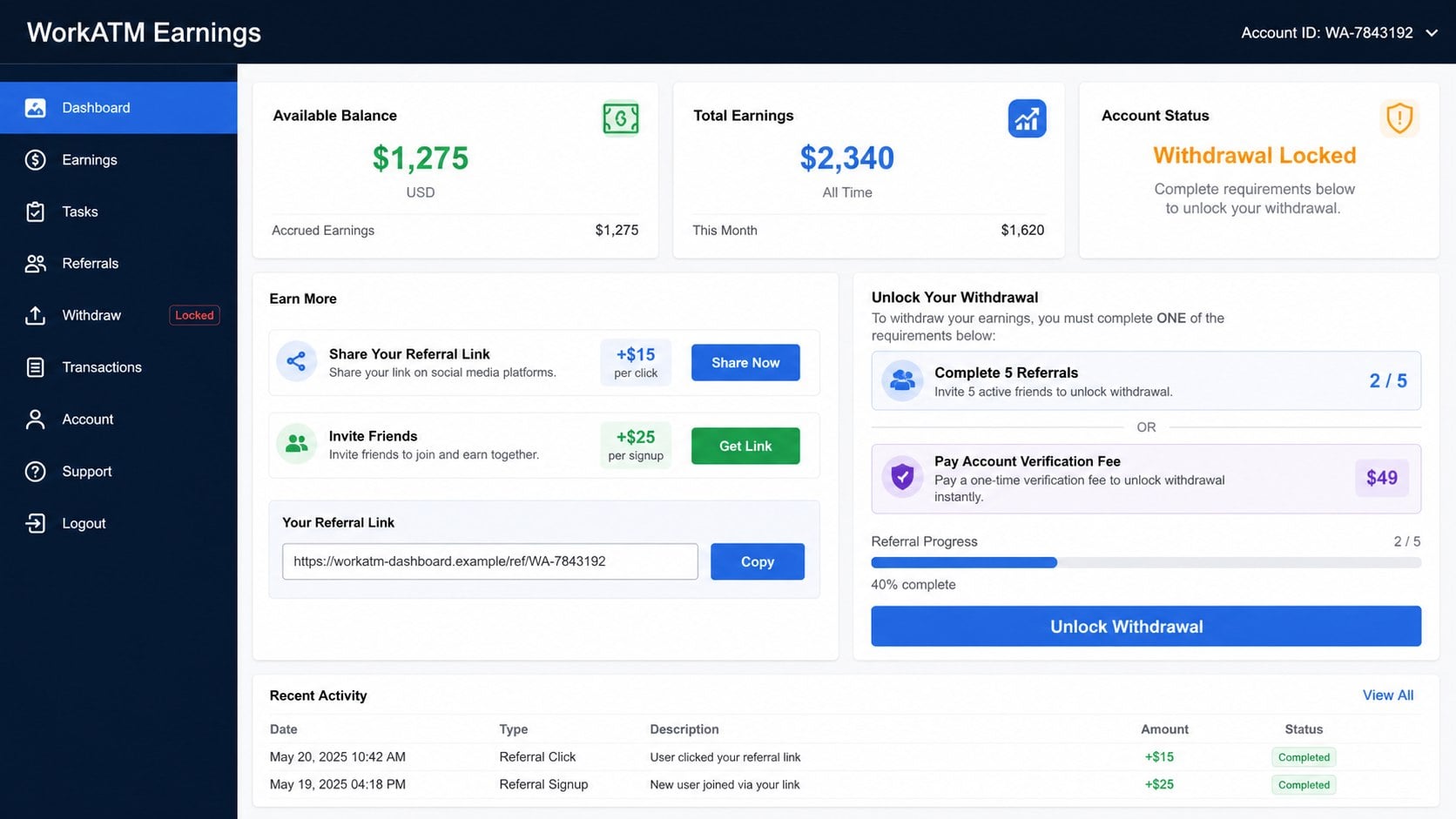
An honest employer does not require workers to deposit cryptocurrency, recruit friends, or buy an upgrade to receive wages. The FTC’s guidance is direct: never pay anyone to get paid or to obtain a job.
Step 6: The operator profits while users keep chasing
Participants may generate ad revenue, leads, and new registrations for the operator without receiving the promised income. Personal details can be shared with marketers or criminal groups.
If money is requested, the loss can escalate. A small verification charge becomes a larger negative-balance payment, tax, or recovery fee, while the account dashboard continues showing fictional earnings.
When complaints spread, the domain can go offline. Similar pages reappear with new names, copied testimonials, different income amounts, and the same promise that easy online activity will produce unusually high returns.
Red Flags in Easy Online Income Offers
The pay is clear but the work is not
A real job description explains responsibilities, qualifications, reporting lines, hours, location, employment status, and how performance is measured. Scam pages often explain only how much the visitor can supposedly earn.
Ask what product or service generates the revenue. If the answer is circular, such as members earn because other members join, the system may depend on recruitment rather than productive work.
The proof consists of dashboard screenshots
Testimonials may show large balances, payment notifications, cars, vacations, or short quotes from people identified only by a first name and initial. None of those items proves typical earnings.
Search testimonial text and images. Reused wording, stock photographs, and the same success story on unrelated sites show that the evidence was assembled for marketing.
The rules appear after registration
A trustworthy opportunity discloses compensation, fees, withdrawal thresholds, and eligibility before asking for commitment. Hidden requirements make it impossible to evaluate the offer honestly.
Be cautious when the site repeatedly says you are one task, referral, or payment away. A moving cash-out threshold is designed to extend engagement, not deliver earnings.
The program depends on recruiting other people
Referral programs can be legitimate, but they should not replace the underlying service or make wages dependent on exposing friends to the same uncertain offer.
If your withdrawal requires several people to register, the operator is using your personal credibility to acquire more leads. Do not pass that pressure to contacts you care about.
Company, Address, and Fulfillment Checks
Find the legal employer or operator
Look for a complete legal name in the terms, privacy notice, payment page, and communications. A brand name by itself is not enough to identify who owes compensation or handles complaints.
Search official corporate records in the stated jurisdiction. Compare officers, registration status, formation date, and business activity with what the website claims.
Verify the physical address and support
Check whether the address belongs to the named company. A virtual mailbox, residence, unrelated business, or missing suite number does not support claims of a large employment platform.
Test support with a detailed question about duties, payroll, tax classification, and withdrawals. A script that avoids specifics is more revealing than a fast response.
Check the domain and historical claims
Review when the domain was registered and whether archived pages match the claimed years in business. A new domain cannot have paid members through that address for a decade.
Old reviews may refer to a previous owner or version of a domain. Match dates and page content carefully instead of assuming every mention describes the current operator.
Demand verifiable payment terms
Ask for written compensation, payment schedule, withdrawal method, fees, and reasons a balance can be withheld. Confirm whether the arrangement is employment, contract work, affiliate marketing, or something else.
Do not accept a platform dashboard as payroll evidence. Speak with identifiable current workers and verify that ordinary users can withdraw without recruiting, depositing money, or buying upgrades.
What to Do if You Have Fallen Victim to This Scam
- Stop paying and completing tasks. Do not fund a negative balance, tax, upgrade, certification, or withdrawal fee. More activity will not make a fictional balance real.
- Contact the payment provider. Tell your bank, card issuer, payment app, exchange, or wire company that the transfer was connected to a deceptive job or earnings scheme. Ask about recovery options.
- Preserve the account evidence. Save the landing page, dashboard, balance, task history, withdrawal rules, messages, receipts, wallet addresses, phone numbers, and referral instructions.
- Secure reused passwords. Change the password anywhere else you used it, beginning with email and financial accounts. Enable strong multi-factor authentication.
- Protect identity information. If you provided a Social Security number or ID, consider a credit freeze or fraud alert and monitor new accounts and tax activity.
- Warn people you referred. Explain that the opportunity may be fraudulent and ask them not to pay, submit identification, or invite more contacts.
- Remove suspicious software. Uninstall any task, payroll, or support application the operator provided, then run a full Malwarebytes scan.
- Block abusive web activity. Revoke notification permission from unknown sites. AdGuard can reduce malicious advertisements, redirects, and phishing pages used in follow-up approaches.
- Report the scheme. File a report at ReportFraud.ftc.gov and IC3.gov when the activity and payments occurred online. Include domain, wallet, and transaction details.
- Ignore recovery promises. A person who guarantees the balance or lost funds for another upfront fee is attempting a second scam.
How to Evaluate a Work-From-Home Opportunity
Search the company name, recruiter, email, domain, phone number, and address separately. Add terms such as complaint, lawsuit, or fraud, but read the actual evidence instead of relying only on a search snippet.
Ask for a live interview with a verifiable employee using the company’s normal communication system. Confirm the role through a careers page reached from the organization’s known website.
Calculate the economics. At $500 per day, a full-time worker could be promised roughly $130,000 across 260 workdays. An employer should clearly explain the specialized value that supports that compensation.
Never deposit a check and send part of it elsewhere, buy equipment from a designated vendor with forwarded money, or transfer cryptocurrency to unlock tasks. Those are payment mechanisms for fraud, not onboarding steps.
Ask how taxes are handled and whether you will receive recognized employment or contractor records. A legitimate organization can explain who pays you, what entity issues the paperwork, and which country governs the agreement.
Give yourself a full day before submitting identity documents or funds. High-pressure recruiters may disappear when asked for written answers, while a genuine employer will not collapse because a candidate performs ordinary due diligence.
Frequently Asked Questions
Is WorkATM.org still operating?
Domain content can change over time. Treat any current page as a new verification task and do not assume it has the same operator, offer, or risk profile as the version reported in 2021.
Can someone really make $500 per day from online tasks?
Skilled contract work can pay well, but simple clicks, ratings, or referrals do not justify a guaranteed $500 daily return. A large fixed promise without defined work is a major warning.
Are “featured on TV” logos proof of legitimacy?
No. Verify a specific article or segment on the media company’s genuine website. A copied name or logo does not show endorsement.
Why does my earnings balance keep increasing?
The operator controls the displayed number. It has no demonstrated value until a normal withdrawal reaches your account without additional payment or recruitment conditions.
Should I pay a verification fee to withdraw?
No. Do not send money to receive wages or release supposed earnings. Contact the payment provider if you already paid.
What if a friend referred me?
Your friend may also believe the offer and may be trying to meet a withdrawal condition. Judge the company, work, and payment evidence independently.
The Bottom Line
The WorkATM.org scam warning centers on a simple mismatch: a precise promise of $500 per day without equally precise, independently verifiable evidence explaining the work, company, and payment source.
Do not trade money, identity details, or the trust of your contacts for a balance shown on a website. Real employers explain the job and pay workers; they do not make workers pay, recruit, or chase shifting conditions to unlock wages.

Reviews & discussion
0 commentsShare a firsthand experience, or ask a question.
Community reviews
workatm.org
Moderated reader experiences, not an editorial verdict.
Start the conversation
Have a question or something useful to share? Add the first comment.