

The Wuffy Robot Dog is being promoted as an AI-powered toy dog that can walk, react, and behave like a real puppy. With viral videos, emotional marketing, and steep discounts, it is easy to see why so many people are tempted to buy it. But once you look past the polished ads, a very different picture starts to emerge.
What Is the Wuffy Robot Dog?
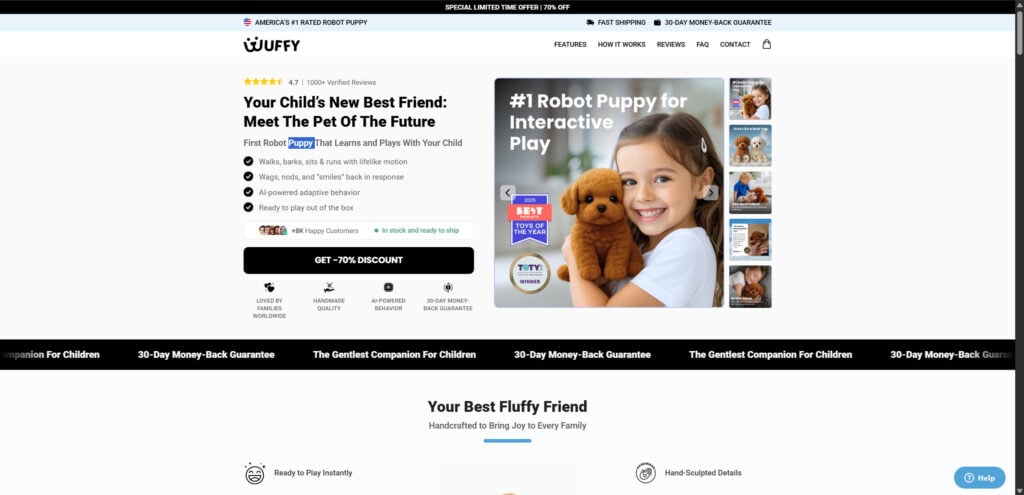
The Wuffy Robot Dog has gone viral on social media, promoted through highly polished videos showing a lifelike, AI-powered toy dog.
According to the ads, it can:
- Walk and wag its tail
- Bark and respond to touch
- “Learn” like a real puppy
- Act as a child’s intelligent companion
It’s marketed as a breakthrough product — a mix of artificial intelligence and emotional bonding.
However, the reality is very different.
Thousands of buyers report that the product does not match these claims. Instead of a smart robotic dog, most receive a cheap plush toy with minimal functionality.
This report breaks down how the scam works, what’s really being sold, and how to avoid similar traps.
Overview: What’s Actually Going On
At first glance, GetWuffy.com looks legitimate.
The website includes:
- Professional product photos
- Emotional testimonials
- Claims of “AI-powered intelligence”
- References to awards and media features
But none of these claims hold up under scrutiny.

The Key Red Flags
1. Misleading Marketing and Fake Product Claims
The ads (especially on Facebook, TikTok, and YouTube) show a highly realistic robotic puppy.
They suggest the product is:
- AI-powered and adaptive
- Capable of learning behaviors
- Built with advanced robotics
- Used by thousands of happy families
What buyers actually receive:
- A basic stuffed toy
- A small battery-powered sound box
- No movement, no sensors, no AI
There is a clear disconnect between the advertisement and the real product.
2. Fake Urgency and Pressure Tactics
The website uses aggressive sales tactics designed to rush buyers.
Common examples include:
- Countdown timers that reset on refresh
- “Only X items left” messages that never change
- Pop-ups claiming discounts are about to expire
These are not real limitations — they are designed to prevent you from thinking or researching.
3. Fake Reviews and Testimonials
The site displays thousands of positive reviews, often rated around 4.7 stars.
Typical claims include:
- “It walks and learns like a real dog!”
- “My child loves it!”
However:
- Profile images are often stock photos or AI-generated
- Reviews are duplicated across similar scam sites
- No independent, verified reviews exist
4. False “AI Technology” Claims
The biggest selling point is also the most misleading.
The product is marketed as:
- “AI-powered”
- “Adaptive”
- “Interactive”
In reality:
- There are no sensors
- No machine learning
- No smart behavior
It’s simply a low-cost plush toy with basic sound effects.
5. Dropshipping and Massive Markups
The operation follows a standard dropshipping model.
How it works:
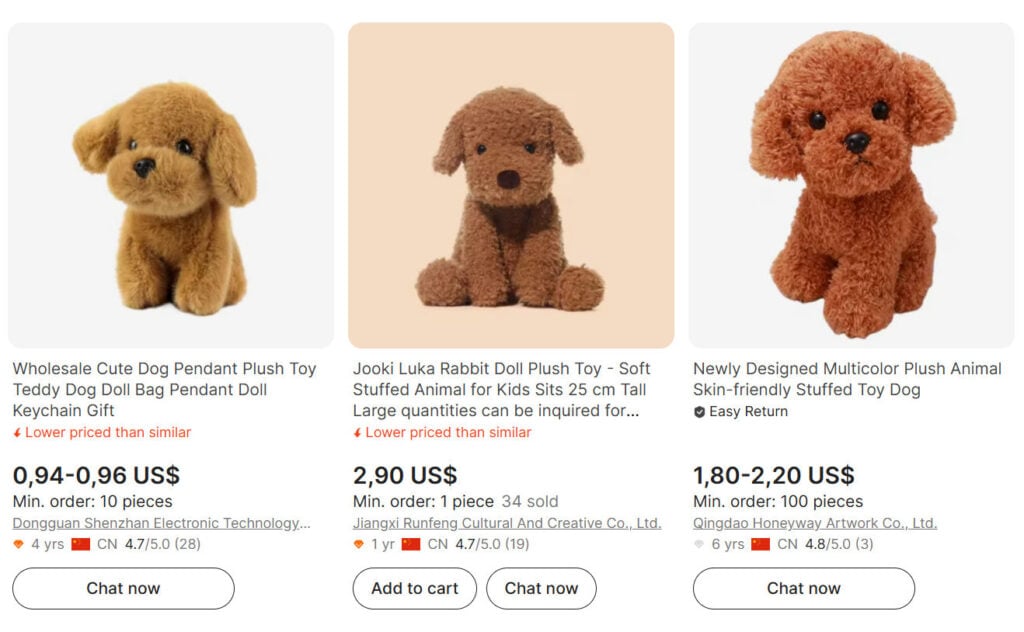
- The seller lists a generic product from Chinese suppliers
- Marks up the price by 500%–1000%
- Ships directly from overseas after purchase
Typical reality:
- Cost on wholesale sites: $1–$3
- Selling price: $29–$59
Returns are technically allowed, but:
- Must be shipped back to China
- Shipping costs often exceed the product value
- Refunds are rarely processed
6. Multiple Names, Same Scam
This is not a one-off product.
The same template appears under different names, such as:
- Dachy 2.0
- Koaly Bear
- FluffyBot Puppy
These sites:
- Use identical layouts
- Reuse the same marketing language
- Disappear and relaunch under new domains
This pattern is typical of short-term scam operations.
How the Scam Works
Step 1: Viral Ads
Scammers create highly engaging videos using:
- CGI animation
- AI-generated content
These videos show features the product does not actually have.
Step 2: Professional-Looking Website
Users are redirected to a polished site designed to build trust quickly.
It includes:
- Fake expert reviews
- Comparison charts
- “Award” badges
- Emotional messaging
Step 3: Emotional Manipulation
The messaging focuses on:
- Children’s happiness
- Companionship
- Learning and responsibility
This makes the purchase feel meaningful, not just transactional.
Step 4: Checkout Manipulation
At checkout, buyers encounter:
- Upsells (buy more, save more)
- Pre-selected bundles
- Countdown timers
Some users report being charged for multiple items unintentionally.
Step 5: Payment and Data Collection
Payments are processed through:
- Unknown third-party processors
At the same time, personal data is collected:
- Name
- Address
- Phone number
Step 6: Shipping Delays
Typical delivery takes:
- 2 to 4 weeks
Tracking is often:
- Delayed
- Invalid
- Non-functional
This delay reduces the likelihood of chargebacks.
Step 7: What Actually Arrives
Customers typically receive:
- A small plush toy
- Minimal or no functionality
- No resemblance to advertised features
Step 8: Failed Refund Attempts
Refund process:
- Requires return to China
- Shipping costs are high ($30–$40)
- Support becomes unresponsive
Most buyers never recover their money.
Step 9: Rebranding Cycle
Once complaints increase:
- The site disappears
- A new domain launches
- The same product is resold
This cycle repeats continuously.
What To Do If You Bought I
Act quickly to limit damage.
1. Contact Your Bank
- Block further charges
- Flag the transaction as suspicious
2. Request a Chargeback
Provide:
- Screenshots of the ad
- Photos of the received product
- Order confirmation
State clearly: “Item not as described.”
3. Report the Scam
Report to:
- Consumer protection authorities
- The platform where you saw the ad (Facebook, TikTok, etc.)
4. Warn Others
Post reviews on:
- Trustpilot
- Scam-report forums
Include photos for credibility.
5. Monitor Your Data
Watch for:
- Spam emails
- Suspicious charges
- Follow-up scam attempts
6. Learn the Warning Signs
Avoid sites that show:
- Unrealistic AI claims
- Heavy discounts (50%–80%)
- No real company details
- Fake urgency tactics
- No independent reviews
The Bottom Line
The Wuffy Robot Dog is not an AI-powered robotic pet.
It is a:
- Low-cost plush toy
- Sold using misleading advertising
- Part of a larger dropshipping scam pattern
Buyers expecting advanced technology receive a basic product with little to no functionality. Refunds are difficult or impossible, and many are overcharged.
If you encounter similar “AI toy” ads, treat them with skepticism. Always verify claims independently before purchasing.
In the current landscape of AI-generated marketing, realistic visuals do not guarantee a real product.
Frequently Asked Questions
What is the Wuffy Robot Puppy?
The Wuffy Robot Puppy is advertised as an AI-powered toy dog sold through sites like GetWuffy.com. The marketing presents it as a lifelike robotic pet that can walk, bark, respond to touch, and behave like a real puppy. The ads make it look like an advanced interactive toy for children. In practice, many buyers say the product they receive is just a simple battery-powered plush toy with little or no real interactivity.
Is the Wuffy Robot Puppy legit?
Based on customer complaints and the way it is marketed, the Wuffy Robot Puppy raises serious concerns. The biggest issue is that the product shown in the ads does not appear to match what many customers receive. Buyers expect a realistic AI-powered robotic dog, but often report receiving a cheap stuffed toy with limited sound effects and no advanced features. That makes the product highly misleading at best.
Is Wuffy Robot Puppy a scam?
Many signs point in that direction. The product is promoted with exaggerated claims about artificial intelligence, learning ability, and lifelike behavior. At the same time, customers report fake-looking reviews, aggressive discount tactics, and refund problems. When a store advertises a high-tech robotic pet but delivers a basic plush toy instead, that fits the pattern of a deceptive online shopping scam.
What do customers actually receive?
According to buyer reports, customers often receive a low-cost plush dog with a small battery box inside. It may make a simple barking or squeaking sound, but it does not behave like the puppy shown in the ads. There is usually no real walking, no advanced touch response, no smart interaction, and no AI learning features. In other words, the delivered item appears to be far cheaper and simpler than advertised.
Does the Wuffy Robot Puppy really use AI?
There is no clear evidence that it does. The marketing repeatedly uses phrases like “AI-powered,” “adaptive,” and “smart companion,” but customers report that the product has none of the features you would expect from actual AI technology. There are no demonstrated sensors, no meaningful learning system, and no proof of advanced robotics. The AI language appears to be used mainly as a sales hook.
Why is the Wuffy website so convincing?
Sites like GetWuffy.com are designed to look polished and trustworthy. They often use:
- Emotional product videos
- Fake urgency messages
- Large discount banners
- Professional-looking product pages
- Glowing customer reviews
- Claims of awards or media recognition
All of this is meant to make buyers feel comfortable enough to purchase quickly, before they take time to research the product.
Why are refunds so difficult?
This is one of the biggest complaints in these types of dropshipping operations. Even if the site claims to offer a money-back guarantee, customers are often told they must return the item to China at their own expense. That shipping cost can be so high that it is not worth it. In many cases, support becomes slow, vague, or nonresponsive once a refund is requested.
Why do some people say they were charged for multiple units?
Several buyers report that these stores use checkout tactics that push larger bundles or make multi-unit offers appear preselected. In some cases, customers believe they ordered one item but end up paying for two or three. This is a common tactic on misleading ecommerce sites that rely on pressure selling and confusing checkout flows.
Is GetWuffy.com a real robotics company?
There is no clear sign that it is. Sites like this often provide very little verified company information, even though they make big claims about innovation, engineering, or exclusive technology. A legitimate robotics company would usually have transparent contact details, independent reviews, real technical demonstrations, and a visible business track record. Scam-style stores typically do not.
Are there other scams like Wuffy Robot Puppy?
Yes. This appears to be part of a broader pattern involving “AI pet” or “interactive toy” scams. Similar stores often sell cheap toys under new names while using nearly identical websites, ad copy, and product promises. When one site gets too many complaints, a new one may appear with a different product name but the same basic setup.
How can I tell if a toy website is a scam?
Watch for these red flags:
- Unrealistic claims about AI or robotics
- Very steep discounts like 60% or 70% off
- Countdown timers and fake low-stock warnings
- No clear company address or phone number
- Reviews that look fake or overly perfect
- No real independent video reviews
- Return policies that require shipping to China
- Product ads that look far more advanced than the price suggests
If several of these signs are present, it is safer to avoid the purchase.
What should I do if I already bought it?
Take action as soon as possible:
- Contact your bank or card provider if the charge looks suspicious.
- Request a chargeback for an item not as described.
- Save screenshots of the ad, order page, and product listing.
- Photograph the item you received.
- Report the seller to the platform where you saw the ad.
- Leave a factual public review to warn others.
The faster you act, the better your chances of recovering your money.








