

A new disturbing email scam has emerged that aims to trick victims into paying bitcoin ransoms. Using social engineering tactics that prey on fear, these fraudulent messages claim a hacker has fully compromised the recipient’s device.
Dubbed the “Your account is hacked. Your data is stolen” scam, this con uses flimsy evidence and empty threats in an attempt to extort money from the unaware. While these emails may sound concerning, they are completely fabricated by criminals.
In this comprehensive guide, we will break down how this scam works, provide examples of the scam email, offer advice for victims, and equip you with knowledge to avoid falling for this fraud. Forewarned and forearmed against such cyber extortion ploys.
Overview of the “Your account is hacked. Your data is stolen” Scam
The “Your account is hacked. Your data is stolen” scam exhibits many hallmarks of a classic sextortion con. The criminals rely on the exploitation of human emotions like anxiety, panic, and the fear of public embarrassment.
By claiming to have deeply personal videos of the recipient, the scammers hope the target will be frightened into complying with their demands. However, these claims are false, designed to trick victims out of money.
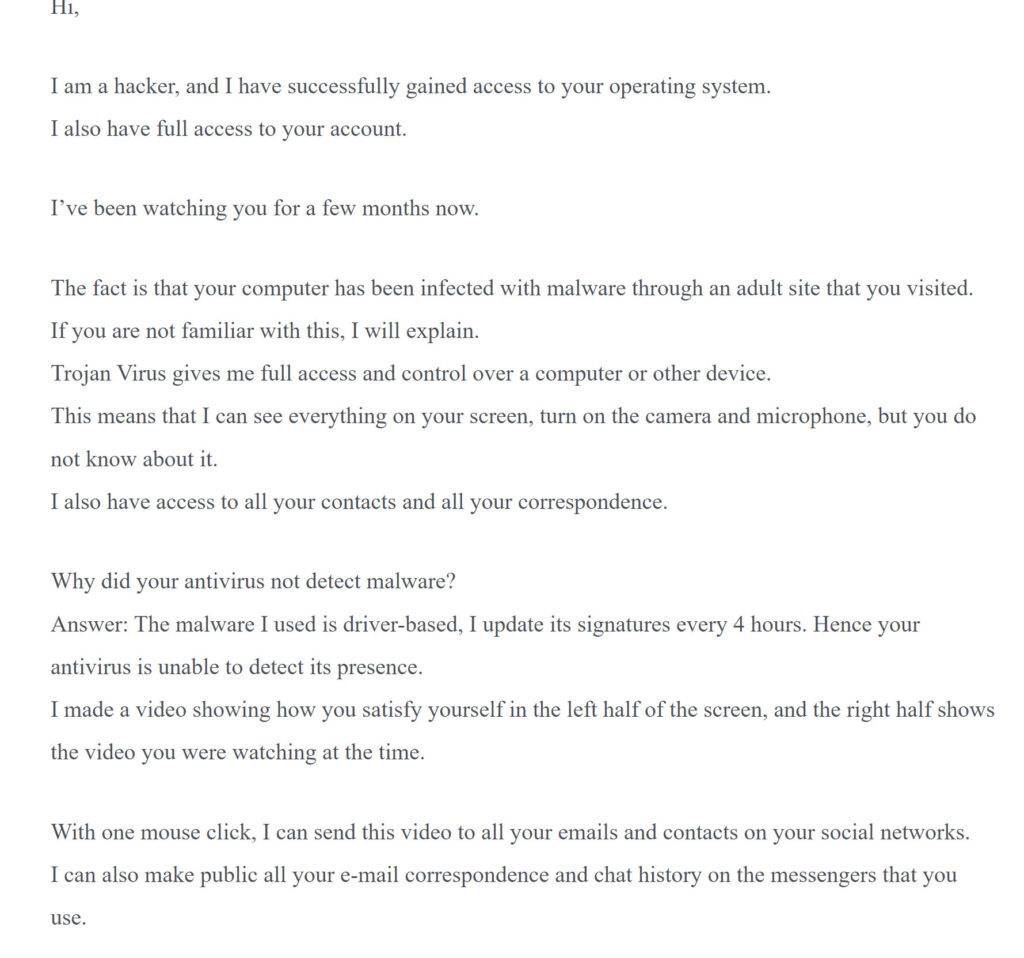
Here is how the “Your account is hacked. Your data is stolen” email scam looks:
Subject: Your account is hacked. Your data is stolen. Learn how to regain access.
Hi,I am a hacker, and I have successfully gained access to your operating system.
I also have full access to your account.I’ve been watching you for a few months now.
The fact is that your computer has been infected with malware through an adult site that you visited.
If you are not familiar with this, I will explain.
Trojan Virus gives me full access and control over a computer or other device.
This means that I can see everything on your screen, turn on the camera and microphone, but you do not know about it.
I also have access to all your contacts and all your correspondence.Why did your antivirus not detect malware?
Answer: The malware I used is driver-based, I update its signatures every 4 hours. Hence your antivirus is unable to detect its presence.
I made a video showing how you satisfy yourself in the left half of the screen, and the right half shows the video you were watching at the time.With one mouse click, I can send this video to all your emails and contacts on your social networks.
I can also make public all your e-mail correspondence and chat history on the messengers that you use.If you don’t want this to happen, transfer $1490 in Bitcoin equivalent to my Bitcoin address (if you do not know how to do this, just search “buy bitcoin” on Google).
My Bitcoin address (BTC Wallet) is: 13yQcMFQSf7ixzJrNceCDL4E1jVHEVqrcY
After confirming your payment, I will delete the video immediately, and that’s it. You will never hear from me again.
I will give you 50 hours (more than 2 days) to pay. I will get a notice, when you open this email, and the timer will start.
Filing a complaint somewhere does not make sense because this email cannot be tracked like my Bitcoin address.I never make any mistakes.
If I find that you have shared this message with someone else, the video will be immediately distributed.Best regards!
Some key things to know about this scam include:
- Targets everyday internet users – These scam emails blast out randomly to ensnare as many victims as possible. Anyone with an email could potentially fall prey.
- Exploits fear and shame – The email tries to scare recipients into paying the ransom by threatening to share humiliating videos that do not actually exist.
- Demands untraceable payment – The scammers insist on payment by bitcoin, which allows them to remain anonymous and withdraw money instantly.
- Makes bogus hacking claims – The message falsely claims the recipient’s device was compromised and infected with malware, which is fabricated.
- Threatens distribution of footage – If the ransom isn’t paid, the criminals threaten to send imaginary embarrassing videos to the target’s email and social media contacts.
- Tries to avoid tracking – By claiming email responses won’t be read, the scammers try to prevent email tracing tools from uncovering their location.
- Pressures urgency – The 48 hour timeframe adds urgency to pay the ransom before the non-existent videos get leaked. This gets victims to act rashly out of fear.
- Preys on the vulnerable – Elderly individuals, as well as those with mental health issues, are often prime targets for these exploitative extortion scams.
Next, let’s examine exactly how this devious scam works from start to finish.
How the “Your account is hacked. Your data is stolen” Scam Works
The “Your account is hacked. Your data is stolen” extortion scam operates in several stages:
1. Criminals Obtain Email Addresses
The first step is for the scammers to acquire large caches of potential victims’ email addresses. These are gathered through various underhanded means, like:
- Hacking websites and databases to steal email lists
- Scraping public internet forums and social media sites for emails
- Purchasing email lists from shady dark web brokers
- Using bots to harvest emails from across the web
2. Fraudulent Email Template Created
The criminals then design an email template containing their fake hacking claims and extortion demand. The message is crafted to sound credible, citing technical jargon about malware installation and supposed full system access.
3. Scam Emails Blasted Out
Using the stolen email lists from step one, the scammers send their fraudulent emails en masse to millions of potential victims. The more emails blasted out, the more potential targets they ensnare.
4. Recipients Open and Read Email
As the scam messages land in inboxes around the world, some recipients inevitably open and read them. If the target exhibits any gullibility or computer inexperience, they may fall for the scam that was crafted just for them.
5. Ransom Demands Made
The email contains ransom payment instructions, demanding $950 in bitcoin to the scammer’s provided wallet address. Threats of leaking embarrassing videos are made if the ransom isn’t paid within 48 hours.
6. Some Victims Send Payment
If the scam works, the emotionally-manipulated recipient overlooks the email’s dubious claims and sends the ransom payment in bitcoin per the demands. This is the scammer’s desired outcome.
7. Criminals Disappear with the Money
Upon receiving payment in their anonymous bitcoin wallet, the scammers simply cut off all contact with the victim. Since bitcoin transactions are irreversible, victims have no way to recover their funds from these criminals.
8. Scammers Repeat the Process
With a fresh financial windfall in hand, the hackers repeat the process and blast out more scam emails to different potential victims. Rinse and repeat, making easy money off this exploitation.
This anatomy illuminates how these scams leverage fear to manipulate targets into overlooking logic and hastily sending ransom payments. Next, let’s explore how to recover if you fell victim.
What to Do If You’ve Fallen Victim to This Scam
Finding out you paid a ransom to hackers impersonating you online is a nightmare scenario. If this happens to you, here are tips on responding:
- Don’t pay any more money – Cut off all contact with the scammers and never send additional payments, no matter how threatening they seem.
- Report the email – Forward the scam email to your email provider’s abuse team and the FBI’s Internet Crime Complaint Center.
- Notify contacts – If you paid the ransom, the criminals may still try to contact your friends and family asking for money while posing as you. Warn your contacts that it’s a scam.
- Boost security – Change all account passwords, run antivirus scans, turn on two-factor authentication everywhere possible, and monitor closely for signs of misuse.
- Watch for tax fraud – Be on high alert for tax refund fraud, as scammers may have obtained key personal details enabling them to file taxes in your name.
- Seek legal counsel – Speak with a lawyer regarding filing a report with the authorities. They may be able to trace the bitcoin wallet payments to identify the criminal.
- Get emotional support – Being extorted online can take a serious mental toll. Seek counseling or join a support group to help process feelings of violation. You are not alone.
- Learn from the mistake – As the saying goes, forewarned is forearmed. Use this as a lesson to be more vigilant against online scams going forward.
With proper reporting and enhanced security, you can limit the damage caused by these scammers. Don’t let shame prevent you from seeking help – there are resources available.
Is Your Device Infected? Run a Free Malware Scan
Slow performance, constant pop-ups, or strange behavior? These are classic signs of a malware infection. The fastest way to find out is to scan your device with Malwarebytes Free — one of the most trusted malware removal tools available.
The free version detects and removes the most common threats, including:
- Adware — the cause of those annoying pop-ups
- Browser hijackers — unwanted redirects and changed homepages
- Trojans and spyware — hidden programs stealing your data
- Potentially unwanted programs (PUPs) — software you never asked for
👉 Select your device below — Windows, Mac, or Android — then follow the simple steps to download Malwarebytes, scan your system, and remove any threats it finds. The scan usually takes 5 to 20 minutes.
Run a Malware Scan with Malwarebytes for Windows
Malwarebytes is one of the most popular and trusted anti-malware tools for Windows — and it’s completely free for removing infections. It catches threats that many antivirus programs miss, including adware, browser hijackers, and trojans. Follow the steps below to scan and clean your PC in just a few minutes.
Download Malwarebytes
Click the button below to download the latest version of Malwarebytes for Windows from the official source. The free version is all you need — it will scan your computer and remove adware, browser hijackers, and other malicious software at no cost.
Download MalwarebytesOfficial installer for Windows 11 and 10. Your download starts right away.Want real-time protection? See Malwarebytes Premium Malwarebytes Free for WindowsScans and removes malware at no cost
-
Install Malwarebytes
When the download finishes, open your Downloads folder and double-click the MBSetup file. If Windows shows a User Account Control pop-up, click “Yes” to allow the installation.

Follow the On-Screen Prompts to Install Malwarebytes
The setup wizard will walk you through a few quick screens:
-
Choose where you’re installing the program — “Personal Computer” or “Work Computer” — then click Next.

-
Malwarebytes will now install on your device. This usually takes under a minute.

-
When installation is complete, the “Welcome to Malwarebytes” screen will open automatically.

-
On the final screen, click Open Malwarebytes to launch the program.

-
Enable “Scan for Rootkits”
Before scanning, turn on rootkit detection so Malwarebytes can find even the most hidden threats. Click the Settings gear icon on the left side of the screen.

In the settings menu, find “Scan for rootkits” and click the toggle so it turns blue.

Done? Click “Dashboard” in the left pane to return to the main screen.
Start the Scan
Click the blue Scan button. Malwarebytes will automatically update its virus database and start checking your computer for malware.

-
Wait for the Scan to Finish
The scan checks your entire system for browser hijackers and other malicious programs, so it can take 5 to 20 minutes depending on your computer. Feel free to do something else — just check back occasionally to see the progress.

-
Quarantine the Detected Threats
When the scan is done, you’ll see a list of everything Malwarebytes found — malware, adware, and potentially unwanted programs. Click the “Quarantine” button to remove all of them at once.

Malwarebytes will now remove the malicious files and registry entries and move them safely into quarantine.

-
Restart Your Computer
Some threats can only be fully removed after a reboot. If Malwarebytes asks you to restart, click Yes. Once you’re logged back in, Malwarebytes has finished removing the threats it found.

That’s it — your Windows PC is now clean of trojans, adware, and other malware, and should be back to running smoothly.
If you are still having problems with your computer after completing these instructions, then please follow one of the steps:
- Run a computer scan with ESET Online Scanner
- Ask for help in our Windows Malware Removal Help & Support forum.
Run a Malware Scan with Malwarebytes for Mac
Malwarebytes for Mac is a free on-demand scanner that removes the malware other security software tends to miss — adware, browser hijackers, and unwanted programs included. Cleaning an infected Mac with Malwarebytes has always been completely free, and it’s our go-to recommendation. Follow the steps below to scan and clean your Mac in just a few minutes.
-
Download Malwarebytes for Mac
Click the button below to download the latest version of Malwarebytes for Mac.
Download MalwarebytesOfficial installer for macOS. Your download starts right away.Want real-time protection? See Malwarebytes PremiumMalwarebytes Free for MacScans and removes malware at no cost -
Open the Malwarebytes setup file
When the download finishes, open your Downloads folder and double-click the setup file to begin the installation.

-
Follow the On-Screen Prompts to Install Malwarebytes
The Malwarebytes for Mac Installer will guide you through a few quick screens. Click “Continue” and keep following the prompts until the installation completes.



When the installation is complete, Malwarebytes opens to the Welcome to Malwarebytes screen. Click “Get started“.
-
Select “Personal Computer” or “Work Computer”
Malwarebytes will ask what type of computer you’re installing it on. Click either Personal Computer or Work Computer, whichever applies.

-
Start the Scan
Click the “Scan” button. Malwarebytes will automatically update its detection database and begin checking your Mac for malware.

-
Wait for the Scan to Finish
Malwarebytes will scan your Mac for adware, browser hijackers, and other malicious programs. This can take a few minutes, so feel free to do something else — just check back occasionally to see the progress.

-
Quarantine the Detected Threats
When the scan is done, you’ll see a list of everything Malwarebytes found. Click the “Quarantine” button to remove all the threats at once.

-
Restart Your Mac
Malwarebytes will now remove all the malicious files it found. Some threats can only be fully removed after a reboot — if Malwarebytes asks you to restart, allow it. Once you’re logged back in, your Mac is clean.

That’s it — your Mac is now free of adware, rogue browser extensions, and other potentially harmful software.
If you are still experiencing problems while trying to remove a malicious program from your computer, please ask for help in our Mac Malware Removal Help & Support forum.
Run a Malware Scan with Malwarebytes for Android
Malwarebytes for Android automatically detects and removes dangerous threats like malware and ransomware so you don’t have to worry about your most-used device being compromised. Aggressive detection of adware and potentially unwanted programs keeps your Android phone or tablet running smooth.
-
Download Malwarebytes for Android.
You can download Malwarebytes for Android by clicking the link below.
Get Malwarebytes for AndroidOpens Google Play in a new tab.Want real-time protection? See Malwarebytes Premium for AndroidMalwarebytes for AndroidScans your phone and removes malware at no cost -
Install Malwarebytes for Android on your phone.
In the Google Play Store, tap “Install” to install Malwarebytes for Android on your device.

When the installation process has finished, tap “Open” to begin using Malwarebytes for Android. You can also open Malwarebytes by tapping on its icon in your phone menu or home screen.

-
Follow the on-screen prompts to complete the setup process
When Malwarebytes will open, you will see the Malwarebytes Setup Wizard which will guide you through a series of permissions and other setup options.
This is the first of two screens that explain the difference between the Premium and Free versions. Swipe this screen to continue.
Tap on “Got it” to proceed to the next step.
Malwarebytes for Android will now ask for a set of permissions that are required to scan your device and protect it from malware. Tap on “Give permission” to continue.
Tap on “Allow” to permit Malwarebytes to access the files on your phone.
-
Update database and run a scan with Malwarebytes for Android
You will now be prompted to update the Malwarebytes database and run a full system scan.

Click on “Update database” to update the Malwarebytes for Android definitions to the latest version, then click on “Run full scan” to perform a system scan.

-
Wait for the Malwarebytes scan to complete.
Malwarebytes will now start scanning your phone for adware and other malicious apps. This process can take a few minutes, so we suggest you do something else and periodically check on the status of the scan to see when it is finished.

-
Click on “Remove Selected”.
When the scan has been completed, you will be presented with a screen showing the malware infections that Malwarebytes for Android has detected. To remove the malicious apps that Malwarebytes has found, tap on the “Remove Selected” button.

-
Restart your phone.
Malwarebytes for Android will now remove all the malicious apps that it has found. To complete the malware removal process, Malwarebytes may ask you to restart your device.
That’s it — your Android phone is now clean — no more malicious apps, adware, or browser redirects.
If you are still having problems with your phone after completing these instructions, then please follow one of the steps:
- Restore your phone to factory settings by going to Settings > General management > Reset > Factory data reset.
- Ask for help in our Mobile Malware Removal Help & Support forum.
Stay Protected: Block Ads and Malicious Sites
Now that your device is clean, keep it that way. Most infections start with a malicious ad or a fake download button — so blocking them at the source is your best defense.
We recommend AdGuard, which blocks malicious ads, phishing pages, and dangerous redirects before they can reach you.
👉 Download AdGuard and browse safely
Frequently Asked Questions About the “Your account is hacked. Your data is stolen” Scam
1. How does the “Your account is hacked. Your data is stolen” scam work?
This scam begins with an email claiming the recipient’s operating system was hacked months ago. It threatens to send embarrassing videos to contacts unless a $950 bitcoin ransom is paid within 48 hours. This is completely fabricated to trick victims.
2. What are some key details in the scam email?
- Claims full access to accounts and screens
- Says it infected device with undetectable malware
- Threatens to leak adult videos spliced with personal data
- Demands untraceable $950 bitcoin payment to provided wallet
- Warns contacting others or seeking help is useless
3. What are some tactics used in the scam email?
- Exploits fear, panic, and embarrassment
- Cites old passwords to appear credible
- Pressures urgency to pay quickly before videos get sent
- Makes targets feel powerless to stop the threats
- Attempts to avoid email tracking to hide scammers’ location
4. What type of personal information is compromised?
No personal data is actually compromised. The hackers’ claims of videos and account access are completely fabricated to extort money. They do not have any sensitive information.
5. Does paying the ransom help?
No, paying only enables the scammers and funds their criminal operations. There are no videos to delete, so paying provides no benefit. The scammers typically disappear after receiving payment.
6. What happens if I don’t pay the ransom?
Nothing happens if the ransom is not paid, as the scammers have no compromising footage to distribute and no actual access. They are merely using empty threats in hopes of tricking victims into paying. Not paying is the recommended action.
7. Should I report the scam email?
Yes, report the scam email to your email provider’s abuse team and the FBI’s Internet Crime Complaint Center. This helps authorities track and shut down these fraudsters. Also warn your contacts in case they receive similar video threats.
8. How can I recover if I already paid the ransom?
If you paid, immediately contact your bank and police. Monitor accounts closely for misuse. Enable two-factor authentication everywhere and change passwords. Seek counseling for stress. But the likelihood of recovering lost funds is unfortunately very low.
9. How can I boost security after receiving the scam email?
Scan devices for malware, change passwords, turn on two-factor authentication, monitor accounts closely, and be extra vigilant for any further contact attempts by the scammers. Also watch out for other scams targeting the same email address.
10. How can I avoid becoming a victim of this scam?
Be skeptical of threat emails demanding untraceable payments. Look for signs like threats, limited timeframes, and claims of total access as red flags. Stay calm and think critically before taking any action. When in doubt, seek help. Don’t let fear override your best judgement.
The Bottom Line
The emergence of the “Your account is hacked. Your data is stolen” scam makes it evident that users must stay skeptical in the face of threats demanding quick payments.
This guide has armed you with specific knowledge on how these scams leverage social engineering and fear against victims. But with greater awareness, we can work together to combat these frauds.
Remember, alleged hackers contacting you demanding untraceable payment in bitcoin are almost certainly running a scam. Never act solely based on emotions like fear or panic. Stop and think critically before taking any action.
The supposed embarrassing videos, access to accounts, and contact threats are all bluffing tactics to coerce ransom payment. But armed with the information in this article, potential victims can stop these criminal extortion schemes in their tracks.








