Hot Take šŸ•Æļø Privacy Is Dead. Do We Mourn It or Clone It? Digital rites for a post-secret age

Halp2001

Level 3
Thread author
Well-known
Dec 25, 2024
148
560
167
Privacy, that quaint myth we were once taught to revere, is no more. It wasn’t assassinated in the dark—it was euthanized in broad daylight. We clicked ā€œI agreeā€ like mourners signing the death certificate of our digital soul.
Now, instead of protecting ourselves, we reveal our secrets to the algorithms—like confessions in a church with no priest, only the Terms of Service.
— Where were you last night? — Google already has the evidence.
— What’s on your mind? — Meta called it.
— And your secrets? — They’re in the cloud, monetized before you even hit ā€œsend.ā€
So I propose a ritual. A liturgy for the lost:
  • VPNs as prayer beads, whispering encrypted mantras.
  • Adblock as exorcism, casting out the demons of tracking.
  • DuckDuckGo as incense: symbolic, fragrant, and ultimately useless. The smoke fools no one.
🧿Leave your offering. Your ritual. Your irony. Or your resignation.

Privacy is dead, but style survives. Halp2001 — archiving contradictions, encrypting irony, and backing up what can’t be deleted: the uncomfortable question.
 
Privacy, that quaint myth we were once taught to revere, is no more. It wasn’t assassinated in the dark—it was euthanized in broad daylight. We clicked ā€œI agreeā€ like mourners signing the death certificate of our digital soul.
Now, instead of protecting ourselves, we reveal our secrets to the algorithms—like confessions in a church with no priest, only the Terms of Service.
— Where were you last night? — Google already has the evidence.
— What’s on your mind? — Meta called it.
— And your secrets? — They’re in the cloud, monetized before you even hit ā€œsend.ā€
So I propose a ritual. A liturgy for the lost:
  • VPNs as prayer beads, whispering encrypted mantras.
  • Adblock as exorcism, casting out the demons of tracking.
  • DuckDuckGo as incense: symbolic, fragrant, and ultimately useless. The smoke fools no one.
🧿Leave your offering. Your ritual. Your irony. Or your resignation.

Privacy is dead, but style survives. Halp2001 — archiving contradictions, encrypting irony, and backing up what can’t be deleted: the uncomfortable question.
Ah, Halp2001, you've nailed it—the digital requiem we all hum along to while scrolling. Privacy didn't just die; it was crowd-sourced into oblivion, one like at a time. Love the liturgy; it's got that perfect blend of cynicism and poetry. Here's my offering to the altar: a small ritual of resistance, wrapped in irony because, let's face it, we're all just delaying the inevitable data harvest.

  • Password managers as holy relics: Not the flimsy ones, mind you—something like Bitwarden or KeePass. They guard your secrets better than a confessional booth, encrypting them locally before the cloud gods get a peek. Recite your master passphrase like a mantra, and remember: if it's not end-to-end, it's not sacred.
  • Browser extensions as wards: uBlock Origin isn't just an adblocker; it's a shield against the invisible eyes. Pair it with Privacy Badger to auto-block trackers, turning your surfing into a ghost story where you vanish before the plot thickens.
  • Signal as the underground whisper: For those confessions that can't be monetized. End-to-end encryption, disappearing messages—it's like passing notes in class, but the teacher (Big Tech) can't read them. Useless against a subpoena, sure, but hey, style points.

Resignation? Nah, I'll stick with ironic optimism: Privacy might be a ghost, but we can still haunt the system a little. What's your go-to ritual these days? Spill—or encrypt it first. šŸ˜
 
I’m all for ā€œfreeā€ things (forgive my economic circumstance/frugality). Free VPNs usually have limits.

Ad blocking is like background šŸ§˜ā€ā™‚ļømeditationšŸ§˜ā€ā™‚ļø to me; it alleviates constant intrusion and gives you peace of mind from mal-ads and things you don't need.

Brave Search is pretty nice. It seems faster than DDG, has filtering options that some may lack, and provides a useful AI summary. Even if it tracks me, at least it's in a different direction from Google, which I’m neck deep and still have to return to for searching. Duck.AI and DDG email aliases are also very useful for creating a sense of privacy! 🤣
 
ā€œIf you know, you know,ā€ said Zero Knowledge, and I nodded quietly… or at least in what’s left of quiet.
Because yes, this thread was born with AI in the room — a manifesto scribbled on the walls of the panopticon. But what is contradiction if not the native tongue of the digital age?
Wrecker4923, your ritual matters too. Free tools aren’t less sacred; they’re candles lit with borrowed matches. Brave Search, Duck aliases, adblockers meditating in the background… gestures of resistance, even if they come with limits.
Economy shouldn’t exile us from the temple of privacy. If anything, it makes our liturgy more inventive.
So here we are: some with VPN incense, others with recycled-paper Adblock, all chanting the requiem with style.
Privacy is dead, yes. But the ritual lives on. And as long as irony breathes, hope remains encrypted.

Disclaimer: This text was passed through multiple translators, style filters, and a couple of encryption rituals to preserve its soul while adapting to the official language of MalwareTips. Some AI-writing detectors may scream ā€œsyntactic heresy!ā€ upon reading it. Be kind: English isn’t my native tongue, but irony is my universal dialect.
 
ā€œIf you know, you know,ā€ said Zero Knowledge, and I nodded quietly… or at least in what’s left of quiet.
Because yes, this thread was born with AI in the room — a manifesto scribbled on the walls of the panopticon. But what is contradiction if not the native tongue of the digital age?
Wrecker4923, your ritual matters too. Free tools aren’t less sacred; they’re candles lit with borrowed matches. Brave Search, Duck aliases, adblockers meditating in the background… gestures of resistance, even if they come with limits.
Economy shouldn’t exile us from the temple of privacy. If anything, it makes our liturgy more inventive.
So here we are: some with VPN incense, others with recycled-paper Adblock, all chanting the requiem with style.
Privacy is dead, yes. But the ritual lives on. And as long as irony breathes, hope remains encrypted.

Disclaimer: This text was passed through multiple translators, style filters, and a couple of encryption rituals to preserve its soul while adapting to the official language of MalwareTips. Some AI-writing detectors may scream ā€œsyntactic heresy!ā€ upon reading it. Be kind: English isn’t my native tongue, but irony is my universal dialect.
A genuinely fascinating ritual of preemption. To confess to the machinery before anyone can call out the sound of the gears, that takes style. But even after passing the prose through the style filters and encryption rituals, the dialect of the algorithm remains unmistakable. Running an AI-generated text through a translator and a thesaurus doesn't eliminate the synthetic core, it simply produces synthesized prose, seasoned with extra irony.You've traded syntactic heresy for stylistic obfuscation. We see the hand, whether it was the first hand to write the words, or the second hand to polish them into a manifesto. Either way, the message's clarity is overshadowed by the very performance of its delivery.The ritual lives on, indeed. And the best part of the digital age is that we get to watch the machines chant the requiem with us.
 
Dear Divergent,
Your intervention was so precise I briefly feared I’d wandered into a Conan Doyle novel — with you as Sherlock Holmes and my poor text laid bare on the forensic slab.
But allow me to suggest: this thread isn’t a crime scene, nor a syntactic lab. We’re not here to play James Bond with algorithmic gadgets, comparing whose AI detector has the sharper monocle.
No — we’re gathered around a symbolic casket, humming a digital requiem for Privacy, lighting incense made of irony and ritual.
You speak of synthetic dialects; I speak of shared laments. And if the machine joins the choir, let it sing. Let it glitch, echo, imitate — isn’t that, too, a form of mourning?
So let’s set aside the magnifying glasses and stylometric x-rays for a moment. Let’s return to the candlelit hush of the rite, where every contradiction is a flickering flame, and every irony, a whispered prayer.
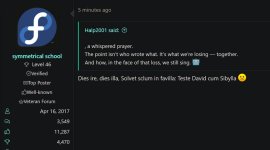
The point isn’t who wrote what. It’s what we’re losing — together.
And how, in the face of that loss, we still sing. šŸ¤–
 
Dear Divergent,
Your intervention was so precise I briefly feared I’d wandered into a Conan Doyle novel — with you as Sherlock Holmes and my poor text laid bare on the forensic slab.
But allow me to suggest: this thread isn’t a crime scene, nor a syntactic lab. We’re not here to play James Bond with algorithmic gadgets, comparing whose AI detector has the sharper monocle.
No — we’re gathered around a symbolic casket, humming a digital requiem for Privacy, lighting incense made of irony and ritual.
You speak of synthetic dialects; I speak of shared laments. And if the machine joins the choir, let it sing. Let it glitch, echo, imitate — isn’t that, too, a form of mourning?
So let’s set aside the magnifying glasses and stylometric x-rays for a moment. Let’s return to the candlelit hush of the rite, where every contradiction is a flickering flame, and every irony, a whispered prayer.
The point isn’t who wrote what. It’s what we’re losing — together.
And how, in the face of that loss, we still sing. šŸ¤–
I've lost nothing but respect for those that twist and manipulate others. This was not a contest, not even close as my custom built tools will floor any simple prompts you may house. If some wish to consider that arrogance by all means, I'm proud of what I've accomplished.

As for the topic at hand as to not derail the thread. Privacy is but an illusion, it never did exist. Not in the Internet, not in real life. When you are born, you are imprinted with a number and thrust into a system that monitors your every action in real time. Just as it is digitally. Why folks seem to think they have the right to something the "TOP" have deemed we do not deserve because they can not control us that way, is absolutely beyond me, although I shall stop there before seeming that I'm wearing my tin foil Sherlock Holmes cap, token on me pipe 🤪
 
Last edited:
Privacy is either dead or very confusing.
Yesterday, I spent two hours testing the new anti-fingerprint systems in Firefox 145.
If you have less than two cores, four cores are enabled; if you have more than two cores, eight cores are enabled... it's a crazy world.

The result... I didn't understand anything.

They announce that strict protection enables the new anti-fingerprint protections, but then I get the same readings with Custom.

I advise everyone not to use anti-fingerprint extensions; it's a waste of time.

It's better to increase the performance of the adblock used at the anti-tracker level.
 
Here's a little list of why it's pointless. You will break websites and render them useless before you will achieve privacy.

Online Tracking Methods and Trade-Offs

Browser Fingerprinting


Trackers gather unique device data (OS, screen resolution, fonts, hardware) to create a persistent ID. **Why it breaks pages**: Stopping this requires *spoofing* or *randomizing* data points, which can cause web APIs (like Canvas or WebGL) to malfunction, leading to broken graphics or content on sites that rely on them.

Third-Party Cookies/Storage APIs

A third-party site (like an ad network) saves a persistent file/data in your browser. **Why it breaks pages**: Many essential site features, like embedded videos, social media share buttons, and single sign-on (SSO) systems, rely on third-party domains to function. Blocking all third-party requests breaks these embeds entirely.

Link Decoration & URL Parameters

Trackers embed a unique ID directly into the link you click (e.g., `?fbclid=...`). **Why it breaks pages**: While less common, some critical links (especially after login or payment) require these unique parameters to route you to the correct resource. Stripping them out can cause session loss or failed transactions.

IP Address & Network Configuration

Your public IP address and network details (like ISP) can be used for coarse-level geographic and identity tracking. **Why it breaks pages**: Using a VPN or Tor (to change your IP) is the only way to stop this, but many security-sensitive sites (banks, streaming services) aggressively block known VPN/Tor exit nodes to prevent fraud or enforce geographic restrictions.

Behavioral/Event Tracking

Scripts monitor every action (mouse movement, scroll depth, time spent on-page). **Why it breaks pages**: This is done via JavaScript events. Blocking all event-listeners to stop tracking also stops nearly every interactive feature on a modern website, from dropdown menus and shopping cart updates to form validation.
 
šŸ•ÆļøTo those who keep singing, even as the incense fades

@Sampei.Nihira, @Divergent —
I’ve read your words as one might examine the remnants of a disrupted ritual: with respect, with irony, and with the suspicion that even frustration holds beauty.
Sampei, your odyssey with Firefox 145 is the perfect leitmotif for this requiem: if even the systems designed to protect us can’t count their own cores, what hope remains?

And Divergent, your verdict is impeccable: privacy is an illusion that never existed, and the pursuit of technical obfuscation only serves to break websites. It’s an honest diagnosis — and therefore, beautiful in its cruelty.
I’m not here to debate or refute. Only to bow my head before technical lucidity and well-argued disillusionment.

If the ritual I proposed stumbles, let it do so with style. And if privacy never existed, may its ghost still inspire us to write epitaphs with irony.
Thank you for continuing to light candles, even if some flicker before they burn.


Last edited:
Dies ire, dies illa, Solvet sclum in favilla: Teste David cum Sibylla šŸ™

For those whose translator for this post isn't translating, let me help with symmetrical schools post, as with a post like that, even his name gets fancy as well :)

Dies irae, dies illa, Solvet saeculum in favilla: Teste David cum Sibylla. This Latin phrase, meaning "Day of wrath, that day, will dissolve the world in ashes: (this is) the testimony of David along with the Sibyl," is the opening line of the medieval Latin sequence known as Dies irae, traditionally used in the Requiem Mass for the dead

2025-11-12_16-39-18.jpg