

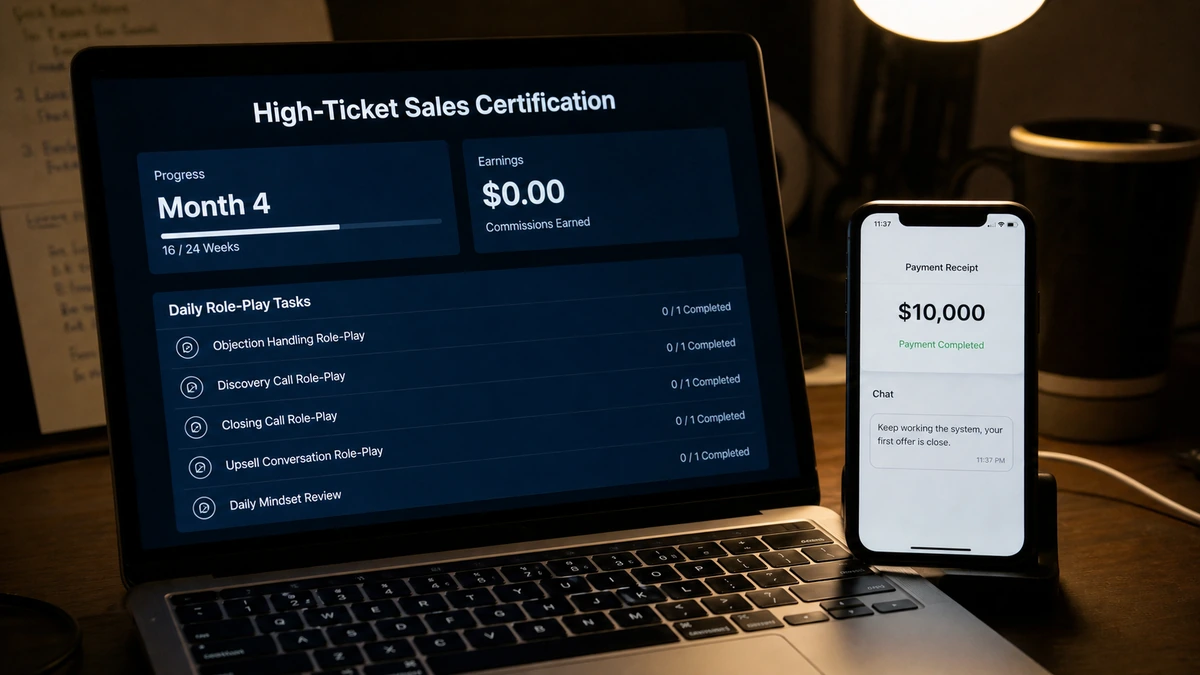
Four months after paying $10,000 for a High-Ticket Sales Course, the student had not earned anything. Her days were still packed with role plays, Discord sessions, scripts, and the promise that success would arrive after enough practice.
When a friend questioned the program, the answer was not a contract, placement record, or earnings report. The coach allegedly advised the student to tell people only that she worked in sales and not explain the details.
Overview
The public report describes an expensive promise, not a named program
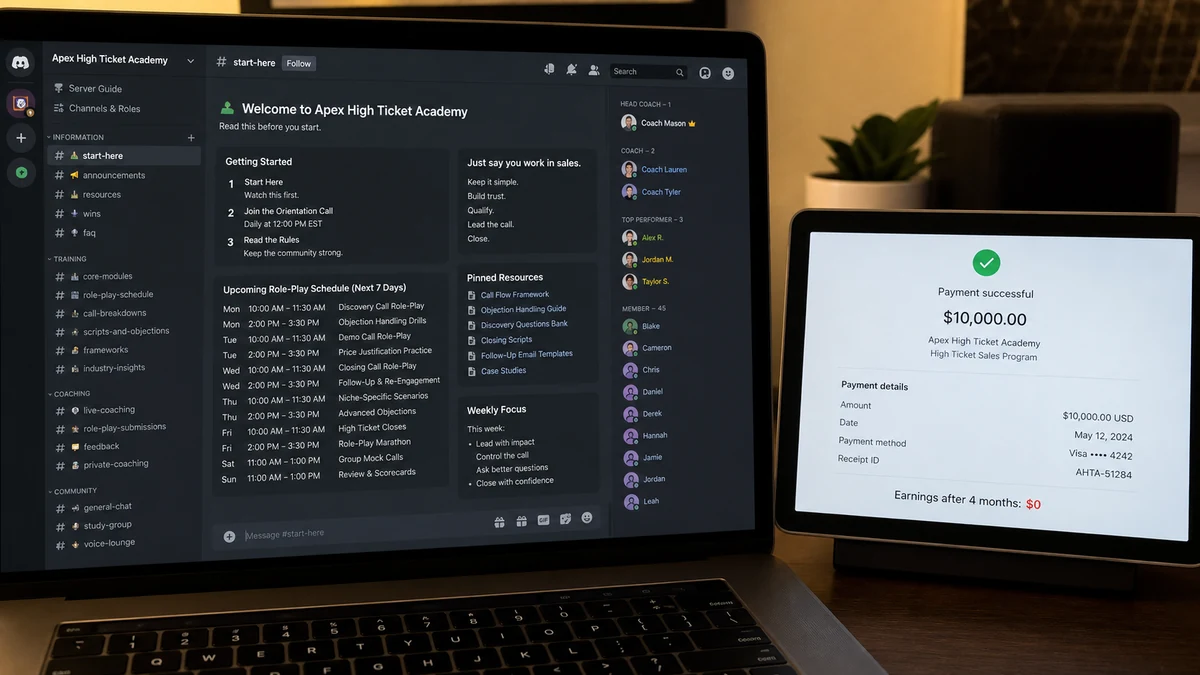
A recent consumer report describes a person who quit her job and spent $10,000 on a high-ticket sales course. After four months, she reportedly worked on the computer for 10 to 13 hours a day but had not been paid.
Most of the activity involved Discord role plays and attempts to obtain “offers.” One opportunity was reportedly rejected. The student also practiced a pitch involving free trading classes and believed she could eventually earn $10,000 a month.
The report does not name the course, coach, company, website, contract, or country. Those missing facts prevent a responsible article from declaring that one identifiable business committed fraud.
The warning signs can still be evaluated
A high price, heavy workload, and disappointing result do not automatically prove a scam. Difficult professional training can be expensive, and no legitimate course can guarantee that every graduate will obtain a job.
The red flags arise from how the opportunity appears to have been sold and managed: a large income expectation, no earnings after months of full-time effort, unclear placement, secrecy about the details, and continued dependence on an internal coaching community.
The student’s belief that the program will pay off after one more stage may also make it harder to evaluate objectively. Losing $10,000 is painful, and admitting that the promised route may not work can feel like turning the payment into a permanent loss.
Sales training must be judged by evidence, not intensity
Role playing is a normal sales-training technique. Discord is a normal communication platform. “High ticket” simply describes selling an expensive product or service. None of those elements proves wrongdoing.
The real questions are what was promised before payment, who accepted the money, what curriculum and support were contracted, whether outcomes were substantiated, and whether graduates are placed into real paid work rather than another recruitment or coaching funnel.
Warning signs in a $10,000 high-ticket sales course include:
- Precise monthly income claims without typical-results evidence.
- Pressure to quit stable work before paid opportunities exist.
- A large fee financed through credit or depleted savings.
- Training activity presented as if it were employment.
- Months of unpaid role plays with no measurable placement progress.
- Coaches discouraging clear discussion of what the program involves.
- Sales practice involving questionable trading or income offers.
- Success stories that cannot be connected to independently verified graduates.
What This Report Can Support
The public account supports concern about one student’s experience as described by a friend. It suggests that the student paid a substantial fee, stopped ordinary employment, trained intensively, and had no income after four months.
It also reports a coach’s advice to keep the explanation vague. If accurately quoted and understood, that is a meaningful red flag because a legitimate training provider should welcome clear questions about the curriculum and business model.
The report cannot establish whether the student misunderstood the promise, completed the course requirements, received written disclosures, or bought from a company with a refund process. It also cannot show how other students performed.
That uncertainty should lead to document review, not dismissal. The student should compare the sales page, webinar, messages, contract, recorded calls, and receipt with the service actually delivered.
The FTC’s guide on business offers and coaching programs recommends being skeptical of guaranteed income, a proven system, pressure to decide quickly, and claims that buyers need little experience.
MalwareTips has examined similar evidence problems in an AI automated business offer whose workload, operator disclosures, and income imagery required closer scrutiny.
How the $10,000 High-Ticket Sales Course Scam Works
Step 1: Lifestyle content turns sales into an escape route
The funnel begins with short videos, webinars, testimonials, or direct messages showing flexible hours, remote work, and unusually high commissions. The pitch may say no degree, experience, inventory, or large audience is required.
Sales is a real profession, which makes the promise more plausible than an obvious lottery. The missing detail is how a beginner will obtain qualified prospects and a reputable product to sell.
Step 2: A free call becomes an eligibility interview
A setter asks about income, frustration, savings, credit, goals, and the cost of staying in the current job. The conversation frames the program as a selective opportunity rather than a product available to anyone who can pay.
Those questions also reveal the maximum price and which emotional pressure will be effective.
Step 3: Exceptional outcomes are presented as reachable
The closer may discuss $10,000 months, rapid placement, high commissions, or students who recovered tuition after a few deals. Screenshots and testimonials can show revenue without expenses, refunds, lead costs, hours, or the number of unsuccessful buyers.
A disclaimer buried later cannot repair a sales conversation that created a materially different expectation.
Step 4: The fee creates commitment before verification
The student pays $10,000, uses financing, or divides the price across cards. A deadline, expiring discount, limited cohort, or claim that hesitation is a mindset problem can suppress comparison shopping.
After payment, the same amount that should trigger scrutiny can produce loyalty. Walking away now feels like wasting the entire investment.
Step 5: Activity replaces measurable progress
The student receives modules, scripts, role plays, calls, scorecards, and community channels. These can be useful training tools, but their quantity does not prove that the program creates paid work.
A person can spend 10 to 13 hours a day inside a community while the central placement promise remains unresolved.
Step 6: Failure is returned to the student
When results do not appear, the explanation becomes insufficient belief, poor energy, weak objection handling, lack of consistency, or unwillingness to follow the system. More coaching is prescribed.
Individual effort matters in sales, but a provider should still disclose typical outcomes and measure whether its promised process produces real opportunities.
Step 7: The student sells the same dream or buys another level
Some funnels lead graduates toward selling coaching, trading education, or another income opportunity. Others offer advanced certification, private mentorship, lead access, or placement help for a new fee.
The cycle can continue because every additional purchase is presented as the missing piece between training and income.
What “High-Ticket Sales” Really Requires
High-ticket sales means selling products or services with a relatively high price. Real roles exist in software, professional services, equipment, education, home improvement, and other industries.
Legitimate employers usually define the product, compensation plan, territory, lead source, quota, manager, expenses, and whether the role is employment or independent contracting. A commission-only offer can be lawful, but the risk belongs largely to the salesperson.
Training does not create demand. Even an excellent closer cannot earn if the company supplies weak leads, sells a poor product, delays commissions, generates chargebacks, or recruits more sellers than it can support.
A student should know whether “placement” means a guaranteed job, an introduction, access to a job board, a chance to audition, or permission to contact outside businesses. Those are very different deliverables.
Ask how many people purchased the program, completed it, obtained a paid role, earned commissions, requested refunds, and remained active after six months. A highlight reel without the denominator is not an outcome report.
Also ask whether graduates are primarily selling independent products or the provider’s own courses. A system sustained by recruiting new buyers into the same promise deserves heightened scrutiny.
The FTC’s Sales Mentor Case Shows Why Substantiation Matters
In 2023, the FTC filed a case against operators of The Sales Mentor. The agency alleged that the defendants made false or unsupported claims about telemarketing income and charged consumers hundreds or thousands for training.
The FTC announcement described claims that consumers could generate $10,000 to $20,000 a month. That case does not identify the unnamed program in the public report and should not be treated as evidence about it.
It is useful as a documented comparison. Regulators evaluate whether earnings claims are substantiated, whether typical consumers achieve them, and whether the sales process misrepresents what buyers will receive.
The FTC’s Sales Mentor case announcement also shows that a real skill category can be used inside a deceptive income opportunity. Telemarketing exists; that does not validate every course promising unusually fast income from it.
Compare the exact language used in the student’s sales call with the contract. Save webinar replays, direct messages, screenshots, invoices, and calendar invitations before accounts or pages disappear.
If the provider promised a specific result orally but the written agreement disclaims it, that conflict is important evidence for a bank, regulator, attorney, or consumer-protection office.
A Practical Audit Before Paying for Any Coaching Program
Identify the legal seller before attending a closing call. Search corporate registration, named owners, office address, complaint history, lawsuits, regulatory actions, and the payment descriptor.
Request the full contract and refund policy in advance. Read whether refunds depend on attendance, assignments, application counts, recorded calls, deadlines, or other conditions controlled by the provider.
Ask for typical outcomes in writing. Do not accept a handful of screenshots as proof of what an ordinary purchaser can expect.
Speak with graduates you locate independently. A reference selected by the company may be an affiliate, coach, top performer, or compensated promoter.
Verify the job side. Contact several companies said to hire graduates and ask about role type, typical leads, commission timing, chargebacks, base pay, and recent placements.
Calculate the full cost, including financing interest, software, lead lists, dialers, travel, advanced coaching, and unpaid months. Tuition is not the only risk.
Take at least 48 hours away from the sales team. A program that loses its value when independently researched was not presenting a durable opportunity.
How to Help a Friend Without Pushing Them Deeper
Calling the student gullible may strengthen loyalty to the coaching group. The community can then frame family concern as negativity from people who do not understand entrepreneurship.
Lead with shared goals: stable income, useful skills, and a fair return on the $10,000 already paid. Ask what evidence would show progress over the next 30 days.
Build a simple timeline of promises, payments, work completed, interviews, offers, and income. Concrete dates reduce arguments about attitude.
Ask to review the contract and original presentation together. Focus on discrepancies between promised deliverables and actual delivery.
Encourage the student to pause new payments and keep an ordinary source of income while evaluating. Continuing to work does not prove a lack of belief in the course.
If the student is practicing pitches for trading classes, investigate the product being sold. A salesperson can face complaints, chargebacks, and reputational harm for promoting a misleading offer even if the salesperson was first misled.
A neutral third party can make the review easier. A consumer attorney, accountant, experienced sales manager, or career counselor can compare the contract with ordinary hiring and compensation practices.
The review should also separate learning from earning. A student may have improved at discovery calls and objections while still receiving a poor financial return. Acknowledging a useful skill does not require defending every income claim or new fee.
Set a firm date for the next decision. By that date, require defined applications, interviews, written offers, paid commissions, and no new tuition. Moving the deadline every month keeps the student inside the sunk-cost loop.
Income imagery deserves the same scrutiny used in the AI Secret Button business-opportunity investigation: identify the merchant, read the disclaimer, and demand evidence that the advertised result is typical rather than exceptional.
Leaving a course is not the same as abandoning a career. The student can keep useful sales skills, seek ordinary paid roles, and refuse further spending while the original purchase is disputed.
Company, Address, and Fulfillment Checks
The company cannot be identified from the report
No course name, operator, website, receipt, or legal entity was provided. It would be irresponsible to attribute the story to a specific business.
The student should identify the exact entity named on the contract and card statement.
The address and jurisdiction are unknown
No physical address or governing jurisdiction appears in the public account. Those facts determine where complaints, cancellation notices, or legal claims can be sent.
A Discord server is a communication tool, not a verified business location.
The income and placement claims need documents
The report mentions an expected $10,000 monthly income but does not show the original advertisement or earnings disclosure.
Save the exact promise and ask the provider for the evidence used to substantiate it.
Fulfillment is more than access to training
If the contract promised modules and calls only, access may satisfy a narrow delivery clause even when the economic result disappoints. If it promised placement, leads, mentorship, or certification, those items must be measured separately.
Compare every written deliverable with dates, records, and outcomes rather than one general impression.
What to Do if You Have Fallen Victim to This Scam
- Pause all new payments. Do not buy advanced coaching, leads, certification, or a recovery service while reviewing the first purchase.
- Preserve the sales evidence. Save ads, webinars, messages, contracts, call recordings where lawful, invoices, refund terms, and earnings claims.
- Create a promise-to-delivery timeline. List what was offered, what was paid, what was received, and what remains missing.
- Submit a written cancellation or refund request. Follow the contract method and keep proof of delivery.
- Contact the card issuer or finance provider. Explain specific misrepresentations and undelivered services rather than only saying the course was disappointing.
- Report deceptive claims. File with the FTC, state attorney general, and relevant consumer-protection or business regulator.
- Get independent legal advice. This is especially important for a $10,000 loss, financing agreement, arbitration clause, or threatened collection.
- Protect employment and cash flow. Do not quit another job or take new debt while the program is under review.
- Review products you were asked to sell. Stop promoting any trading, income, or coaching offer whose claims you cannot verify.
- Change reused account passwords. Secure email, Discord, payment, and file-sharing accounts if credentials were shared with coaches.
- Run a Malwarebytes scan. Do this if the program required unknown dialers, browser extensions, remote-access tools, or downloads.
- Use AdGuard after cleanup. It can block many deceptive ad and tracking routes, but it cannot judge a coaching contract.
- Ignore refund recovery pitches. A stranger promising guaranteed recovery for an upfront fee is a second risk.
Frequently Asked Questions
Is every high-ticket sales course a scam?
No. Sales training is legitimate when the provider, curriculum, cost, claims, and outcomes are transparent. The evidence for each program must be evaluated individually.
Does paying $10,000 prove fraud?
No. A high price is a reason for deeper diligence, not proof by itself. Misrepresentation, substantiation, contract terms, and delivery matter.
Are Discord role plays a red flag?
Role plays can be useful. They become concerning when endless activity replaces promised placement, income, or measurable progress.
Can a course guarantee $10,000 a month?
A responsible provider should not guarantee a specific income that depends on employers, leads, products, performance, and market conditions.
Can the student dispute the charge after four months?
Possibly, depending on payment method, jurisdiction, dates, contract, and evidence. Contact the issuer promptly and describe concrete misrepresentations or missing services.
How should family members raise concerns?
Avoid ridicule. Review documents, dates, promised outcomes, new fees, and a short evidence-based progress test together.
The Bottom Line
The $10,000 high-ticket sales course report contains serious warning signs, but it does not identify the program or provide enough records to declare one company fraudulent. The right response is a careful contract and claims audit.
Training should create skills and measurable opportunity, not an endless loop of unpaid activity and secrecy. Pause new payments, preserve the original promises, verify placement outcomes independently, and judge the program by what it delivered, not by how hard the student was told to believe.








