

The Bill Gates AI Secret Button Scam promises the kind of opportunity that feels impossible to ignore. A famous technology leader appears to reveal an overlooked AI system, ordinary people supposedly earn money within days, and access seems to cost less than a routine online purchase.
Behind that story is a sales page currently branded around AI Matrix. We examined its income claims, $67 access offer, contact form, marketing consent, payment route, disclaimers, company disclosures, and the important details the celebrity-style promotion leaves unanswered.
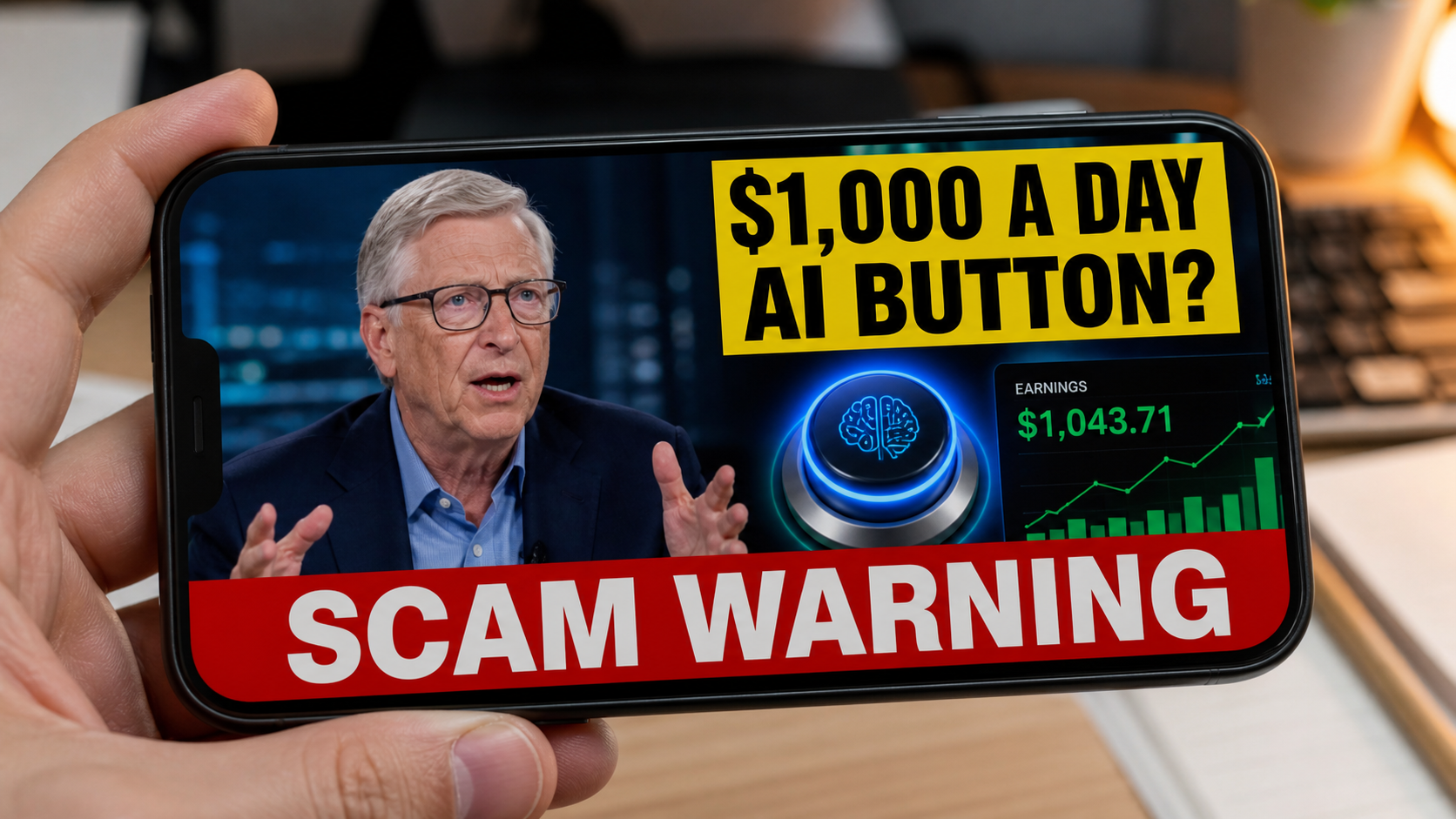
The first image recreates the appearance of the deceptive social videos being warned about. A realistic Bill Gates likeness, glowing AI button, earnings chart, and $1,000-a-day headline compress an entire get-rich-quick story into one phone screen.
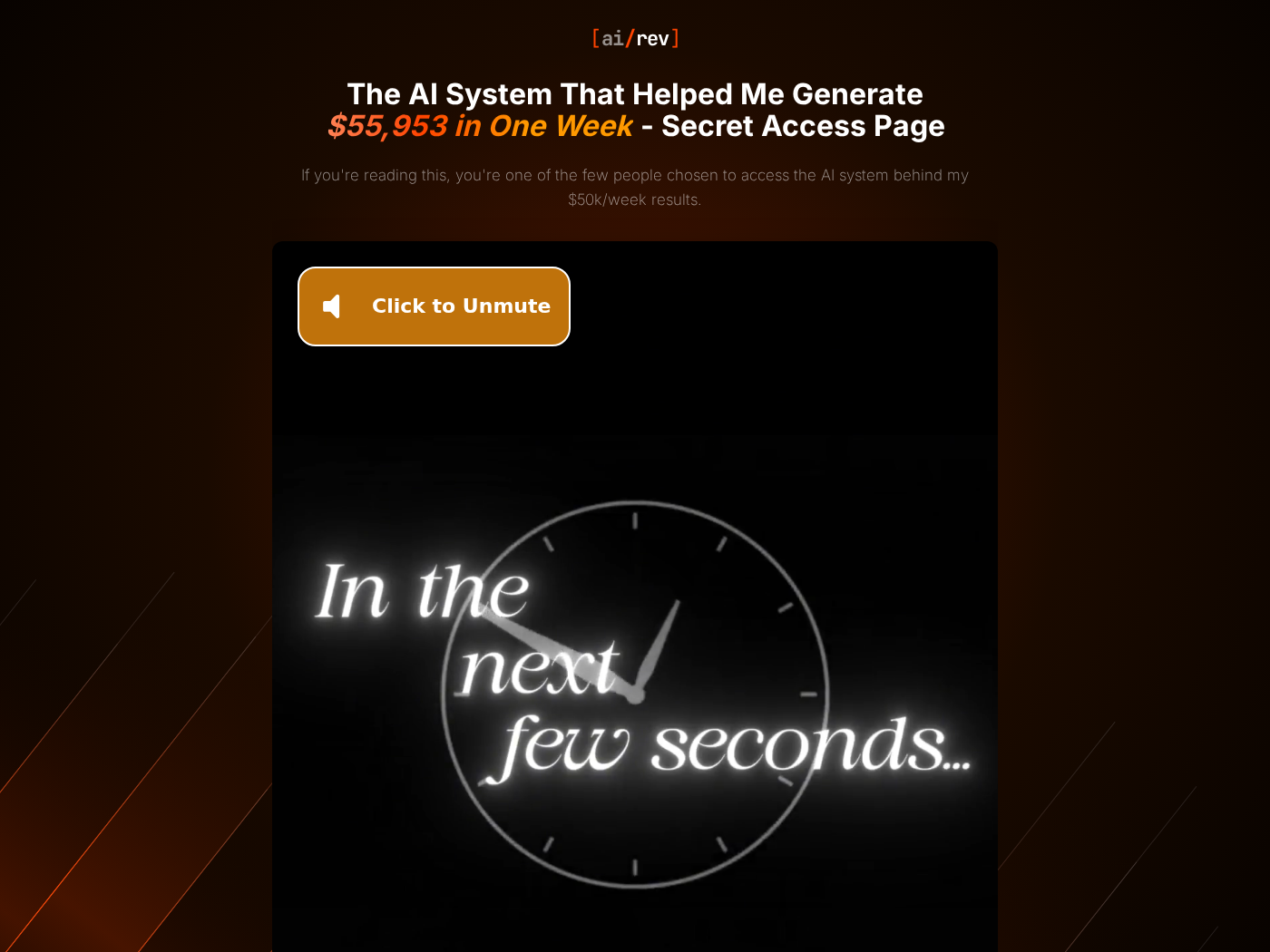
The live sales page uses a different visual style but the same emotional mechanics. It claims that an AI system helped generate $55,953 in one week and tells visitors they are among the few people chosen to access the system behind supposed $50,000 weekly results.
A dark page, autoplay-style presentation, unmute button, limited-access language, and precise earnings figure create urgency before the visitor can identify the legal operator or understand what the $67 purchase actually provides.
Overview
Bill Gates is the bait, not a verified participant
We found no credible evidence that Bill Gates created, endorsed, invested in, or revealed the AI Matrix offer. A synthetic or contextually edited celebrity clip cannot establish a commercial relationship. Verification requires a statement on an official channel and clear disclosure from the seller.
The use of a technology billionaire is strategic. Viewers may transfer Gates’s reputation in software and investing to an unrelated digital offer, even when the checkout provides no documentary connection to him.
The current page makes extraordinary income claims
The landing page says its AI system helped generate $55,953 in one week and describes access to results around $50,000 per week. It also displays a 4.4 out of 5 rating based on 1,475 reviews and a 60-day guarantee.
Those statements come from the seller-controlled page. The income disclaimer says results are not typical and offers no guarantee that a buyer will make money. That quiet qualification conflicts with the certainty and precision used in the main headline.
The visible $67 offer is not a proven subscription
The accessible page advertises access for $67 and routes payment through a separate payments.aimatrixsystem.com domain. The payment page was protected by Cloudflare during our review, so we could not independently inspect every final billing term.
We therefore cannot label the current offer a confirmed recurring subscription. Buyers must review the last authorization screen for upsells, memberships, rebills, software fees, coaching, or continuity language and save it before submitting payment.
- Fake or manipulated celebrity videos create the initial authority.
- The offer suggests an AI button can produce unusually large income.
- The live page claims $55,953 generated in one week.
- Access is advertised at $67 with a 60-day guarantee.
- The page requests a full name, email address, and US phone number.
- Submitting the form includes consent to marketing emails and text messages.
- The checkout uses a separate AI Matrix payment domain.
- Recurring billing was not verifiable from the publicly accessible payment screen.
What the AI Secret Button Story Is Really Promising
The campaign sells escape more than technology. It speaks to people who are worried about bills, retirement, job insecurity, or missing the AI boom, then offers a system that supposedly removes the need for experience, programming, sales, or meaningful effort.
A secret button is the perfect metaphor because it makes a complex process feel mechanical. Pressing it supposedly turns artificial intelligence into automatic income. The viewer is discouraged from asking who pays the money, what asset is traded, what service is delivered, or why the opportunity needs a deceptive celebrity ad.
The precise earnings figure adds false concreteness. $55,953 sounds like an audited result rather than a round marketing promise. Yet the page does not provide independently verified account records, a reproducible business model, typical-user distribution, or evidence connecting those results to the product sold for $67.
Scarcity then reframes caution as loss. The visitor is told that few people are chosen and the access page is secret. That message is difficult to reconcile with a publicly promoted funnel designed to accept many leads and payments.
Finally, the celebrity story provides an explanation for success before the service is understood. If Bill Gates allegedly supports the system, the viewer may assume technical and financial due diligence has already been completed. It has not.
What Our AI Matrix Investigation Found
The current landing page at fluxoriumlabs.com brands the presentation as an AI system and repeatedly highlights a claim of $55,953 generated in one week. It describes the visitor as specially selected even though the page is accessible through an ordinary public URL.
The page advertises $67 access, a 60-day guarantee, and a 4.4 out of 5 rating based on 1,475 reviews. We did not find an independent review dataset on the page that would let readers inspect dates, verified purchases, negative feedback, or the calculation method.
Before purchase, the form asks for a full name, email, and US phone. Its consent language allows marketing emails and texts. A person can therefore enter a follow-up sales funnel even if they do not finish the $67 transaction.
Payment takes place on payments.aimatrixsystem.com rather than the landing-page domain. A separate payment host is not automatically fraudulent, but it makes merchant identity, data sharing, refund responsibility, and final billing terms especially important.
The visible privacy and terms links returned the sales presentation rather than a clearly accessible legal policy in our web review. We also did not find a prominent legal company name, physical address, or ordinary support identity on the opening page.
The income disclaimer says outcomes vary, results are not typical, and no earnings are guaranteed. A disclaimer cannot erase the net impression of a headline built around exceptional weekly income, secret access, selected users, and celebrity authority.
How the Bill Gates AI Secret Button Scam Works
Step 1: A deepfake celebrity clip stops the scroll
The ad appears to show Bill Gates or another recognizable technology figure discussing an AI opportunity. Real interview footage may be combined with synthetic audio, altered captions, and edited mouth movement.
The advertiser relies on recognition. The viewer notices the famous face before checking the sponsored page, domain, disclosure, or whether the clip exists in the person’s authentic interview archive.
Step 2: A daily income number creates instant desire
The message promises $1,000 a day, $50,000 a week, or another unusually precise amount. The earnings are described as accessible to beginners with little time and no specialized skill.
No clear customer, market, asset, or value-producing activity explains where the money comes from. The number functions as emotional bait rather than a forecast supported by risk and performance data.
Step 3: A fake news page launders the claim
The click can lead through an advertorial designed to resemble CNN, Fox News, Forbes, a television transcript, or a financial-news investigation. Logos and page structure create borrowed credibility.
The address bar reveals that the page is not hosted by the copied publication. Buttons all move toward the same offer, and there is no independent reporting, author verification, or editorial correction path.
Step 4: The secret button becomes AI Matrix
The vague AI opportunity is finally attached to a product name. On the current page, AI Matrix is presented as the system behind a claimed $55,953 week.
The service remains poorly defined compared with the strength of the income promise. Buyers should know exactly what software, training, signals, license, support, and ongoing costs they receive before paying even $67.
Step 5: Contact details feed continued sales pressure
The visitor is asked for a name, email, and US phone number, with consent to receive marketing messages. That creates value for the funnel even if the first purchase is abandoned.
Follow-up texts or calls may introduce urgency, coaching, account setup, larger packages, or another related offer. Never allow an inbound caller to remote-control a device or move money on your behalf.
Step 6: The $67 checkout can lead to additional decisions
A modest entry price lowers resistance. The payment route may then present order bumps, upgrades, premium access, coaching, memberships, or future billing terms that were not prominent in the celebrity video.
We could not verify the protected final payment screen, so those additions are risks to check, not established facts. Read the total, merchant, refund policy, and recurring authorization before clicking the final order button.
Step 7: Refund and charge disputes become harder than joining
If the system does not produce the implied income, the seller can point to the disclaimer stating that results are not typical. The buyer then has to identify the merchant and satisfy the 60-day guarantee procedure.
Screenshots matter because the landing page, celebrity creative, price, or domain may change. The original representation and final billing authorization are the strongest evidence in a refund or card dispute.
Company, Address, and Fulfillment Checks
The famous face tells you nothing about the merchant
Bill Gates is not the seller. The company accepting payment should be named in the checkout, terms, receipt, and card descriptor. The current landing page did not prominently identify a legal entity or physical office during our review.
Do not send money when the operator is harder to identify than the claimed earnings. A real business opportunity should disclose who provides the service, which law governs the purchase, and where formal notices can be sent.
A hidden address blocks meaningful verification
Without a clear company address, a buyer cannot easily distinguish headquarters from a mailbox, registered agent, call center, or fulfillment contractor. Digital products still need a responsible legal seller.
Search the payment descriptor after it appears, but do not wait until a dispute to perform the check. Ask for the legal name, address, refund destination, and tax or registration details before authorizing the card.
A protected checkout is not a trust certificate
Cloudflare can protect legitimate and illegitimate sites. The fact that a payment page uses HTTPS or a security service means the connection may be encrypted, not that the income claims, seller, or refund promise have been verified.
Call or email support before purchase and ask what the $67 includes, whether anything renews, and how the 60-day guarantee works. Save the answer and compare it with the final checkout.
There is no physical supplement origin to blame here
This offer appears to sell digital AI-related access, so claims about Chinese supplement factories or fulfillment centers would be irrelevant and misleading. The applicable traceability questions concern the software provider, payment merchant, data processor, and support operator.
The risk comes from an opaque business identity, unverifiable earnings, celebrity impersonation, lead collection, and uncertain final billing. Those facts are serious enough without adding unsupported claims about manufacturing.
Why the Earnings Disclaimer Does Not Fix the Main Impression
A responsible income offer explains risk before highlighting exceptional results. AI Matrix does the reverse. The largest text promotes $55,953 in one week, while the disclaimer later says results are not typical and earnings are not guaranteed.
That structure matters because consumers form their expectation from the headline, video, scarcity, and testimonials. A quieter legal paragraph cannot automatically neutralize an overall message that suggests unusually easy and repeatable income.
The supposed technology remains secondary to the story. Genuine AI tools can automate tasks, analyze data, and improve productivity, but they do not create money without a customer, investment, market risk, valuable service, or other economic mechanism.
The lack of a verified Bill Gates relationship is another decisive failure. If the celebrity claim is false, the advertiser is willing to fabricate the strongest reason viewers have for trusting the offer. The remaining claims deserve stricter scrutiny, not the benefit of the doubt.
Our conclusion is based on the funnel, not on the idea that every $67 digital course is fraudulent. This specific route combines a false celebrity premise, extraordinary earnings, selected-user language, thin company disclosure, and a protected checkout we could not fully inspect.
Warning Signs to Watch For
- Bill Gates appears to endorse a system outside his verified channels.
- A single AI button supposedly produces $1,000 a day with minimal work.
- The ad routes through a fake financial-news or television layout.
- The page claims $55,953 in one week while disclaiming typical results.
- Visitors are told they are specially chosen on a publicly accessible page.
- Seller-controlled ratings provide no inspectable review history.
- The legal company and physical address are not prominent.
- The landing page and payment page use different domains.
- Contact submission includes marketing email and text consent.
AI is real technology, but that fact cannot validate a secret-income funnel. When a false celebrity endorsement, copied news design, exceptional earnings, scarce access, lead collection, and opaque merchant appear together, the safest decision is to keep your money and data away.
What to Do if You Have Fallen Victim to This Scam
- Save every version of the offer. Capture the celebrity ad, fake article, landing page, $67 checkout, guarantee, disclaimer, receipt, confirmation emails, and card descriptor. Include dates and the advertiser profile.
- Request a refund immediately. Contact the merchant in writing under the advertised 60-day guarantee. State what was promised, what was delivered, and whether you authorize any future billing.
- Cancel unknown memberships separately. Review the final receipt for coaching, software, premium access, or continuity terms. Ask for written confirmation that each service and recurring authorization has ended.
- Call the card issuer for unresolved charges. Dispute unauthorized rebills or a merchant’s failure to honor written refund terms. Provide screenshots of the false endorsement, sales claims, cancellation, and any support response.
- Stop contact with high-pressure callers. Do not pay an upgrade, deposit, tax, withdrawal fee, or account activation charge. Never install remote-access software or share a one-time verification code with an inbound caller.
- Change reused credentials. If you created a password used elsewhere, replace it on every affected account and enable multi-factor authentication. Watch email and phone messages for follow-up impersonation.
- Check the device for unwanted software. Run Malwarebytes after any download or remote-access session. Use AdGuard to reduce malicious ad and tracking exposure.
- Report the impersonation. Report the ad to the platform, the FTC, and the FBI Internet Crime Complaint Center if money, identity data, or remote access was involved.
Frequently Asked Questions
Did Bill Gates create the AI secret button?
We found no credible evidence that Bill Gates created, endorsed, or revealed AI Matrix or a system guaranteeing daily income. Verify any commercial claim through his official channels rather than a sponsored clip.
What is AI Matrix selling?
The current page advertises $67 access to an AI-related system, but the economic mechanism and exact deliverables are much less clear than the earnings claims. Buyers should demand a written feature and cost list.
Can an AI system really generate $55,953 in one week?
The seller displays that figure, but we found no independent audit showing typical buyers reproduce it. AI can assist work and analysis, yet income still depends on value, customers, capital, skill, and risk.
Is the $67 payment a subscription?
The public page shows a $67 offer, but the protected final checkout prevented complete verification of billing terms. We cannot confirm recurring charges. Read and save the final authorization before payment.
Why does the page ask for a phone number?
The form includes consent to receive marketing emails and texts. That can lead to follow-up sales communication even when a visitor does not complete the original purchase.
Does the 60-day guarantee make AI Matrix safe?
No. A guarantee is only as useful as the identifiable merchant, clear procedure, reachable support, and actual refund performance. It does not verify the celebrity endorsement or income claims.
The Bottom Line
The Bill Gates AI Secret Button Scam uses a fabricated celebrity connection to make an opaque digital offer look like a privileged technology opportunity. The live funnel adds extraordinary weekly earnings, selected-user language, seller-controlled ratings, contact collection, and a $67 purchase.
There is no verified Bill Gates endorsement and no independent evidence that typical customers achieve the advertised results. Until the legal merchant, exact service, total billing, recurring terms, and performance evidence are clear, the correct move is to avoid the offer.








