

A call from a familiar 352 number feels local, especially if you live near Gainesville, Ocala, or Inverness. The voice on the other end may even claim to represent a nearby court, utility, or sheriff’s office.
The 352 area code scam does not depend on owning a Florida telephone line. It depends on making the number look close enough that you answer before questioning the story.
Overview
Neighbor spoofing makes a distant caller appear local
The 352 area code scam uses manipulated caller ID, internet calling, disposable numbers, or compromised accounts. The displayed number can resemble a home, business, or agency in north-central Florida.
A 352 prefix covers communities including Gainesville, Ocala, The Villages, Inverness, and surrounding areas. That geographic familiarity is the bait, not evidence of the caller’s location.
The caller borrows the authority of a real local organization
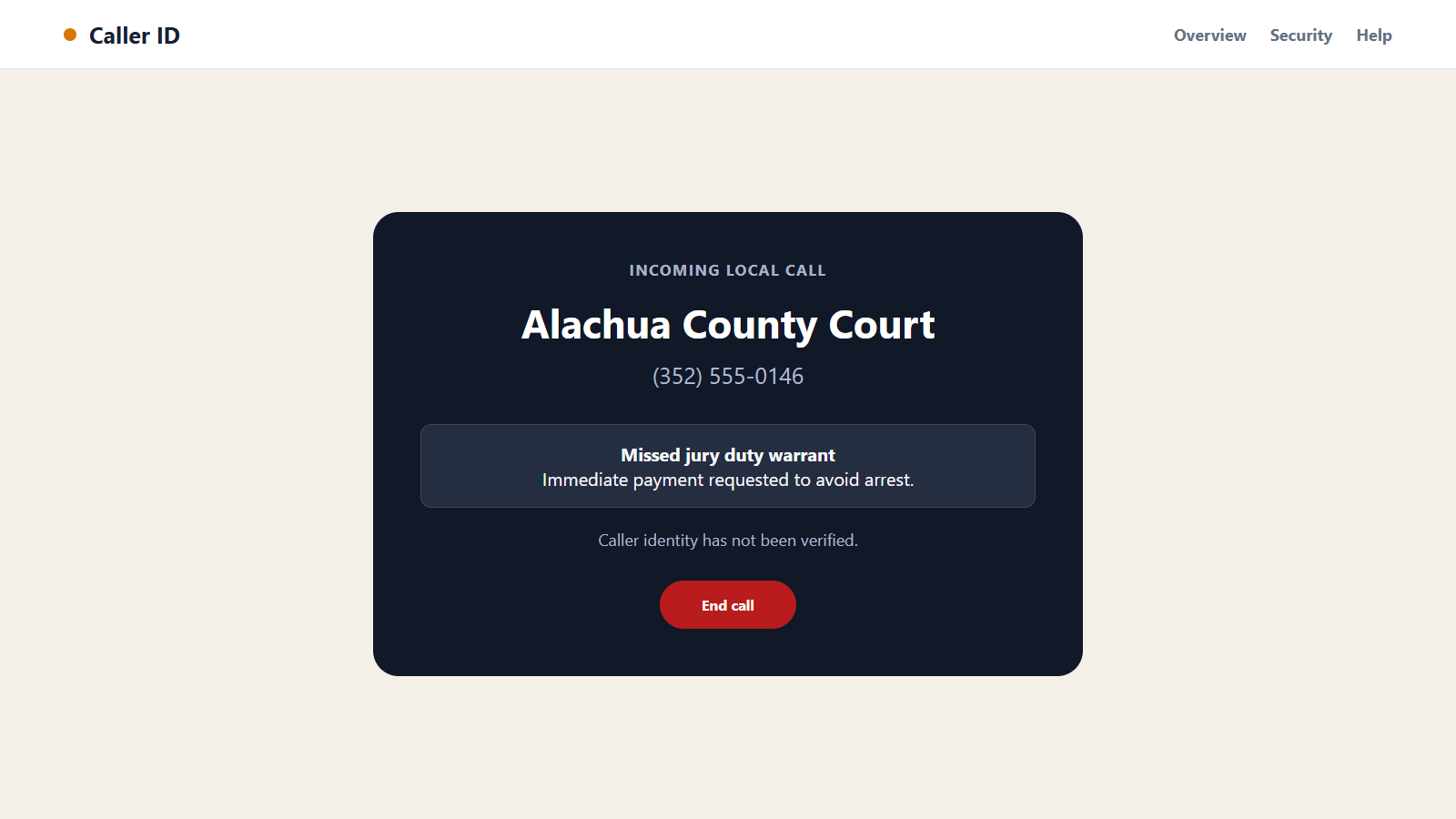
Common scripts involve missed jury duty, utility disconnection, unpaid taxes, a relative in custody, bank fraud, or an Apple Pay alert. The criminal creates a problem that supposedly must be solved during the call.
A real agency name, employee name, or local address may be copied from public information. Those accurate details make the invented demand sound official.
The payment route reveals the true purpose
The victim may be told to buy gift cards, use a payment app, deposit cash into a cryptocurrency kiosk, or provide card details. Phishing texts can send the same person to a copied payment page.
These rules cut through most local-number stories:
- Caller ID can be falsified and should never verify identity by itself.
- A court will not erase an arrest warrant in exchange for gift cards.
- A utility payment should be checked through the official customer account.
- A bank will not ask for a code or a transfer to protect money.
- Do not call the number contained in the threatening message.
- Look up the organization independently and start a fresh contact.
A legitimate issue remains verifiable after you hang up. A scammer insists the opportunity to fix it will disappear.
Common 352 Area Code Scam Stories
Missed jury duty and arrest threats
The caller claims you ignored a summons and now face a warrant. A badge number, judge’s name, or courthouse address is supplied to make the accusation feel documented.
The supposed solution is an immediate bond or fine. Real courts do not settle warrants through gift cards, cryptocurrency, or a payment-app transfer to an officer.
Power shutoff and urgent restoration fees
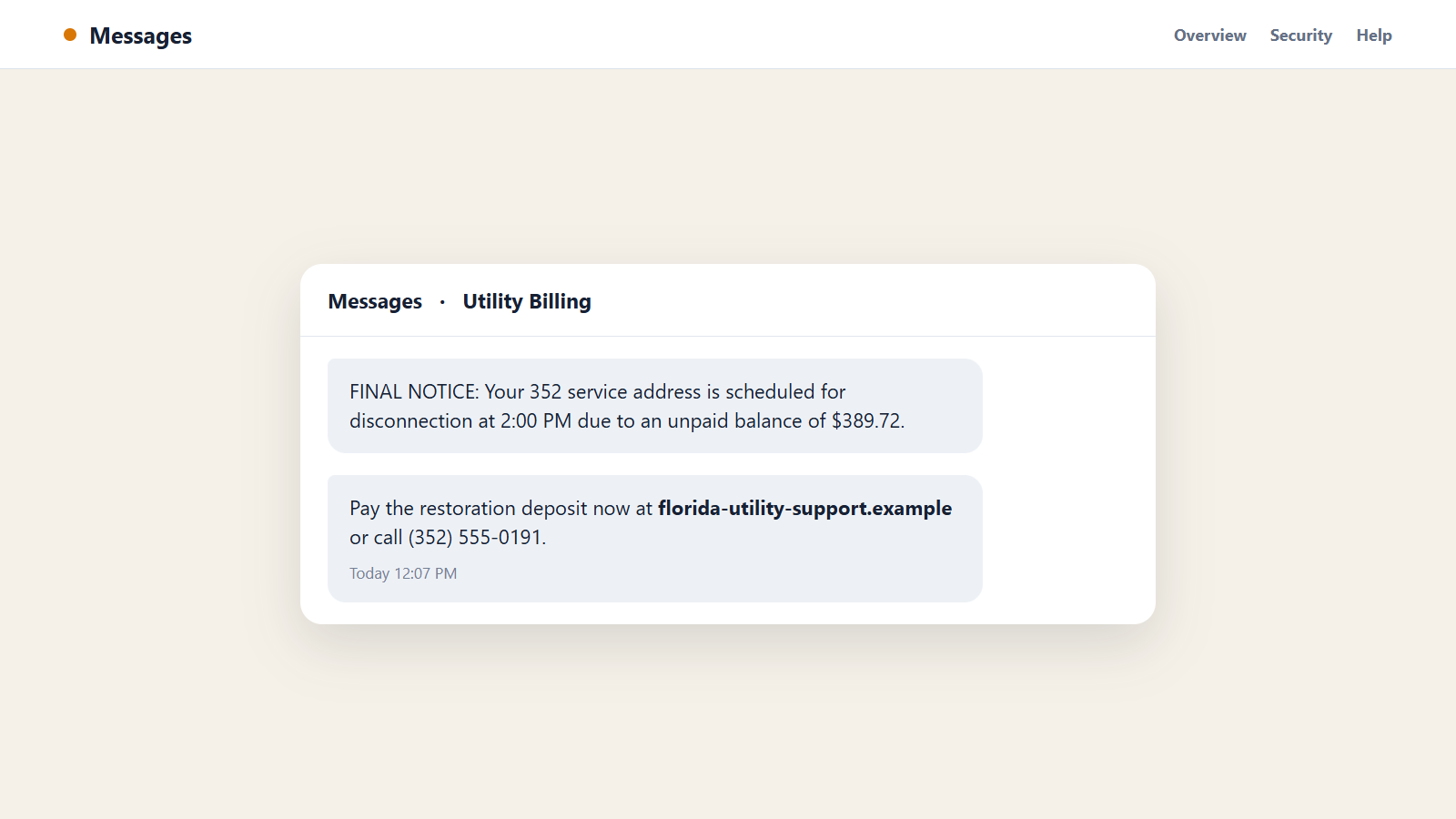
An impostor says an unpaid balance will cause service to be disconnected within an hour. Businesses are often targeted during busy periods when losing electricity would be especially costly.
The deadline is designed to prevent the customer from checking the utility app, statement, or published service number.
Bank and digital-wallet security alerts
A text or robocall reports a large purchase, new device, or Apple Pay enrollment. Responding connects the victim to a fake fraud representative.
The attacker asks for credentials, card information, or a one-time code and uses them to attempt a real account action.
Family emergencies and fabricated bail requests
The caller says a child or grandchild was arrested or injured nearby. Another voice may pose as a lawyer, police officer, or hospital worker.
Secrecy and embarrassment are built into the script so the victim does not call the relative directly.
Why a Local Florida Number Is So Persuasive
People answer nearby numbers because the caller could be a doctor, school, contractor, neighbor, or small business not saved in contacts. Scammers exploit that reasonable uncertainty.
Caller ID was designed to display routing information, not to serve as strong identity proof. Modern calling services can replace the displayed number with one selected by the sender.
The criminal may copy the first six digits of the victim’s own number. This neighbor-spoofing pattern makes the call appear to come from the same community or exchange.
Public records supply local color. Court rosters, utility names, police staff pages, and property addresses help a script sound specific without giving the caller any real authority.
Pressure then narrows the victim’s attention. Arrest, service loss, financial theft, and a relative’s emergency are problems that feel dangerous to postpone.
The caller may discourage independent checks by saying the line is recorded, the investigation is confidential, or hanging up will trigger enforcement. None of those statements makes verification unsafe.
A spoofed number can belong to an innocent resident or business. Calling it back may reach someone who has no connection to the fraud.
Once a person responds, the number may be marked as active. That can lead to more texts, robocalls, and tailored impersonation attempts.
Time of day can make the deception stronger. Utility calls arrive near closing time, court threats appear before a weekend, and bank warnings land when a branch is harder to reach.
Some callers invite the target to verify a badge number through an internet search. Finding the same name on a real agency page only proves that the criminal copied a public identity.
Voice cloning adds another concern to family-emergency stories. A short recording from social media may be enough to imitate a distressed relative, so the emotional sound of the call cannot replace a separate family check.
How to Verify a 352 Call or Text
Let unknown calls go to voicemail when possible. A legitimate local organization can leave a message that you verify without the pressure of a live conversation.
Do not use a callback number, web address, or QR code supplied by the caller. Search for the official organization and compare several trustworthy records.
For a court threat, contact the clerk through the county’s official website. Ask whether a summons, case, fine, or warrant exists under your name.
For a utility claim, sign in through the provider’s normal app or type its known address into a browser. Check the balance and service notices before making any payment.
For a bank alert, use the application or the number printed on your card. Never confirm a password, PIN, or security code to an incoming caller.
The FTC’s phone-scam guidance warns that scammers can make any name or number appear on caller ID. It recommends contacting the organization independently.
If the call concerns a relative, contact that person or another family member using a number you already know. A family verification phrase can settle future emergencies quickly.
How the 352 Area Code Scam Works
Step 1: The operation selects a Florida identity to imitate
The group chooses a court, sheriff, utility, bank, delivery company, or local business. Public websites provide names, logos, addresses, and telephone numbers.
Some campaigns change the identity daily while keeping the same basic payment script.
Step 2: Caller ID or the sending number is made to look local
Voice-over-IP tools can insert a 352 number into the display. Text campaigns may use a newly registered local line or an account taken over from another person.
The visible prefix increases the chance that a resident answers or reads the message.
Step 3: The opening creates fear before verification begins
The target hears about a warrant, cutoff, unauthorized payment, or family emergency. The caller gives enough detail to feel informed but keeps the situation difficult to check.
A short deadline turns a routine verification step into something that feels risky.
Step 4: Real local facts are mixed with invented claims
The scammer may know the victim’s address, county, relative’s name, or service provider. Public records and breached data make these details available.
Correct background information does not prove the central accusation is true.
Step 5: The victim is isolated from reliable help
The caller says not to contact family, the utility, branch staff, or another officer. Staying on the line supposedly protects the case.
Isolation keeps a calmer person from challenging the demand.
Step 6: Payment or account access is requested
The criminal directs a gift-card purchase, cryptocurrency deposit, payment-app transfer, or card transaction. A phishing page may collect identity and banking details instead.
The chosen route is fast and difficult to reverse, unlike a normal county or utility payment.
Step 7: Proof of payment is captured immediately
Gift-card numbers, kiosk receipts, transfer screenshots, or one-time passcodes are requested during the call. Once the code or funds are delivered, the value can disappear quickly.
The caller may remain connected until every step is complete.
Step 8: New demands or repeat scams follow
A second fee may be invented for taxes, release, reconnection, or account restoration. The target can also receive recovery calls from people claiming they can return the loss.
The local appearance changes, but the pressure and payment methods stay familiar.
Company, Address, and Fulfillment Checks
The organization must be located through an independent directory
Find the court, utility, sheriff, bank, or company through its official government or corporate site. Do not rely on contact information supplied in the suspicious message.
Call a published number and ask whether the employee, case, and demand exist.
The payment destination must belong to the named organization
County fines and utility balances use established payment portals, statements, or in-person offices. They are not collected through gift cards, cryptocurrency wallets, or a worker’s payment account.
A familiar organization name in the recipient note can be typed by anyone.
The physical address must match the correct county and department
Scam scripts sometimes combine a real Ocala address with an Alachua County claim or list a court that does not handle the alleged matter. Compare the jurisdiction and department carefully.
Do not travel to an address supplied by a threatening caller without confirming it independently.
The promised result must follow a normal documented process
A genuine payment creates a receipt, account entry, case record, and appeal or support route. A caller who promises instant warrant removal or secret service restoration cannot provide that chain.
Ask how the issue can be reviewed in writing before any funds move.
Warning Signs of a 352 Area Code Impostor
- A local caller demands payment during the first contact.
- Arrest or disconnection is threatened within minutes or hours.
- The only accepted method is a gift card, kiosk, crypto wallet, or payment app.
- You are told not to speak with staff, relatives, or another agency.
- A bank code or full login is requested.
- The website does not use the organization’s verified domain.
- The caller becomes hostile when you suggest calling back independently.
- Local facts are accurate, but no written case can be produced.
Area code familiarity is not a substitute for any of the checks a genuine payment would survive.
What to Do if You Have Fallen Victim to This Scam
- Stop the contact. End the call, stop replying, and do not send another payment even if a new penalty is threatened.
- Call the financial provider. Report the transfer or card payment as scam-related and ask for a freeze, recall, charge dispute, or recipient alert.
- Contact the real organization. Tell the court, sheriff, utility, or bank that its name and a 352 number were used in an impersonation.
- Secure compromised accounts. Replace exposed passwords, remove unknown devices and recipients, and enable strong multi-factor authentication.
- Act on gift cards quickly. Contact the issuer with the receipt and card number. Ask whether unused value can be frozen before redemption.
- Protect identity information. If a Social Security number or ID was shared, create a recovery plan through IdentityTheft.gov and consider credit freezes.
- Scan any device used with a link. Run Malwarebytes after removing unknown downloads, extensions, or remote-access tools.
- Reduce malicious page exposure. AdGuard can help block known phishing sites and deceptive advertisements, though it cannot identify every spoofed call.
- Save and report evidence. Keep the call log, voicemail, texts, receipts, recipient details, and website address. Report the fraud to the FTC and local police when money was lost.
- Prepare for recovery fraud. Treat unsolicited refund promises as a second scam. Never pay an advance fee to trace or release stolen money.
Frequently Asked Questions
Does a 352 caller ID mean the caller is in Florida?
No. The displayed number can be spoofed, routed through an internet service, or sent from a compromised account.
Why do scammers copy my own first six digits?
Neighbor spoofing makes a call resemble numbers from the same local exchange, increasing the chance that you answer.
Will a Florida court call for gift-card payment?
No legitimate court settles a jury-duty warrant through gift cards, cryptocurrency, or a personal payment account.
Should I call the displayed 352 number back?
Look up the organization separately. The displayed number may belong to an innocent person whose identity was copied.
What if the caller knows my address and county?
That information can come from public records or a breach. Verify the claimed case through an official channel before taking action.
Can blocking one 352 number stop the campaign?
It can stop that line, but the operation may rotate spoofed numbers. Enable carrier filtering and continue ignoring unverified demands.
The Bottom Line
The 352 area code scam turns a familiar Florida prefix into borrowed trust, then uses a court, utility, bank, or family emergency story to demand fast action.
Let the caller go, find the real organization yourself, and verify the claim outside the conversation. A genuine local problem can withstand that pause; a scam depends on preventing it.

Join the discussion
0 commentsShare your experience or ask a question about this article.
Discussion
Start the conversation
Have a question or something useful to share? Add the first comment.