

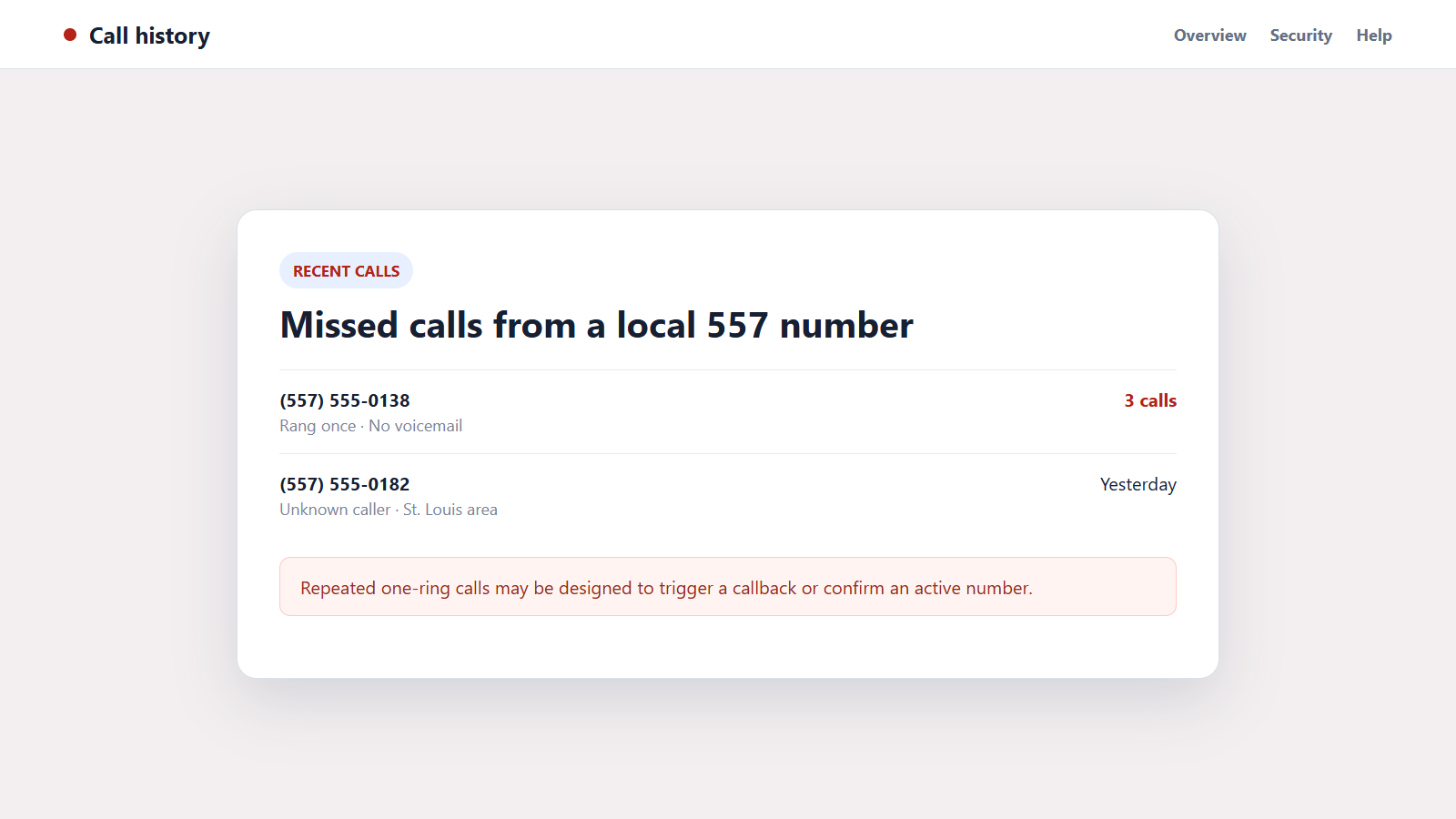
The missed call lasted barely a second. It came from a 557 number, looked close to St. Louis, and left just enough curiosity to make calling back feel harmless.
The 557 area code scam uses that small moment of recognition in several different ways. A one-ring callback, friendly wrong-number text, or official-sounding local caller can all open a much larger fraud.
Overview
The 557 prefix is real, but the displayed identity may not be
The 557 area code serves as an overlay for the St. Louis region alongside 314. Legitimate residents and businesses use it, which is exactly why a scammer wants the number to look familiar.
Caller ID can be spoofed, internet numbers can be created quickly, and legitimate accounts can be compromised. A local prefix establishes location only after the caller is independently verified.
Different scripts begin with the same request for engagement
A one-ring call wants a callback. A wrong-number text wants a polite reply. An authority impersonator wants the target to stay on the line and accept the caller’s version of events.
Any response confirms that a person monitors the number. The operation can then shift from a broad opening into a tailored story.
The real danger appears after the ordinary beginning
The caller may demand a fine, offer a fake service, build a friendship, promote cryptocurrency, or request an account code. A simple hello becomes the first step toward money or identity theft.
Use these habits with unknown 557 contacts:
- Let unexplained calls reach voicemail.
- Do not return a one-ring call solely because the number appears local.
- Avoid answering a wrong-number text with personal details.
- Verify agencies and businesses through published contact information.
- Never send a code, gift card, crypto payment, or urgent transfer.
- Block and report a number once the deceptive purpose is clear.
The objective is not to distrust every 557 caller. It is to make the caller earn trust through information the caller did not control.
Common 557 Area Code Scam Patterns
One-ring and repeated missed calls
The telephone rings once and stops, sometimes several times over a few days. The unusual pattern encourages the recipient to return the call.
A callback may reach a high-cost service, a recorded sales funnel, or an operator who begins collecting personal information.
Friendly wrong-number conversations
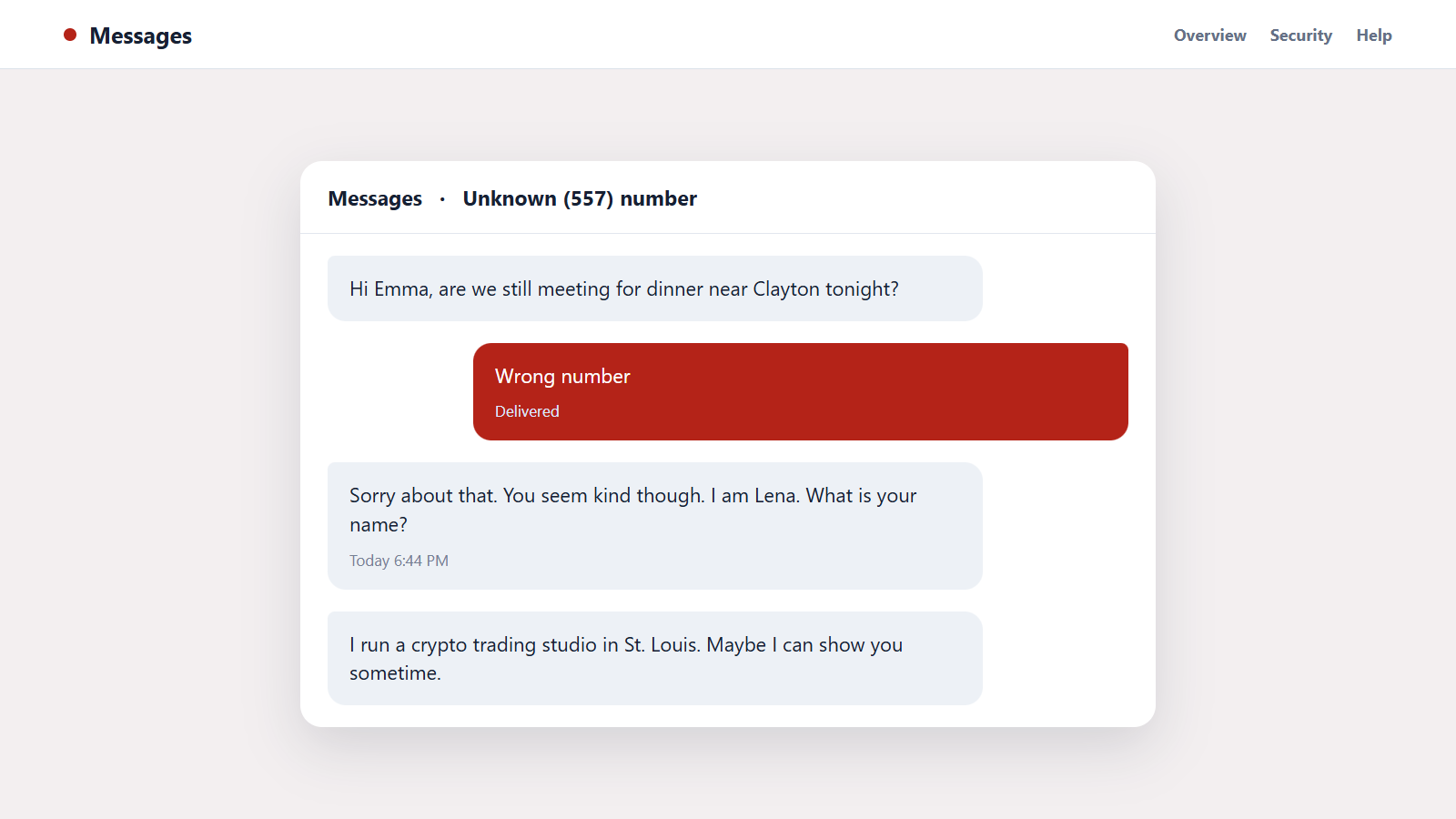
A stranger asks for someone else, then turns the correction into casual conversation. The messages are warm, patient, and seemingly unrelated to money.
Days or weeks later, the new acquaintance mentions investment success, a crypto platform, or an exclusive trading opportunity. The long setup is designed to lower skepticism.
Local authority and service impersonation
A caller claims to represent police, a court, a utility, a delivery service, or technical support. The story includes a fine, overdue bill, account problem, or expiring service.
The solution requires immediate payment or identity confirmation instead of a normal written process.
Subscription and warranty offers
Robocalls promote lower insurance, debt relief, vehicle protection, or account cancellation. Pressing a key connects the recipient to a sales or data-collection operation.
Even when no payment is made, the response can mark the number as active and generate more calls.
What Makes a St. Louis Number Effective Bait
Overlay codes are still unfamiliar to some residents. A person may answer because the number could belong to a new clinic, school, delivery driver, contractor, or customer.
The 557 prefix also gives a criminal a flexible local identity. It can be paired with a copied business name or the victim’s own exchange to look more relevant.
Scammers know that curiosity is easier to create than trust. A missed call needs no detailed story; it only asks the recipient to take the next step.
Wrong-number messages work differently. They begin with a believable mistake and allow the target to feel helpful. The scam develops only after several harmless exchanges.
Authority calls rely on fear. A confident voice, case number, and St. Louis reference can make an accusation feel urgent even when no written notice exists.
Information from social media and public records makes the script more personal. Mentioning an employer, neighborhood, or relative does not prove that the sender knows you legitimately.
Telephone authentication labels can help carriers assess a call, but they do not validate every claim made by the person speaking. The story still needs independent verification.
Local-number rotation also frustrates blocking. Each call can display a different 557 line, including numbers belonging to innocent subscribers.
Voicemail transcription can remove the caller’s dramatic delivery and make the demand easier to assess. Read the claim calmly, then compare it with a statement, account, or official office record before returning anything.
A wrong-number operation may move the conversation to WhatsApp or Telegram after the first exchange. The change gives the scammer richer profiles, easier file sharing, and an account that can survive after the original line disappears.
Fake investment relationships often include ordinary daily conversation before money is mentioned. Photos of meals, travel, or a supposed office are used as social proof, but those images can be stolen or generated.
The invented platform may permit one small withdrawal. That carefully controlled success persuades the victim to deposit a larger amount, after which taxes, liquidity fees, and account-verification charges appear.
One-ring campaigns can also exploit international routing that resembles a domestic number at a glance. Check the entire dialing sequence and do not assume the callback has the same rate as an ordinary Missouri call.
How to Investigate an Unknown 557 Contact
Start with the behavior, not the area code. A genuine caller should explain the purpose, leave a useful voicemail, and allow you to verify the matter without pressure.
Search the complete number in several places, but do not treat a missing complaint as proof of safety. Spoofed and newly created numbers may have no history.
If a business is named, open its official site through a fresh search and call the published number. Ask whether the employee, order, invoice, or appointment exists.
If the caller claims to be a government worker, use an official Missouri, county, or municipal site. Do not rely on a number provided in the voicemail.
Ask friends or relatives about an emergency through a known contact. A private family question can expose an impersonator without revealing useful information.
Never test a suspicious link by entering false details. Merely opening the page can expose device and network information, while a convincing copy may persuade you to continue.
The FTC’s neighbor-spoofing advice explains that familiar local digits are used to make people answer. Verification must happen outside the incoming contact.
How the 557 Area Code Scam Works
Step 1: A contact list is prepared or generated
Numbers can come from data breaches, marketing lists, public directories, or automated dialing across a local range. The first outreach does not need detailed knowledge of every recipient.
Basic location data helps the campaign select a believable 557 identity.
Step 2: The operation creates a low-friction opening
A single ring, empty voicemail, wrong name, or vague account notice creates curiosity. The recipient is encouraged to call, reply, or press a key.
This small action feels safer than sending money, so more people take it.
Step 3: Engagement confirms a responsive number
A returned call or text signals that a real person is available. The operation may record language, time zone, age clues, and willingness to converse.
That information guides the next script and can be shared with other scammers.
Step 4: The story becomes personal
A wrong-number sender asks about work and hobbies. An authority caller uses a name, address, or nearby location. A sales caller identifies a supposed debt or service.
Specific details create familiarity while the core claim remains unverified.
Step 5: Trust or pressure is increased
The friendly scam may continue for weeks and include daily messages. The urgent version threatens arrest, disconnection, fees, or account loss within hours.
Both routes reduce the chance that the target stops to seek outside advice.
Step 6: Money, access, or identity data is requested
The target receives an investment link, payment instructions, verification form, or request for a one-time code. Gift cards and cryptocurrency are attractive because reversal is difficult.
A remote-access request can give the criminal direct control over accounts.
Step 7: The first success leads to larger demands
A fake investment dashboard shows profits but requires tax or verification fees before withdrawal. An authority impostor discovers another fine, while a service scam adds upgrades.
The first payment is treated as evidence that the target can be pressed again.
Step 8: The number disappears or changes roles
Once challenged, the sender blocks the victim or abandons the line. Another supposed agent, investigator, or recovery company may make contact later.
The 557 number was a disposable front, not a reliable path to the people behind the operation.
Company, Address, and Fulfillment Checks
The named company must confirm the contact independently
Call the organization using a number from its verified site, bill, card, or established account. Ask whether the representative and reference number are genuine.
A real employee will not object to this separate verification.
The local address must belong to the correct entity
Scammers copy real St. Louis addresses, sometimes from an unrelated business. Check the suite, department, corporate registration, and relationship to the offer.
A map listing alone is not proof that the caller operates there.
The payment recipient must match the contract or bill
A legitimate company does not collect a formal debt through an employee’s payment app, gift cards, or an unnamed crypto wallet. The recipient should match written records.
Pause when the caller changes the payment destination during the conversation.
The service must have clear terms and a real delivery path
Ask what is being provided, when it arrives, how cancellation works, and which company is responsible. Vague guarantees and immediate fees do not create a verifiable service.
Do not pay merely to keep a supposed offer or investigation open.
Warning Signs of a 557 Area Code Scam
- The call rings once repeatedly but leaves no meaningful voicemail.
- A wrong-number sender quickly tries to become a friend.
- A new acquaintance introduces cryptocurrency or private investing.
- A local agency supposedly needs gift cards or an instant transfer.
- The caller refuses to let you verify through another number.
- A robocall asks you to press a key to avoid more calls.
- A link uses an unrelated domain despite displaying a known brand.
- The story becomes more urgent when you ask for written evidence.
The safest clue is often the mismatch between the serious claim and the informal payment or verification method.
What to Do if You Have Fallen Victim to This Scam
- End all contact. Stop replying, block the number, and do not explain which part of the story you discovered was false.
- Contact the payment provider. Report the exact transaction as fraud and ask for recall, chargeback, wallet freeze, or recipient review options.
- Secure financial accounts. Change compromised credentials, remove unknown recipients and devices, and review recent activity with the bank.
- Protect the telephone account. Ask the carrier to add a strong PIN and check for forwarding, SIM replacement, or account changes.
- Preserve the conversation. Save messages, usernames, telephone numbers, wallet addresses, receipts, and screenshots before accounts disappear.
- Respond to identity exposure. If sensitive records were shared, use IdentityTheft.gov and consider freezing credit reports.
- Check the device. Remove unfamiliar software and run Malwarebytes if you installed an app, extension, or remote-control program.
- Block deceptive web traffic. AdGuard can help stop known phishing and advertising domains, but it will not verify an ordinary telephone conversation.
- Report the incident. Submit the number shown on caller ID, any callback number, and the payment details to the FTC, the carrier, and local police when appropriate.
- Expect a second approach. Ignore unsolicited recovery agents and new online friends who know about the loss. Never pay an advance recovery fee.
Frequently Asked Questions
Is every unexpected 557 call fraudulent?
No. The prefix is used by legitimate St. Louis-area subscribers. The claim and identity still need verification before you act.
Can I be charged simply for answering?
Ordinary answering normally does not create a premium charge, but engaging can confirm an active number and lead to further attempts.
Why does a one-ring scam want me to call back?
The callback may generate a charge, connect you to a sales or fraud script, or confirm that a responsive person owns the number.
Are wrong-number texts always dangerous?
Not every mistake is malicious, but an unknown sender who pushes friendship, investment, or another platform should be blocked.
Does a carrier verification checkmark prove the caller’s story?
No. Authentication can help assess number use, but it does not certify that every statement or payment request is honest.
Should I report a spoofed number that belongs to someone innocent?
Yes, report the call details and explain that spoofing is suspected. Do not accuse the apparent number owner directly.
The Bottom Line
The 557 area code scam starts with local familiarity but can develop into callback charges, impersonation, account theft, or a long investment confidence trick.
Do not let the St. Louis prefix perform the caller’s verification. Pause, locate the real organization yourself, and keep unknown contacts away from your money, codes, and personal life.

Join the discussion
0 commentsShare your experience or ask a question about this article.
Discussion
Start the conversation
Have a question or something useful to share? Add the first comment.