

CraveCut Cutting Mix Drink is being promoted as a daily drink mix that claims to help control cravings, reduce bloating, support metabolism, improve energy, and make weight management feel easier.
But before ordering, buyers should look closely at the claims, the subscription policy, the refund conditions, the shipping details, and the generic “cutting mix” supplement category this product belongs to. This appears to follow a familiar weight-loss supplement funnel pattern: social media-style craving-control claims, limited-time discounts, automatic refill risk, template-like policy errors, and refund terms that may be less simple than the “30-day money-back guarantee” suggests.
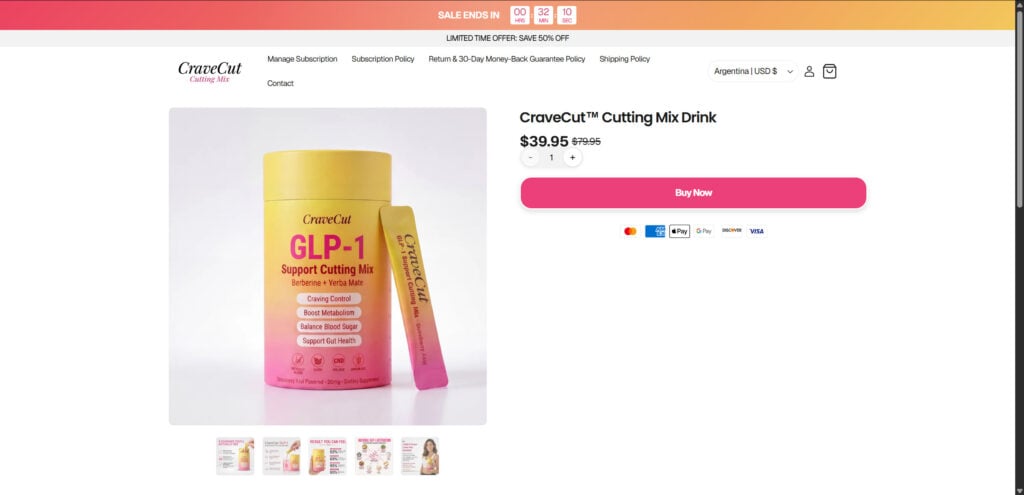
CraveCut Overview
CraveCut is sold through TryCraveCut.com as “CraveCut™ Cutting Mix Drink.” The product page lists it at $39.95, reduced from a claimed $79.95, with “SAVE 50%” and a sale countdown timer.
The page claims CraveCut can help with:
- cravings
- bloating
- low energy
- appetite control
- metabolism support
- digestion
- feeling lighter
- discipline around snacking
- steady energy
- workout performance
- recovery
- confidence
The product is positioned as a daily “cutting mix” rather than a standard protein powder, tea, or capsule supplement. The visible page text says it combines ingredients “known to support appetite control, metabolism, and digestion,” but it does not clearly present a full Supplement Facts panel in the page text available from the site.
That missing transparency matters.
A product making appetite, metabolism, digestion, and energy claims should clearly show its full ingredient list, exact doses, stimulant content, sweeteners, serving size, warning label, manufacturing details, third-party testing, and subscription terms.
CraveCut may ship a real drink mix. The issue is whether the product is being oversold and whether buyers understand the purchase terms before paying.
Why CraveCut Raises Red Flags
1. The weight-loss and appetite-control claims are broad
CraveCut is not just marketed as a flavored drink. It is promoted around cravings, bloating, energy, metabolism, digestion, discipline, and transformation.
That is a wide set of claims for one drink mix.
Cravings and weight gain can have many causes: sleep, stress, calories, protein intake, blood sugar swings, medications, emotional eating, hormone changes, insulin resistance, thyroid disease, dieting history, alcohol, low fiber intake, or highly processed foods.
A drink mix cannot identify the cause of someone’s cravings or bloating. If the product is promoted as a simple daily solution, buyers should be skeptical unless the brand provides strong evidence on the exact finished formula.
2. “Cutting mix” is a trendy supplement category
The phrase “cutting mix” has become common in social media weight-loss marketing. These products are often promoted as craving-control or “natural GLP-1” style drinks, sometimes with ingredients like berberine, chromium, yerba mate, 5-HTP, magnesium, green tea, or fiber blends.
The problem is that many products in this category use the same sales story:
- control cravings
- feel full
- support metabolism
- reduce bloating
- replace snacking
- help weight loss
- taste like a refresher
- support “GLP-1”
- work without dieting
Some ingredients may have legitimate research behind limited metabolic or appetite-related effects. But that does not mean every “cutting mix” product works as advertised, contains effective doses, or is safe for every user.
3. The official page does not clearly show enough formula detail
The visible CraveCut product page text does not clearly show a full ingredient panel, exact dosing, or Supplement Facts label.
That is a major trust issue.
Before buying any supplement drink, buyers should know:
- active ingredients
- exact milligrams per serving
- caffeine or stimulant content
- sweeteners
- allergens
- serving size
- number of servings
- warnings
- country of manufacture
- third-party testing
- batch testing
- heavy metal testing
- microbial testing
- whether it is suitable for pregnancy, medications, or medical conditions
If a supplement page focuses more on transformation claims than transparent labeling, buyers should slow down.
4. The page uses internal survey-style proof
CraveCut’s page shows claims such as:
- 92% reported higher daily energy
- 88% improved strength and stamina
- 85% noticed boosted drive and confidence
The page says these figures are based on internal studies and customer feedback surveys.
That wording is important. Internal surveys and customer feedback are not the same as independent clinical trials. They can be useful for marketing, but they do not prove the product causes weight loss, craving control, metabolic improvement, or fat loss.
Self-reported results can be influenced by expectation, placebo effect, diet changes, gym routines, caffeine intake, reduced snacking, or normal day-to-day variation.
5. The subscription policy creates real buyer risk
CraveCut has a subscription policy that says customers can enroll in an Auto-Refill Program by selecting “Subscribe & Save” and confirming at checkout.
The policy says subscribers receive a fresh supply every 30 days and that the card is charged automatically every 30 days.
That means CraveCut is not necessarily a one-time purchase if the buyer selects the subscription option.
Subscription supplements are one of the most common sources of buyer complaints because customers may not notice the recurring terms during checkout, especially when the subscription price appears cheaper.
6. Canceling early may trigger a fee
The subscription policy says subscribers may cancel at no cost once they have received their second monthly order.
It also says that if a customer cancels before the second order is processed, an early cancellation fee applies. The fee equals the difference between the subscription price and the standard non-subscription price of the product.
That is a major red flag.
A buyer may think “cancel anytime” means they can try one order and stop. But the policy suggests that canceling during the first month may cost extra.
That makes the subscription less flexible than the sales wording may imply.
7. Already processed subscription orders may not be refundable
The subscription policy says buyers must cancel at least one business day before the next scheduled renewal date. If the order has already processed and shipped before cancellation, the company says it cannot issue a refund for that shipment.
This creates a predictable problem.
A customer may see the charge, immediately contact support, and still be told it is too late because the order already processed.
That is why buyers should avoid subscription refills unless they genuinely want repeat shipments.
8. The policy pages contain template errors
There are several signs of reused or inconsistent policy wording.
The subscription policy says CraveCut wants to keep your “sleep schedule optimized on auto-pilot” and refers to “sleep support,” even though the product being sold is a cutting mix drink for cravings, bloating, and energy.
The refund policy refers to “CraveCut™ Gummies” and says users must take “the gummies” daily for 30 days. But the product page sells a Cutting Mix Drink.
These mismatches are not minor. They suggest the policies may have been copied from another product or template and not properly edited.
For a supplement brand, sloppy policy wording weakens trust.
9. The refund guarantee has strict conditions
The page promotes a 30-day money-back guarantee, but the refund policy says buyers must use the product consistently for a full 30 days before initiating a return.
It also says early refund requests cannot be honored.
That means if a customer experiences side effects, dislikes the taste, notices the product is not what they expected, or wants to return it before 30 days, the guarantee may not apply.
Opened packages are only eligible after the full 30-day period has passed and no results were experienced. The customer must contact support, have eligibility verified, follow return instructions, and wait for the product to be received and confirmed before the refund is processed.
This is not the same as a simple “try it and return it anytime” guarantee.
10. Shipping may come from China
CraveCut’s shipping policy says orders may ship from fulfillment centers in Australia, Canada, the United States, New Zealand, or China, depending on stock availability, the buyer’s address, logistics, and other conditions.
That means buyers should not assume the product ships domestically.
Shipping from China can affect delivery time, return practicality, tracking reliability, and customer expectations.
The average delivery time listed is 8–12 business days after dispatch. That does not include every possible delay, processing issue, or fulfillment problem.
11. The site uses urgency and checkout add-ons
The site uses a sale countdown timer, “limited time offer,” and “save 50%” messaging. The cart also displays a “Priority Handling” option, described as a way to get an order processed before others.
These are common direct-response tactics.
They are designed to make buyers complete the purchase quickly and add small extras. Buyers should not let countdown timers or priority handling prompts distract them from checking the final total, subscription status, refund policy, and shipping terms.
12. Similar cutting mix drinks are sold elsewhere
CraveCut is not in a unique product category. Similar drink mixes are sold on Amazon, eBay, Walmart-style marketplaces, and social media stores.
Some use similar claims around cravings, metabolism, gut health, GLP-1 support, berberine, chromium, yerba mate, 5-HTP, and energy.
That does not prove CraveCut is fake. But it suggests the product may be part of a broader private-label supplement trend rather than a unique breakthrough.
When many brands sell similar “cutting mix” products with similar claims, buyers should compare labels, doses, testing, price per serving, subscription terms, and refund policies.
How the CraveCut Sales Funnel Appears to Work
Step 1: The ad targets cravings and bloating
The marketing focuses on people who feel out of control around snacks, bloated after meals, tired during the day, or frustrated with weight loss.
This is effective because cravings are emotionally frustrating. A drink mix that promises control sounds easier than tracking calories, eating more protein, changing habits, or speaking with a clinician.
Step 2: The product is framed as a daily control tool
CraveCut positions itself as something you can mix into water and use daily to feel lighter and more disciplined.
This makes the product feel simple. The buyer does not need to understand the full science. They just drink it and expect appetite and metabolism support.
Step 3: Transformation-style proof builds confidence
The page uses internal survey percentages and transformation language. This creates the impression that the product is already proven by other customers.
But internal feedback does not prove typical results. It is marketing evidence, not clinical proof.
Step 4: The sale pushes immediate action
The product is shown at $39.95 instead of $79.95 with a countdown timer.
This creates urgency and makes the buyer feel they are getting a limited deal.
Step 5: Subscription refills create recurring revenue
The presence of a Manage Subscription page and subscription policy shows that repeat billing is part of the store structure.
If a customer selects Subscribe & Save, they may be billed every 30 days. Canceling before the second order may trigger a fee.
That makes the subscription model a key risk.
Step 6: Refund friction appears later
If the product does not work, the buyer may discover that the refund requires full 30-day use, eligibility verification, return instructions, and product return.
If a subscription renewal already processed, the policy says the company cannot refund that shipment.
This is where many supplement buyers become frustrated.
Main Red Flags
- Broad claims around cravings, bloating, metabolism, digestion, energy, and transformation.
- Visible product page does not clearly show a complete Supplement Facts panel in the fetched text.
- Heavy discount claim: $79.95 reduced to $39.95.
- Sale countdown timer and limited-time offer messaging.
- Internal survey percentages used as proof.
- Subscription refills every 30 days.
- Cancellation must happen before the next renewal.
- Early cancellation before the second order may trigger a fee.
- Already processed subscription shipments may not be refunded.
- Refund policy refers to “gummies,” while the product is a drink mix.
- Subscription policy refers to “sleep support,” while the product is marketed for cravings and cutting.
- Refunds require 30 days of consistent use before a claim.
- Shipping may come from China or other international fulfillment centers.
- Similar cutting mix products are widely sold under other names.
- Weight-loss supplements are a high-risk category for exaggerated claims.
Is CraveCut a Scam?
CraveCut may ship a real drink mix, so this may not be a simple “pay and receive nothing” scam.
The bigger issue is the marketing and purchase terms.
A fair conclusion is this: CraveCut appears to be a high-risk weight-loss supplement offer because it combines broad appetite and metabolism claims, social media-style positioning, limited formula transparency in the visible page text, subscription billing, early cancellation fees, and refund-policy mismatches.
The product may help some users feel more in control if it replaces snacks, increases fluid intake, contains stimulants or appetite-support ingredients, or creates a routine. But buyers should not assume it will produce fat loss, suppress cravings safely, or work like prescription weight-loss medication.
Safety Concerns Buyers Should Consider
Be careful with CraveCut or any cutting mix drink if you:
- are pregnant or breastfeeding
- are under 18
- have diabetes
- take blood sugar medication
- take antidepressants or serotonin-related medication
- take blood pressure medication
- take stimulants
- have heart rhythm issues
- have anxiety or panic disorder
- have liver or kidney disease
- have an eating disorder history
- are sensitive to caffeine or stimulants
- use GLP-1 medication or weight-loss medication
If the formula contains common cutting-mix ingredients such as berberine, chromium, 5-HTP, yerba mate, green tea, caffeine, or magnesium, it may interact with medication or cause side effects in some people.
Do not combine weight-loss supplements with prescription medications without medical advice.
What To Do Before Buying
1. Look for the full Supplement Facts label
Do not buy based only on claims. Ask for:
- full ingredient list
- exact dosage per serving
- caffeine content
- 5-HTP amount, if included
- berberine amount, if included
- chromium amount, if included
- sweetener list
- allergen information
- third-party testing
- certificate of analysis
- country of manufacture
If the seller cannot provide this clearly, do not buy.
2. Avoid Subscribe & Save at first
If you only want to test CraveCut, choose a one-time purchase. Do not select auto-refill unless you understand the billing schedule and early cancellation fee.
3. Screenshot the checkout page
Save screenshots showing:
- one-time purchase or subscription
- selected quantity
- total price
- shipping cost
- priority handling add-on
- renewal terms
- early cancellation fee
- refund policy
- merchant name
- final payment screen
This helps if you need to dispute a charge later.
4. Read the subscription policy carefully
Do not rely on “cancel anytime” language alone. The policy says free cancellation applies after the second monthly order, and canceling before the second order may trigger an additional fee.
5. Compare similar products
Search for:
- cutting mix drink
- craving control drink mix
- berberine chromium 5-HTP drink
- GLP-1 support drink mix
- appetite control drink powder
- weight loss drink sticks
Compare price per serving, ingredients, testing, reviews, and subscription terms.
What To Do If You Already Ordered
1. Check if you are subscribed
Look for:
- Subscribe & Save
- auto-refill
- every 30 days
- next renewal date
- recurring charge
- subscription portal
- Manage Subscription
- refill program
If you do not want repeat orders, cancel immediately.
2. Save proof of cancellation
Use the account portal and email support. Keep screenshots and confirmation emails.
Use clear wording:
“I am canceling all subscriptions, auto-refills, recurring billing, and future shipments connected to this order. Please confirm in writing that no future charges will occur.”
3. Watch your payment method
Monitor your card, PayPal, Shop Pay, Apple Pay, or Google Pay for recurring charges. If a renewal appears after cancellation, act quickly.
4. Keep packaging
If you want a refund, keep the package and any remaining product. The policy requires return instructions and confirmation before refund processing.
5. Do not wait until renewal day
Cancel at least one business day before the next scheduled renewal. Earlier is safer.
6. Request a refund in writing
If you used the product for 30 days and had no results, cite the 30-day guarantee and ask for return instructions.
7. Dispute if necessary
Contact your bank, credit card company, or PayPal if:
- you were enrolled in subscription billing without clear consent
- you were charged after cancellation
- you were charged an early cancellation fee you did not understand
- the product never arrives
- the seller refuses the advertised guarantee
- refund terms contradict the sales page
- the product is not as advertised
- support does not respond
Use clear wording such as:
- “subscription not clearly disclosed”
- “unauthorized recurring charge”
- “item not as described”
- “merchant refuses advertised refund”
- “misleading supplement claims”
- “unclear early cancellation fee”
FAQ
What is CraveCut Cutting Mix Drink?
CraveCut is a drink mix marketed for cravings, bloating, appetite control, digestion, metabolism support, and daily energy.
Is CraveCut a scam?
CraveCut may ship a real product, but the offer has several red flags: broad weight-loss claims, subscription billing, early cancellation fees, policy-template errors, and refund conditions that may make money-back claims harder to use.
Does CraveCut help with weight loss?
The site markets it for craving control and metabolism support, but buyers should not assume it causes meaningful fat loss. Weight loss depends on calorie intake, diet quality, activity, sleep, medical factors, and consistency.
Does CraveCut have a subscription?
Yes. The subscription policy says customers who select Subscribe & Save receive a fresh supply every 30 days and are charged automatically.
Can I cancel CraveCut anytime?
The policy says you can cancel, but it also says free cancellation applies after the second monthly order. Canceling before the second order may trigger an early cancellation fee.
Are subscription renewals refundable?
The policy says if an order has already processed and shipped before cancellation, the company cannot issue a refund for that shipment.
Is the 30-day guarantee easy to use?
Not necessarily. The refund policy says customers must use the product consistently for a full 30 days before requesting a refund, and early refund requests cannot be honored.
Why does the refund policy mention gummies?
That appears to be a policy mismatch. The product page sells a Cutting Mix Drink, but the refund policy refers to “CraveCut Gummies” and “the gummies,” suggesting copied or poorly edited policy text.
Where does CraveCut ship from?
The shipping policy says orders may ship from fulfillment centers in Australia, Canada, the United States, New Zealand, or China, depending on stock and logistics.
Should I buy CraveCut?
Be cautious. Ask for the full Supplement Facts panel, avoid subscriptions at first, screenshot checkout terms, and do not treat it as a proven weight-loss solution.
The Bottom Line
CraveCut Cutting Mix Drink is marketed as a craving-control and metabolism-support drink that can help users feel lighter, more energized, and more disciplined around food.
The product may be a real drink mix, but the offer carries several warning signs: broad weight-loss claims, limited formula transparency in the visible product-page text, internal survey-style proof, subscription billing every 30 days, an early cancellation fee before the second order, strict refund conditions, and policy errors referring to gummies and sleep support.
If you are considering CraveCut, avoid the subscription, request the full Supplement Facts label, compare similar products, and screenshot all checkout terms. If you already ordered, check immediately for auto-refill enrollment and cancel in writing if you do not want recurring charges.








