

Gen-Z-Mart.site presents itself as a trendy jewelry store with free shipping, large social-media numbers and an “Easy Return And Refund” promise displayed across the top of the page. The polished black storefront and constant sale prices are meant to make a new visitor feel that the shop is established.
Our review found the opposite. The store does not publish a usable refund policy, its standard refund-policy page returns a 404 error, its footer omits basic legal and customer-service pages, and its contact section contains vague details and unfinished template copy. We consider Gen-Z-Mart.site an unsafe shopping website and recommend that consumers do not place orders there.
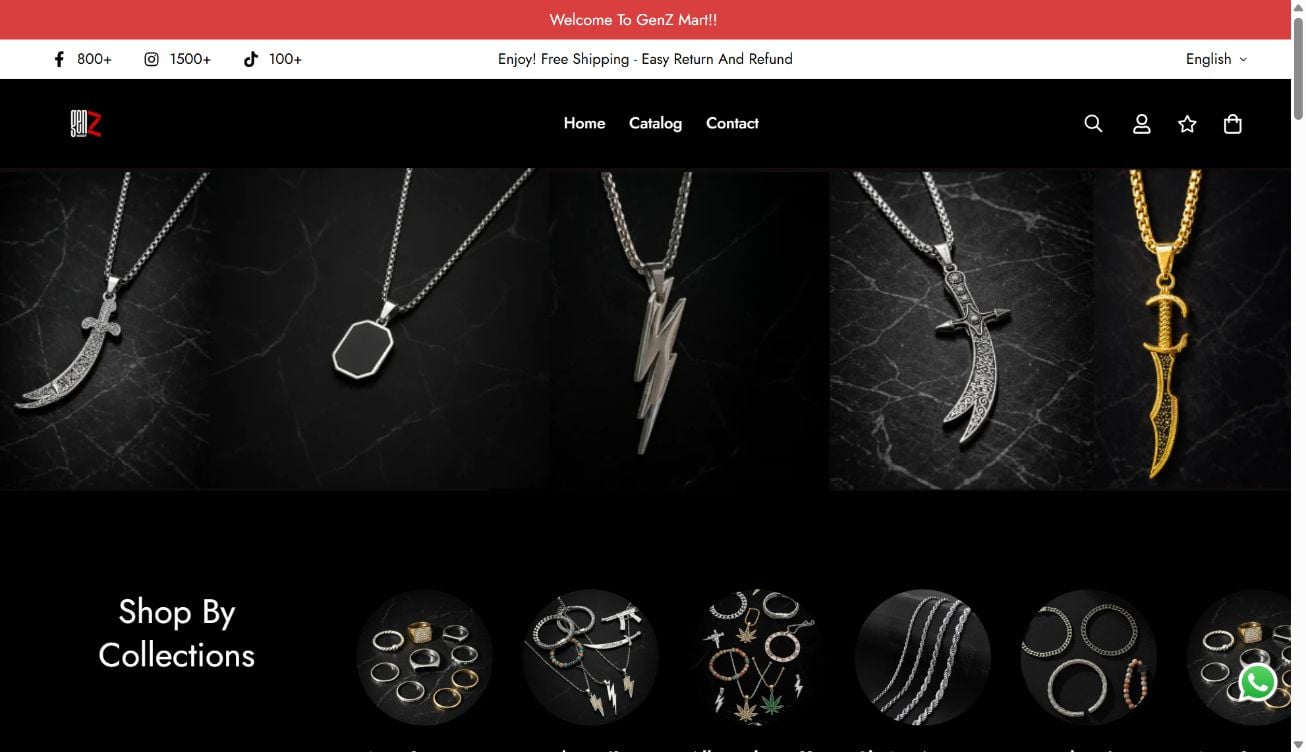
Gen-Z-Mart.site Scam Store Overview
A polished storefront hides weak buyer protection
Gen-Z-Mart.site sells chains, pendants, bracelets and rings through a familiar e-commerce layout. Product cards show steep markdowns and payment logos, while the announcement bar promises free shipping and easy returns. These design elements create the appearance of an established retailer but do not identify who is responsible when an order goes wrong.
The strongest warning is the contradiction around returns. The homepage advertises “Easy Return And Refund,” yet the navigation offers only Home, Catalog and Contact. No refund policy appears in the footer, and the expected refund-policy address returns Page Not Found. Buyers receive no published deadline, return address or procedure.
The contact page looks copied from a store template
The contact page lists “Jinnah School Street Karachi Pakistan,” a telephone number and a free Gmail address, but no registered legal entity or clearly verifiable location. Several sentences are incomplete, including newsletter and store notices that stop mid-thought.
This matters because low-cost dropshipping and fake-store operations often spend more effort on product imagery than on accountable customer service. A package may contain a cheap item that does not match the advertising, arrive after a long delay or never arrive. Without a real return process, the customer can be trapped between an unresponsive seller and an expensive international return.
- The sales hook: jewelry presented with large crossed-out prices and permanent-looking discounts.
- The trust claim: free delivery, easy refunds, social counts and many payment logos.
- The missing protection: no accessible refund terms, return address, privacy notice or clear legal operator.
- The likely outcome: a poor-quality or mismatched item followed by delays, excuses or no practical refund route.
A secure checkout cannot repair these problems. Payment logos do not guarantee product quality, delivery, support or a refund. Based on the contradictions visible on the live site, Gen-Z-Mart.site should be treated as a scam store and avoided.
Warning Signs on Gen-Z-Mart.site
The promises are stronger than the business information
An online shop should make its legal identity, return terms and customer-service process easier to find than its sale banners. Gen-Z-Mart.site reverses that priority: discounts and product cards are prominent, while the rules that protect a buyer are absent.
The issue is not one spelling mistake. It is the combined pattern of missing policies, vague ownership, copied text and a return promise that cannot be followed.
Red Flags at a Glance
- No published refund policy. The site promises refunds but does not provide the conditions or procedure.
- The refund route is broken. The expected policy page returns a 404 Page Not Found response.
- No legal operator is identified. A brand name, Gmail address and vague street line replace company details.
- The template is unfinished. Multiple sentences end abruptly or contain generic copy unrelated to the store.
- Markdowns are used everywhere. Large regular prices make ordinary products appear heavily discounted.
- Social numbers are self-declared. Counts displayed in the header are not evidence of fulfilled orders or satisfied customers.
- Buyer protections are difficult to verify. No clear return destination, cancellation rule or complaint process is shown.
Why the “Easy Return And Refund” Claim Is Misleading
A slogan is not a return policy
A usable return policy should tell customers how many days they have, which items qualify, what condition is required, who pays return shipping, where the parcel must go and when money is returned. Gen-Z-Mart.site displays none of that beside its promise.
Without written conditions, the seller can invent a new obstacle after payment. The buyer may be told that sale products are excluded, that a complaint was filed too late or that the item must be shipped to an undisclosed overseas address at the customer’s expense.
- No deadline: the buyer cannot know how quickly a complaint must be opened.
- No return address: there is no way to estimate shipping cost or prove where an item was sent.
- No eligibility rules: the seller can reject opened, discounted or allegedly used items after the fact.
- No refund timing: the customer is not told when money should return to the original payment method.
Dropshipping can turn a cheap item into an expensive dispute
The storefront pattern is consistent with low-accountability dropshipping: generic product photography, broad markdowns and thin store information. The seller may never inspect the item before another supplier ships it.
That arrangement does not automatically make every shop fraudulent, but it becomes unacceptable when the seller also hides the practical return path. If the received pendant looks different, uses cheaper materials or arrives damaged, the customer may discover that the “easy” refund exists only in the banner.
Payment icons do not guarantee a chargeback
A card payment can provide dispute rights, but consumers must still act quickly and preserve evidence. Debit transfers, wallet payments and other methods may offer less protection, and a seller can delay until a dispute deadline approaches.
Do not order merely because a familiar card logo appears. The safer decision is to buy comparable jewelry from a retailer with verified ownership, independent reviews and published return terms.
How the Gen-Z-Mart.site Scam Works
Step 1: A social post or ad promotes heavily discounted jewelry
The shopper sees a pendant, bracelet or chain in a short video, sponsored post or shared link. A large markdown makes the item appear temporarily affordable.
The advertisement sends the shopper directly to Gen-Z-Mart.site, bypassing independent research about the business.
Step 2: The storefront supplies instant trust signals
The page shows free shipping, easy returns, social-media counts and numerous payment logos. Professional product images make the catalog feel larger and more established than the business information supports.
The visitor is encouraged to judge the design rather than verify the operator and policies.
Step 3: A discount pushes the shopper to order quickly
Crossed-out regular prices create the impression of a bargain. Quick-add buttons reduce the time available to compare products or search the images elsewhere.
The buyer reaches checkout before noticing that the store has no accessible refund terms.
Step 4: The payment is accepted without clear obligations
The customer submits an address and payment while the seller has not stated delivery estimates, cancellation rights or a complete return process.
An order confirmation may provide a number, but that number does not prove that a matching product will be delivered.
Step 5: A cheap, mismatched or delayed item becomes the dispute
The parcel may contain jewelry that looks different from the product photographs, uses lower-quality materials or arrives after a long wait. Some customers may receive no useful tracking or parcel at all.
The difference between advertising and delivery is where the apparent bargain becomes a loss.
Step 6: Customer service creates return obstacles
The seller can delay replies, ask for repeated photographs, offer a small partial refund or demand return shipping to an expensive destination. None of these conditions was clearly disclosed before payment.
The cost and effort of returning a low-value item may exceed the original purchase price.
Step 7: Delay reduces the chance of recovering the money
Repeated promises to investigate or resend the order can keep the buyer waiting. Meanwhile, card and marketplace dispute windows continue to run.
The operation keeps the payment when the customer gives up or misses the deadline for outside help.
How To Check an Online Jewelry Store Before Paying
Verify the seller, not only the product page
Search the exact domain and business details before ordering. A store should have a traceable legal operator, complete policies, a return address and independent customer history that exists outside its own social accounts.
For Gen-Z-Mart.site, the live page does not meet that standard. The missing refund policy alone is enough reason to choose another seller.
A Safer Verification Sequence
- Open every policy page. Confirm that refund, shipping, privacy and terms pages exist and contain specific rules.
- Verify the legal business. Match the company name, registration, address and telephone number.
- Search product images. Look for identical catalog photos and compare prices on established marketplaces.
- Read independent complaints. Ignore testimonials controlled by the store and look for delivery and return experiences.
- Test customer service. Ask a precise return question before paying and judge whether the answer is complete.
- Use protected payment. Prefer a credit card and avoid transfers, cryptocurrency or payment methods with weak disputes.
What To Do If You Ordered From Gen-Z-Mart.site
Document the order and act before dispute deadlines
Save the order page, product description, price, confirmation, tracking details and the homepage promise of easy returns. Take screenshots because the website can change or disappear after complaints begin.
Send one clear written request to the store stating the problem and the remedy you want. Keep the message factual and ask for a reply by a reasonable date, but do not let repeated excuses consume the payment provider’s dispute window.
If the item never arrives, is materially different or the seller refuses the advertised refund, contact the card issuer or payment service promptly. Explain that the merchant did not deliver as represented and provide the saved evidence.
Recovery Checklist
- Preserve screenshots of the product, sale price, refund promise and missing or broken policy page.
- Keep confirmation emails, tracking numbers, packaging labels and photographs of the received item.
- Ask the seller in writing for the full return address, refund amount and processing deadline.
- Do not pay another fee to release, insure or redeliver the same order.
- Open a card or payment dispute before its deadline when the seller does not provide a real solution.
- Report misleading advertising to the platform or social network where the store was promoted.
- Replace card details if unfamiliar charges appear and monitor statements for repeated billing.
- Reject recovery services that promise to retrieve the money in exchange for an upfront payment.
Treat partial refund pressure carefully
A seller may offer a very small refund while asking you to close an existing dispute. Do not close a dispute until the agreed money is back and the issue is genuinely resolved; reopening may not be possible.
If a parcel arrives after a non-delivery claim, update the payment provider honestly and continue the dispute based on any material difference, damage or unfulfilled return promise. Keep every communication in the official case record.
Frequently Asked Questions
Is Gen-Z-Mart.site a legitimate store?
We do not consider it a safe or trustworthy retailer. Its refund promise conflicts with the missing policy, and the site does not provide the transparent business and buyer-protection details expected from a reliable shop.
Why does the site show many payment logos?
Payment logos indicate possible checkout methods, not that the merchant will deliver the advertised item or honor a refund. Buyer protection depends on the payment method and a timely dispute.
Can I return an item to Gen-Z-Mart.site?
The site advertises easy returns but does not publish a usable refund policy or clear return procedure. That contradiction is one of the main reasons we recommend not ordering.
What if the store offers only a partial refund?
Compare the offer with what was promised and do not close a payment dispute before the money is received. A token refund may be used to avoid a full reversal.
The Bottom Line
Gen-Z-Mart.site has the visual shell of an online jewelry store but not the transparent policies and accountable business details that make a purchase reasonably safe. Its “Easy Return And Refund” banner is contradicted by a missing policy and a broken refund page.
Do not order from this site. If you already paid, preserve the live-page evidence, demand a written remedy and use your payment provider’s dispute process before the deadline expires.








