

EpiCooler is promoted as a compact, plug-and-play air conditioner that supposedly cools rooms within minutes, provides winter heating, and reduces energy bills without hoses or professional installation.
Its ads are appearing across numerous websites and social media campaigns, often accompanied by large discounts, dramatic cooling graphics, and thousands of alleged customer reviews. This article examines what EpiCooler actually is, how the sales network operates, and what buyers report receiving.
What Is EpiCooler?
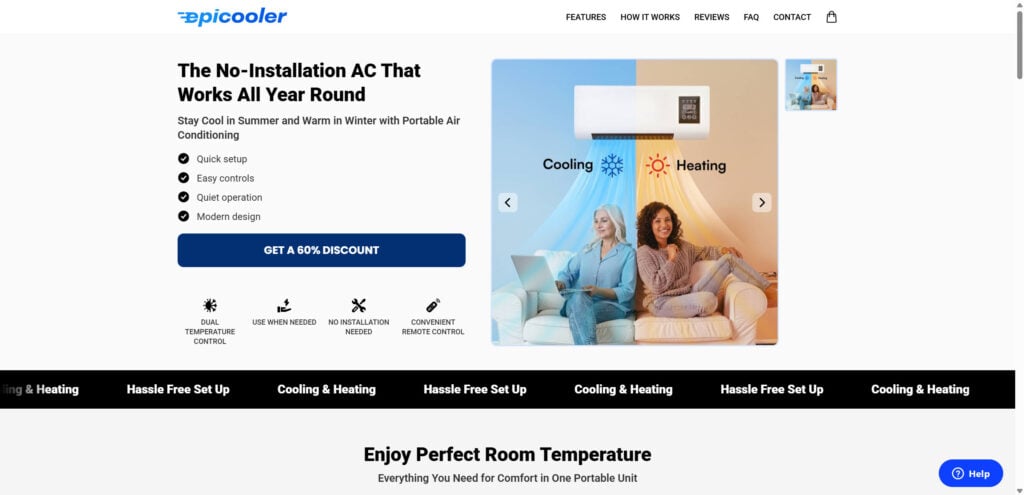
EpiCooler is advertised as a portable heating and cooling appliance that can be mounted on a wall or moved between rooms. The main website says it offers six operating modes, remote control, quiet performance, filtered air, and instant cool or warm airflow without drilling, hoses, or professional installation.
A separate EpiCooler sales page makes even stronger claims. It says the unit cools a room in under five minutes, covers up to 51 square meters, lowers the temperature to 16°C, heats to 45°C, and cuts energy bills by as much as 75% compared with traditional air conditioning. It also describes a supposed “TurboCool Technology” that draws warm air across cooling coils before releasing “ice-cold” air into the room.
Those claims make EpiCooler sound like a genuine refrigeration appliance. However, the product shown in the advertisements appears to be a generic wall-mounted electric heater with a basic fan function.
There is no credible evidence that it contains a compressor, refrigerant circuit, condenser, evaporator, or another system capable of removing heat from a room.
EpiCooler Is Being Sold Through Numerous Websites
One of the clearest warning signs is the number of websites promoting what appears to be the same appliance.
The product is currently advertised through EpiCooler.com and EpiCooler-AC.com, but those are far from the only pages involved. The same design and near-identical sales copy also appear on EpiCooler.uk, EpiCoolerPortableAC.org, TheEpiCooler.com, Try-EpiCooler.site, CompareProducts.shop, GlobeAutoStore.com, UnrealGadgetXXX.pro, and other reseller, affiliate, and advertorial pages.
These websites are not all proven to be owned by the same company. Some appear to be sellers, while others are affiliate pages, generic storefronts, or promotional sites that earn money by directing visitors to a checkout.
What can be verified is that they repeatedly use the same product images, the same no-installation story, and the same promises of rapid heating and cooling. Claims involving 51-square-meter coverage, six operating modes, 16°C to 45°C temperature settings, quiet operation, and discounts of up to 60% appear across multiple domains.
This widespread network makes EpiCooler appear more established than it may actually be. A shopper searching for the product encounters page after page repeating the same positive story, creating the impression that numerous independent sources have reviewed and recommended it.
In reality, many of those pages are simply promoting the product.
EpiCooler-AC.com Is an Advertisement, Not an Independent Review
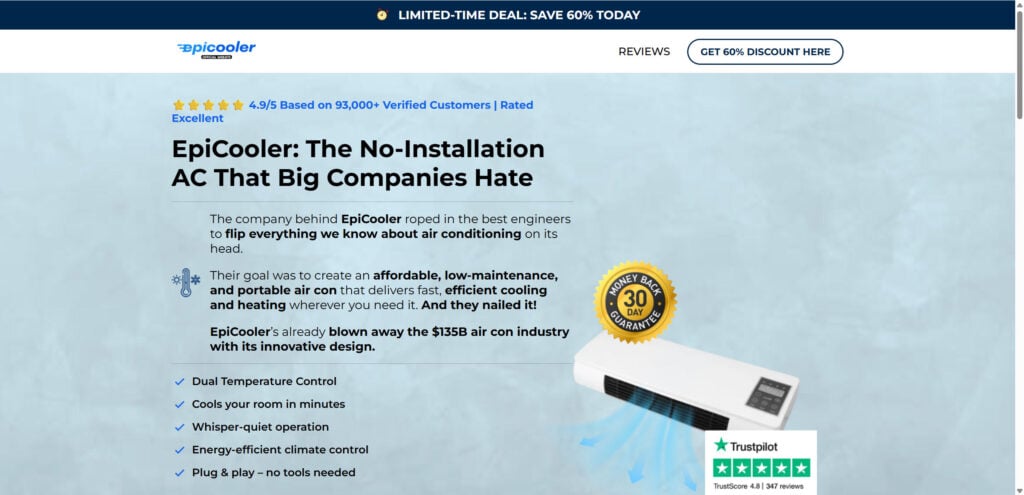
EpiCooler-AC.com is designed like an authoritative product review or consumer feature. It says EpiCooler was developed by top engineers, has disrupted the air-conditioning industry, and is rated 4.9 out of 5 by more than 93,000 verified customers.
Only near the bottom does the page explain what it really is.
Its disclosure says the website is an advertisement rather than a news article, blog, or consumer-protection report. The owner receives compensation for leads or sales and says it is not responsible for product returns, customer support, or shipping. Customers who have problems are instructed to contact the product provider instead.
That distinction matters because the affiliate page makes some of the campaign’s most dramatic promises. It claims that EpiCooler produces genuinely cold air, cools a room within minutes, covers 51 square meters, uses cooling coils, and reduces energy bills by up to 75%.
However, the same page distancing itself from returns and support is not the company customers will deal with after paying.
The advertisement makes the sale. Another company handles the consequences.
EpiCooler Is Not a Real Air Conditioner
A genuine air conditioner removes heat from the indoor environment and releases that heat elsewhere. Its refrigeration cycle normally uses an evaporator, refrigerant, compressor, condenser, and a system that rejects collected heat into the outdoor air.
EpiCooler shows no convincing evidence of containing that equipment.
There is no outdoor unit, exhaust hose, refrigerant specification, compressor rating, certified cooling capacity, or BTU figure. Genuine room air conditioners are rated by the amount of cooling they provide in BTUs per hour, allowing customers to match the appliance with the size of the room.
EpiCooler instead relies on temperature settings and room-size promises without publishing a verifiable cooling-capacity rating.
A display that can be set to 16°C does not prove that the appliance can cool the room to that temperature. A basic electric heater can be programmed to display almost any number, even when it has no mechanism for generating refrigerated air.
The “Cooling Coils” Explanation Does Not Make Sense
EpiCooler-AC.com claims that warm air enters the appliance, passes over internal cooling coils, and returns to the room as cold air. It then says condensation evaporates inside the unit, eliminating the need for a drain hose or water tank.
That explanation avoids the most important question: where does the heat go?
Cooling coils do not make heat disappear. When a refrigeration system absorbs heat from indoor air, that heat must be released somewhere else. A conventional portable AC sends it outdoors through an exhaust hose, while a split system transfers it to an external condenser.
When both the cold side and hot side of a cooling system remain inside the same enclosed room, the appliance cannot produce a net reduction in temperature. The heat removed from one stream of air is released back into the room, along with additional heat from the electricity consumed by the device.
The absence of a hose or outdoor component is not a technological advantage. It is evidence that the unit does not operate like a real air conditioner.
What the Product Appears to Be
The comparison image below shows visually matching wall-mounted appliances offered by Chinese wholesale suppliers for approximately $7 to $9 per unit.
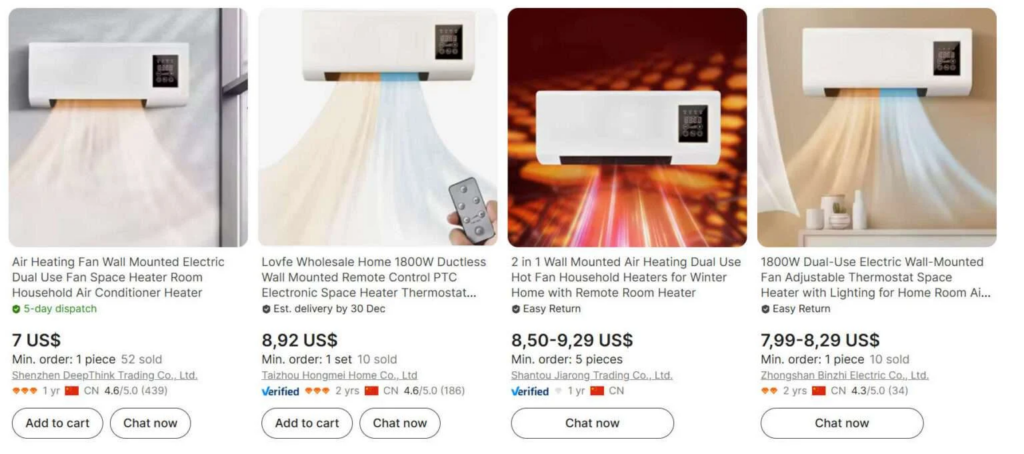
These products use the same rectangular white housing, black display, bottom air outlet, remote control, and orange-and-blue airflow graphics shown in EpiCooler advertisements.
They are sold as electric fan heaters, wall-mounted space heaters, or dual-purpose hot-air appliances. Their likely internal design consists of a PTC ceramic heating element and a small fan.
When the heating element is active, the fan pushes warm air into the room. When the heater is switched off, the fan can continue circulating room-temperature air. Sellers can then describe the ordinary fan setting as a “cool mode,” even though the appliance is not producing cold air.
This explanation matches numerous customer reports describing EpiCooler as a heater with a weak fan rather than an air conditioner. Trustpilot’s summary of EpiCooler.com reviews highlights complaints that the product is not an air conditioner, alongside dissatisfaction involving orders, payments, refunds, and slow support responses.
The Seller’s Terms Mention Fulfillment From China
The direct EpiCooler website identifies the seller as UAB Rara Digital, a company registered in Lithuania. Its terms explain that orders may be manufactured, stored, or shipped from international fulfillment centers and specifically address products dispatched from the People’s Republic of China.
This does not prove that every EpiCooler order is shipped directly from China. It does confirm that Chinese fulfillment is part of the seller’s stated operating model.
The combination of cheap matching wholesale products, international fulfillment, rotating promotional websites, and a large retail markup is consistent with a private-label or dropshipping operation.
The seller may not have invented the device at all. It can purchase a generic product from an existing supplier, add the EpiCooler name, and build a high-value story around it.
The Advertising May Use AI-Generated or Edited Images
EpiCooler’s own terms state that product images and videos may be digitally enhanced, edited, stylized, staged, computer-generated, or created using artificial intelligence. The terms also warn that the delivered product’s design, packaging, specifications, materials, proportions, or appearance may vary from what customers see online.
This is particularly concerning because EpiCooler’s marketing depends heavily on dramatic visual demonstrations.
Advertisements may show blue air blasting from the unit, rooms cooling rapidly, digital temperature effects, or people reacting to an apparently freezing breeze. The company’s terms provide room for those scenes to be simulations rather than real demonstrations of the delivered product.
The terms also say that certain differences between the advertising and the actual item may not qualify as grounds for a refund, provided the product broadly conforms to its intended use and general description.
That creates a convenient defense. The advertising can make the appliance appear like an advanced air conditioner, while the seller may later argue that the customer still received a heating-and-airflow device.
How the EpiCooler Scheme Works
A Generic Heater Is Turned Into a Revolutionary AC
The operation begins with a cheap wall-mounted electric heater. Its appearance already resembles the indoor portion of a split air-conditioning system, making it ideal for deceptive visual marketing.
The device is given a memorable brand name, a professional logo, and technical-sounding features such as “TurboCool Technology.” A basic fan setting becomes cooling mode, while a ceramic heating element becomes advanced dual-temperature climate control.
The physical product barely changes. What changes is the story surrounding it.
Social Media Ads Create the Illusion of Real Cooling
The seller or its affiliates run eye-catching advertisements on Facebook, Instagram, TikTok, YouTube, or display-ad networks.
These ads target people dealing with summer heat, high electricity prices, rental restrictions, or homes without central air conditioning. EpiCooler is positioned as the shortcut that delivers all the benefits of AC without installation costs, refrigerant, hoses, or high power consumption.
Blue airflow graphics and edited room-temperature demonstrations make the device appear to produce refrigerated air. Because viewers see the advertisement for only a few seconds, they rarely stop to ask how the heat is supposedly being removed from the room.
Buyers Are Sent Through an Advertorial Network
Clicking the advertisement may not take the shopper directly to the seller.
Instead, the visitor can land on a review-style page such as EpiCooler-AC.com, where the product is described as a breakthrough rejected by the traditional air-conditioning industry. The page displays alleged expert development, enormous customer numbers, glowing testimonials, and repeated low-stock warnings.
Other searches lead to EpiCooler.uk, EpiCoolerPortableAC.org, TheEpiCooler.com, generic storefronts, promotional blogs, and purported review pages that repeat the same claims.
The volume of pages creates artificial legitimacy. Instead of discovering independent criticism, the shopper is surrounded by promotional content designed to lead back to a checkout.
Fake Urgency Prevents Careful Research
The pages repeatedly advertise discounts of 45%, 50%, or 60%, while warning that stock is low and demand is unusually high.
EpiCooler-AC.com displays a low-stock notice throughout the page and describes the discount as a limited-time opportunity. EpiCooler.com similarly promotes savings of up to 60% and says the product is in high demand.
This is designed to shorten the buyer’s decision process. The customer is encouraged to order before checking the specifications, searching for the original wholesale product, or reading the return conditions.
The discount also creates an inflated sense of value. A cheap heater appears to be a premium appliance temporarily available at a bargain price.
The Customer May Be Redirected to a Separate Checkout
Some promotional pages do not process purchases themselves. EpiCooler-AC.com openly states that it is a marketplace that receives compensation for referring customers and is not responsible for shipping, support, or returns.
Visitors are sent to another checkout provider, which may operate under a different domain or merchant name.
This fragmented structure becomes important when something goes wrong. The advertisement, seller, payment processor, fulfillment warehouse, and return department may all be separate entities.
A buyer may contact the promotional website only to be told that it has no responsibility for the product.
A Cheap Heater Arrives Instead of an Air Conditioner
The delivered appliance may power on, respond to the remote, display different temperatures, produce warm air, and operate in several fan modes.
Those functions allow the seller to argue that the product works.
However, when the buyer activates the supposed cooling mode, the heating element simply switches off and the fan circulates ambient air. The room does not become colder because the device has no refrigeration system capable of removing heat.
This is more difficult to dispute than receiving nothing. Tracking confirms that a package was delivered, and the appliance performs at least part of its description.
The buyer must prove that the product was materially misrepresented as an air conditioner rather than simply disappointing.
Returns Become the Final Obstacle
EpiCooler advertises a 30-day refund guarantee, but the formal policy requires prior approval and a Return Merchandise Authorization. Customers must use the exact return address supplied by support, include tracking, and pay the return-shipping cost themselves. Original shipping charges are not refunded.
A change-of-mind return must be unused, undamaged, and in its original packaging. General merchandise must show no signs of use beyond normal inspection
That creates a practical problem because customers need to unpack and test the device before discovering that it does not cool.
If the return address is international, tracked shipping for an electrical appliance can consume a significant portion of the potential refund. Some customers may accept a partial refund or give up rather than continue dealing with support.
A New Website Keeps the Campaign Alive
The same product can be promoted through another domain whenever one site accumulates too many complaints or begins ranking alongside scam warnings.
A fresh website receives new testimonials, renewed discount timers, and claims that the product has just launched. Older domains and affiliate pages can remain online, creating an expanding web of supposed endorsements.
This does not prove that every site belongs to one operator. It does demonstrate how the same misleading product story can be distributed across many websites while responsibility remains difficult to trace.
Customer Reviews Tell a Very Different Story
The independent review picture is far less impressive than the ratings displayed in the advertisements.
Trustpilot’s EpiCooler.com summary highlights negative feedback involving a product that customers say is not an air conditioner, along with order problems, payment concerns, refund difficulties, and slow customer-service responses.
The separate EpiCooler.co.uk Trustpilot profile currently has a rating of 1.2 out of 5 from 87 reviews, with all recorded ratings shown as one star. Reviewers commonly describe long delivery times, a product that fails to cool, low-quality construction, and difficulty obtaining useful return information.
Another profile associated with Get-EpiCooler.com has a score of 1.4 out of 5 from 45 reviews, with 96% awarding one star. Reviewers repeatedly say the device is not an air conditioner and describe unresolved refund requests, partial-refund offers, and unresponsive support.
Customer reviews are individual reports and do not prove that every order produces the same result. However, their consistency matches the visible hardware: buyers receive a heater and fan rather than a genuine cooling appliance.
Is EpiCooler a Scam?
EpiCooler appears to be a real physical product, and many customers report eventually receiving an appliance.
The concern is not limited to non-delivery. It is the difference between the product advertised and the product delivered.
The advertisements sell an air conditioner capable of producing cold air and cooling rooms of up to 51 square meters. The visible appliance appears to be a generic Chinese wall heater with a fan mode, while matching wholesale units are offered for approximately $7 to $9.
The campaign is supported by a network of direct stores, affiliate pages, resellers, promotional articles, and review-style websites. Some pages make extraordinary performance claims while legally distancing themselves from shipping, returns, and customer support.
EpiCooler’s own terms admit that marketing materials may be AI-generated or digitally altered, products may be shipped from China, and the delivered item may differ from the visuals. Its return process requires approval, buyer-paid shipping, and strict packaging conditions.
Taken together, the offer is highly misleading and too risky to recommend.
Final Verdict: Do Not Order EpiCooler
EpiCooler is not a revolutionary no-installation air conditioner.
It appears to be an inexpensive wall-mounted electric heater promoted through exaggerated claims, digitally enhanced advertising, affiliate advertorials, inflated discounts, and numerous supposedly independent websites.
The appliance may heat a small area and circulate room-temperature air when its heating element is switched off. It cannot provide genuine air conditioning without a compressor, refrigerant, condenser, evaporator, or a way to reject heat outside the room.
The claims of ice-cold airflow, five-minute room cooling, 51-square-meter coverage, and massive energy savings are not supported by credible technical specifications or independent performance tests.
Do not order EpiCooler from EpiCooler.com, EpiCooler-AC.com, or another promotional website expecting a real air conditioner. You are likely paying a large markup for a cheap fan heater that cannot cool a room as advertised.
What to Do If You Already Ordered EpiCooler
Begin by saving the advertisement, product page, checkout screen, cooling claims, room-size promise, guarantee, confirmation email, and payment record. Promotional pages can change, so preserve the exact claims that influenced the purchase.
Check your bank statement to identify the merchant that processed the payment. The name may differ from the website where you first saw the product because affiliate sites can redirect orders to separate sellers or payment agents.
When the order has not shipped, request cancellation immediately in writing. When it arrives, record the complete unboxing and photograph the product label, packaging, instruction manual, electrical specifications, remote control, and included accessories.
Test the cooling claim using a room thermometer placed away from the direct airflow. Measure the room temperature before switching on the alleged cooling mode and again after the unit has operated for a reasonable period.
When the room does not cool, request a full refund and state:
“EpiCooler was advertised as an air conditioner capable of producing cold air and cooling a room. The delivered product has no refrigeration system and only circulates room-temperature air. It is significantly not as described, and I am requesting a full refund.”
Do not allow repeated troubleshooting messages, replacement promises, or partial-refund negotiations to push you beyond your bank’s dispute deadline.
When the seller refuses to cooperate or provides an unreasonable overseas return address, contact your credit-card issuer, bank, or PayPal. Describe the transaction as “item significantly not as described” and provide the advertisement, product photographs, temperature test, seller correspondence, and refund policy.
FAQ
Is EpiCooler a real air conditioner?
No credible evidence shows that EpiCooler contains the compressor, refrigerant, evaporator, condenser, or heat-exhaust system required for genuine air conditioning.
What is EpiCooler really?
It appears to be a wall-mounted electric fan heater. It may produce warm air through a ceramic heating element and circulate room-temperature air when used in fan mode.
Can EpiCooler cool a bedroom?
It may create a breeze when directed toward someone, but it should not reduce the overall bedroom temperature like a real air conditioner.
Does EpiCooler contain cooling coils?
The advertising claims that it does, but the seller provides no credible refrigeration specifications or explanation of how the collected heat leaves the room.
Why does EpiCooler not need an exhaust hose?
The most likely explanation is that it does not actively refrigerate the room. Genuine portable air conditioners normally need a way to exhaust collected heat.
Is EpiCooler shipped from China?
The seller’s terms say products may be shipped from fulfillment centers in China. The origin of an individual order may vary.
Does EpiCooler use AI-generated advertising?
Its terms state that images and videos may be edited, staged, computer-generated, or created with artificial intelligence.
Why are there so many EpiCooler websites?
The product is promoted through direct stores, country-specific sites, affiliates, resellers, and review-style marketing pages. They are not all proven to share one owner, but many repeat the same imagery and claims.
How much do similar heaters cost?
The supplied wholesale comparison shows visually matching Chinese wall heaters priced at approximately $7 to $9 per unit, depending on the seller and order quantity.
Does EpiCooler offer refunds?
The direct website advertises a 30-day policy, but customers need prior approval, an RMA, and tracked return shipping. The customer pays the return cost, and original shipping fees are non-refundable.
Should I order EpiCooler?
No. The product appears to be a cheap fan heater marketed with unsupported air-conditioning claims, while independent reviews describe weak performance and difficult returns.









I bought it and had it delivered. It is a scam, there is no air cooling as shown in the advertisement. Just a fan. with a heater. It took so long to arrive, and so many emails, I have given up on it. I will throw it away and call it a 150 dollar lesson in stupidity.
A fan with a heater dressed up as an air conditioner is sadly the whole business model here, and I’m sorry it cost you $150 to find that out. Before you write it off entirely, it’s worth one call to your card issuer to dispute the charge as not as described — even with the delay, many issuers will still look at it, and you have nothing to lose by asking. Save the ad, the emails, and photos of what actually arrived. Thanks for the honest warning to other readers.