

BuzzKrush is promoted as the little orange lamp that can finally make mosquitoes disappear from bedrooms, patios, campsites, and family gatherings. The advertisement promises a powerful electric zapper, long battery life, a large protection area, and a limited discount that seems difficult to pass up.
The product itself is much less remarkable than the campaign surrounding it. Before entering a card number, shoppers should examine the generic hardware, inflated marketing claims, expensive checkout funnel, and return conditions that can turn a simple purchase into a frustrating dispute.
Overview
BuzzKrush is a heavily promoted dropshipping offer for a generic rechargeable camping lamp with an electric insect grid. Social media ads and the sales page present it as a special mosquito-control breakthrough, even though visually similar products are available from wholesale suppliers for a small fraction of the advertised retail price.
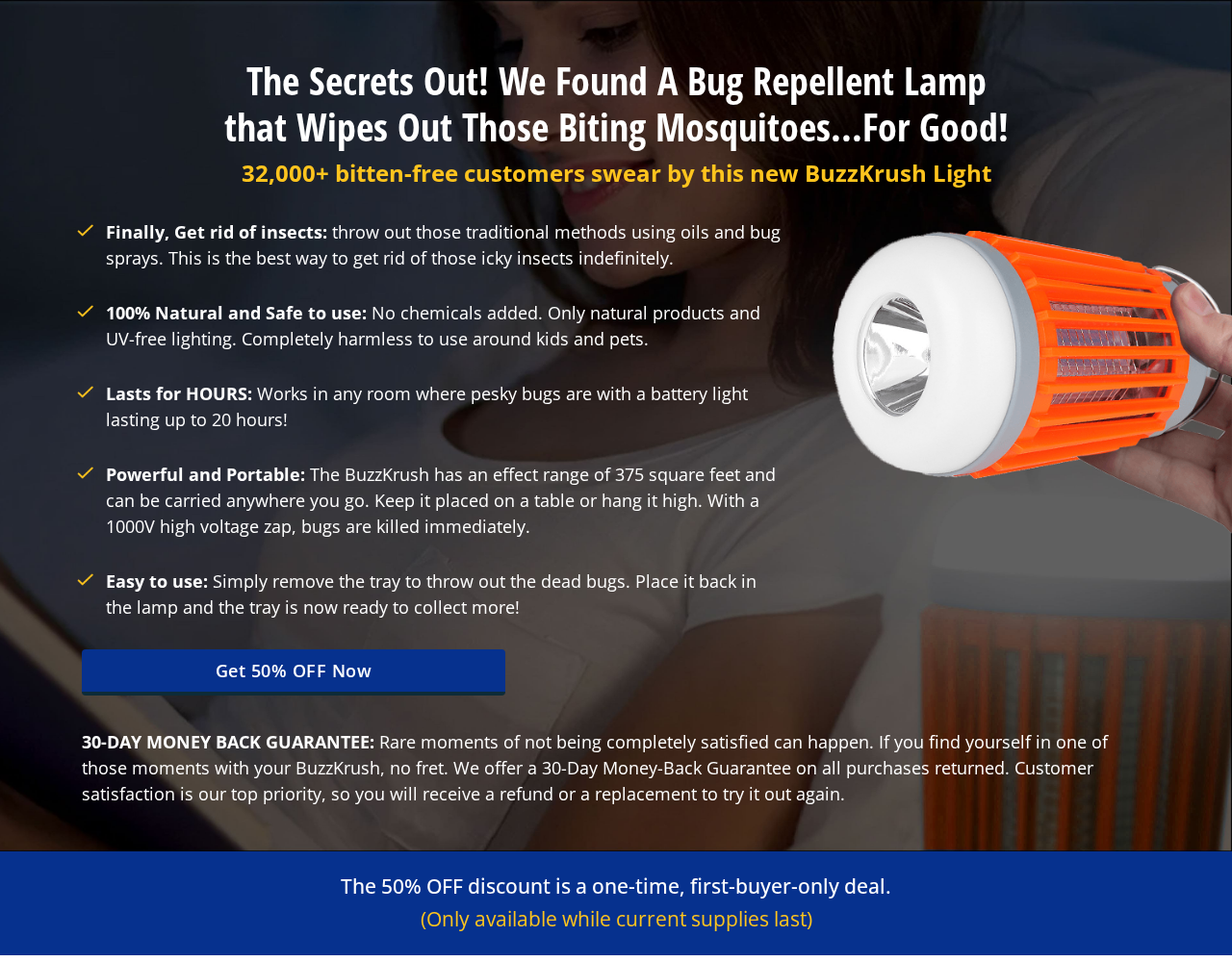
At the time of our review on August 6, 2026, BuzzKrush advertised one lamp for $39.99, reduced from a claimed retail price of $79.98. The page said more than 32,000 customers had become “bitten-free” and described the device as a safe, natural way to get rid of insects indefinitely.
The strongest claims go well beyond what a small, generic light-and-grid device can reasonably prove. BuzzKrush says the lamp has a 1000V zap, covers 375 ft², withstands extreme weather, runs for as long as 20 or 24 hours, and can become a personal insect exterminator with more than 10,000 hours of coverage.
There is a real electrical product behind the marketing. A light can attract and kill some flying insects that approach its charged grid. The problem is the enormous gap between that modest function and the promise of reliable, broad mosquito protection for families, sleepers, campers, and outdoor gatherings.
BuzzKrush does not publish independent field testing showing how many host-seeking female mosquitoes the device catches under realistic conditions. It does not provide species-specific results, comparisons with established traps, or evidence that one lamp creates the advertised protection zone.
The safest advice is simple: do not order BuzzKrush through this advertising funnel. The hardware appears to be an inexpensive mass-market item sold at a steep markup, while the checkout and return process introduce additional costs and obstacles.
What the BuzzKrush advertisement promises
The landing page is designed to make an ordinary lamp feel like a new discovery. It surrounds an enlarged product image with confident language, impressive numbers, reassuring safety statements, and a large button offering 50% off.
Among the claims displayed during our review were:
- More than 32,000 allegedly bite-free customers.
- A 1000V electric grid that kills bugs immediately.
- An effective range of 375 ft².
- Battery operation lasting up to 20 hours in one section and up to 24 hours in another.
- Solar charging and micro USB recharging.
- Weatherproof operation in rain, snow, and heat.
- Safe use around children and pets with no chemicals.
- More than 10,000 hours of insect coverage.
- Delivery within 3 to 7 days.
- A 30-day money-back guarantee.
These are seller claims, not conclusions from an independent laboratory. A shopper sees the impressive figures repeatedly, but the page does not link them to a test report that explains the method, environment, mosquito species, sample size, or measured outcome.
The price increases dramatically between factory listings and the ad
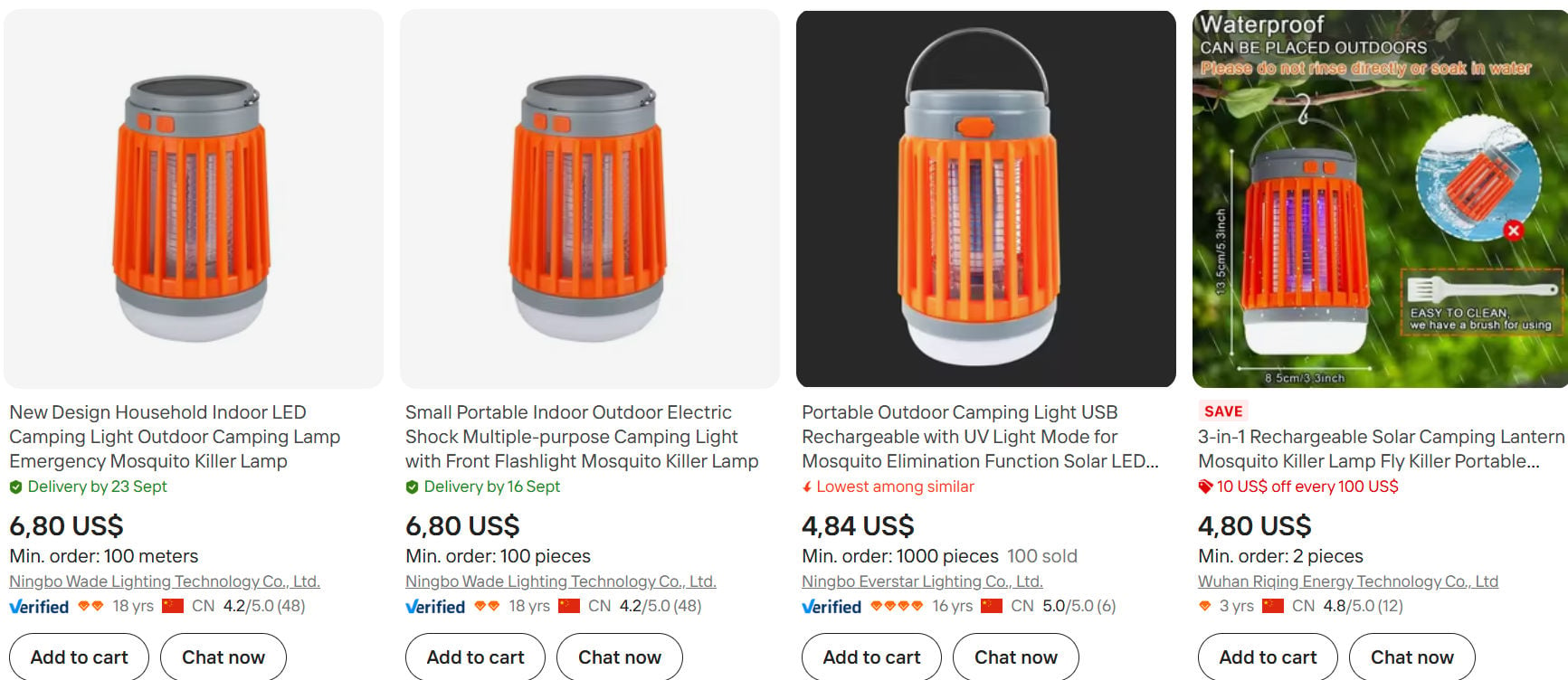
The Alibaba comparison supplied to MalwareTips shows orange and gray mosquito-killer camping lamps priced between $4.80 and $6.80, depending on the listing and minimum order. The products have the same general lantern shape, front flashlight, orange protective cage, hanging handle, and electrified inner grid seen in BuzzKrush advertising.
This comparison does not prove that every BuzzKrush unit came from one specific Alibaba seller. It does demonstrate that this style of product is generic, widely offered, and available at wholesale prices far below the supposed $79.98 retail value.
A dropshipper can purchase or source a low-cost item, give it a memorable name, build a dramatic sales page, and sell it for many times the factory price. The markup pays for social media advertising, affiliate commissions, payment processing, fulfillment, and profit. It does not turn the underlying lamp into new technology.
BuzzKrush charges $39.99 for one unit before shipping. The page code also lists shipping at $9.95 or $14.95 for different campaign configurations. A shopper attracted by the $39.99 headline can therefore face a total of $49.94 or $54.94 before any other optional item or local charge.
The checkout uses urgency, bundles, and add-on products
Clicking the main offer opens a dedicated checkout page rather than a conventional product cart. The page announces that a 55% discount has already been applied, labels one package a best seller, and displays recent-purchase notifications to create the impression that other people are buying at that moment.
A large pop-up then offers another 10% discount that allegedly must be used within five minutes. It says only five lucky visitors receive the coupon each week, yet the timer and message are automated sales elements presented to page visitors.
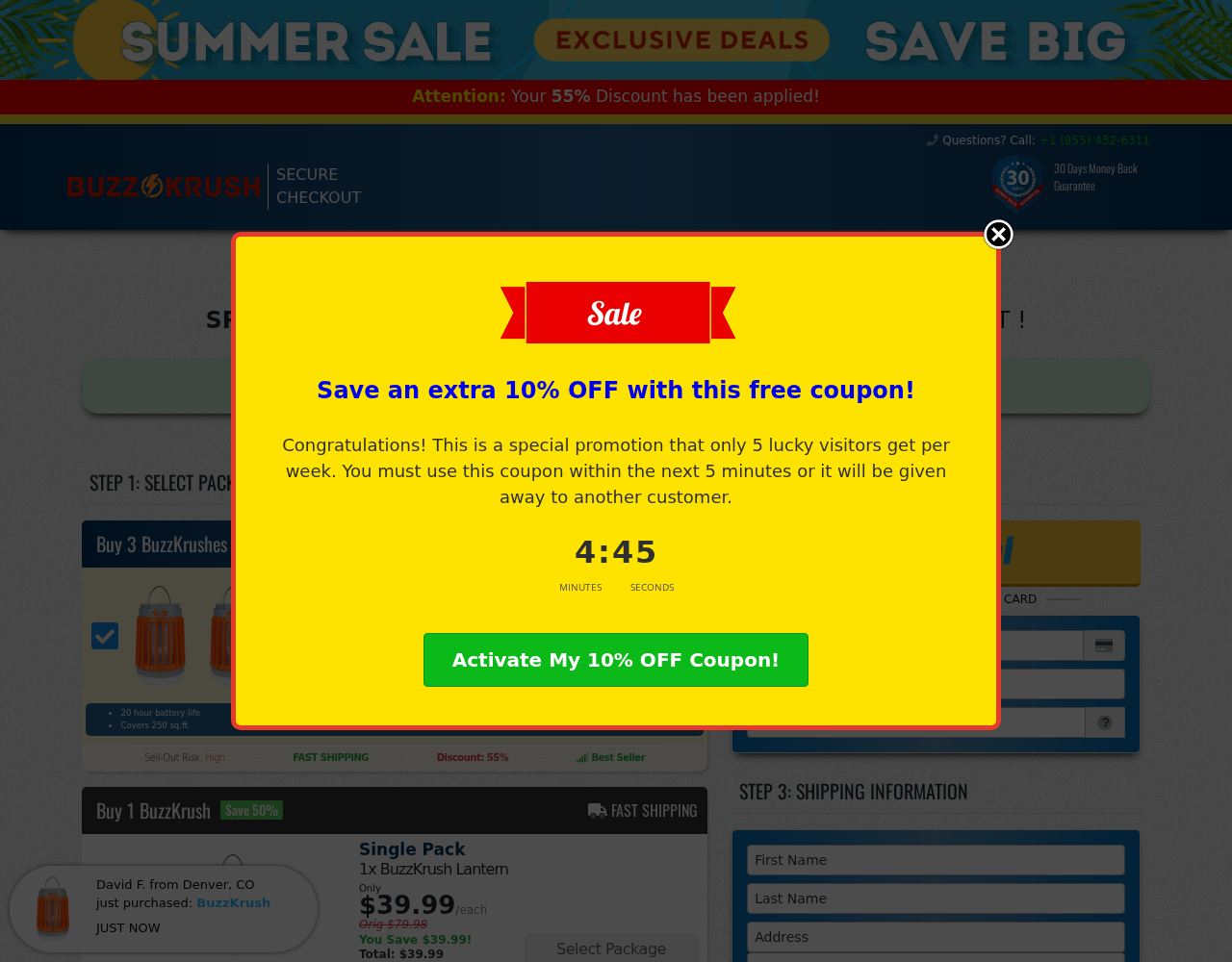
The underlying campaign data includes multi-unit packages, package protection, extra lamps, chargers, pet collars, citronella cartridges, watches, and sticker packs. Not every item will necessarily appear in every session, but the structure is built to raise the final order value after the first ad has secured the click.
This matters because buyers frequently remember the price from the social ad, not the total they approved. Anyone who has already ordered should compare the confirmation, pending transaction, and final posted charge line by line.
The mosquito-control claims need much stronger evidence
Mosquito behavior is more complicated than the BuzzKrush page suggests. Different species respond differently to light, time of day, color, temperature, carbon dioxide, human odor, moisture, and other cues.
The CDC guide to mosquito surveillance traps explains that professional traps often use attractants such as carbon dioxide, octenol, or human-scent lures to attract more female mosquitoes. CDC light traps commonly combine a light with carbon dioxide released by dry ice.
That does not mean a light-based device can never catch a mosquito. It means a seller promising that one small lamp will clear a large space and keep a family bite-free should provide direct evidence for that exact product and use case.
BuzzKrush instead relies on testimonials, marketing percentages, and broad statements. It does not show a controlled comparison between occupied areas using the lamp and equivalent areas without it. It also does not explain how many of the insects pictured or counted are actually biting mosquitoes rather than moths, gnats, or other flying insects.
The product description contradicts itself
The page repeatedly describes the light as “UV-free” and “100% UV radiation-free.” Elsewhere, the product category and visually similar wholesale listings are commonly described as using UV light to attract insects.
BuzzKrush also says one charge lasts up to 20 hours in the headline section but up to 24 hours later on the same page. The device is described as solar-powered, while its charging instructions emphasize a micro USB cable.
A product can support more than one charging method, and battery runtime can vary by operating mode. A trustworthy technical page would explain those modes, battery capacity, solar panel output, charging time, and test conditions. BuzzKrush provides the larger number without that context.
“Weatherproof” does not tell buyers what the lamp can survive
Electrical products used outdoors need precise water-resistance information. BuzzKrush says the lamp can withstand extreme rain, snow, and heat, but it does not display a recognized ingress-protection rating or independent safety certification for the complete device.
The supplied Alibaba image shows one similar listing using the word “waterproof” while also warning buyers not to rinse or soak the device. That small qualification illustrates why shoppers should not interpret a broad marketing word as permission to leave a rechargeable high-voltage product in heavy rain.
Do not place an unverified electrical insect lamp where children can touch the grid, where it can fall into water, or where rain can enter its charging port. Marketing language is not a substitute for the manual and certification markings on the actual unit.
The 30-day refund promise is much weaker in the return policy
The main advertisement promises a 30-day money-back guarantee and says customer satisfaction is the priority. The separate return page removes shipping and handling from the refund and requires the item to be in the same condition received and in its original packaging.
The most serious problem appears where a normal policy would provide a warehouse address. BuzzKrush tells customers to mail the product to support@BuzzKrush.com. An email address cannot receive a physical parcel.
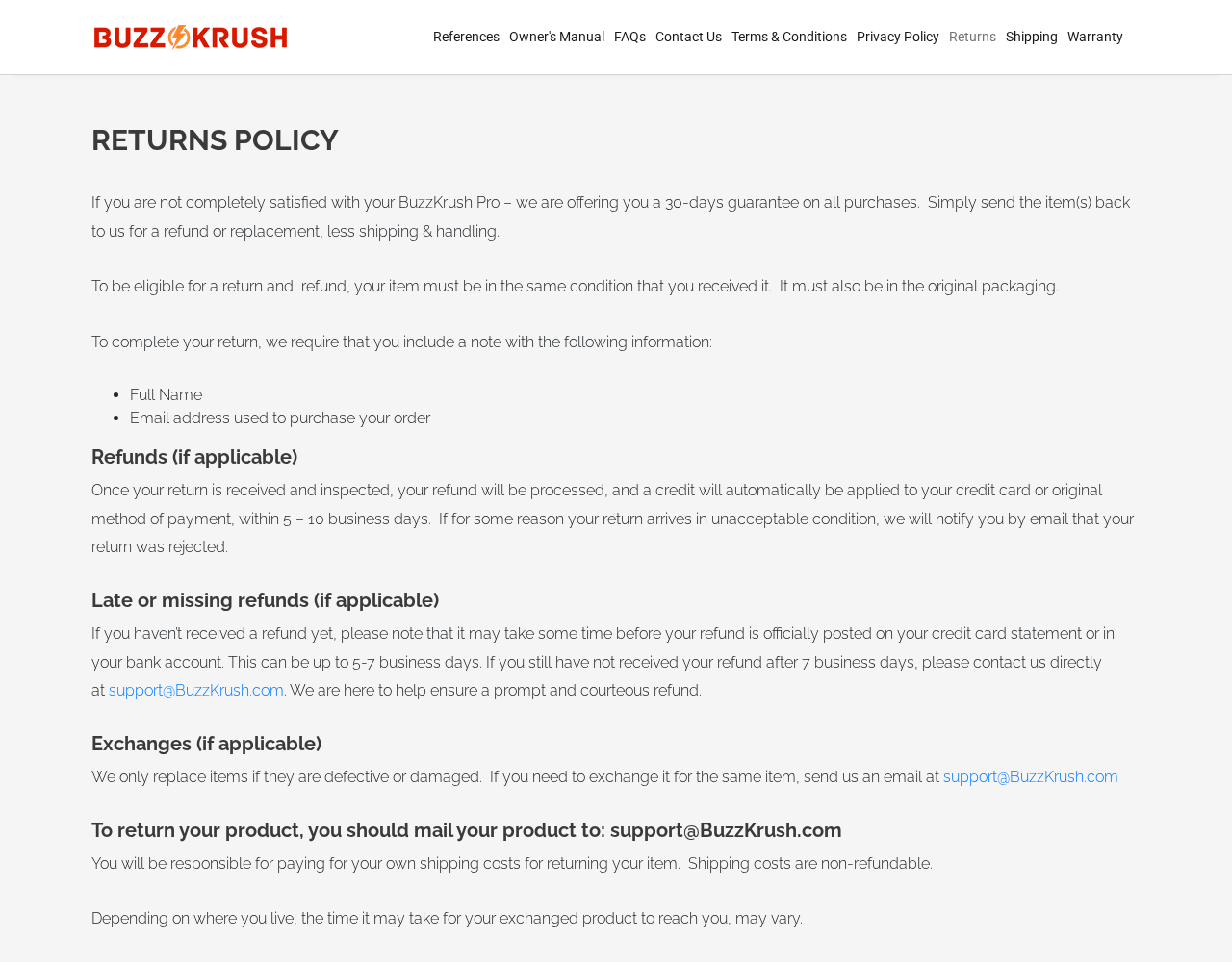
A buyer must therefore contact support and hope to receive a usable destination before sending anything back. The terms also reserve a minimum 15% restocking fee. On a $39.99 product, that fee alone is at least $6.00, in addition to non-refundable outgoing shipping and the cost of tracked return postage.
The result can make a refund economically pointless. A buyer may spend almost as much returning the cheap device as the amount they expect to recover, especially if support supplies an overseas return address.
Seller-controlled reviews are not independent proof
The sales page reports an average 4.6 rating and presents an unusually positive distribution, with 89% of reviews shown as 5-star, 11% as 3-star, and 0% in the other categories. The testimonials live on a page controlled by the seller.
There is no clear independent verification system showing that each reviewer purchased the product, used it around mosquitoes, and submitted an unedited opinion. Star graphics and first names should not carry the same weight as a review history on an independent platform.
The FTC’s Consumer Reviews and Testimonials Rule guidance explains why fake, false, or misleading reviews are a serious consumer-protection issue. We are not claiming that every BuzzKrush testimonial is fabricated. We are saying the page gives shoppers no reliable way to verify them.
Quick BuzzKrush warning signs
- A generic product is marketed as a special discovery or breakthrough.
- Wholesale listings show similar hardware for about $4.80 to $6.80.
- The advertised retail value of $79.98 is not independently established.
- The page makes sweeping mosquito-control claims without field-test data.
- Battery runtime changes from 20 to 24 hours on the same sales page.
- The marketing says UV-free while the product category commonly relies on UV or violet light.
- Countdowns, scarcity claims, and recent-purchase pop-ups pressure a quick decision.
- Shipping and optional offers can increase the total beyond $39.99.
- The return page lists an email address where a physical address should appear.
- Outgoing shipping, return postage, and at least a 15% restocking fee may be lost.
How The Operation Works
BuzzKrush follows a familiar direct-response dropshipping funnel. Each stage reduces the time available for comparison and increases the amount a shopper is willing to spend.
1. A dramatic social media ad introduces the “solution”
The campaign begins with a short video or polished image showing peaceful sleep, outdoor relaxation, or a cloud of insects disappearing near the lamp. AI-generated or heavily edited scenes can make the product look more effective and more substantial than it is.
The ad focuses on the emotional problem: itchy bites, buzzing at night, worries about children, and ruined summer evenings. It rarely pauses long enough to show a controlled, continuous demonstration.
2. A generic lamp is presented as proprietary technology
The memorable BuzzKrush name, custom logo, large product rendering, and technical-sounding figures create the impression of a purpose-built system. In reality, visually similar lamps are readily available through wholesale marketplaces.
Rebranding is central to the markup. The buyer compares BuzzKrush with professional mosquito-control equipment, not with a $4.80 to $6.80 generic camping lamp.
3. Broad promises replace measurable evidence
Words such as powerful, natural, safe, weatherproof, and effective are repeated beside numbers like 1000V and 375 ft². The combination feels scientific even though the page does not provide the underlying test.
A voltage figure alone does not prove attraction range or mosquito reduction. The grid can only kill an insect after that insect approaches and touches it.
4. A crossed-out price anchors the value
The claimed $79.98 value makes $39.99 look like a major saving. The shopper is not shown the $4.80 to $6.80 wholesale category at the moment of decision.
Once the higher value is accepted, paying $39.99 plus shipping can feel reasonable even if the physical item is cheaply made.
5. The checkout adds a timer and social pressure
The checkout says the discount has been applied, shows a five-minute extra coupon, and displays recent-purchase messages. These elements make leaving the page feel like losing money.
A calm shopper would open another tab, compare models, read the policy, and search independent reviews. The funnel is designed to prevent that pause.
6. Bundles and extras raise the transaction
Multi-pack options encourage buyers to equip several rooms or give lamps to relatives. Protection, chargers, additional lamps, and other upsells can add more to the order.
The final charge may therefore bear little resemblance to the first price remembered from the ad. Currency conversion or an unexpected merchant descriptor can create further confusion.
7. Fulfillment supplies a low-cost product
The buyer may receive a functioning light and electric grid, but that does not validate the promise of a mosquito-free space. Cheap plastic, a small battery, weak illumination, charging problems, or minimal water resistance can become visible only after opening the package.
Because a parcel was delivered, a complaint must focus on inaccurate claims, defects, wrong quantity, or merchandise that was not as described rather than simple non-delivery.
8. The return conditions shift the cost back to the buyer
Support can require photos, original packaging, prior approval, and tracked return shipping. The customer loses the first shipping charge, pays to return the device, and may lose at least another 15% to restocking.
The missing physical address adds another obstacle. Delays can consume the 30-day window while the customer waits for instructions.
9. Advertising continues under new creatives
If one ad accumulates skeptical comments, a seller can launch another video, affiliate page, discount, or product name while sourcing the same generic hardware. AI tools make it inexpensive to generate many summer scenes and testimonial-style clips.
This is why buyers should evaluate the physical product and terms, not just the name shown in the latest advertisement.
What To Do If You Have Fallen Victim
If you ordered BuzzKrush, stay calm and act before return and card-dispute deadlines expire. Good records are more useful than an angry message.
- Save the advertisement and every important page. Capture the social post, landing-page URL, 1000V claim, 375 ft² claim, battery runtime, weatherproof statement, price, guarantee, checkout, and return policy. Save the date because the content can change.
- Compare the confirmation with your statement. Check the quantity, shipping fee, package protection, accessories, taxes, and total. Note any duplicate transaction or amount you did not clearly approve.
- Keep the package and shipping label. Do not discard the original box, insert, USB cable, brush, label, or customs declaration. The return policy specifically refers to original packaging.
- Photograph defects and misleading details. Record the lamp failing to charge, battery runtime, weak grid, missing accessories, damaged housing, or any water-resistance warning that conflicts with the ad. Never deliberately expose the product to water for a test.
- Contact BuzzKrush in writing. State the order number, delivery date, exact problem, and requested resolution. Ask for a complete physical return address and a prepaid, tracked return label. An email address is not a valid parcel destination.
- Do not mail the product without authorization. A parcel sent to an unconfirmed address can be refused or lost. Keep screenshots of every attempt to obtain the correct destination.
- Calculate the real refund before accepting. Ask whether original shipping, return postage, and the 15% restocking fee will be deducted. Request the exact refund amount in writing.
- Be careful with partial-refund offers. A small refund for keeping the product may limit later options. Ask your card issuer how accepting it could affect a dispute.
- Contact the card issuer promptly. Explain whether the issue is a wrong amount, duplicate charge, defective item, or merchandise not delivered as advertised. The FTC’s billing dispute guidance warns consumers not to let a slow seller process push them beyond card protections.
- Use precise evidence in a dispute. Include the ad, invoice, policy, product photos, support messages, and tracking. Explain the difference between the promised performance and the actual device without exaggeration.
- Monitor the payment card. Watch for duplicate or unfamiliar charges. If anything unauthorized appears, call the bank and ask whether the card number should be replaced.
- Report the advertising. Report the social media ad and submit the seller, URL, amounts, and screenshots to the FTC at ReportFraud.ftc.gov. Reports help investigators identify repeated campaigns.
The Bottom Line
BuzzKrush is an inexpensive generic mosquito-lamp concept wrapped in aggressive, high-margin marketing. The $39.99 headline, unsupported performance claims, countdown checkout, extra charges, missing return address, non-refundable shipping, and 15% restocking fee make the offer a poor and risky purchase.
Do not order BuzzKrush because a social media video makes it look revolutionary. If you already paid, preserve the ad and packaging, request a physical return address in writing, calculate every deduction, and contact your card issuer before important dispute deadlines pass.








