

Purella Complete Liver Support is presented as a simple daily answer to fatigue, bloating, brain fog, and worrying liver test results. The bottle looks polished, the ingredients sound clinical, and the page repeatedly suggests that a liquid formula can give an overworked liver what ordinary supplements and prescriptions supposedly miss.
That story becomes much less reassuring once the store is examined as a whole. Purella uses copy found on several unrelated liver-drop websites, mixes the Purella and Purelia names, keeps automatic-refill infrastructure on a sold-out product, and makes a 60-day refund promise that does not match its written return policy.
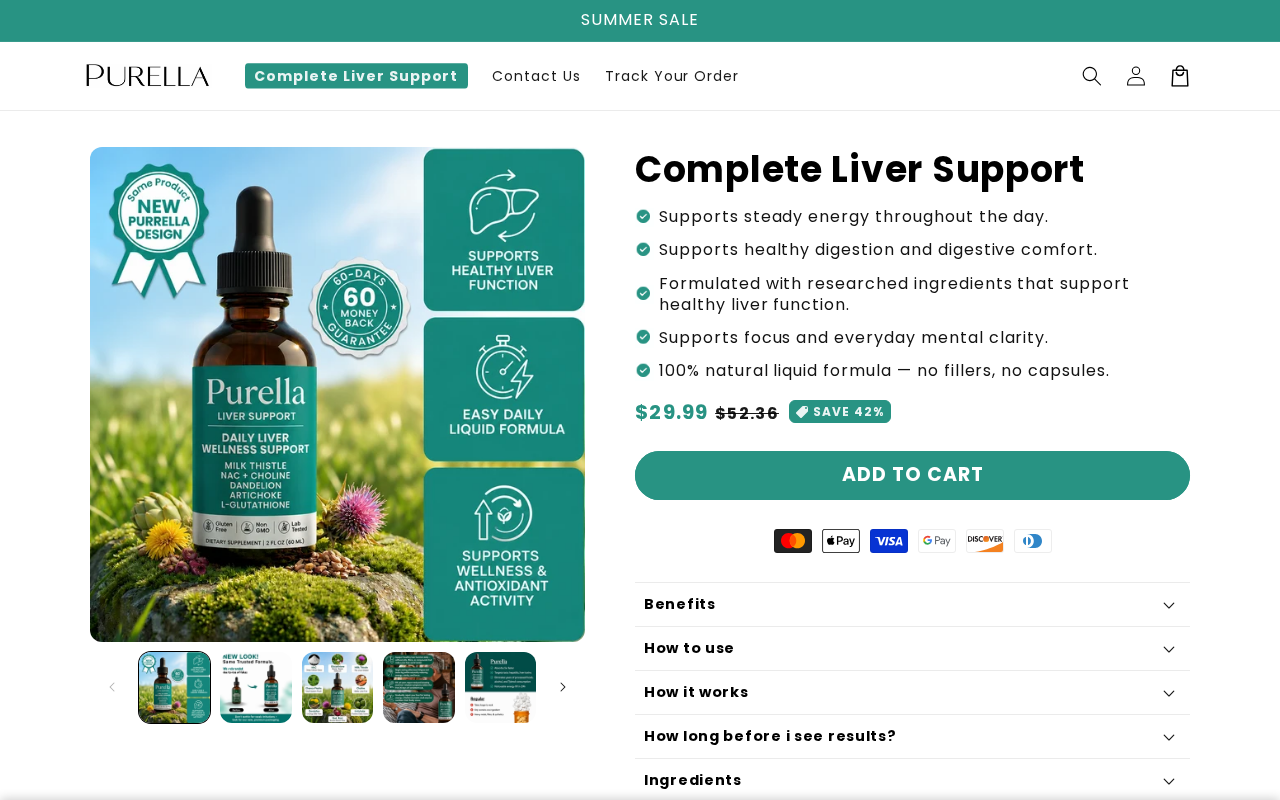
Purella Complete Liver Support Overview
Purella is a liquid dietary supplement sold through officialpurella.com. At the time of our review, the product was displayed at $29.99, reduced from $52.36, but every visible purchase button was disabled and marked “Sold out.” That means we could not complete a live order or prove what a buyer would see at payment today.
The advertised serving is 2 mL per day. The formula lists glutathione 50 mg, NAC, milk thistle extract 30:1 at 200 mg, dandelion root extract 4:1 at 200 mg, artichoke extract 4:1 at 100 mg, beet root extract 30:1 at 100 mg, choline citrate 50 mg, and a 100 mg proprietary herbal blend.
Who is behind Purella?
Purella names Upfront Ecommerce LLC and publishes 5001 Lake Front Dr, Tallahassee, FL 32303, plus +1 (448) 867-7548. Florida’s official corporate record confirms an active Upfront Ecommerce LLC, document L26000293187, filed on May 26, 2026. The record lists unit F8 at the same address, an FEI/EIN of “none,” and no annual reports yet.
The company is therefore not an invented name, but it was extremely new when this review was prepared. Property listings identify 5001 Lake Front Dr as a large apartment complex, not a supplement plant or fulfillment warehouse. Purella omits unit F8 from the address displayed to shoppers.
A residential registration can be lawful for a home-based online business. It does not, however, tell customers who manufactures, tests, bottles, or ships the drops. We found no independent business listing that tied the published 448 number to a laboratory or fulfillment operation. The evidence supports “new ecommerce company using a residential address,” not “proven fake company.”
That exact formula, including the same extract ratios and the same six-herb proprietary blend, appears under Purelia, Livora, Ocuvana, Aloura, Dovi, Rosalyssa, and Orchid branding. White-label supplements are not automatically fraudulent, but identical copy and identical testimonials make claims of a unique breakthrough formula difficult to trust.
Our verdict on Purella
Purella was not an active subscription trap when we checked because the product was sold out.
However, it is a high-risk offer with an automatic-refill policy, contradictory guarantees, copied medical marketing, and poor quality control. We would not enter payment details unless the company first provides clear one-time pricing, current lab documentation, and a single refund policy that it agrees to honor.
- Current availability: Sold out during our inspection.
- Displayed price: $29.99, compared with $52.36.
- Subscription: A written 30-day automatic-refill policy exists, although no live plan could be selected while the item was unavailable.
- Company named by the site: Upfront Ecommerce LLC, Tallahassee, Florida.
- Main concerns: copied formula and reviews, Purelia text on a Purella page, medical-style claims, and conflicting refund terms.
How The Purella Liver Support Scam Works
We use the word “scam” here to describe the misleading sales pattern people search for, not to claim that no customer ever receives a bottle. The more precise concern is a white-label health offer built around exaggerated outcomes and terms that are easier to promise in advertising than to claim in practice.
1. Ordinary symptoms are reframed as a hidden liver problem
The pitch begins with symptoms almost anyone may experience: an afternoon energy slump, mental fog, bloating, sluggish digestion, or difficulty losing weight. Rather than acknowledging how many conditions can cause these problems, the page suggests that the liver is congested, depleted, or falling behind.
This is persuasive because it gives scattered frustrations one simple explanation. It can also be unsafe. Elevated ALT or AST results, pain under the ribs, jaundice, fatigue, and digestive changes require proper assessment. A product page cannot determine whether the cause is fatty liver disease, medication, alcohol, infection, gallbladder trouble, another condition, or nothing serious at all.
2. Familiar ingredients are upgraded into a treatment story
NAC, glutathione, milk thistle, choline, dandelion, and artichoke are real substances with legitimate research around particular biological roles. Purella turns those individual facts into a much larger narrative: the drops supposedly repair cells, restore a “master repair molecule,” improve enzyme numbers, drain bile, stop fat accumulation, and slow silent scarring.
That leap is not supported merely because the label contains recognizable ingredients. Research on an ingredient at a defined dose is not proof that this mixture, in this form, at these amounts, will reverse liver fat or normalize laboratory results. The page does not provide a clinical trial of the finished Purella product.
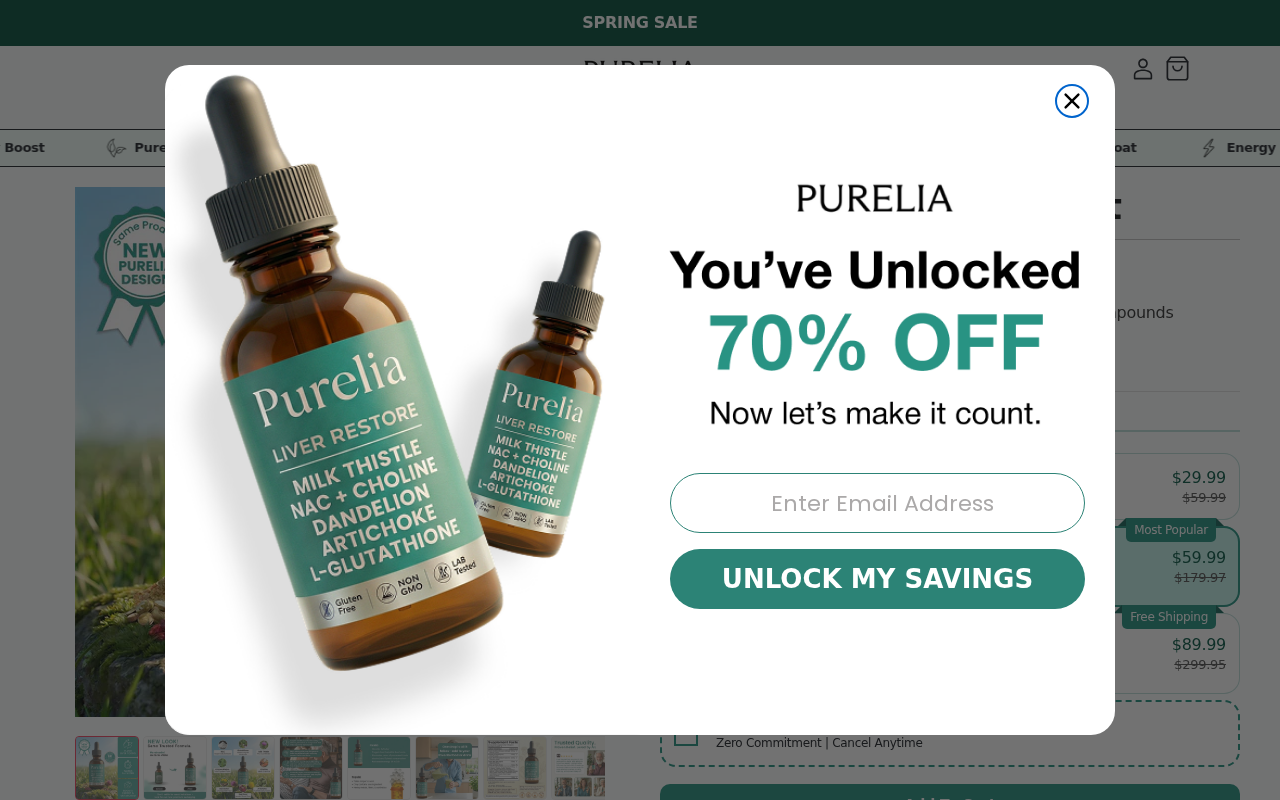
3. A mass-market formula is presented as something exclusive
Purella says buyers should avoid “fakes” on Amazon or eBay, yet its own ingredient list and much of its sales copy are shared by numerous storefronts. Some of those pages use the same review stories, the same ages, the same claimed liver-enzyme improvements, and the same timeline of benefits.
The Purella page even slips into the Purelia name in several sections. It also contains unrelated skincare wording about tranexamic acid and ceramides. These are not small scientific disagreements; they are editing failures that suggest a sales template was copied and repurposed without careful review.
4. Testimonials substitute for verifiable product evidence
Stories on the site describe dramatic drops in ALT and AST, improved ultrasound findings, reduced liver fat, and doctors being impressed by the results. These are precisely the outcomes that would require medical records, a controlled trial, or transparent survey methods to evaluate.
Instead, the page offers names, ages, photographs, and “verified buyer” labels without explaining how the reviews were collected or verified. Several stories reappear under other brand names. A testimonial duplicated across unrelated products is marketing material, not independent confirmation that the bottle produced the claimed result.
5. Scarcity pushes the buyer toward repeat deliveries
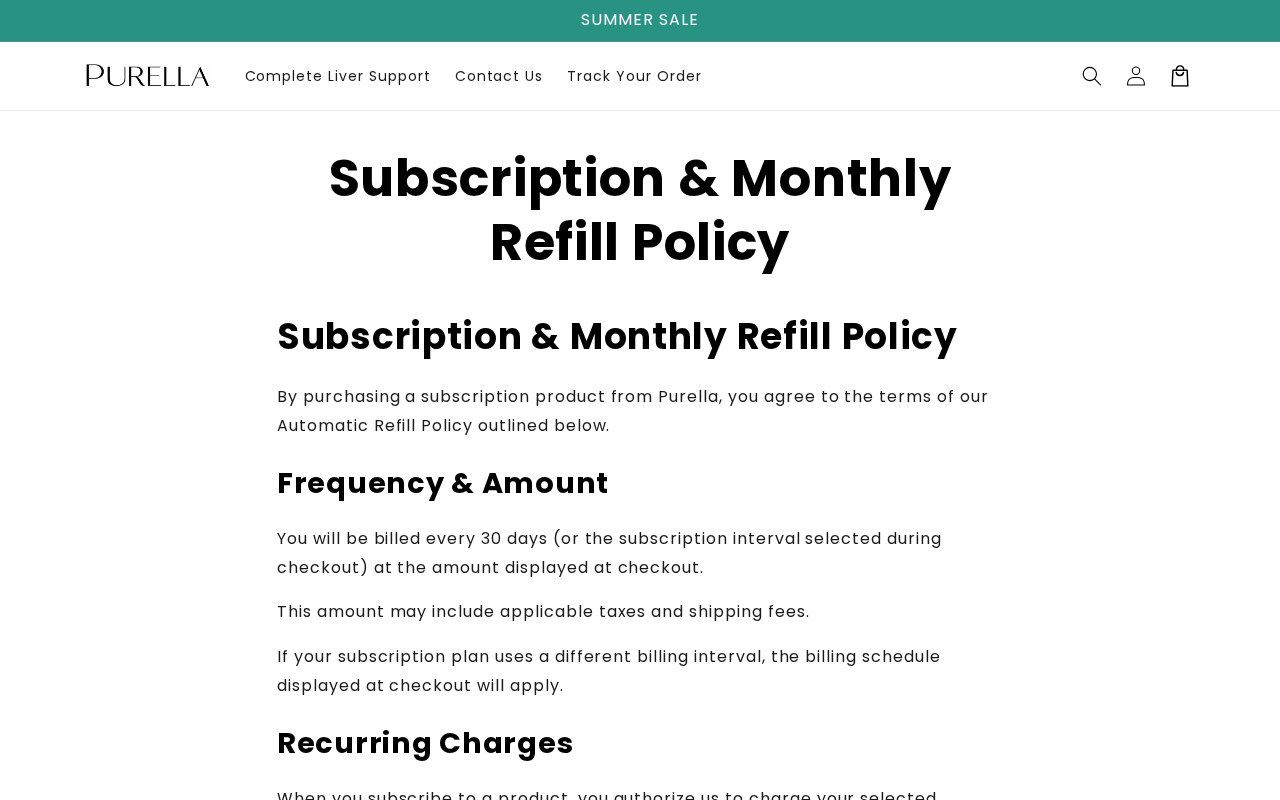
The page says the product sold out repeatedly and warns that subscribing protects the customer from future stockouts. Purella’s separate subscription policy confirms that a subscriber can be billed every 30 days and that charges continue until cancellation.
The policy requires cancellation at least 24 hours before the next billing date. Once a renewal order has entered processing, the site says it cannot be canceled. Those details matter because a buyer who focuses on the discount or stock warning may not appreciate how quickly the next order can become non-cancelable.
6. The guarantee sounds broader than the actual policy
On the product page, Purella promotes a 60-day money-back guarantee and says a customer can receive a full refund even if the bottle is empty, with no questions asked. The dedicated refund page gives a 30-day window instead, requires prior authorization, asks for a reason, and says the return will be inspected before approval.
Customers may also be responsible for return shipping, while original shipping charges are non-refundable. One footer link points to a missing refund page, although a different refund URL works. When a sales promise and the formal policy disagree, assume the narrower conditions may be enforced and save screenshots before ordering.
Are Purella’s Liver Claims Supported by Evidence?
The FDA does not approve dietary supplements for safety and effectiveness before they reach the market. The agency also explains that a product intended to diagnose, treat, cure, or prevent disease is regulated as a drug, even if the seller calls it a supplement.
Milk thistle has been studied for liver conditions, but the National Center for Complementary and Integrative Health says the evidence is conflicting or too limited for firm conclusions.
It also notes that some commercial milk-thistle products have contained different amounts from the label or contaminants, which is why a general “third-party tested” badge should be backed by an accessible batch report.
NAC has an important hospital use for acetaminophen poisoning, but that does not make an oral wellness blend equivalent to intravenous treatment. In a randomized placebo-controlled trial involving people with metabolic dysfunction-associated steatotic liver disease, 600 mg of NAC three times daily for eight weeks did not significantly improve liver enzymes or liver fat compared with placebo.
Purella does not clearly state the amount of NAC in its formula on the page we reviewed. Without a complete dose, finished-product trial, batch certificate, and evidence for the advertised outcomes, terms such as “hospital-grade,” “anti-fibrotic,” and “directly into the bloodstream” should be treated as promotional language.
What to do if you have fallen victim to this Scam
- Check whether the charge was one-time or recurring. Review the order confirmation, cart receipt, and bank description. Search your email for “subscription,” “automatic refill,” “every 30 days,” “renewal,” and “Purella.” Do not rely only on the product being sold out now; an earlier subscription may still renew.
- Cancel in writing immediately. Contact support@officialpurella.com and state that you are canceling all subscriptions and future shipments. Include the order number and the email used at checkout, but never send a full card number, password, or identity document unless your bank independently requires it.
- Save proof before the pages change. Capture the product promise, the 60-day guarantee, the 30-day refund policy, the automatic-refill terms, your confirmation, and every support reply. Save files with the date visible. The contradictions may help if the merchant or bank disputes what you were shown.
- Request a refund using both promises. Quote the broad guarantee shown on the product page and also follow the formal return process. Ask for an RMA and a written return address. Use tracked shipping if a return is required and retain the receipt.
- Contact your card issuer if billing continues. If a renewal was not clearly authorized, the company ignores cancellation, or the promised refund is refused, call the number on the back of your card. Explain the timeline and ask about blocking future merchant charges and disputing the transaction.
- Report misleading billing or health claims. U.S. consumers can report subscription problems to the FTC at ReportFraud.ftc.gov. Safety problems or serious reactions involving a dietary supplement can be reported through the FDA’s Safety Reporting Portal.
- Speak with a healthcare professional. Stop using the product and seek advice if you develop a reaction. If you bought Purella because of abnormal liver tests, pain, jaundice, swelling, dark urine, or persistent fatigue, arrange a proper medical evaluation rather than waiting 60–90 days for a supplement to change the numbers.
How to Avoid Similar Liver Supplement Offers
- Search a distinctive sentence from the advertisement in quotation marks. Identical wording across unrelated brands is a strong white-label clue.
- Compare the sales-page guarantee with the dedicated refund policy before paying. Look for shorter windows, unused-item requirements, sale exclusions, and return-shipping costs.
- Inspect every checkbox and cart line for automatic refills. A discounted first order may create a monthly plan.
- Ask for a complete Supplement Facts label and a batch-specific certificate of analysis from an identifiable laboratory.
- Be cautious when a supplement predicts exact improvements in ALT, AST, ultrasound findings, liver fat, or fibrosis without a trial of the finished product.
- Never replace prescribed care or diagnostic testing with a “detox” program sold through urgency timers and testimonials.
Purella Questions Buyers Should Ask
How Purella is connected to Purelia, Livora, Ocuvana, and Aloura
Purella is part of the same observable white-label product family as Purelia, Livora, Ocuvana, and Aloura. They repeat the same doses, extract ratios, 100 mg herbal blend, medical narrative, and named customer stories.
That does not prove the stores share one owner. The documented connection is the product and marketing material. Our Complete Liver Support clone-network investigation compares the companies, addresses, subscription designs, and AI-generated customer gallery.
Does an active Florida LLC prove Purella works?
No. It proves that an entity with the disclosed name was filed and active when checked. It does not prove the drops were clinically tested, the testimonials are authentic, or the refund promise will be honored. Corporate registration and product validation are separate questions.
Is the Tallahassee address a fulfillment center?
No evidence we found supports that description. The official filing includes apartment unit F8, and property listings describe a multifamily complex. Purella may use an undisclosed third-party shipper, but the website does not identify one.
Could Purella become a subscription trap?
Yes. The store maintains a monthly-refill policy and says subscribers are charged every 30 days. The product was sold out and no live recurring choice could be tested, so buyers should recheck the checkout if stock returns rather than relying on this snapshot.
Anyone ordering after a restock should save the purchase-frequency control, cart, confirmation, and next-billing date. A policy can remain online while the product configuration changes, and the only reliable evidence is the exact state presented before payment.
The Bottom Line
Purella may be a real bottle supplied by a disclosed U.S. company, but the store does not earn trust. The product was sold out when checked, so we cannot call it an active subscription trap today.
The larger pattern remains concerning: copied formula and reviews, medical-style promises, mixed brand names, a 30-day refill system, and a refund policy that is far narrower than the 60-day “no questions asked” claim.
Our recommendation is to avoid Purella Complete Liver Support unless the company corrects the page, reconciles its policies, publishes verifiable testing, and makes one-time versus recurring billing unmistakable. Anyone worried about liver health should use medical testing and professional advice, not a cloned sales page, as the starting point.








