

Aloura’s Complete Liver Support is sold with a comforting promise: a few daily drops can help the liver process modern life, restore energy, reduce bloating, and support healthier blood work. A large sale timer and generous guarantee make ordering feel almost risk-free.
The checkout tells a different story. Aloura preselects recurring delivery, displays one subscription discount while applying another, and uses the same formula and sales narrative found on a growing network of unrelated supplement stores. Its refund policy is also far stricter than the 60-day promise on the product page.
Aloura Complete Liver Support Overview
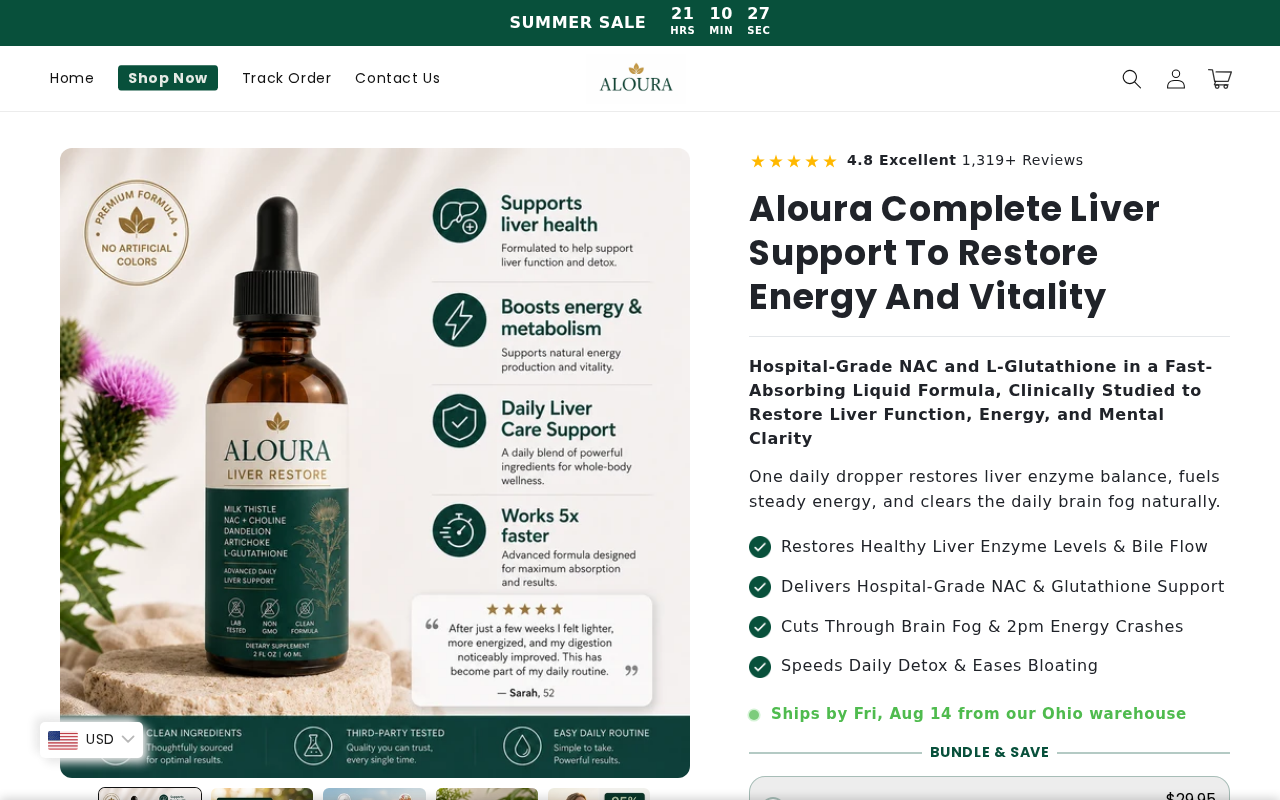
Aloura Health sells a 2 fl oz liquid supplement through alourahealth.store. The one-time price was $39.95 during our review. A nearby “Subscribe & Save 10%” choice displayed $29.95 and was already selected when the page loaded.
The hidden product form contained selling plan 6460309757, confirming that the selected option was a recurring Shopify purchase rather than a cosmetic label. The actual difference between $39.95 and $29.95 is roughly 25%, not the advertised 10%. A shopper sees three incompatible messages: 10% copy, a 25% price reduction, and a preselected plan.
The formula lists glutathione 50 mg, NAC, milk thistle 200 mg, dandelion root 200 mg, artichoke 100 mg, beet root 100 mg, choline citrate 50 mg, and a 100 mg proprietary blend. The same exact sequence and doses appear under Purelia, Purella, Dovi, Livora, Ocuvana, and Rosalyssa.
Who owns Aloura Health?
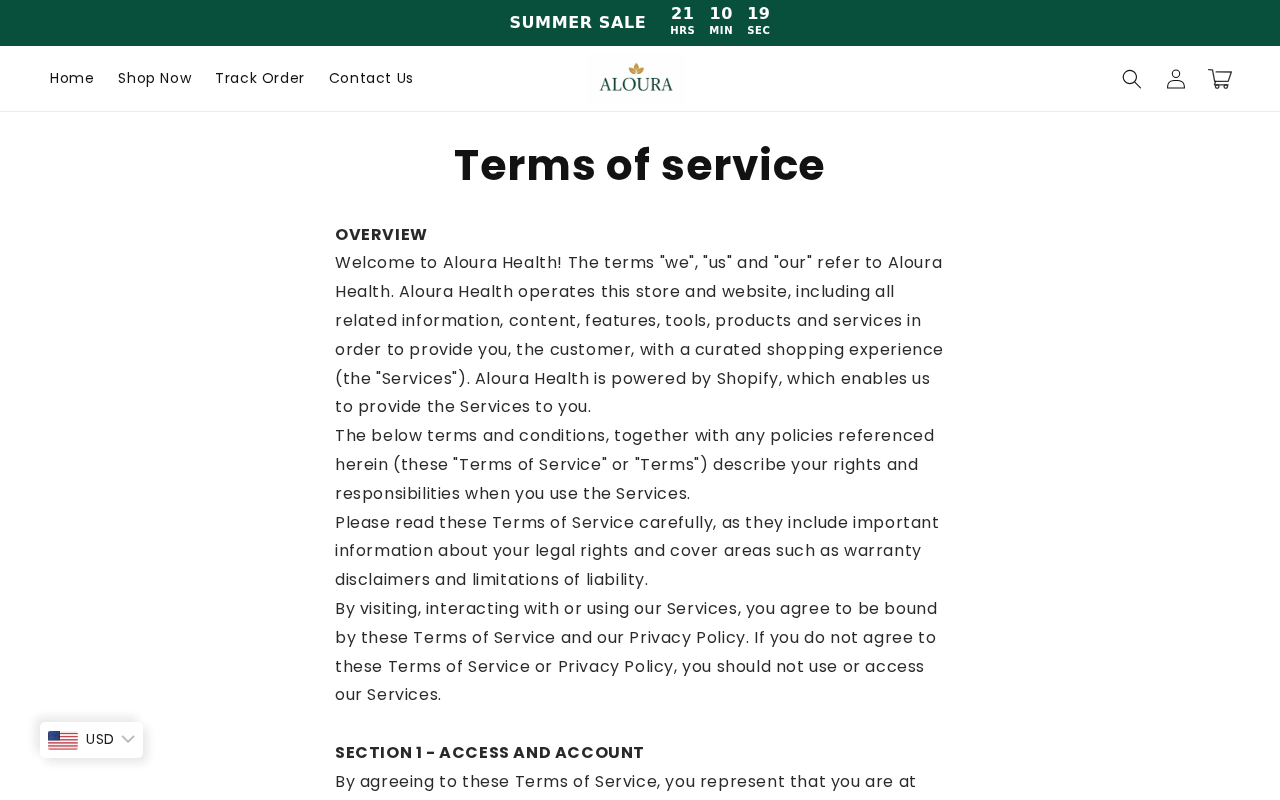
The footer says the store is operated by Tarot Club LLC and publishes info@alourahealth.store. The contact page offers a web form and claims support hours from 9 a.m. to 8 p.m. EST, Monday through Sunday, but it does not publish a customer-service telephone number.
Aloura’s terms and privacy policy do not give Tarot Club LLC’s street address, mailing address, registration number, state of formation, manager, manufacturer, return warehouse, or fulfillment center. Without a jurisdiction, we could not confidently match the name to one specific official corporate record.
Tarot Club LLC may be a real ecommerce entity, but the store does not provide enough identifying information for shoppers to verify it.
We found no evidence that the company manufactures supplements or operates its own warehouse. We also cannot prove the parcel comes from China merely from the site; the fulfillment origin must be checked on an actual label or customs record.
Why Aloura Looks Like a Subscription Trap
- The recurring purchase is selected before the shopper makes an active choice.
- The page says 10% off while the displayed plan price is about 25% lower.
- A hidden Shopify selling-plan value is attached to the purchase form.
- The supplement formula and testimonials are recycled across unrelated brands.
- The product page offers a 60-day “empty bottle” guarantee, while the policy allows 30-day returns for unused items.
- Discounted orders may collide with the policy’s sale-item exclusion.
- The named LLC has no published address, registration jurisdiction, or telephone contact.
How The Aloura Subscription Scam Works
1. Health anxiety brings the shopper to the page
Advertisements for liver drops often begin with everyday symptoms such as tiredness, a swollen feeling after meals, brain fog, or slow weight loss. The copy implies that toxins and an overworked liver are the hidden explanation, even though those symptoms are nonspecific.
The story then introduces fatty liver, fibrosis, high enzymes, and future decline. A reader who is worried about a serious condition becomes receptive to an easy at-home reset. This framing can bypass the normal question: has this finished product actually been tested?
2. Familiar ingredients create medical credibility
NAC, glutathione, milk thistle, and choline are recognizable names. The page discusses their biological roles and turns that background into an implied outcome for Aloura. Evidence about a nutrient or plant does not establish that a specific multi-ingredient liquid will reverse liver fat or normalize laboratory results.
The FDA does not preapprove dietary supplements for effectiveness before sale. Disease-treatment claims can also cross the line from a supplement claim into a drug claim. A disclaimer at the bottom does not automatically correct a page that repeatedly implies treatment of identifiable liver disease.
3. A generic formula is turned into an exclusive brand
Aloura’s exact formula is not exclusive. Other stores use the same doses, ingredient order, proprietary blend, review wording, and before-and-after narrative. Some even retain another brand’s name inside the copy, a strong sign of template reuse.
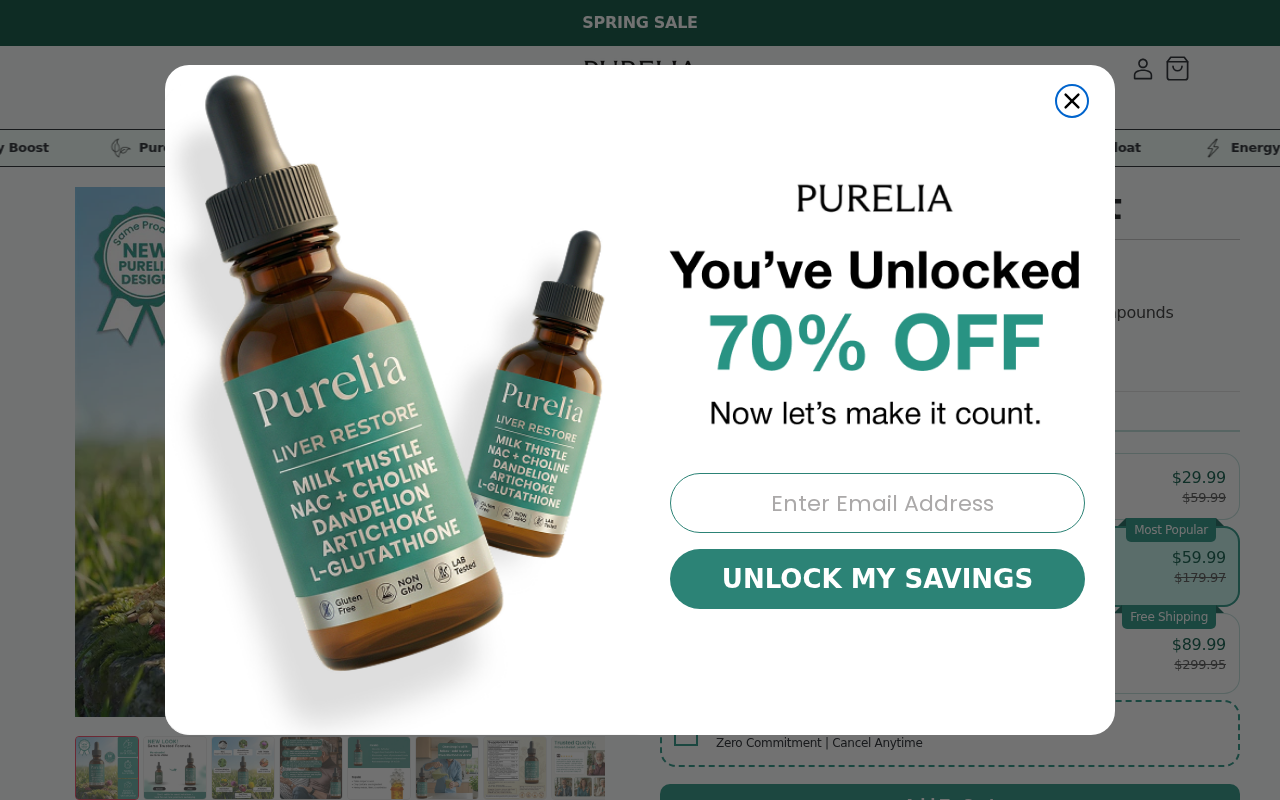
A white-label supplier can legally make products for multiple brands. What buyers need is transparency: who produced this batch, where it was made, what it was tested for, and whether the certificate matches the lot in the bottle. Aloura does not make those answers prominent.
4. The subscription is selected before informed consent
When we inspected the live page, the “Subscribe & Save 10%” control reported aria-checked=”true”. The form also carried a recurring selling-plan identifier. Unless the shopper notices the state and changes it, the discounted path is the default.
Preselection matters because a discount can look like an ordinary promotion. The buyer may focus on the lower $29.95 figure and overlook that the choice authorizes future charges and shipments. A recurring plan should be disclosed clearly beside the final total, interval, cancellation method, and renewal amount.
5. Conflicting discounts make the true offer harder to understand
The label says 10% off, but $29.95 compared with $39.95 is approximately 25% off. The discrepancy may be a careless configuration error, yet it prevents a shopper from knowing which subscription terms were intentionally offered.
These differences also complicate refunds. If an email later describes another amount or renewal price, the customer needs screenshots to show what the page displayed at the moment of purchase. Never rely only on the cart after payment because it can change.
6. Bundles and urgency increase the first payment
A countdown-style “SUMMER SALE” banner and large savings encourage immediate action. Multi-bottle options make a longer routine sound necessary, while the subscription lowers the apparent per-order price. Together, these devices reduce the chance that the buyer compares policies.
Urgency is particularly questionable for a health product because responsible decisions require time. A genuine deadline should have clear terms and should not simply reset for the next visitor or session.
7. The generous guarantee collides with the written policy
The product page promises a full refund within 60 days, even if the bottle is empty, with no questions asked. Aloura’s formal refund policy instead gives 30 days and says an item should be unused, in its original packaging, and accompanied by proof of purchase.
The policy also says sale items cannot be returned. Since the storefront prominently uses sale pricing and subscription savings, customers could reasonably wonder whether the advertised guarantee applies to the order they are being encouraged to place.
8. Cancellation depends on a low-transparency support channel
The site publishes an email and form but no phone or postal notice address. Email cancellation can work, but a customer should not have to identify an undisclosed company or warehouse after a recurring order has already renewed.
If support is delayed, the subscription may renew while the buyer waits. The safest approach is to cancel immediately in writing, save the sent message and any automated acknowledgment, and involve the card issuer before another charge if the merchant does not confirm.
What Science Says About Aloura’s Ingredients
NCCIH describes the evidence for milk thistle in liver conditions as conflicting or insufficient. Quality can vary between supplements, and contamination or inaccurate labeling is a broader concern in the category. A plant’s historical use is not proof of fibrosis reversal.
NAC has legitimate medical applications, but dose and condition matter. A recent randomized trial using 600 mg three times daily in MASLD did not significantly improve liver enzymes or steatosis versus placebo. Aloura does not clearly state the NAC amount needed to compare the product with that research.
People with symptoms or abnormal tests need an appropriate history, examination, laboratory work, and sometimes imaging. Supplements can interact with medication or be unsuitable during pregnancy, surgery, or particular medical conditions. A testimonial is not a diagnostic tool.
What to do if you have fallen victim to this Scam
- Check whether the order is recurring. Search the confirmation for subscription, selling plan, automatic delivery, renewal, or a future charge date. Do not assume the lower price was one-time.
- Cancel in writing now. Email info@alourahealth.store and use the contact form. State that you cancel all recurring plans, revoke authorization for future charges, and require written confirmation.
- Preserve the default selection. Save screenshots showing the checked subscription, $29.95 plan price, $39.95 one-time price, 10% label, and any renewal interval or checkout disclosure.
- Request the advertised refund. Quote the 60-day empty-bottle promise. Ask the merchant to reconcile it with the 30-day unused-item policy and sale exclusion before returning anything.
- Use tracked returns only. Obtain an authorized return address and RMA, photograph the bottle and parcel, and keep tracking. Do not mail supplements to an address found for another Tarot Club LLC.
- Monitor the card. Watch for another charge and unfamiliar merchant descriptors. If support does not confirm cancellation, ask the issuer about stopping future recurring transactions.
- Dispute unauthorized renewals. Provide the issuer with the page state, confirmation, cancellation, replies, and timeline. Explain that recurring delivery was preselected and the advertised discount was inconsistent.
- Report and seek care where appropriate. Report deceptive negative-option billing to the FTC and state consumer office. Report serious supplement reactions to the FDA and seek medical help for concerning symptoms.
How to Avoid Similar Subscription Traps
- Uncheck every preselected subscribe-and-save option before reviewing the total.
- Confirm the interval, renewal price, cancellation method, and deadline on the final page.
- Search the complete formula to identify rebranded products.
- Verify the legal company, address, phone, manufacturer, and return warehouse.
- Save the guarantee and policy before paying.
- Use a payment method with clear dispute rights and monitor it after cancellation.
Frequently Asked Questions About Aloura
How Aloura is connected to Purelia, Purella, Livora, and Ocuvana
Aloura repeats the formula and sales structure seen on Purelia, Purella, Livora, and Ocuvana. The wording about NAC, glutathione, liver enzymes, silent damage, and expected week-by-week results also follows the same template.
Aloura is operationally different because its recurring selling plan was preselected in our test. Shared content does not establish that Tarot Club LLC owns the other stores. Our network article separates the proven content links from unproven ownership assumptions.
Was the Aloura subscription really selected by default?
Yes, in our live session. The accessible state of the Subscribe & Save control was checked, and the purchase form contained a Shopify selling-plan identifier. That is stronger evidence than simply seeing the word “subscribe” on the page.
The configuration could change later. Customers should inspect the actual state at the moment they order and capture it before entering payment information. A merchant may also provide a clearer disclosure later in checkout, so the entire sequence matters.
Is Tarot Club LLC fake?
We cannot make that claim. Aloura names the LLC but omits its jurisdiction, registration number, address, and managers. Without those details, a registry search can produce unrelated companies with the same or similar name. The accurate finding is that ownership is insufficiently disclosed and cannot be independently verified from the store.
Where is Aloura fulfilled?
The site does not identify a warehouse or fulfillment provider. It could use a contract manufacturer, a U.S. logistics center, an overseas supplier, or more than one facility. Neither the general shipping language nor Shopify hosting proves the origin of the bottle.
What if Aloura calls the next charge a normal renewal?
Send the cancellation immediately and keep the sent timestamp. If the charge occurred after a clear cancellation or you never knowingly authorized recurring billing, tell the card issuer that the subscription was preselected and provide screenshots. Do not describe a charge as unauthorized if you knowingly selected and retained the plan.
Can the guarantee override the refund policy?
That depends on the facts and applicable consumer law. A prominent promise can be relevant evidence even when a policy is narrower. Customers should quote the exact 60-day language, ask for a written explanation, and preserve the page rather than arguing from memory.
If Aloura refuses, a payment provider or consumer agency can evaluate the conflicting representations. Keep communications factual: amount, date, page promise, product condition, cancellation request, return instructions, and merchant response.
Do not rely on deleting a customer account or removing a product from the cart after payment. Those actions may not cancel the Shopify selling plan. Cancellation should produce a specific confirmation showing the plan status, effective date, and that no future order is scheduled.
If the merchant offers only store credit, decide whether that matches the cash-refund promise you saw. A replacement or credit can be reasonable when voluntarily accepted, but it should not become the only remedy after advertising a full money-back guarantee.
The Bottom Line
Aloura has the clearest subscription-trap design in this group: recurring delivery was preselected, a selling plan was attached, and the discount wording did not match the actual price. The copied supplement story and contradictory refund rules add to the risk.
We recommend avoiding Aloura Complete Liver Support. The site should require an affirmative subscription choice, identify Tarot Club LLC fully, disclose fulfillment and manufacturing details, and reconcile its guarantee before asking anyone to trust a recurring health-product order.








