

A $19.99 bottle of liver-support drops may not look like the beginning of an expensive subscription. That is what makes the Dovi offer easy to underestimate.
The product is presented as a one-time delivery, but the checkout also enrolls consenting buyers in a Dovi VIP membership that becomes $49.99 every 28 days after a short trial. Left active for a year, that membership can cost roughly $650.
Our investigation found a real storefront and an active Nevada company, but also contradictory billing policies, a very new domain, medical-style claims without product-specific clinical proof, an unverified manufacturing trail, and a pending Dovi trademark owned by an individual in China.
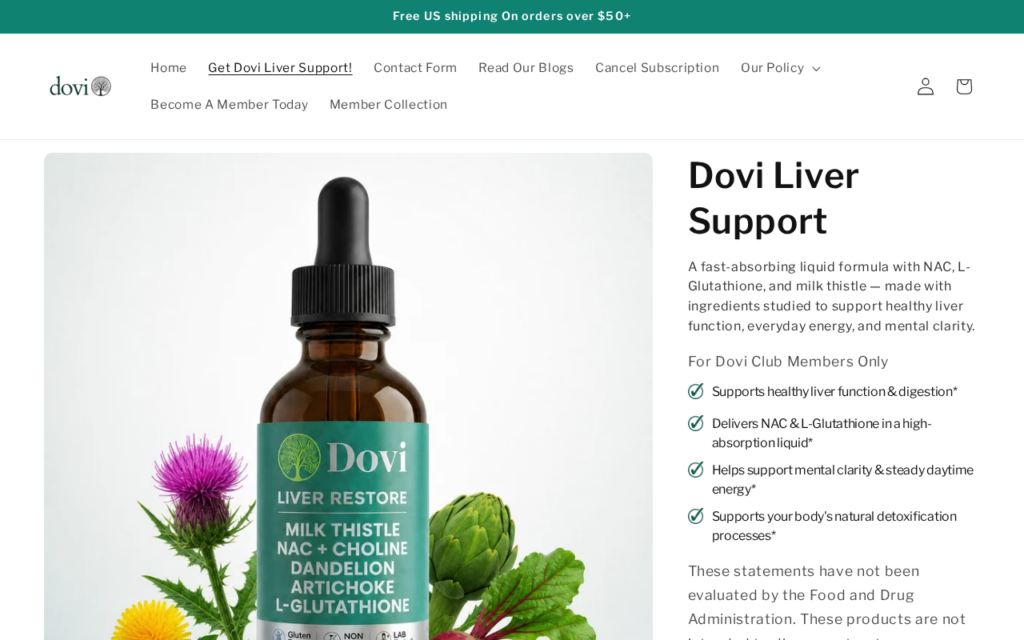
Overview of the Dovi Liver Support Offer
Dovi Liver Support, also shown as Dovi Liver Restore, is a liquid dietary supplement promoted with milk thistle, NAC, L-glutathione, choline, dandelion, artichoke and other ingredients. The website connects the formula with liver function, energy, mental clarity, digestion and the body’s natural detoxification processes.
The first-time offer appears inexpensive. One bottle is advertised for $19.99, while larger bundles lower the displayed cost per bottle. The page uses familiar trust signals such as a 60-day guarantee, lab-testing language, GMP references, customer stories and research-oriented wording.
The physical supplement order itself appears to be a single delivery. Public Shopify product data does not contain a Shopify selling plan, and the quantity options are configured as one-time variants. The recurring element is introduced separately through the external checkout.
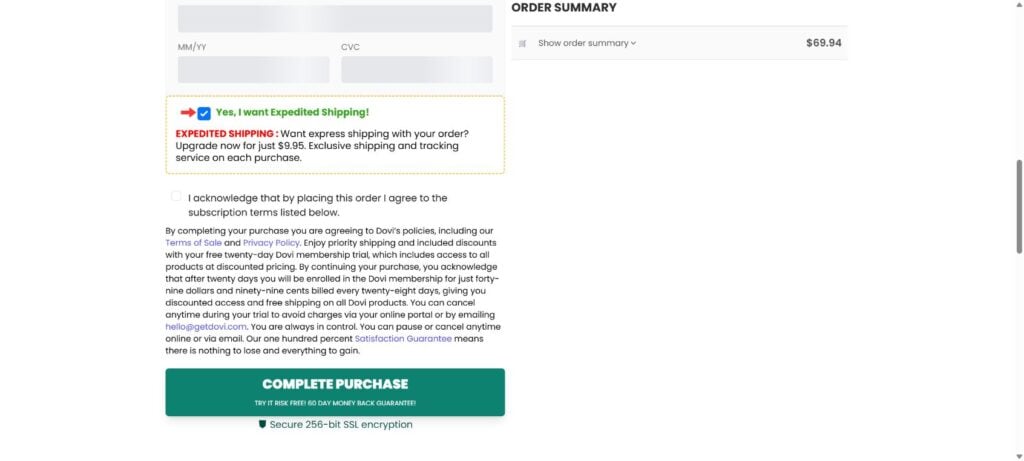
Near the payment button, buyers are asked to acknowledge subscription terms. The text says the purchase includes a free 20-day Dovi membership trial. Unless canceled during the trial, that membership becomes a $49.99 charge every 28 days and continues until the customer cancels.
This is an important distinction. Dovi does not appear to promise a fresh bottle every 28 days in exchange for the membership fee. The recurring charge buys access to a digital VIP club offering discounted products and shipping benefits. A customer can therefore be charged repeatedly without receiving an automatic supplement refill.
Is Dovi Liver Support a Scam or Legit?
Dovi is not an anonymous page with no identifiable operator. The site names NEXA AD SERVICES LLC, and Nevada’s official business search lists that company as an active domestic LLC. The store publishes contact details, policies and a customer portal.
Those facts do not make the offer safe or transparent. A functioning business can still use a high-risk subscription funnel. The question is whether an ordinary buyer is likely to understand what will be charged, how often it will happen and what must be done to stop it.
Dovi’s pages do not tell one consistent story. The checkout and Terms of Sale describe recurring membership billing, while another Terms & Conditions page says purchases do not renew and do not constitute subscriptions. The trial length, billing interval and refund language also vary between pages.
Our verdict is that Dovi Liver Support is a high-risk subscription-trap offer that we do not recommend. We are not claiming that every order is fake or that no supplement will arrive. The problem is that a low-cost product purchase can lead to a much larger recurring membership charge through a sales flow containing material contradictions.
How the Dovi Liver Support Subscription Trap Works
Step 1: A low introductory price gets the buyer’s attention
The funnel begins with an easy-to-understand bargain. A bottle that is represented as having a much higher normal value is offered for $19.99, and multi-bottle packages appear to reduce the unit price further.
This framing keeps attention on the supplement and the apparent discount. A shopper who arrived because of liver concerns is thinking about ingredients, reviews and whether the product may help, not about joining a separate paid shopping club.
Step 2: Medical-style language makes the product feel established
The promotional page uses phrases such as “Hospital-Grade NAC,” discusses liver enzymes and fatty liver, and presents testimonials describing changes in laboratory numbers and ultrasound results. It also describes the liquid as fast absorbing and connects ingredients with detoxification, bile flow, energy and brain fog.
Individual ingredients may have legitimate research behind them, but that does not validate this exact Dovi mixture or prove the advertised outcomes. We found no public Dovi clinical trial, batch-specific certificate of analysis or linked laboratory report supporting the finished product.
Step 3: The product page sends buyers to a separate checkout
The Dovi product page does not complete the sale through an ordinary Shopify cart. Its purchase button leads to a Funnelish checkout on the secureorder.getdovi.com subdomain.
This separation matters because Shopify’s public product record contains no selling-plan group. A buyer inspecting only the Shopify product configuration could reasonably conclude that the offer is one-time, while the membership rules are added in the external payment flow.
Step 4: The checkout emphasizes a single delivery
At the beginning of the checkout, the page says orders are processed as a single, one-time delivery. That statement accurately describes the bottles, but it does not describe the complete financial relationship created by the transaction.
A shopper may read “one-time delivery” as “one-time charge.” The distinction becomes visible only later: the supplement does not automatically refill, but the separate VIP membership can keep billing the same card.
Step 5: An extra $9.95 shipping option is selected
During our checkout review, the $9.95 expedited-shipping checkbox was selected by default. A buyer who does not notice it can pay more than the bundle price that first attracted them.
The option is visually identified, so it is not invisible. However, default selection shifts the burden to the customer to remove the upgrade before paying.
Step 6: The recurring membership appears near the final button
Lower on the page, the customer sees a separate acknowledgement that the order is subject to subscription terms. The accompanying paragraph says the free membership lasts 20 days and then becomes $49.99 every 28 days.
The subscription checkbox was not selected during our inspection, which is an important mitigating detail. A buyer must actively acknowledge the terms before completing the purchase. Even so, the disclosure competes with the earlier one-time wording, shipping upgrade, guarantee and order total.
Step 7: The membership can cost about $650 per year
A charge every 28 days is not the same as one charge per calendar month. There are approximately 13 such billing periods in a year, placing the annual cost near $650 before tax.
The recurring fee is also much larger than the advertised one-bottle price. A shopper drawn in by a $19.99 product can face a $49.99 membership debit less than three weeks later, followed by another debit every four weeks.
Step 8: Cancellation and refund rules create friction
Dovi says customers can cancel through an online account, by email or by telephone. The membership page also says cancellation must be received at least three business days before the next billing date to affect that cycle.
The Terms of Sale state that membership fees are generally non-refundable after they are charged. This means discovering the membership on a bank statement may be too late for an easy refund, even if future billing is successfully stopped.
Dovi’s Published Policies Contradict Each Other
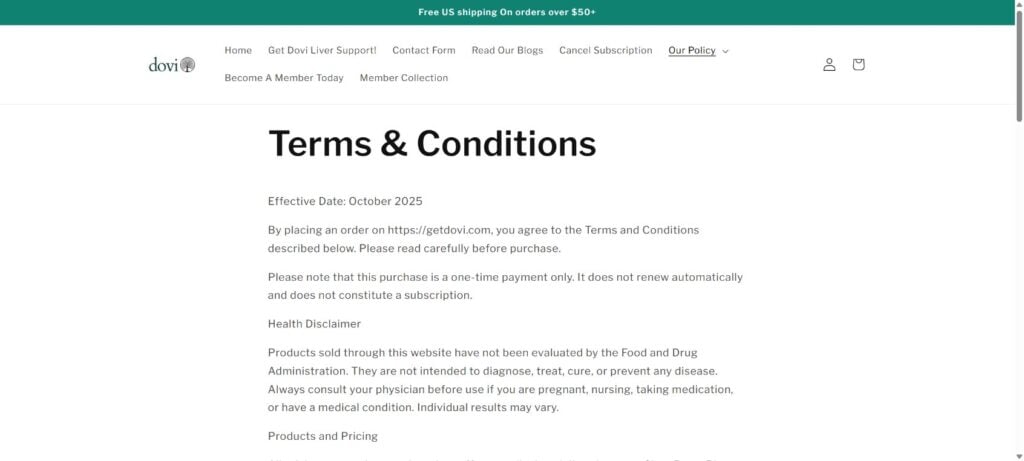
The clearest evidence comes from Dovi’s own legal pages. Its Terms & Conditions say that a purchase is a one-time payment, does not renew automatically and does not constitute a subscription.
The separate Terms of Sale contain an entire section for the Dovi VIP Club. That section says a free trial automatically becomes a paid subscription and gives $49.99 every 28 days as the example fee.
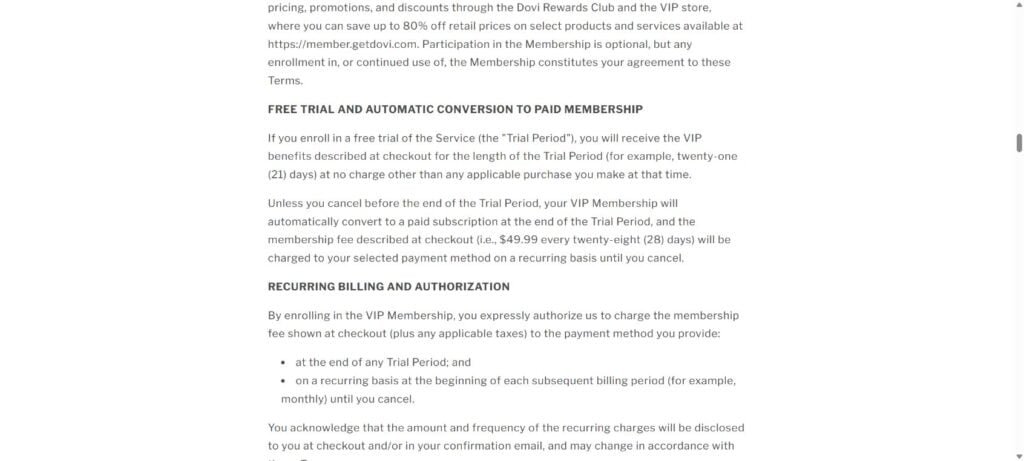
These are not two harmless ways of saying the same thing. One page tells the buyer there is no subscription, while another authorizes recurring billing. A customer should not have to decide which of the merchant’s legal pages is accurate after entering payment information.
- Trial period: The checkout says 20 days, while the Terms of Sale use 21 days as an example.
- Billing frequency: The checkout says every 28 days, while the membership page says $49.99 per month.
- Product refunds: One policy describes a 30-day return with customer-paid postage, while the refund page advertises 60 days and a prepaid label.
- Membership refunds: The physical product is promoted with a 60-day guarantee, but charged membership fees are described as generally non-refundable.
The Federal Trade Commission describes this type of recurring arrangement as a negative-option offer. Its guidance says online sellers should clearly disclose material terms, obtain express informed consent and provide a simple cancellation method. Contradictory statements make informed consent harder, even when a checkbox is present.
Who Is Behind Dovi?
NEXA AD SERVICES LLC is a very new Nevada company
Dovi identifies its operator as NEXA AD SERVICES LLC at 885 Tahoe Boulevard, Incline Village, Nevada. The official Nevada business search lists the company as active, with Nevada Business ID NV20263561430 and a filing date of April 14, 2026.
The getdovi.com domain was registered three days later, on April 17, 2026. The public Shopify record says the Dovi Liver Support product itself was created and published on June 23, 2026.
A young company is not automatically dishonest. It does mean the brand has little operating history, and the absence of a large complaint record cannot be treated as proof that billing and refunds work smoothly over time.
The published address offers virtual-office services
885 Tahoe Boulevard is associated with Mountain Workspace, a coworking location offering private offices, desks, mail delivery and virtual-office plans. This can be a legitimate business address, but it does not identify a Dovi laboratory, supplement factory or dedicated fulfillment center.
Dovi says its products ship from US warehouses, including an Ohio facility, yet it does not publicly identify that facility on the product page. We could not independently connect the Nevada address with supplement manufacturing.
The Dovi Liver Restore trademark has a Chinese owner
USPTO application 99925317 for “DOVI LIVER RESTORE” was filed on July 7, 2026. The official record lists the owner as Chuanbing Zhou, an individual with an address in Wengyuan, Guangdong, China.
This establishes a direct Chinese connection to the pending Dovi Liver Restore trademark. It does not prove that the Nevada LLC is Chinese-owned, that the liquid was filled in China or that the product is counterfeit.
Dovi’s marketing says the supplement is made in the USA with globally sourced ingredients. Without a named manufacturer, facility address, certificate of analysis or traceable batch report, the actual manufacturing chain remains unverified.
The Product Evidence Does Not Match the Marketing Confidence
The formula appears to be a private-label product
Dovi’s ingredient panel closely matches liver-support drops sold under other brand names. MyLivana, for example, lists the same 200 mg milk thistle extract, 200 mg dandelion extract, 100 mg artichoke extract, 100 mg beet extract, 50 mg choline, 50 mg L-glutathione and a 100 mg proprietary blend containing NAC and several botanicals.
Matching formulas do not prove that every brand uses the same manufacturer. They do show that the recipe is not obviously unique to Dovi and may be part of a broader white-label or private-label supplement supply chain.
The NAC amount is not clearly disclosed
NAC is one of the most prominent ingredients in Dovi’s headline, bottle presentation and promotional copy. However, the displayed Supplement Facts information does not provide a clear individual NAC quantity separate from the proprietary blend.
That makes phrases such as “Hospital-Grade NAC” difficult to evaluate. A buyer is shown the ingredient’s name repeatedly but is not given enough product-specific evidence to judge the amount or compare it meaningfully with published research.
The main product image appears to be AI-generated
Dovi’s public Shopify data exposes an image filename referencing an AI image generator. This does not prove the delivered bottle is imaginary, but it does mean the storefront’s polished hero visual should not be treated as photographic proof of the actual packaged product.
Some testimonials appear older than the public product
The promotional page displays customer stories dated March, April and May 2026. The Shopify product record says Dovi Liver Support was created in late June 2026, and the company and domain were formed in April.
The page also refers to a Dovi customer survey conducted in 2025. It is possible that a formula or campaign existed elsewhere before this Shopify listing, but the website provides no explanation or independent evidence connecting those earlier experiences to the current product.
Copy-and-paste errors add to the concern. Parts of the Dovi liver page refer to “Rosabella Moringa,” a different supplement, suggesting that sections of the sales material were adapted from another campaign without a complete editorial review.
Medical and Safety Claims Require Caution
The FDA does not approve dietary supplements for safety and effectiveness before they are sold. A standard disclaimer saying statements were not evaluated by the FDA does not transform an unsupported product claim into clinical proof.
Dovi’s promotional material includes stories about fatty liver, liver-enzyme changes, ultrasound findings and “restoring liver function.” Those are substantially more persuasive than a general statement that a nutrient supports normal body function, yet no controlled trial of the complete Dovi product is provided.
Several ingredients can also interact with medical conditions, medications or allergies. Dovi itself warns that milk thistle, dandelion and artichoke belong to the Asteraceae family and may pose an allergy risk for people sensitive to ragweed, daisies, chrysanthemums or related plants.
A liver supplement should not replace testing, diagnosis or treatment. Fatigue, abdominal discomfort, jaundice, unusual laboratory results or suspected fatty liver deserve medical evaluation because the cause and appropriate care cannot be determined by an online advertisement.
Dovi Liver Support Red Flags at a Glance
- The checkout pairs a one-time product delivery with a $49.99 recurring VIP membership.
- The membership renews every 28 days, which can produce about 13 charges per year.
- One legal page says there is no subscription, while another authorizes recurring billing.
- The trial is described as 20 days in checkout and 21 days in another policy example.
- The membership is described as every 28 days in one place and monthly in another.
- Membership charges are generally non-refundable after billing.
- The $9.95 expedited-shipping option was selected by default during our review.
- The company, domain and Shopify product are all very new.
- The Nevada address is a coworking and virtual-office location, not an identified factory.
- The pending Dovi Liver Restore trademark is owned by an individual in China.
- No public batch-specific certificate of analysis or named manufacturer was found.
- The formula closely resembles liver drops sold by other private-label brands.
- The product page includes copied references to a different supplement brand.
- Some testimonials and a claimed 2025 survey predate the current public product history.
- Medical-style testimonials are not backed by a clinical trial of the finished Dovi formula.
What to Do If You Have Fallen Victim to the Dovi Subscription Trap
- Cancel the VIP membership immediately. Use the customer portal if it is available, then send a separate cancellation email to hello@getdovi.com. Dovi also publishes +1 659-226-5965 for support. Do not wait until the final day because the membership page says requests should arrive at least three business days before billing.
- State exactly what you are canceling. Write that you are canceling the Dovi VIP membership and all future recurring charges, not merely a supplement shipment. Include the order number and the email address used at checkout, but never send a full card number or security code.
- Ask for written confirmation. Request a reply stating that the membership is canceled, the effective date and whether another charge is scheduled. A portal screenshot showing “canceled” is useful, but an email creates an additional time-stamped record.
- Save every version of the offer. Keep the order confirmation, checkout screenshot, bank entry, cancellation request and Dovi’s conflicting one-time and recurring-payment terms. Web pages can change, so evidence captured near the transaction date is especially valuable.
- Review the original order total. Check whether the $9.95 expedited-shipping option was included and whether the bundle quantity matches what you intended to buy. Ask support to explain any amount that does not match the final checkout you approved.
- Watch for the billing descriptor. Dovi says charges appear as DOVI* GETDOVI.COM. Review the card around day 20 and every 28 days afterward. Do not assume that replacing a physical card automatically prevents a merchant’s recurring payment token from being updated.
- Request a refund promptly if $49.99 was charged. Explain that you did not intend to keep a digital shopping membership and point to the Dovi page stating the purchase did not constitute a subscription. Even though the Terms of Sale call membership fees generally non-refundable, a documented request gives the merchant an opportunity to resolve the dispute.
- Contact the card issuer if billing continues. Describe the transaction accurately as a recurring membership charge that continued after cancellation or that was not clearly understood. Provide the cancellation record and contradictory terms. Ask the issuer to block future recurring charges from the merchant token, not only to replace the card.
- Check for related exposure. If you reused a password in the Dovi portal, change it anywhere else it was used and enable multi-factor authentication on your email account. A merchant dispute does not automatically mean your card was stolen, but password reuse can turn one shopping account into a wider security problem.
- Stop using the supplement if you develop a reaction. Seek medical care for breathing difficulty, swelling, hives, severe abdominal symptoms, fainting, yellowing skin or eyes, or other concerning effects. Report serious supplement reactions through the FDA Safety Reporting Portal and keep the bottle, lot number and packaging.
The Bottom Line
Dovi Liver Support may result in a real bottle being delivered, but the transaction is not as simple as the $19.99 headline suggests. The checkout can add a digital VIP membership that becomes $49.99 every 28 days, potentially costing about $650 per year without sending automatic refills.
The active LLC and visible subscription checkbox are not enough to overcome the contradictory legal pages, young operating history, unclear manufacturing trail, reused formula, questionable testimonial timeline and unsupported product-specific medical claims.
Our recommendation is to avoid the Dovi offer. If you already ordered, cancel the VIP membership in writing immediately, save the evidence and monitor the card for DOVI* GETDOVI.COM charges every 28 days.








