

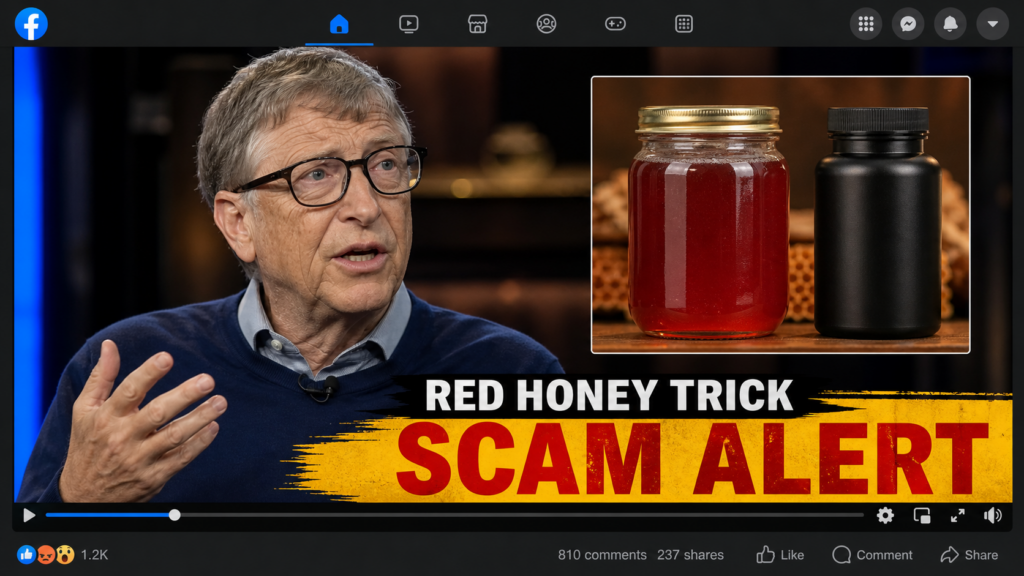
A polished video appears in a social feed and seems to show Bill Gates discussing a little-known red honey discovery. Doctors are introduced, medical language follows, and the story feels just plausible enough to keep watching.
The names and bottles may look convincing, but the details deserve a much closer look before anyone follows the link or enters a card number.
Overview
What the “red honey trick” advertisement claims
The promotion presents a red honey mixture as a hidden answer to male vitality, circulation, energy, or sexual performance. Some versions frame it as a natural discovery that powerful companies supposedly do not want men to know about.
Bill Gates may appear in manipulated footage, while researchers and doctors are named to give the presentation scientific weight. Recent versions have invoked Yoshinori Ohsumi, David Samadi, Anika Ackerman, and Rina Malek. Their appearance in an advertisement is not evidence that they participated in it.
The story stays the same while the product changes
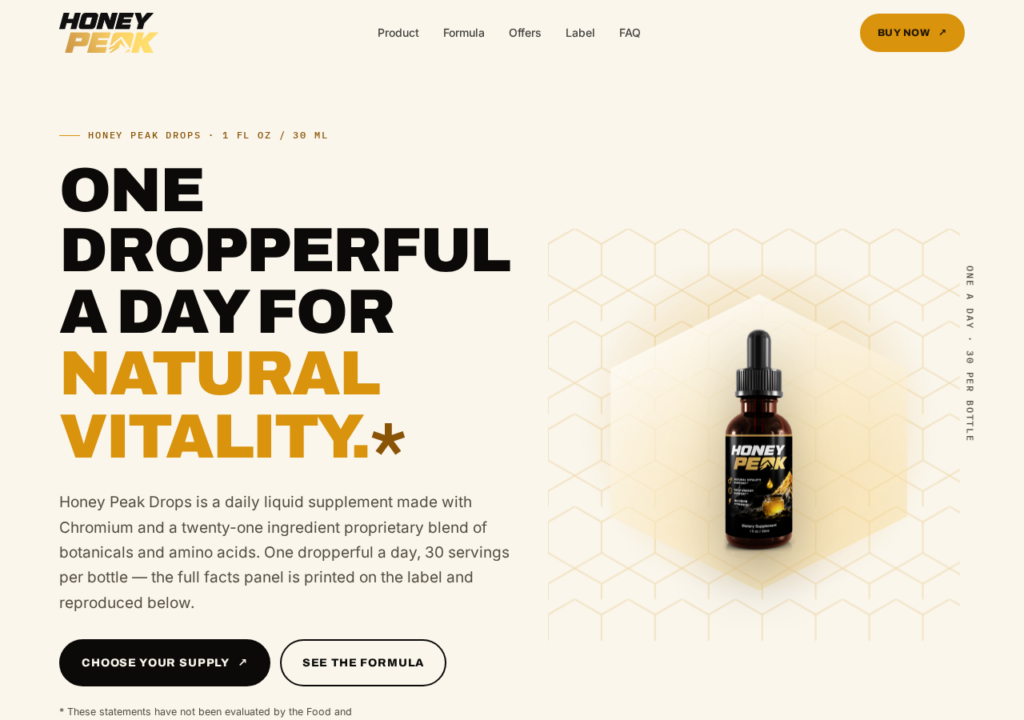
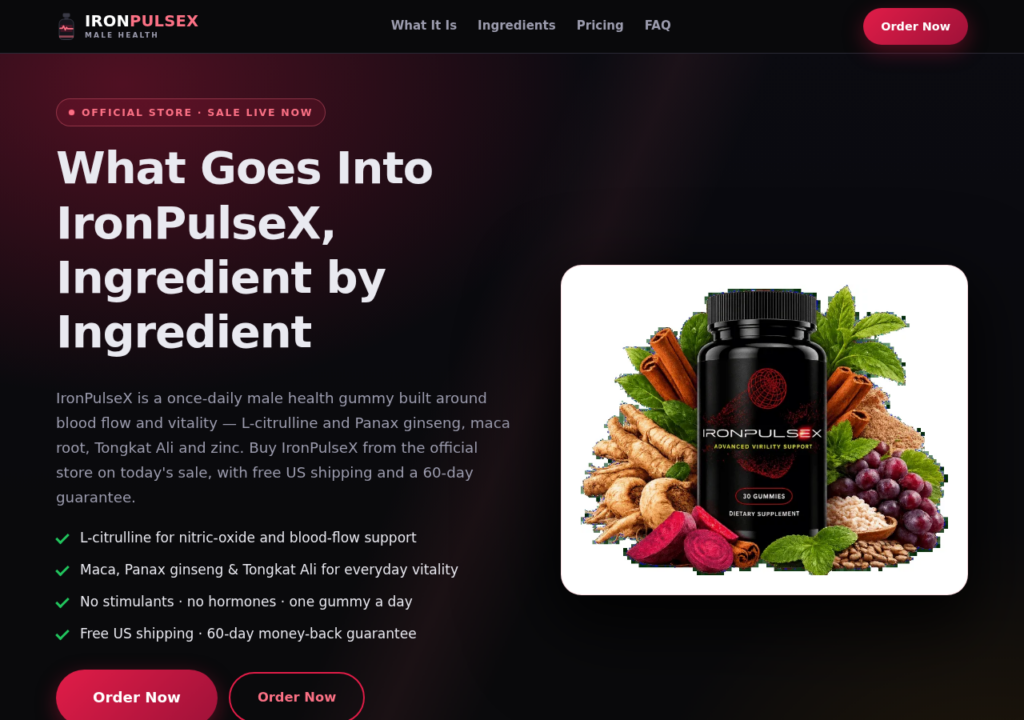
The most revealing detail is not a single bottle. It is the reusable sales story. One campaign may lead to IronPulseX gummies, while another uses nearly the same celebrity and red honey narrative to promote Honey Peak Drops.
That product rotation matters. A genuine medical discovery would be tied to identifiable research, a defined treatment, and verifiable clinical evidence. A marketing script that survives while the product name changes behaves more like an advertising template than a medical breakthrough.
Why this campaign is dangerous
The immediate risk is financial, but it is not the only one. A buyer may order a supplement based on an endorsement that never happened, accept a larger package than expected, overlook a recurring-purchase option, or delay speaking with a qualified clinician about a real health concern.
- The celebrity video may be AI-generated, lip-synced, or deceptively edited.
- The “news” page may be an advertorial created by the seller or an affiliate.
- The doctors named in the pitch may have no connection to the product.
- The checkout may emphasize multi-bottle bundles or a recurring-delivery choice.
- The company identity on the receipt may differ from the brand on the bottle.
These red flags do not prove that every bottle contains the same ingredients or that every customer will have the same billing experience. They do show why the purchase should be judged by the actual seller, checkout, label, and evidence, not by the emotional story in the advertisement.
Why the Bill Gates and Doctor Endorsements Do Not Hold Up
There is no credible public announcement from Bill Gates connecting him to a red honey supplement for male performance. A believable face and voice in a short video are no longer reliable proof of participation.
The same applies to the doctors and researchers placed around him. Yoshinori Ohsumi received the Nobel Prize for discoveries concerning mechanisms of autophagy. That scientific achievement does not establish that he developed or endorsed a commercial honey drop or male-enhancement gummy.
Scammers often borrow a real accomplishment, strip away its context, and attach it to a completely different product. The result sounds scientific because part of the story is true, even though the commercial conclusion does not follow from it.
Other names can be swapped into the presentation depending on the audience. A urologist may be used for a sexual-health angle, a researcher for a longevity angle, and a television-style presenter for a news angle. None of those appearances should be trusted without confirmation from the person’s official website or verified social account.
A real endorsement should be independently visible outside the sales funnel. If the only proof is a clip embedded in an affiliate page that immediately pushes a supplement, the safest conclusion is that the clip is marketing material, not medical confirmation.
How the Scam Works
Step 1: An AI celebrity video stops the scroll
The campaign begins with a short Facebook, Instagram, TikTok, or YouTube-style video. It may show Bill Gates speaking in a studio, a doctor reacting to a “discovery,” or a man describing a private red honey recipe that restored his confidence.
The opening is designed for emotion, not careful evaluation. Embarrassment, aging, relationship anxiety, and the promise of a private solution keep viewers from pausing to verify the source.
Step 2: The ad promises a recipe but withholds the useful detail
Viewers are told that the answer uses honey, a red ingredient, or a biological process such as autophagy. The advertisement rarely gives a complete recipe with measurable ingredients and safety information.
Instead, it creates a curiosity gap. To learn the supposedly important detail, the viewer must click, keep watching, or sit through a long presentation.
Step 3: A fake news-style page supplies borrowed credibility
The click may open a page styled to resemble CNN, Fox News, a health magazine, or a television interview. Logos, scrolling headlines, studio graphics, and familiar faces create the impression that an independent newsroom investigated the story.
Look closely at the address bar. The domain usually does not belong to the news organization being imitated. Navigation links may not work, the article may have no real author archive, and every button may lead to the same sales presentation.
Step 4: The medical story becomes a supplement pitch
After the viewer invests time in the presentation, the promised recipe turns into a commercial product. IronPulseX and Honey Peak Drops are current examples connected to versions of this narrative, but another bottle can replace them tomorrow.
This switch is important. The viewer clicked for information about a household “trick,” yet the funnel eventually argues that only a specific proprietary supplement can deliver the promised result.
Step 5: The offer pushes bundles and urgency
The landing page commonly shows three or six-bottle packages, countdown messages, limited inventory, free shipping, or a steep discount. A single-bottle option may appear less attractive or may be placed below a larger package.
Urgency discourages the buyer from comparing the Supplement Facts panel, researching the merchant, or reading the return terms. A timer on a web page is not proof that stock or pricing is genuinely limited.
Step 6: Checkout details can change the real cost
The product page is not the final authority on what will be charged. Buyers need to inspect the last checkout screen for quantity, shipping, taxes, continuity terms, and any “Subscribe & Save” selection.
Some funnels also present post-purchase upsells that look like part of the original order. Pressing an additional purchase button can create another charge, even when the shopper believes they are simply confirming the first transaction.
Step 7: Support and refunds become the difficult part
If the package, charge, or result is not what the buyer expected, the seller may require prior authorization, return tracking, every bottle, or action within a specific guarantee window. The customer may also discover that the name on the card statement is not the product name.
That confusion can cost valuable time. The safest response is to document the order immediately and contact both the seller and card issuer before any stated deadline passes.
IronPulseX and Honey Peak Drops Are Examples, Not the Whole Story
IronPulseX is marketed as a men’s supplement, while Honey Peak Drops is presented as a daily liquid formula for strength, energy, and vitality. Their forms and ingredient stories differ, but both can be placed behind the same broad red honey narrative.
That does not mean the two products are necessarily made by the same company or contain the same formula. It means shoppers should separate the bottle from the advertisement that delivered them to it.
A useful test is simple: if the product name disappeared from the ad, would the rest of the presentation still work for another supplement? When the answer is yes, the “discovery” is probably a reusable acquisition story.
Company, Address, and Fulfillment Checks
The brand name is not enough
A logo on a bottle is not the same as a clearly identified legal seller. Before paying, compare the name in the website terms, privacy policy, refund policy, checkout, order confirmation, and card descriptor.
IronPulseX pages reviewed in August 2026 have used several names in different places, including IronPulseX, Nature’s Formulas, Daily Health, IronPulseX Research, and even a different product research name on a references page. That inconsistency makes it harder to determine who is responsible for the transaction.
Addresses may identify warehouses, mailboxes, or unrelated offices
An address should be checked, not merely copied. IronPulseX materials have listed a returns location at 19655 E 35th Dr., Suite 100, Aurora, Colorado, and a separate Orlando address in other site text.
A returns warehouse can legitimately receive packages without being the manufacturer or headquarters. The concern is transparency. If the site does not explain the relationship between the brand, seller, warehouse, and processor, customers may not know who must resolve a billing dispute.
Phone and email details should work before money changes hands
IronPulseX pages have displayed more than one phone number, including (720) 619-8477 and (970) 406-7582, alongside support email information. Different numbers are not automatically fraudulent, but the site should explain their roles.
Call before ordering. Ask the representative to state the exact product, legal seller, full price, recurring-delivery status, cancellation process, and return address. If the agent cannot answer basic order questions, do not assume the guarantee will be easier after a charge.
Unknown manufacturing is a health warning, not a minor paperwork issue
Do not assume a supplement is safe because the page says “natural,” “doctor formulated,” or “made in an FDA registered facility.” Those phrases do not mean the FDA approved the finished supplement to treat a disease.
Look for a complete Supplement Facts panel, serving size, individual ingredient amounts, warnings, lot information, manufacturer or distributor identity, and a way to report an adverse event. Avoid claims that every unfamiliar supplement is produced in China unless there is evidence for that specific product.
The sharper point is this: when the seller hides behind rotating brands, vague addresses, unreachable support, or an unexplained fulfillment center, the customer cannot reliably verify what was made, where it was made, or who is accountable if something goes wrong.
What to Do if You Have Fallen Victim to This Scam
- Save the entire purchase trail. Screenshot the ad, landing page, checkout, quantity, guarantee, subscription language, receipt, card descriptor, emails, and tracking page. Save the package and every bottle.
- Contact the seller in writing. State the order number, charge amount, requested resolution, and whether you reject future shipments. Ask for written confirmation and a return authorization if the policy requires one.
- Call your card issuer promptly. Explain any quantity mismatch, unauthorized recurring charge, deceptive endorsement, or refused refund. Ask how to stop future merchant charges and whether a dispute is appropriate.
- Do not return the package blindly. Obtain the correct address and instructions first. Use tracked shipping and keep the receipt. A warehouse receiving the parcel does not guarantee that the merchant will match it to your account.
- Talk to a healthcare professional. If you used the supplement, experienced symptoms, or stopped prescribed treatment because of the ad, contact a doctor or pharmacist. Bring the bottle and ingredient panel.
- Secure the device used for payment. If the page triggered downloads, browser warnings, redirects, or suspicious notifications, run a scan with Malwarebytes. Remove unfamiliar browser extensions and review saved payment information.
- Block the advertising path. AdGuard can reduce exposure to malicious advertising, tracking links, and deceptive pop-ups. It does not replace careful checkout review, but it can remove part of the funnel scammers depend on.
- Report the campaign. Report the social-media ad, the seller to the FTC at ReportFraud.ftc.gov, and any adverse supplement reaction through the FDA’s Safety Reporting Portal.
Frequently Asked Questions
Did Bill Gates endorse the red honey trick?
No credible evidence shows that Bill Gates endorsed IronPulseX, Honey Peak Drops, or a red honey supplement for male performance. Treat an isolated social-media clip as manipulated unless it is independently confirmed through an official source.
Did Yoshinori Ohsumi create the supplement?
There is no credible evidence that Yoshinori Ohsumi created or endorsed these products. His Nobel-recognized autophagy research does not validate a commercial honey drop or gummy.
Are IronPulseX and Honey Peak Drops the same product?
No. They are presented as different products with different forms and branding. Their relevance here is that versions of the same advertising story can direct viewers to different bottles.
Does “one-time purchase” guarantee there will be no refill?
It is a useful statement, but the final checkout controls the order. Confirm that no recurring option is selected, save the confirmation, and monitor the next two statements for unexpected charges.
Can a supplement legally claim to cure a medical condition?
A product marketed as a dietary supplement is not FDA-approved to treat or cure disease. Disease-treatment claims require a much higher regulatory and evidence standard than ordinary supplement marketing.
What is the clearest warning sign in this campaign?
The strongest warning is the mismatch between the dramatic medical discovery and the rotating product at the end. When the story remains unchanged while the bottle changes, the story is serving the sale.
The Bottom Line
The fake Bill Gates red honey trick is a reusable advertising funnel, not a verified medical breakthrough. AI celebrity footage, borrowed scientific authority, fake news styling, and a long recipe story are used to move viewers toward whichever supplement is currently attached to the campaign.
Judge the offer by the real seller, label, checkout, and evidence. If those details cannot stand on their own without Bill Gates, a famous doctor, or a secret honey story, keep your card out of the funnel.








