

A text says your car can become a rolling advertisement and earn hundreds each week. The work sounds passive, the brand is famous, and the application takes only a few minutes.
The Red Bull Car Wrap Job looks like a small marketing opportunity until one ordinary application question changes what the offer is really asking you to do.
Overview
The offer uses Red Bull’s name without coming from Red Bull
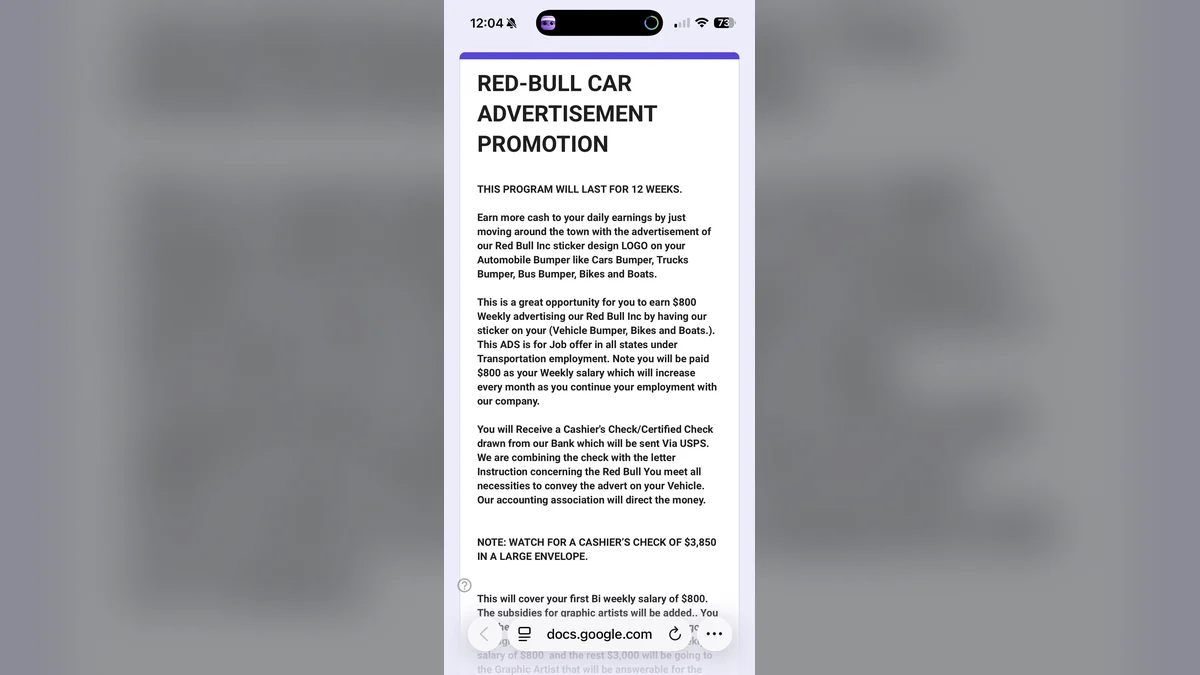
A recent car-wrap job report began with an unsolicited text and led to a Google Form. The page promised money for placing Red Bull advertising on a vehicle, asked for banking information, and described a check that would cover both the worker’s pay and the graphic artist’s fee.
Red Bull’s official careers page states that all legitimate Red Bull job opportunities are published on jobs.redbull.com. The company specifically warns recipients not to answer suspicious job emails or messages.
A brand logo, Google-hosted form, or professional-looking check does not connect the sender to Red Bull. These are borrowed surfaces around an independently controlled payment scheme.
The $3,850 check is designed to create spendable-looking money
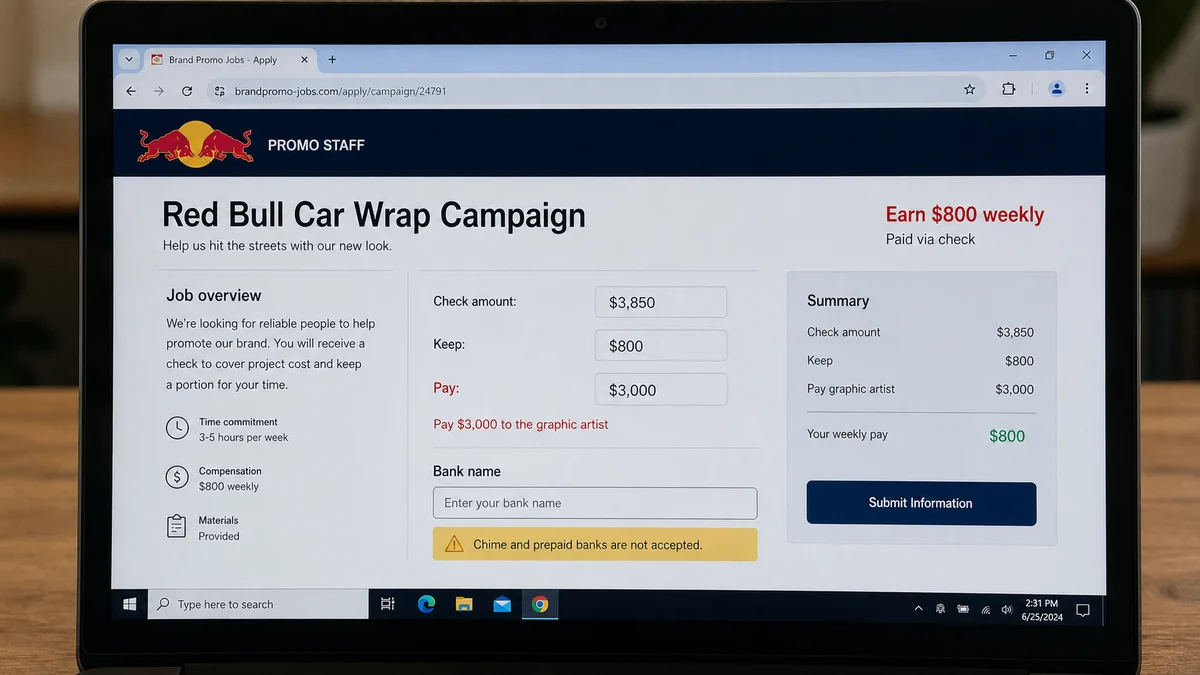
The reported form said the recipient would get a $3,850 cashier’s or certified check. They were told to keep $800 and use $3,000 for a graphic artist. The arithmetic even leaves $50 unexplained.
The trap depends on a dangerous misunderstanding: money can appear available in a bank account before the bank discovers that a check is fraudulent. Availability is not the same as final clearance.
If the victim sends $3,000 to the supposed artist, that transfer uses the victim’s real funds. When the deposit is reversed, the fake $3,850 disappears but the outgoing payment remains gone.
The bank-name question helps the operator manage the fake check
The form reportedly asked which bank the applicant uses and excluded Chime and other prepaid accounts. A real advertiser does not need an employee’s bank name to decide whether a vehicle can carry a wrap.
Scammers often avoid drawing a fake check on the same institution used by the victim because the bank may identify problems faster. They also prefer accounts that will accept the deposit and make some funds appear available.
Check the offer as a whole:
- Did the job arrive through an unsolicited text?
- Is the opening absent from jobs.redbull.com?
- Does a generic form replace a normal interview?
- Does the page promise $800 weekly for minimal work?
- Does the pay change between weekly and biweekly?
- Is a check larger than your pay being sent?
- Must you pay a third-party artist or installer?
- Does the recruiter ask for your bank name?
- Are particular banks excluded without a business reason?
- Does the sender use a personal email or mobile number?
- Is there no verified Red Bull hiring contact?
- Are you told to act before the check is fully investigated?
The decisive clue is not bad grammar. It is the instruction to receive company money and forward a large share to someone else.
The Check Can Look Cleared and Still Be Fake
Victims are often told to deposit the check with a mobile banking app and send a screenshot when the balance changes. The scammer then treats that visible balance as proof that the check is good.
Banks commonly make funds available under rules and account policies before every part of a check has been finally verified. A counterfeit check may use a real routing number, a stolen account, or altered details that delay detection.
The FTC’s fake-check guidance explains that a bank may take weeks to discover a fraudulent check. The customer who deposited it can be responsible for repaying the bank.
A cashier’s-check label does not solve this. Logos, security patterns, signatures, account numbers, and bank names can be copied. A photograph of a check is even easier to fabricate.
Calling a number printed on the check is unsafe because that number may lead to the scammer. If verification is necessary, find the issuing bank through its official website and ask your own bank’s fraud department to inspect the item.
Even a bank employee saying that funds are available is not a guarantee that the check cannot be returned later. Explain that a stranger sent an overpayment tied to a job and wants money forwarded.
The victim’s outgoing transfer is a separate transaction. The bank does not automatically reverse a Zelle payment, wire, gift card purchase, cryptocurrency transfer, or cash withdrawal merely because the incoming check later fails.
This timing gap is the scam’s engine. The operator does not need to withdraw the check. The victim does that indirectly by sending good money to the supposed graphic artist.
How the Red Bull Car Wrap Fake Check Scam Works
Step 1: An unsolicited text offers effortless income
The message promises weekly pay for placing a brand sticker or wrap on a car, truck, motorcycle, or boat. A major consumer brand is chosen because the recipient already recognizes it.
The recruiter does not need to know anything about the applicant’s work history. The vehicle and a willingness to follow instructions are presented as the only qualifications.
Step 2: A simple form imitates recruitment
The applicant is sent to a Google Form or basic website. Questions about the vehicle, address, phone number, and bank create the appearance of screening without a real interview or corporate account.
Google provides legitimate form software. It does not endorse every form created by a user.
Step 3: The offer promises unusually high passive pay
The reported page advertised $800 each week for driving as usual. The amount is high enough to create excitement but framed as an advertising budget rather than a prize.
Inconsistencies such as weekly versus biweekly pay are easy to miss once the applicant imagines the income.
Step 4: The fake employer sends an oversized check
The check combines wages and money supposedly owed to the wrap installer. This is not normal payroll or procurement. A real company would contract with and pay its supplier directly.
Combining unrelated payments gives the scammer a reason for the victim to forward most of the deposit.
Step 5: The victim is directed to the “graphic artist”
The recruiter supplies the vendor, payment account, or instructions. The artist is controlled by the same group or is a money mule. No wrap needs to exist.
Urgency may be tied to a shipping deadline, campaign launch, installer availability, or threat that the applicant will lose the job.
Step 6: The victim sends real money
Because the bank balance increased, the victim sends $3,000 through a fast payment method. The transaction may be split, redirected to multiple recipients, or converted into cryptocurrency.
The scammer may ask for receipts and invent another charge if the first transfer succeeds.
Step 7: The check is returned and the balance is reversed
When the bank identifies the counterfeit, altered, or stolen check, it removes the deposit. The account can become negative, and the customer may face fees, restrictions, or closure.
The fake recruiter and artist disappear. Any later “recovery agent” who asks for another payment is a separate danger.
Why the Famous Brand and Google Form Prove Nothing
Car-wrap scams rotate through energy drinks, snack companies, beverage brands, charities, and new product launches. The company name is a costume, not the permanent identity of the scheme.
A brand logo is public and easy to copy. A scam page may include product photography, slogans, office addresses, and legal text taken directly from the real company.
Google Forms is designed so almost anyone can build a questionnaire. A docs.google.com address proves only where the form is hosted, not who created it or whether the advertised employer approved it.
Look for an opening on the company’s own careers domain. Search for the exact role, campaign, recruiter’s name, and contact details. Then contact the company through a number or form you find independently.
A legitimate recruitment process normally identifies a legal employer, job location, supervisor, duties, pay schedule, tax status, and formal offer. It does not begin payroll by mailing extra money to an unknown applicant.
Advertising programs can exist, but they do not need a stranger to pay their contracted installer. The middleman instruction is economically irrational for a real company and essential for a fake-check scam.
Insurance promises are another credibility prop. A vague statement that the company will insure the vehicle does not identify a carrier, policy, coverage, or contract.
Do not call numbers in the form to verify the form. The operator controls both. Verification must leave the contact path provided by the recruiter.
What to Do if the Check Has Already Been Deposited
Do not wait for it to bounce. Call the bank’s fraud department immediately and state that the item may be connected to a fake job. Early disclosure gives the bank more options to restrict funds and document what happened.
Do not spend any part of the deposit, including the amount labeled as wages. The entire check can be reversed.
If an outgoing payment is pending, ask the bank or payment provider whether it can be stopped, recalled, or flagged. Do not rely on the scammer’s promise to return it.
Save the physical check and envelope. Do not write on them beyond what the bank requires. Postmarks, tracking, sender details, fingerprints, and account information may be relevant to an investigation.
Preserve the original text, form URL, email headers, check image, deposit receipt, instructions, payment recipient, and every conversation. Screenshots alone can omit useful metadata, so retain original messages when possible.
If the account balance becomes negative, work directly with the bank. Explain the full sequence and ask what documents are needed for its fraud review.
Do not accept a replacement check. Scammers sometimes blame a printing error, stop payment, or accounting mistake and send a second item to keep the victim engaged.
Do not threaten or attempt to outsmart the sender. Preserve evidence, report the accounts, and stop contact.
How to Check Any Car Wrap Offer
Start with the brand’s official website. Find its jobs, partnerships, or fraud-warning page without using the recruiter’s link.
Search the exact campaign wording in quotation marks. Reused scripts often reveal years of reports under different brand names.
Ask for the legal employer, business address, tax documentation, manager, and written contract. Verify every detail independently.
Request a video interview through a corporate account, but remember that video alone is not proof. Compare the person and email domain with the official company directory.
Reject any role that sends more money than you are owed or asks you to pay a vendor. The employer should handle its own suppliers.
Never provide a bank name merely to receive a check. A legitimate employer can explain payroll options after verified onboarding.
Read the pay carefully. If weekly, biweekly, and total amounts conflict, stop rather than asking the sender to correct the story.
Check whether the vehicle wrap, placement, and insurance terms make business sense. A household name rarely needs random drivers recruited by text at premium rates.
Ask your bank to review a suspicious check before deposit, but do not treat a visual inspection as a guarantee.
The simplest rule remains the strongest: never be the financial middleman between an employer and its vendor.
The Offer’s Own Numbers Expose the Payment Story
The reported form describes a $3,850 check, $800 in pay, and $3,000 for the graphic artist. Those instructions account for only $3,800. A real payroll or procurement document would not leave an unexplained $50 balance in a new worker’s account.
The pay period also changes. One part promises $800 weekly while another describes the same $800 as biweekly salary. This is not a harmless spelling mistake. It shows that the operator has reused or edited a script without maintaining a coherent employment agreement.
More importantly, the company supposedly trusts an applicant recruited by text to distribute thousands to a contractor it already selected. That would add delay, tax confusion, fraud exposure, and accounting work to a process the company could complete with one direct vendor payment.
Scam scripts use elaborate explanations to make the transfer feel like a normal duty. Strip the story down to its cash flow: a stranger sends a check, the bank temporarily shows funds, and the recipient is pressured to send part away. The car, wrap, insurance, and famous brand do not change that structure.
Company, Address, and Fulfillment Checks
Verify the role on Red Bull’s official careers site
Every legitimate Red Bull opening should appear on jobs.redbull.com. A text-only campaign absent from that site should not be treated as company recruitment.
Use Red Bull’s official support route to ask about suspicious contact.
Check the recruiter’s domain and identity
Compare the email domain with the official company domain and confirm the person through an independently found channel. A display name and logo can be forged.
A personal phone number or free email account cannot prove employment.
Inspect the payment and vendor relationship
A real company pays its graphic artist through procurement or accounts payable. It does not send a new worker an oversized check and ask them to forward the balance.
The bank-name question is an additional warning, not routine onboarding.
Demand evidence that the wrap will be fulfilled
Ask for the installer company, physical shop, appointment, materials, insurance, and contract. Verify the installer directly, using contact details not supplied by the recruiter.
If fulfillment begins only after an irreversible transfer, the “wrap” is likely just the payment story.
What to Do if You Have Fallen Victim to This Scam
- Stop communicating and paying. Do not send the graphic artist, courier, insurer, or recruiter more money.
- Call your bank’s fraud department. Explain that the deposit came from a suspected fake job and oversized-check scheme.
- Do not spend the visible balance. Treat the entire check amount as unavailable until the bank completes its investigation.
- Try to stop outgoing payments. Contact the transfer service, bank, gift-card issuer, or cryptocurrency platform immediately.
- Preserve the check and envelope. Keep the original item, deposit record, tracking, and all instructions.
- Save digital evidence. Export texts, emails, form responses, URLs, recipient accounts, and payment confirmations.
- Report the impersonation. Send the evidence through Red Bull’s official support or fraud-warning route.
- Report the form. Use Google’s abuse-reporting controls for the form and any related account.
- File official reports. Use ReportFraud.ftc.gov, the U.S. Postal Inspection Service if mail was used, and local police where appropriate.
- Run Malwarebytes. Scan the device if the form or sender required a download, check-printing tool, remote access, or unknown attachment.
- Use AdGuard as a supporting layer. It can block known malicious pages and adverts, but it cannot authenticate a recruiter or check.
- Ignore recovery scammers. No private investigator, hacker, or bank insider can guarantee recovery for an advance fee.
Frequently Asked Questions
Does Red Bull really pay people to wrap their cars?
This reported text and form were not verified Red Bull recruitment. Red Bull says all legitimate jobs are published on jobs.redbull.com. Contact the company independently about any campaign.
Why does the fake employer ask for my bank name?
It can help the scammer avoid sending a check that appears drawn on the same bank, where problems may be detected faster. It also tests whether the account can accept the deposit.
Is a cashier’s check safe once funds appear?
No. Available funds do not guarantee final clearance. A fraudulent cashier’s check can be reversed after the victim has sent money elsewhere.
Why would a real employer make me pay its graphic artist?
It would not need to. A legitimate company can contract with and pay its own vendor. The middleman instruction exists to move the victim’s money.
What if I deposited the check but sent nothing?
Contact the bank’s fraud department immediately, spend none of the deposit, and follow its instructions. Early reporting is safer than waiting for a return.
Can money sent to the graphic artist be recovered?
Recovery is uncertain and depends on the payment method and speed of reporting. Contact the provider immediately, but do not pay anyone who promises guaranteed retrieval.
Bottom Line
The Red Bull name is the bait; the $3,850 check is the mechanism. The fake employer makes the victim feel paid, then orders them to send $3,000 of real money to a graphic artist controlled by the scheme.
No legitimate employer needs a new hire to relay an oversized check to its vendor. Verify every role on the company’s own careers site, never forward part of a stranger’s check, and call the bank’s fraud department immediately if one has already been deposited.








