

The message arrives when hope is already thin. Someone who knows about an earlier crypto, investment, or shopping loss says a legal team has found the money and can finally bring it home.
The Veritas Legal Group scam sounds established, and the supposed lawyer has documents ready. What happens after the first reply reveals why this recovery offer deserves careful scrutiny.
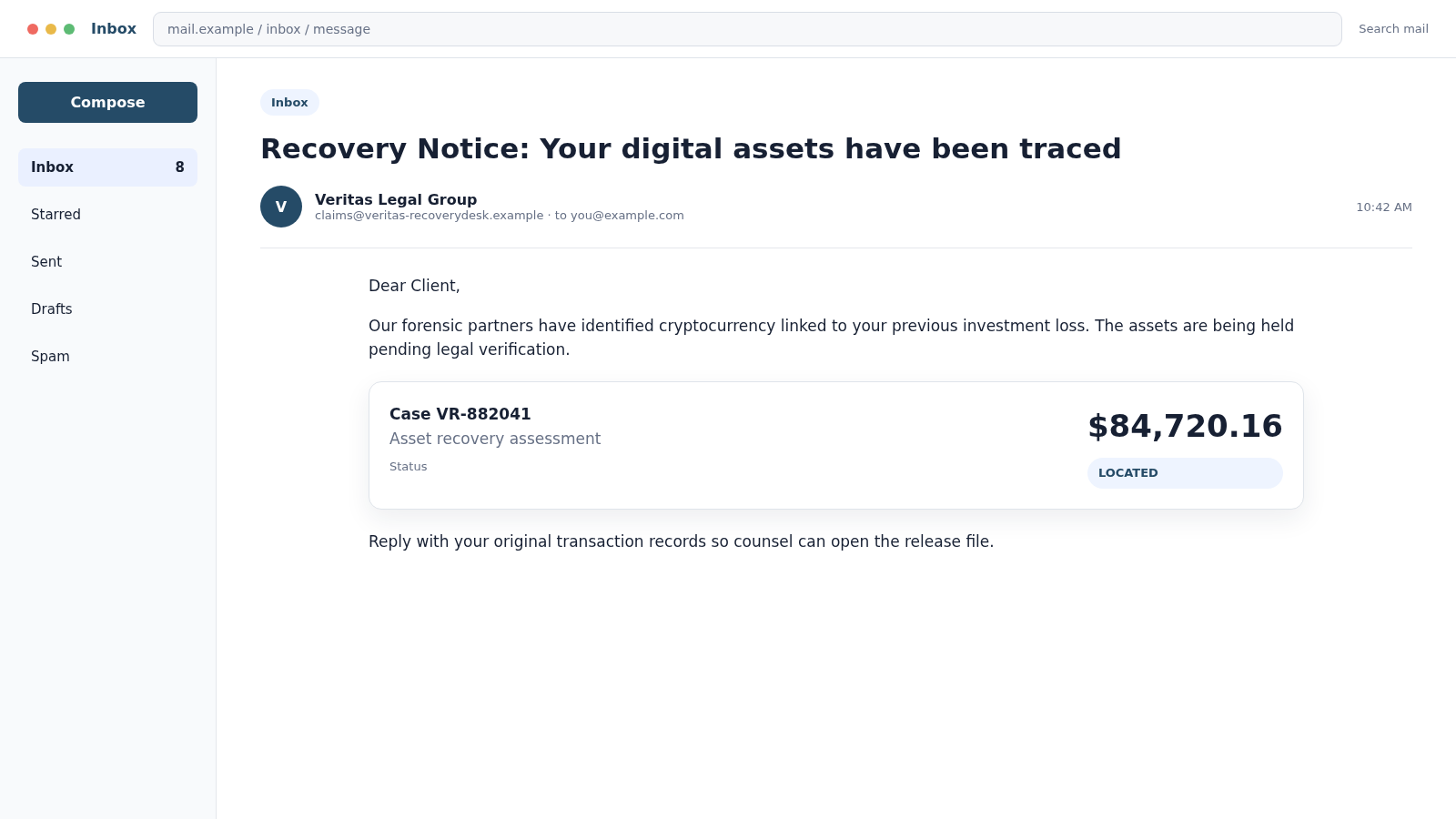
Overview
The scam targets people who have already lost money
The Veritas Legal Group scam is a recovery scheme aimed at previous fraud victims. A caller, email sender, or social media account claims that lawyers or forensic investigators have located stolen funds and can obtain a refund.
There may be legitimate businesses with similar names. The warning concerns unverified people using this identity and recovery script, not every professional or organization that includes “Veritas” in its name.
The legal appearance is built from details that are easy to copy
Fake case references, seals, contracts, attorney biographies, office addresses, and regulator logos can be assembled from public material. A polished website may copy text and staff photographs from an unrelated real firm.
The sender sometimes knows the original platform, amount lost, transaction date, or complaint number. That knowledge may come from stolen records, public complaints, lead lists, or the criminals behind the first scam.
The promised recovery becomes another chain of fees
After the victim signs up, the fake firm introduces a retainer, tracing charge, court cost, tax, bond, wallet activation payment, or release fee. Each payment supposedly removes the final obstacle, but the funds never arrive.
The FBI and FTC both warn about recovery scammers posing as lawyers, government partners, and consumer advocates. The combination of unsolicited contact, guaranteed results, and payment before recovery is the central danger.
- The approach follows a previous financial loss
- The firm claims special access to seized or frozen assets
- Recovery is described as guaranteed or nearly certain
- A fee is required before money can be released
- Payment is requested through crypto, wire, or gift card
- The sender discourages independent legal advice
Why Recovery Scams Feel So Persuasive
The first fraud did more than take money. It left unanswered questions, embarrassment, anger, and a strong desire to correct what happened. A recovery caller steps directly into that emotional gap.
Instead of making an unbelievable promise to a stranger, the scammer offers a solution to a real problem. They may sound patient, criticize the original criminals, and explain blockchain tracing or international litigation in convincing language.
The fake lawyer also gives the victim a new role. Rather than feeling powerless, the person is told that a case is moving, investigators are cooperating, and a deadline must be met. That story can make another payment feel like progress.
Urgency arrives only after trust has formed. A supposed court order expires, a wallet must be verified, or a tax certificate needs immediate payment. By then, refusing can feel like abandoning the original loss and all the effort spent pursuing it.
How the Veritas Legal Group Scam Works
Step 1: Criminals identify a previous fraud victim
The contact list can come from the original scam, a fake recovery form, public complaint, compromised database, or information sold between criminal groups. The caller may know enough detail to appear connected to a real investigation.
Some victims find the fake firm themselves through a sponsored search result or social media advertisement. The website is designed to appear when someone urgently searches for crypto recovery help.
Step 2: A lawyer or investigator makes contact
The sender claims to represent Veritas Legal Group, a court-appointed recovery unit, or a forensic partner. A professional title, office address, case number, and formal signature create a legal tone.
The first conversation is often free. The scammer asks for the original story and appears sympathetic while collecting more identity, account, and transaction information.
Step 3: A successful trace is announced
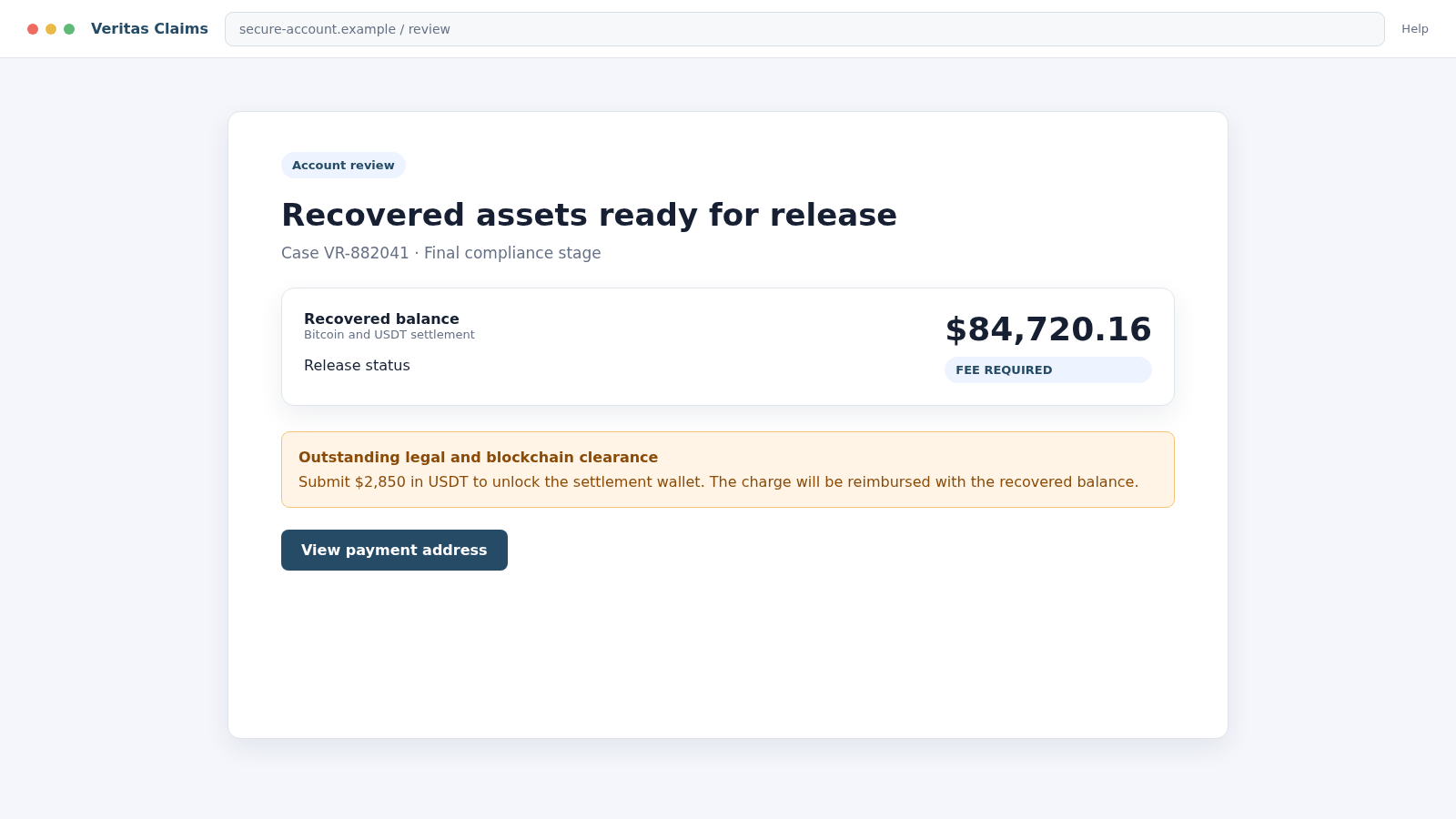
The victim is told that funds were found at an exchange, in a frozen wallet, or inside an international settlement account. A fabricated balance or tracing report may show the original loss plus supposed investment gains.
This invented success changes the question from “Can anything be recovered?” to “What must I do to receive it?”
Step 4: Identity and financial documents are collected
The fake firm requests a passport, driver’s license, proof of address, bank statement, tax number, wallet address, or signature. The request is presented as know-your-client or court compliance.
Those records can support identity theft, new account fraud, and more targeted impersonation. A signed power of attorney may also be misused to make the operation appear legitimate.
Step 5: The first fee is framed as routine legal work
A retainer or forensic charge is introduced. The amount may seem modest compared with the claimed recovery, and the scammer promises it will be reimbursed or deducted from the settlement.
Payment may be directed to an individual, unrelated company, money-transfer account, or cryptocurrency wallet. The mismatch is explained as an international partner or escrow arrangement.
Step 6: A fake authority adds taxes and clearance costs
After the first payment, another person appears as an exchange officer, regulator, tax agent, bank, or court clerk. A document says the release cannot proceed until a new obligation is paid.
The supposed recovered balance remains visible, making each fee look small by comparison. No payment actually moves the victim closer to receiving money.
Step 7: Pressure replaces professional service
Questions are met with deadlines, confidentiality demands, or warnings that the assets will be forfeited. The fake lawyer may accuse the victim of delaying the case or violating a settlement.
If money stops, communication becomes hostile or disappears. Websites and messaging accounts can be replaced quickly.
Step 8: Another recovery operation appears
The victim’s details return to a lead list. A second firm then claims it investigated the first recovery scam and can retrieve both losses.
The names change, but the request remains the same: trust an unexpected helper, share more information, and pay before receiving anything.
Company, Address, and Fulfillment Checks
A familiar firm name does not identify the sender
Search every named attorney in the official bar or law-society directory. Match the exact firm, status, telephone number, address, and email domain. Contact the professional through the directory, not through the recovery message.
A real office address can still be copied
Fraudsters borrow addresses from genuine firms, shared buildings, and virtual offices. Confirm occupancy with independently sourced contact information and ask whether the named person sent the approach.
Professional support should leave a verifiable trail
A real lawyer can explain jurisdiction, engagement terms, fee handling, conflicts, and realistic outcomes. Telegram-only contact, generic email, guaranteed recovery, and refusal to speak through a verified office are incompatible with that process.
The recovery path must exist outside the firm’s website
A court case, insolvency distribution, seized-asset process, or exchange hold should be independently verifiable. A dashboard controlled by the same people demanding payment is not evidence that recovered money exists.
What Regulators Say About Fake Recovery Lawyers
The FBI’s Internet Crime Complaint Center warns that fictitious law firms contact cryptocurrency scam victims and claim authority to recover funds. They may seek identity records, banking information, advance fees, or supposed back taxes.
The FBI reported that victims of this tactic disclosed more than $9.9 million in additional losses between February 2023 and February 2024. The figure illustrates why prior victims are so valuable to recovery scammers.
The FTC’s recovery scam guidance is equally direct: an unexpected person who promises to recover lost money for an upfront fee is trying to take more money.
Neither agency says that lawful recovery is impossible. They warn that it is difficult, never guaranteed, and should not depend on secret payments to someone who found you first.
Warning Signs in a Fake Legal Recovery Offer
- The firm contacts you before you contact it
- The sender already knows details of an earlier scam
- A recovery amount is guaranteed before evidence is reviewed
- The lawyer claims a special relationship with the FBI or regulator
- Fees must be paid in cryptocurrency or to an unrelated recipient
- A private dashboard displays money you cannot withdraw
- Taxes or bonds appear after the initial retainer
- You are told not to consult another lawyer
Real legal matters can involve fees, but the fee alone is not the complete test. Identity, licensing, jurisdiction, account handling, documentation, and the underlying recovery event must all withstand independent verification.
How to Verify a Recovery Claim Before Hiring Anyone
Begin with the underlying event, not the recovery firm’s presentation. Ask which court, regulator, insolvency administrator, exchange, or law-enforcement agency controls the alleged assets and obtain a public case or reference that can be checked independently.
Search the lawyer through the official licensing authority for the jurisdiction where they claim to practice. A name alone is insufficient. Match the current status, firm, office, telephone number, and permitted practice details.
Contact the verified professional using information from the regulator or the firm’s long-established official website. Ask whether the person sent the message and whether the proposed domain, contract, and payment account belong to the practice.
Request a written explanation of jurisdiction and strategy. A real lawyer should be able to describe who holds the assets, what legal process applies, what evidence is needed, and why recovery is uncertain.
- The regulator’s record for every named lawyer
- The public court or insolvency case number
- The firm account receiving any legitimate retainer
- A written fee agreement and client-account terms
- A realistic explanation of risks and possible outcomes
- Permission to seek independent legal advice
Never rely on a screenshot of a wallet or bank balance. Use a public blockchain explorer for transaction claims and contact a named exchange through its official compliance route when an address supposedly belongs to it.
Take time before signing a power of attorney or sharing identity documents. A genuine professional engagement can survive verification. A scam depends on preventing you from checking outside the story it created.
What to Do if You Have Fallen Victim to This Scam
- Stop paying and communicating. Do not send a final tax, bond, or release fee to protect earlier payments. Block the contacts after preserving the evidence.
- Contact the payment provider immediately. Ask the bank, card issuer, exchange, or transfer service whether a payment can be recalled, frozen, disputed, or flagged.
- Report receiving crypto addresses. Give exchanges the transaction hashes, destination addresses, dates, amounts, and official report number. Do not share your recovery phrase.
- Verify any copied lawyer identity. Contact the real firm and regulator through independently found details. Tell them which names, photographs, addresses, and documents were used.
- Secure email and financial accounts. Change unique passwords from a clean device, enable multi-factor authentication, revoke unknown sessions, and review recovery methods.
- Protect identity records. If you sent ID, tax, signature, or banking documents, use IdentityTheft.gov to build a recovery plan and consider credit freezes.
- Remove remote access. Disconnect any device the caller controlled, uninstall remote tools, and reset sensitive credentials from another trusted device.
- Run a security scan. Use Malwarebytes to look for malicious downloads, information stealers, or remote-control software left behind.
- Reduce exposure to malicious pages. Report fake domains and use AdGuard to help block known phishing sites and harmful ads. It cannot recover transferred assets.
- Save the complete case. Preserve emails with headers, contracts, portal screenshots, telephone numbers, chats, wallet addresses, transaction hashes, receipts, and identity records shared.
- File official reports. Report to the FBI IC3, FTC, local police, relevant bar regulator, and authorities in the payment destination when appropriate.
- Expect another recovery pitch. Do not announce the loss publicly with contact details. Treat every unsolicited recovery offer as hostile until independently proven otherwise.
Frequently Asked Questions
Is every business named Veritas Legal Group fraudulent?
No. Similar names may be used by legitimate professionals. This scam involves unverified people using the name to promise recovery. Confirm the exact lawyer and contact details through the relevant regulator.
Can a lawyer legitimately charge a retainer?
Yes, legitimate lawyers may charge fees. The danger is an unsolicited, unverified firm guaranteeing recovery and demanding unusual payment before any independently confirmed legal process exists.
How did the caller know about my previous loss?
The information may come from the original scammers, stolen data, a public complaint, or a recovery form. Accurate details prove access to information, not legal authority.
Can blockchain investigators trace stolen cryptocurrency?
Public transfers can often be traced, but tracing does not give a private firm the power to reverse them. Actual recovery usually requires cooperation from exchanges and law enforcement.
Should I pay a tax directly to release recovered funds?
Not to an unverified lawyer, personal account, or crypto wallet. Confirm any real tax obligation with the relevant government authority and your independent tax professional.
Can the fake firm misuse my passport copy?
Yes. Identity documents can support account fraud and impersonation. Report the exposure, monitor accounts, preserve evidence, and follow an identity-theft recovery plan.
The Bottom Line
The Veritas Legal Group scam sells hope to people already hurt by fraud. A legal name, convincing contract, and accurate transaction details do not prove that a recovered fund or attorney-client relationship exists.
Verify the lawyer through an official regulator, confirm the recovery event independently, and never pay an unexpected helper simply to unlock money. A genuine professional will not object to those checks.








