

A Viking bracelet priced at $0.01 sounds like a strange reward for arriving before a warehouse closes. The story is vivid, emotional, and time-sensitive.
Forge & Fjord says the jewelry is effectively free and only shipping remains. The real question is what the buyer purchases after every charge is counted.
Overview
The jewelry price is not the transaction price
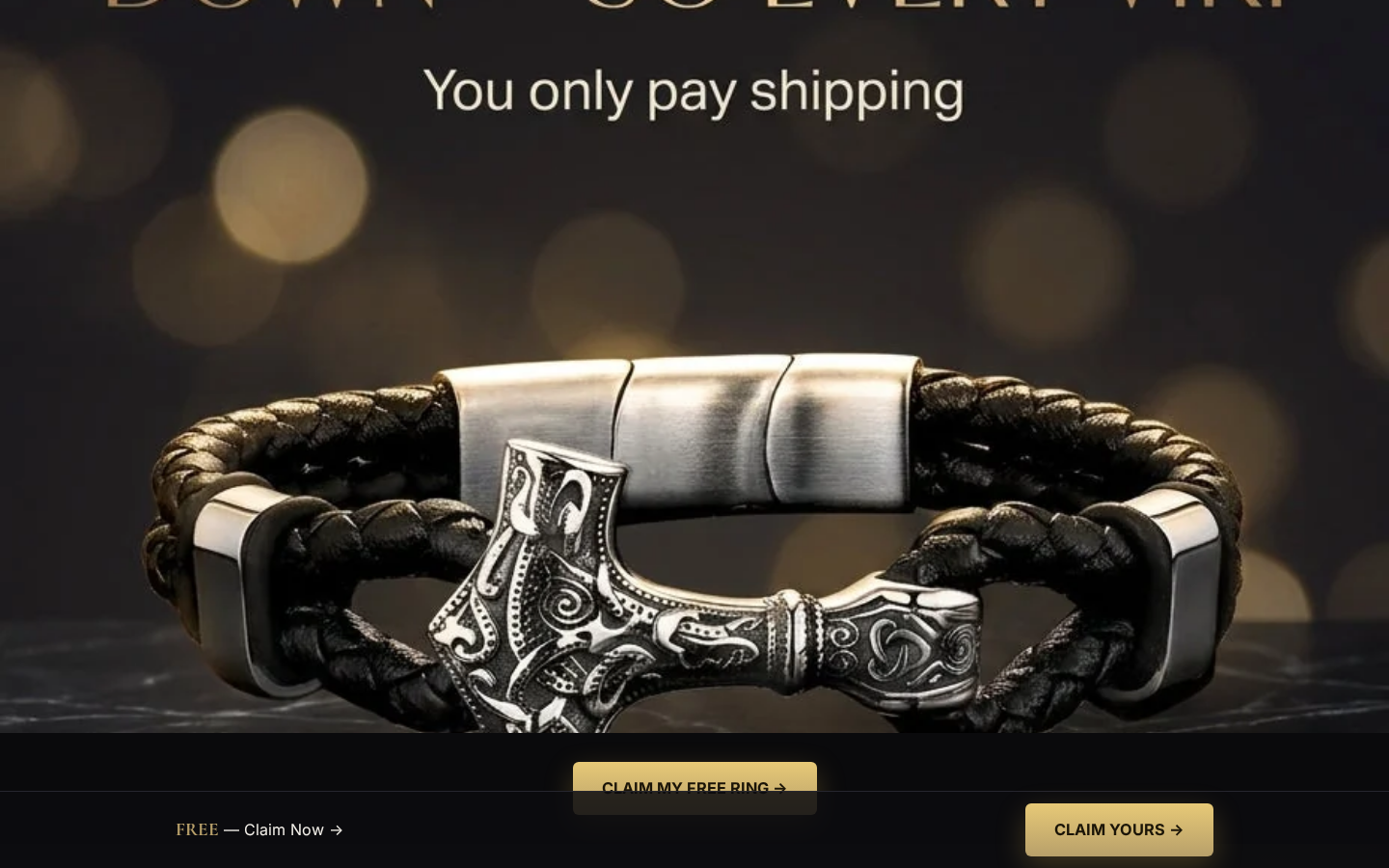
Forge & Fjord advertises selected Viking-style pieces for free or $0.01 during what it calls a closing-down warehouse clearance.
The landing page says shipping costs $19.95 for each piece. Ordering multiple “free” items multiplies that charge rather than creating one ordinary parcel fee.
The customer is therefore buying jewelry through mandatory shipping. The label changes, but money still leaves the card for every item.
The closing story creates pressure that is difficult to verify
The advertisement says a lease is ending, the business is downsizing, and thousands of pieces must leave the warehouse.
It also uses an “ends today” banner and a timer. Yet the site continues operating while promotions move between free and $0.01 wording.
We found no independently documented lease, warehouse address, closure date, or named owner supporting the personal story.
Customer reports now describe parcels arriving from China despite the American warehouse story, cheap materials, mismatched items, and rejected refund requests.
Some buyers report receiving jewelry. That confirms the scheme can deliver low-value goods while the false closure story and inflated shipping remain deceptive.
The site publishes policies but little corporate identity
Forge & Fjord provides shipping, returns, privacy, and terms pages, along with info@forgefjord.com.
The terms do not prominently identify a registered legal entity, business registration number, public telephone line, or physical headquarters.
That leaves buyers relying on an online brand and email inbox if the jewelry, delivery, guarantee, or refund differs from expectations.
- The promotion has used both free and $0.01 product pricing.
- Shipping is advertised at $19.95 for each piece.
- Buttons lead through a separate Shopify store domain.
- Closing claims are paired with a repeating urgency timer.
- The seller says delivery takes roughly 7 to 14 business days.
- No clearly verified workshop or warehouse address appears in the policies.
The safest comparison is simple: search the exact design elsewhere, include every mandatory fee, optional insurance, and taxes, then decide whether the closing narrative adds meaningful value.
A genuine clearance should still make economic sense without its countdown. Comparable jewelry, transparent postage, and a traceable seller provide a more useful benchmark.
Save the basket screen before paying. It records each shipping line, optional protection, promotional wording, and the total you actually authorized.
Our investigation does not show that nothing will arrive. It shows a “free” offer where shipping functions as the sale price and the backstory lacks verification.
What Forge & Fjord Promises
The page describes stainless-steel rings, pendants, earrings, and braided bracelets inspired by Norse symbols.
It says the pieces come from a small United States workshop, carry authentic craftsmanship, ship domestically, and arrive within two to five days.
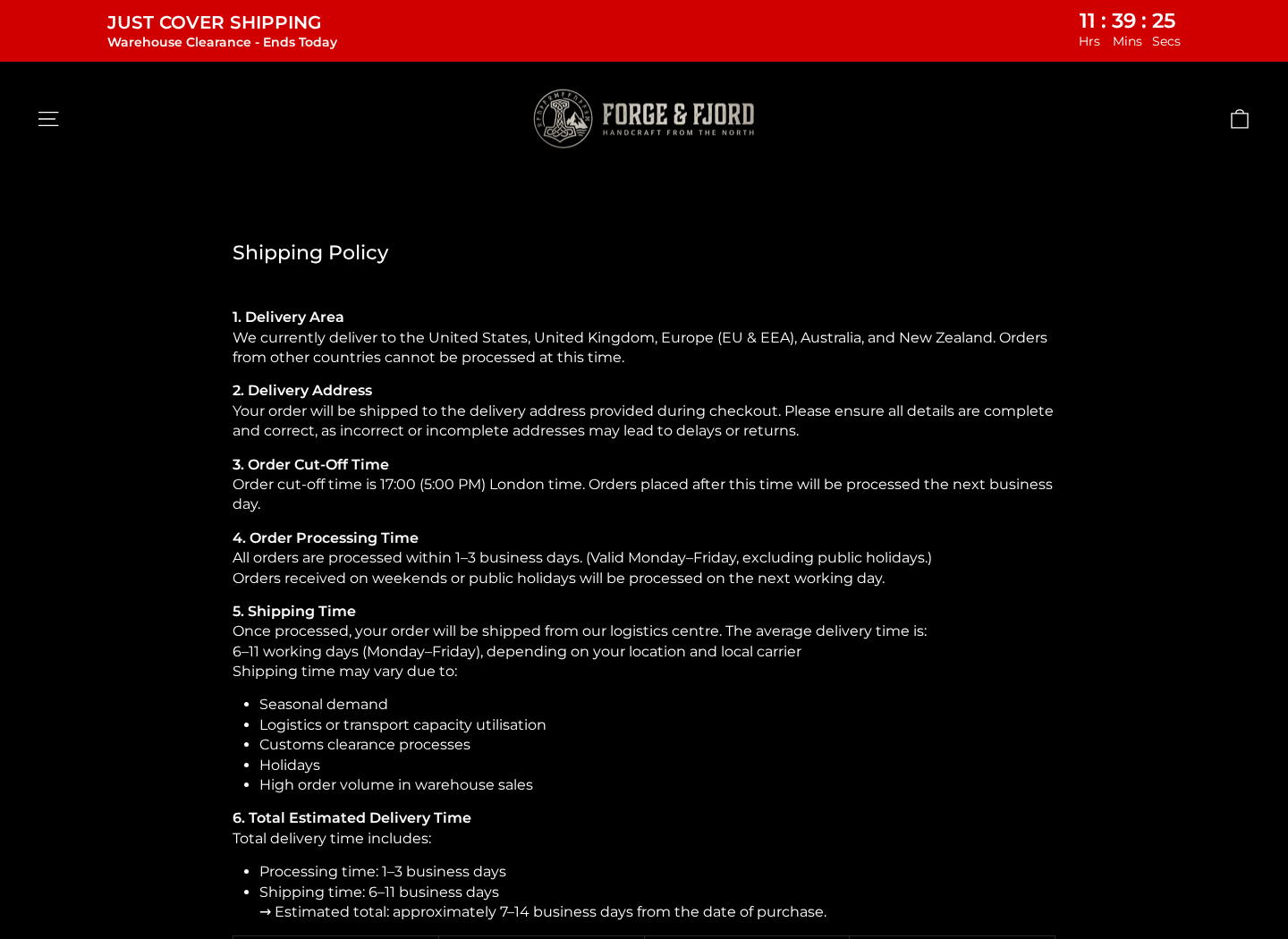
The formal shipping policy tells a different timing story. It estimates one to three business days for processing and six to eleven for transit.
That produces an overall estimate of seven to fourteen business days, excluding customs delays.
The policy also says orders move from a “logistics centre” without identifying that facility.
The landing page calls the jewelry solid, skin-safe, durable, and built for daily wear. Detailed material verification is limited.
For example, a phrase such as “stainless steel” does not identify grade, plating, nickel content, coating durability, or the actual manufacturing source.
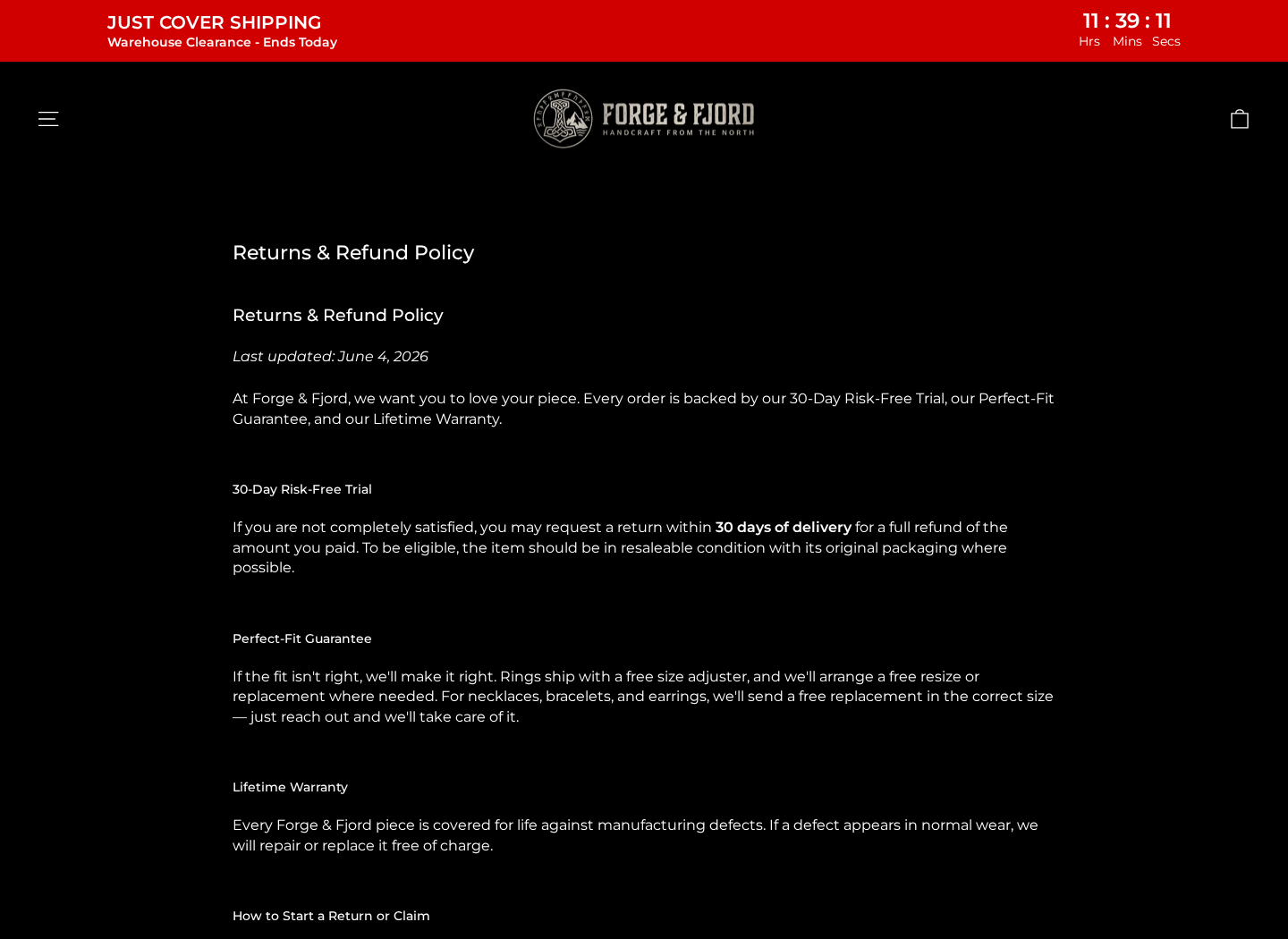
The lifetime warranty covers manufacturing defects, according to the return page. Change-of-mind return postage remains the customer’s responsibility.
A buyer should read those formal pages rather than relying on the more generous emotional language surrounding the order buttons.
How “Free, Just Pay Shipping” Really Works
Free-plus-shipping offers are a familiar direct-response model. The merchant removes the visible product price and collects revenue through another required line.
That does not automatically make an offer illegal or fraudulent. A seller may legitimately discount inventory and still recover postage and handling.
The important test is whether the shipping amount reflects transportation or quietly includes product cost, marketing expense, and profit.
Forge & Fjord says the $19.95 rate is the real shipping cost and is not inflated to recover the item’s value.
However, the charge applies separately to each piece, even when several pieces travel in one order.
Four $0.01 pieces can therefore create $79.80 in advertised shipping before optional extras or taxes.
That structure makes the order economically similar to buying four inexpensive pieces for about $19.95 each with “free shipping.”
The customer should judge the final total, not the accounting label attached to it.
How the Free-Plus-Shipping Jewelry Scam Works
Step 1: A dramatic closing story appears in an advertisement
The campaign says a small workshop is losing its lease and would rather give jewelry to “real warriors” than keep paying storage.
This story adds personality and loss. The visitor feels they are helping an artisan while receiving a last-chance bargain.
No independent document on the page establishes the workshop, lease, owner, or scheduled closure.
Step 2: A countdown makes checking feel risky
An “ends today” message and timer suggest that researching the company could mean losing the remaining stock.
The page also says popular pieces are finite and will not return once the last one ships.
When a timer resets or the promotion remains available later, it is a persuasion device rather than proof of a deadline.
Step 3: The $0 or $0.01 label anchors the decision
Visitors begin with the idea that the jewelry costs virtually nothing. That anchor makes a $19.95 shipping fee feel easier to accept.
The site has changed between “free” and “one penny” language while preserving the same basic economic offer.
The tiny product price also creates a memorable headline that travels well through social advertising.
Step 4: Testimonials and guarantees make the offer feel proven
The page displays named reviewers, cities, five-star comments, fast-delivery claims, and detailed praise about weight and durability.
These testimonials appear within the seller’s own funnel. We did not find a visible independent verification method attached to them.
Claims such as 30-day trial, perfect-fit guarantee, and lifetime warranty lower the shopper’s fear of disappointment.
Step 5: Multiple free items multiply the required charge
The campaign encourages shoppers to claim several pieces or add a gift box while stock lasts.
Shipping is charged per piece, so the total grows almost exactly as if each item carried a normal retail price.
At that point, the shopper is no longer accepting a token giveaway. They are placing a meaningful ecommerce order.
Step 6: Fulfillment may reveal an ordinary mass-market product
The sales story emphasizes a small workshop and authentic Norse craftsmanship, but the site does not identify a workshop address or named maker.
Generic Viking jewelry with similar designs is widely available through wholesale and marketplace channels.
If the received piece is mass-produced, its practical value may be close to the mandatory shipping charge.
Step 7: A return can cost nearly as much as the order
Change-of-mind customers must pay return postage, and the seller must provide instructions first.
The policy promises a refund of the amount paid after inspection, but the economic treatment of the original shipping charge needs written clarification.
Returning low-cost jewelry across an unknown fulfillment route may erase much of the possible recovery.
The Separate Shopify Domain Deserves Attention
Several claim buttons on the Forge & Fjord promotion route through duztxt-y2.myshopify.com.
Shopify commonly provides internal store domains, so this alone does not indicate fraud.
It does show that Forge & Fjord is a storefront identity layered over a generic platform account with an unrelated-looking technical name.
Buyers should confirm that the checkout still identifies Forge & Fjord and that the merchant descriptor is disclosed before payment.
An unexpected company name on the receipt can complicate card disputes if no record connects it to the advertised brand.
Save both URLs, the cart, and the final checkout summary. Do not rely only on the public landing page.
Also check for optional shipping insurance, gift boxes, warranties, memberships, or other add-ons that may enter the cart.
The site offers a $3.95 shipping-insurance product. Verify whether it is selected and whether ordinary carrier loss is already the seller’s responsibility.
Are the Reviews and “Live Stock” Claims Reliable?
The landing page calls its inventory count honest and presents reviewers as real owners.
However, seller-controlled text cannot authenticate itself. A genuine review system should explain purchase verification, dates, moderation, and negative feedback.
Some testimonials mention surprisingly fast delivery from the United States. The formal policy allows a considerably longer total timeline.
The page also includes statements about recent sales volume and people viewing the product.
Such counters can be generated by storefront applications. Without independent data, they should be treated as marketing prompts.
A closing warehouse should show declining inventory and a defined final date. The store does not provide auditable stock records.
Search independent feedback using the domain, email address, checkout descriptor, and any company name from the receipt.
Reviews about receiving an item do not settle whether quality, original value, or the closure story was represented accurately.
Company, Address, and Fulfillment Checks
No legal company is prominently identified
The terms repeatedly name Forge & Fjord but do not clearly state a registered corporate entity or registration number.
A brand is useful for marketing. A legal name is necessary when a consumer needs to send formal notice or identify the card merchant.
Ask support for the contracting entity before ordering and compare the answer with checkout records.
No workshop or warehouse address is disclosed
The story depends on a lease ending at a United States workshop, yet the policy pages do not publish that workshop’s address.
The shipping page refers only to a logistics center. This prevents an independent check of the claimed closing facility.
A fulfillment center can dispatch packages without owning the brand or manufacturing the jewelry.
The site offers email but no prominent phone number
Different pages use info@forgefjord.com and support@forgefjord.com. We did not find a clearly displayed public customer-service telephone number.
Email creates a useful written trail, but buyers depend on the operator choosing to reply.
Send a question about original shipping refunds and the return destination before purchase. Save the response.
Product origin is not established by “ships from US”
A domestic parcel can contain imported mass-produced goods. Shipping origin and manufacturing origin are separate facts.
The seller does not provide a named maker, factory, batch, steel grade, or country-of-origin statement on the inspected promotion.
Without those details, “authentic craftsmanship” remains advertising rather than a traceable supply-chain claim.
What to Check Before Claiming a Piece
Add only one item and observe the complete total. Then compare that total with similar jewelry from established sellers.
Check whether shipping increases per piece or reflects the parcel’s actual combined weight.
Remove shipping insurance or gift packaging unless you deliberately want it.
Ask whether the original $19.95 shipping charge is refundable when using the 30-day trial.
Request the legal company name, workshop location, return country, and expected card descriptor.
Search the product image to identify matching wholesale listings and realistic material value.
Read the metal description carefully if you have nickel sensitivity or other contact allergies.
Use a protected payment method and keep a screenshot of every checkout screen.
What to Do if You Have Fallen Victim to This Scam
- Calculate the real order. Record the item count, $19.95 charges, insurance, gift options, taxes, and final total rather than focusing on $0.01.
- Request cancellation immediately. Email both published addresses with the order number and an unambiguous cancellation request. Ask for written confirmation.
- Preserve the closing claims. Save the timer, lease story, delivery promise, material claims, guarantees, checkout, receipt, and tracking information.
- Inspect delivery carefully. Photograph the sealed package, label, jewelry, dimensions, markings, defects, and every difference from the advertisement.
- Obtain authorized return instructions. Confirm the destination and whether original shipping is refunded. Use tracking and keep proof of delivery.
- Escalate unresolved charges. Explain to the card issuer whether goods were undelivered, misdescribed, duplicated, or refused under the advertised guarantee.
- Protect the browsing path. Run Malwarebytes after suspicious downloads or redirects. AdGuard can reduce repeated deceptive advertising and tracking links.
- Report the campaign. Give the ad platform and consumer authority screenshots showing the closure story, recurring deadline, per-piece fee, and seller identity gaps.
Frequently Asked Questions
Is Forge & Fjord jewelry really free?
The item line may show $0 or $0.01, but mandatory shipping is advertised at $19.95 per piece. The transaction is not cost-free.
Does this prove Forge & Fjord sends nothing?
No. Buyers may receive jewelry. The scam is the false-looking closure story, inflated per-piece shipping, China fulfillment, quality mismatch, and difficult refund path.
Why charge shipping separately for every item?
The site says $19.95 reflects shipping for each piece. Economically, repeated fees can function like individual product prices within one order.
Is the store actually closing?
We found no independent lease, warehouse address, named owner, or fixed closure date verifying the story presented on the landing page.
Can I return unwanted jewelry?
The policy describes a 30-day return window, prior email contact, inspection, and customer-paid postage for change-of-mind returns.
Is there a subscription hidden in this offer?
We did not find clear evidence of a jewelry refill subscription. Buyers should still inspect checkout for insurance, memberships, or recurring add-ons.
The Bottom Line
Forge & Fjord uses a familiar free-plus-shipping scam. The jewelry may arrive, but the unverified closing story makes ordinary imported goods look like a final gift.
The mandatory $19.95 charge on every piece functions like its real price. China-fulfillment reports and refund complaints make this offer one to avoid.

Join the discussion
0 commentsShare your experience or ask a question about this article.
Discussion
Start the conversation
Have a question or something useful to share? Add the first comment.