

In the past few months, social media has been hit by a surge of “store closing” jewelry sites that all follow the same script. They claim to be a beloved, family-run boutique that’s been around for decades, and they promise a final retirement liquidation where “everything must go.”
John & Mary is one of the most convincing versions of that formula.
At first glance, it looks almost wholesome: an elderly couple, years of craftsmanship, a sentimental goodbye, and “luxury” pieces supposedly reduced from $139 to $0. All you have to do is pay a small shipping fee.
But that warm story is not the product. It’s the bait.
Behind the polished storefront is a subscription trap built to quietly charge your card month after month, often while giving you little to nothing in return. In many cases, victims also end up exposing their payment details to a merchant setup that is designed to be difficult to trace, hard to contact, and quick to vanish.
This article breaks down how the John & Mary scam works, why it’s so effective, the warning signs that matter most, and what to do right now if you already placed an order.

Scam Overview
The John & Mary “Store Closing Sale” scam is designed to look like a real jewelry business liquidating inventory after decades of operation. The site is filled with glossy product photos, emotional storytelling, and dramatic discounts that reduce items to $0 while framing shipping as the only cost.
That part is intentional. It lowers your guard.
The real goal is not selling jewelry. The real goal is getting you to complete checkout while a recurring membership is quietly added to your order. Many victims do not realize they agreed to a subscription until they see repeated charges on their bank statement.
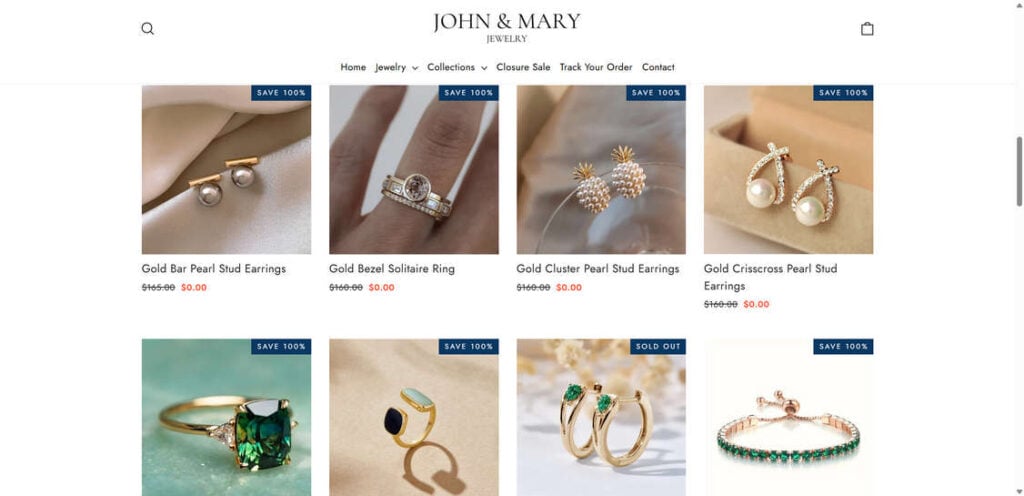
The illusion of a long-running boutique
Everything about the site is engineered to feel established and trustworthy.
Common elements include:
- A heartfelt “meet the founders” story featuring John and Mary as an elderly husband-and-wife team
- “Since 1996” or similar banners meant to imply a long track record
- Photos of smiling older people in a workshop or boutique setting
- Testimonials from major U.S. cities to create a sense of legitimacy
- Patriotic language like “proud American brand” or “family owned”
This is emotional persuasion, and it works because it encourages people to buy with empathy instead of skepticism.
The issue is that the “history” does not match reality. Scam stores like this are typically brand-new domains with no verifiable business footprint, no long-standing customer base, and no traceable corporate identity.
The “free jewelry” hook
Pricing items at $0 is not generosity. It’s a psychological lever.
It works because:
- “Free” triggers impulsive decisions, even in cautious shoppers
- A $10 to $12 shipping fee feels like low risk
- People tell themselves, “Worst case, I’m out ten bucks”
- The checkout feels normal, so buyers stop scrutinizing details
The scammers still profit immediately from shipping fees, and they profit far more if the subscription is successfully attached.
The real trap: negative option billing
The most dangerous part is the checkout page.
Victims commonly report a pre-selected checkbox that adds access to a “Jewelry Club” or membership program. The terms are usually presented in a way that blends into the page, collapses into tiny text, or sits under an arrow that most people never click.
Typical terms include:
- $29.99 billed monthly
- Automatic recurring charges until canceled
- Cancellation required days before the next renewal
- No phone number
- Cancellation routed through email or a vague web form
- Little or no confirmation that cancellation worked
This is a classic negative option billing setup: you are enrolled by default unless you notice the box and opt out.
It’s not an accident. It’s the core business model.
Urgency, fake scarcity, and countdown pressure
To keep you moving quickly, the site usually layers on urgency tactics such as:
- “Only 4 left” stock messages
- Countdown timers claiming the sale ends in hours
- “High order volume” warnings
- Loud banners like “LAST CHANCE” or “CLOSING TODAY”
These elements are designed to shut down decision-making. The goal is speed, not clarity.
Reviews and photos that don’t add up
Many of these stores also rely on fake social proof:
- Generic reviewer names (initial + last name)
- Identical writing patterns across different products
- Fixed five-star ratings for nearly everything
- Customer photos that look synthetic or oddly blurred
- The same reviews reused on other “closing sale” sites
When you see that kind of uniformity, you’re not looking at a community of customers. You’re looking at a template.
“American brand” claims with zero verification
Another common tactic is to claim a U.S. identity while providing no verifiable proof:
- No real business registration you can confirm
- No legitimate physical address with a matching storefront
- No leadership profiles you can verify anywhere online
- No history outside the site itself
If the only place “John & Mary” exists is on that single website and its ads, that’s a major red flag.
How the Scam Works
This scam follows a predictable sequence that appears across countless cloned stores. The name changes, the story changes, but the funnel stays the same.
Step 1: Aggressive social media ads pull you in
Most victims discover John & Mary through paid ads on Facebook, Instagram, TikTok, or YouTube. The ads usually combine:
- Emotional “retirement” storytelling
- “closing forever” language
- luxury product photos
- a free offer with a small shipping fee
The images are often stolen from legitimate brands, creators, or wholesale listings. They look high-end because they were never taken by the scammers in the first place.
Step 2: A professional-looking site builds instant trust
Once you click, you land on a clean storefront with:
- polished product photography
- modern fonts and design
- “about us” storytelling
- testimonials and badges
- urgency elements
Scammers understand a simple truth: most people judge legitimacy by appearance first.
Step 3: $0 pricing lowers your risk perception
When the price is shown as $0, your brain reframes the situation.
Instead of “Should I trust this store?” it becomes “Why not try it?”
That shift is the opening the scam needs.
Step 4: Checkout hides the subscription enrollment
The checkout looks normal: shipping details, payment fields, order summary.
But tucked into the page is the trap:
- a pre-checked membership box
- minimized subscription terms
- wording that makes it seem like a harmless perk
Most shoppers do not notice it, and the site is designed that way.
Step 5: Order confirmation reassures you
After purchase, you typically get a generic confirmation email with:
- an order number
- vague shipping claims
- weak tracking links (or none)
- a generic support email
The subscription is often not emphasized, or it’s buried in fine print.
Step 6: Recurring charges appear
Within days, the first membership charge hits. After that, it repeats monthly.
Victims commonly report:
- recurring $29.99 charges
- difficulty canceling
- no phone support
- vague replies or no replies at all
- charges continuing even after cancel attempts
Step 7: The store disappears and relaunches under a new name
Once complaints stack up, these sites often vanish.
Then the same operators repeat the play:
- new domain
- new name
- same checkout pattern
- same stolen images
- same “closing sale” story
John & Mary is usually just one skin on a larger network.
What To Do If You’ve Been Scammed
If you ordered from John & Mary or any “free jewelry, pay shipping” site and now see charges, move fast. Speed matters with subscription traps.
1) Contact your bank or card issuer immediately
Tell them clearly:
- you were misled into a recurring subscription
- the enrollment was not clearly disclosed
- the charges are unauthorized or deceptive
Ask for:
- a dispute or chargeback
- a merchant block to stop future billing
- a replacement card if needed
Banks see this pattern constantly and often take it seriously when you explain the hidden subscription aspect.
2) Try to cancel, but don’t rely on it
If the site is still online, submit cancellation through whatever method they offer.
Do it, but treat it as documentation, not a solution.
3) Screenshot everything
Capture proof while you still can:
- product pages showing $0 pricing
- checkout page with the pre-checked box
- the subscription terms
- emails you received
- ads (if you can still find them)
- receipts and charge descriptions from your statement
This evidence strengthens your dispute.
4) Monitor statements for at least 3 to 6 months
Watch for:
- repeat charges from the same descriptor
- slightly changed merchant names
- unexpected international charges
- multiple charges in a short window
If anything reappears, report it immediately.
5) Report the scam
Reporting increases the chance the ad accounts and domains get flagged.
Common reporting options include:
- FTC complaint tools (U.S.)
- IC3 (FBI Internet Crime Complaint Center)
- BBB Scam Tracker
- your country’s consumer protection authority
- econsumer.gov for cross-border fraud
6) Secure your accounts
If you reused passwords or used the same email-password combo elsewhere, change passwords immediately. Use unique passwords and enable 2FA where you can.
7) Reduce future exposure
Most people get pulled into these scams through ads, not search.
Tools that block malicious ads and known scam domains can help reduce repeat exposure, especially on social media.
The Bottom Line
John & Mary is built to feel like a sweet story and a harmless deal, but it’s structured like a subscription trap.
The key signs are consistent:
- a brand-new “family business” narrative
- luxury items priced at $0
- shipping-only checkout
- urgency banners and countdown pressure
- pre-selected membership enrollment
- weak customer support
- recurring charges that are difficult to stop
- a site that can disappear overnight
If you already ordered, the best move is to protect your payment method immediately, document the checkout trap, and dispute charges before more appear.
FAQ
Are John & Mary jewelry pieces real?
Most of the product photos are typically stolen, reused, or sourced from elsewhere. Victims often report receiving nothing or receiving low-quality items that do not match the photos.
Why is everything priced at $0?
It’s bait. The “free” offer reduces skepticism and gets you to checkout, where the subscription enrollment happens.
Is John & Mary a real family-owned business?
The story is designed to feel real, but these sites commonly have no verifiable business history outside their own pages and ads.
What is the “Jewelry Club” charge?
It’s the recurring membership fee added at checkout, often through a pre-checked box with minimized terms.
Why is the membership box pre-selected?
Because it increases conversions. It’s a deliberate design tactic meant to capture consent without clear awareness.
I placed an order. What happens next?
Usually: a confirmation email, vague shipping promises, weak tracking, then a recurring charge that appears within days.
Can my bank refund the charges?
Often yes, especially when you explain the deceptive subscription enrollment and provide screenshots of the checkout terms.
How do I avoid similar scams?
Be extra cautious with “free + shipping” offers, check for verifiable business info, look for independent reviews, and always scan checkout pages for pre-selected add-ons or membership boxes before paying.

Join the discussion
16 commentsShare your experience or ask a question about this article.
Discussion
Hi, it said sale ends May 4, 2026. But my time zone already says 2:25 am the next day.
Also, the “3 free pieces” is already pre-selected via a round tab box, and can’t be unchecked.
You’re right that this is probably the 8th different skin I’ve seen on this scam. I’ve also backtracked the store operation to a PO Box out of Brooklyn, New York City, same as Whop, their supposedly secure payment processor. Checked on records for Whop, and saw a laundry list of complaints about abrupt termination of services, lack of customer support, and lack of response to inquiries of concern. Further searching reveals that the PO Box is forwarded from another one out of New Jersey. Hope this helps someone.
In reply to Jordan Harvey
Both of those observations are worth more than the whole sales page, so thank you for writing them down.
The sale deadline that has already passed in your timezone and yet the page still works tells you the date is decorative – it is usually rendered from your own device’s clock with a day or two added, which is why it reads as tomorrow for everyone and never actually expires. Reload the page and the countdown resets. Genuine limited offers do not follow you around.
The pre-selected “3 free pieces” that cannot be unchecked is the more serious one, because that is how the recurring charge gets in. If a checkout will not let you decline an addition, the addition is the product – the “free” items are almost always the first delivery of a subscription, with the terms in grey text below the fold. A checkbox that cannot be cleared is also a straightforward negative-option violation under the FTC’s rules, which require clear consent for recurring billing.
My advice would be simply not to complete that order. If you already have, ring your card issuer, dispute the charge as an unauthorised recurring enrolment, and ask them to revoke the merchant’s authorisation and issue a new card number. Screenshot the checkout with the locked box first – that image is unusually good evidence, both for the bank and for a complaint at reportfraud.ftc.gov.
i have recievd my package also i got some thing donot belong to me if i got email from mary -john than i can give more infomation
In reply to nirmala amin
Hi Nirmala, thank you for sharing this. Receiving items you did not order or items that do not match the order is a red flag. Keep the packaging, label, and any emails from Mary & John. If there is an unknown charge, contact your card issuer.
John and Mary Jewelry isn’t a scam. I received my order today and am happy with the jewelry. It’s kinda a mix between costume jewelry, but nicer. I don’t see an area on here to post an image of the jewelry I ordered, but I’ll look.
In reply to Alanna
Thank you for posting it – that is a fair report and it belongs on the page alongside the complaints. Costume jewellery at the better end of that range, arriving as ordered, is a perfectly reasonable outcome and worth other readers knowing about.
We cannot accept images in comments, unfortunately – it is a spam and privacy measure – but a description is fine, and if you have posted a review anywhere else, saying where is useful.
Two things worth keeping an eye on, not to argue with your experience but because they are the substance of most complaints here. Check your statement over the next couple of months for a recurring charge, since that is the most common issue with sites in this category rather than the goods themselves. And if you order again, make sure you are on the same domain rather than a near-identical spelling, since successful storefronts get cloned. If the second order goes as well as the first, do come back and say so.
This is so awful. Thank you immensely for spreading this information. I hope this website gets the attention that it deserves. I had just found the website and was contemplating purchasing something myself!
In reply to Sophia
Hi Sophia, thank you for sharing that.
You made the right decision by stopping and researching before buying. These sites are designed to look convincing, especially with limited-time offers and strong marketing. Taking a few minutes to check can make all the difference.
Thanks, your informative article saved me from falling for this scam. It felt weird, like the site wasn’t really a long time established business. The urgency and sense that no one would advertise if their business is ending made me feel I should research it before making any purchases! Good thing too!
I’m really disappointed that Facebook does not consider this against their advertiser terms, because apparently it’s an ad they’re happy to leave up after I tried reporting it.
In reply to Ti
Hi Ti, thank you for sharing that.
You picked up on exactly the right warning signs: urgency, a story that did not feel like a real long-established business, and pressure to buy before thinking it through. I’m glad you trusted that instinct and researched it first.
It is also frustrating when scam-style ads remain up after being reported, which is one reason public warnings from readers matter so much.
I just saw this ad on YouTube shorts for this John & Mary when scrolling. I knew “Free” high-end jewelry was too good to be true..
Thanks for the well documented information!
In reply to Nicole
Hi Nicole, thank you for sharing that.
That instinct was right. “Free” luxury jewelry offers are one of the oldest online shopping traps, especially when they are pushed through short video ads and social media. I’m glad you stopped and checked before ordering.
I placed a order about 10 minutes ago and I am still waiting for my confirmation
In reply to Donna Hampton
Hi Donna, this is tied to a subscription-style scam, I would not wait too long for the confirmation email.
First, check your spam or junk folder and also look at your bank or card account to see whether the charge already went through. If it did, contact your bank or card issuer as soon as possible and explain that you are concerned this may be a recurring subscription charge you did not clearly authorize. Ask them what options you have to block future billing and dispute the charge if needed.
In reply to Donna Hampton
The scam is still on. I clicked on an ad which led me directly to their e-commerce site. No information where this business is based (odd). Everything was a hundred percent off and it said to hurry, sale ends midnight Sunday March 29. My system clock read Sunday 1 am. My thought was, wait: this store front can easily disappear overnight couldn’t it? I’ve actually heard this can happen with an actual brick and mortar store. A lady thought she was buying a product outright but it turned out to be a contract worth $14,000 or something ridiculous like that charged as monthly installments. She went back to this store and it was gone. I read about this in the news!!!
Thank you for publishing this scam and preserving consumer integrity and sanity! As always, it’s buyer beware out there. I was really tempted, thinking well maybe they extended the deadline just to get rid of everything they had on hand. But really, in the real world, absolutely nothing would be left. If such a “sale” should happen sincerely, it would surely be reserved for past loyal customers. The scam is still on. I clicked on an ad which led me directly to their e-commerce site. No information where this business is based (odd). Everything was a hundred percent off and it said to hurry, sale ends midnight Sunday March 29. My system clock read Sunday 1 am. My thought was, wait: this store front can easily disappear overnight couldn’t it? I’ve actually heard this can happen with an actual brick and mortar store. A lady thought she was buying a product outright but it turned out to be a contract worth $14,000 or something ridiculous like that charged as monthly installments. She went back to this store and it was gone. I read about this in the news!!!
Thank you for publishing this scam and preserving consumer integrity and sanity! As always, it’s buyer beware out there. I was really tempted, thinking well maybe they extended the deadline just to get rid of everything they had on hand. But really, in the real world, absolutely nothing would be left. If such a “sale” would happen sincerely, it would be reserved for past loyal customers. It’s also odd they didn’t impose buying limits. The scam is still on. I clicked on an ad which led me directly to their e-commerce site. No information where this business is based (odd). Everything was a hundred percent off and it said to hurry, sale ends midnight Sunday March 29. My system clock read Sunday 1 am. My thought was, wait: this store front can easily disappear overnight couldn’t it? I’ve actually heard this can happen with an actual brick and mortar store. A lady thought she was buying a product outright but it turned out to be a contract worth $14,000 or something ridiculous like that charged as monthly installments. She went back to this store and it was gone. I read about this in the news!!!
Thank you for publishing this scam and preserving consumer integrity and sanity! As always, it’s buyer beware out there. I was really tempted, thinking well maybe they extended the deadline just to get rid of everything they had on hand. But really, in the real world, absolutely nothing would be left. If such a “sale” should happen sincerely, it would surely be reserved for past loyal customers. The scam is still on. I clicked on an ad which led me directly to their e-commerce site. No information where this business is based (odd). Everything was a hundred percent off and it said to hurry, sale ends midnight Sunday March 29. My system clock read Sunday 1 am. My thought was, wait: this store front can easily disappear overnight couldn’t it? Then I remember I’ve actually heard this can happen with an actual brick and mortar store. A lady thought she was buying a product outright but it turned out to be a contract worth $14,000 or something ridiculous like that charged as monthly installments. She went back to this store and it was gone. I read about this in the news!!!
Thank you for publishing this scam and preserving consumer integrity and sanity! As always, it’s buyer beware out there. I was really tempted, thinking well maybe they extended the deadline just to get rid of everything they had on hand. But really, in the real world, absolutely nothing would be left. If such a “sale” would happen sincerely, it would be reserved for past loyal customers—no costly advertising needed. It’s also odd they didn’t impose buying limits.
In reply to Arxsyn
Hi, thank you for taking the time to write this.
You picked up on several classic red flags: no clear business information, unrealistic “everything must go” pricing, urgency that does not make sense, and a storefront that could disappear as quickly as it appeared. Those details are exactly why these fake closing-sale sites are so dangerous.
I’m glad you trusted your instincts and checked before buying.