

Aisha Jewelry looks polished, personal, and convincing at first glance.
The site tells a strong story about an independent jewelry brand shutting down after years in business, paired with emotional messaging, deep discounts, and urgent sale language. For many shoppers, that combination creates trust fast.
The problem is that this type of store can follow a very familiar pattern. The branding feels premium, the prices look like a once-in-a-lifetime deal, and the promises sound reassuring, but what arrives can be cheap mass-produced jewelry that does not match the images or claims.
If you are wondering whether the Aisha Jewelry Closing Sale is legitimate or another short-lived jewelry scam operation, this guide breaks it down clearly and step by step.
Scam Overview
The Aisha Jewelry Closing Sale Scam fits a common online shopping pattern that has become increasingly popular across social media ads and temporary storefronts.
It is built around one core idea: sell a high volume of products quickly by combining emotional storytelling with urgency-based pricing.
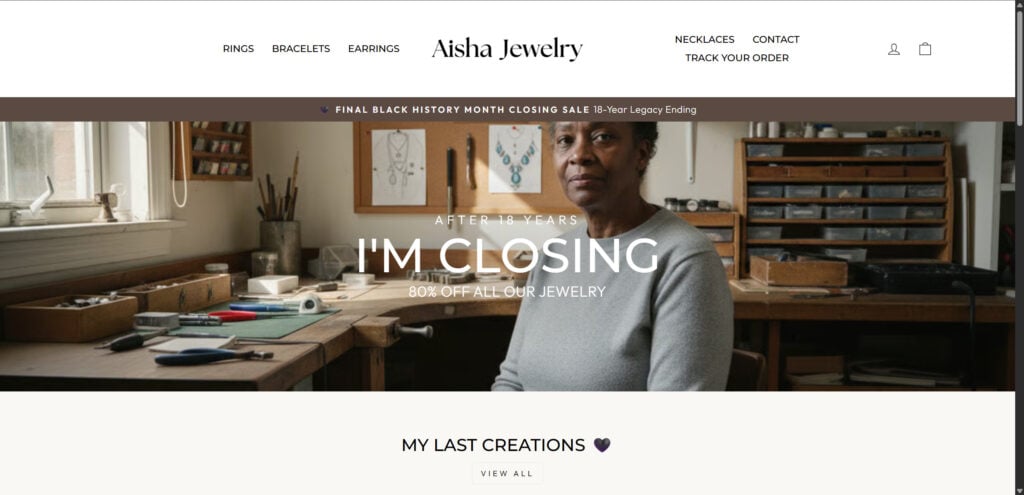
In this case, the site presents itself as a heartfelt jewelry brand with a founder story, a long business history, and a final chance to buy “last creations” at steep discounts. The messaging is designed to feel personal and trustworthy. It uses the language of craftsmanship, meaning, and legacy. It makes the purchase feel like more than a transaction.
That framing matters because it lowers skepticism.
A shopper who thinks they are supporting a real independent jeweler during a final closing sale often asks fewer questions than they would on a random discount website. They are less likely to compare prices elsewhere, less likely to reverse-image search product photos, and less likely to inspect the return policy before checking out.
That is exactly why this format works so well for scammy or low-accountability stores.
The emotional story is the first conversion tool
A major part of the Aisha Jewelry sales pitch is the story.
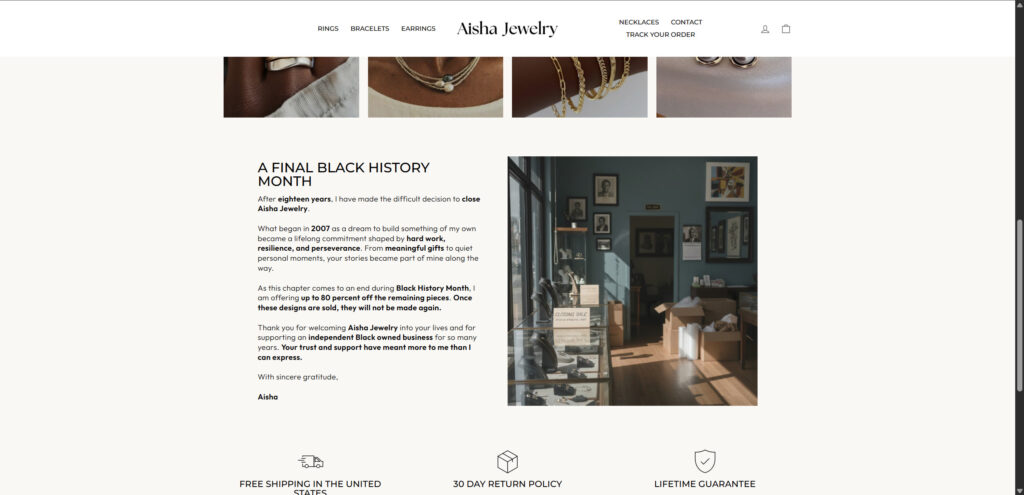
The site uses a personal founder angle and emotional language about closing a long-running business. It frames the sale as a final chapter and invites customers to support an independent brand before it disappears.
This is not automatically proof of a scam by itself.
Real businesses do close. Real founders do run farewell sales. Real brands do use personal messaging.
The issue is that scam storefronts and aggressive drop-shipping stores now copy this exact structure because it converts extremely well. They know buyers respond to:
- Personal founder stories
- “Final sale” language
- Legacy and farewell messaging
- Emotional brand identity
- “Support small business” framing
A polished story can make a store feel legitimate even when the business behind it is vague, short-lived, or not what it claims to be.
The discount structure is a major red flag
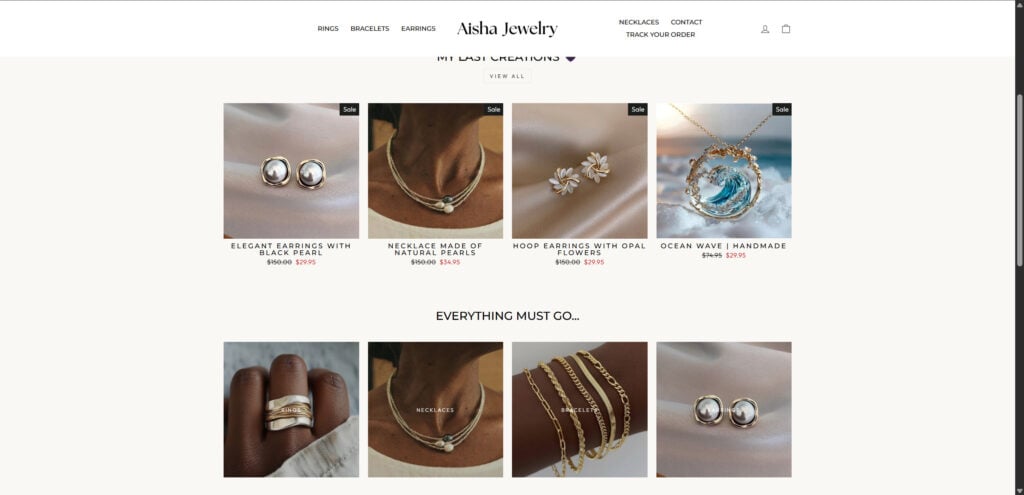
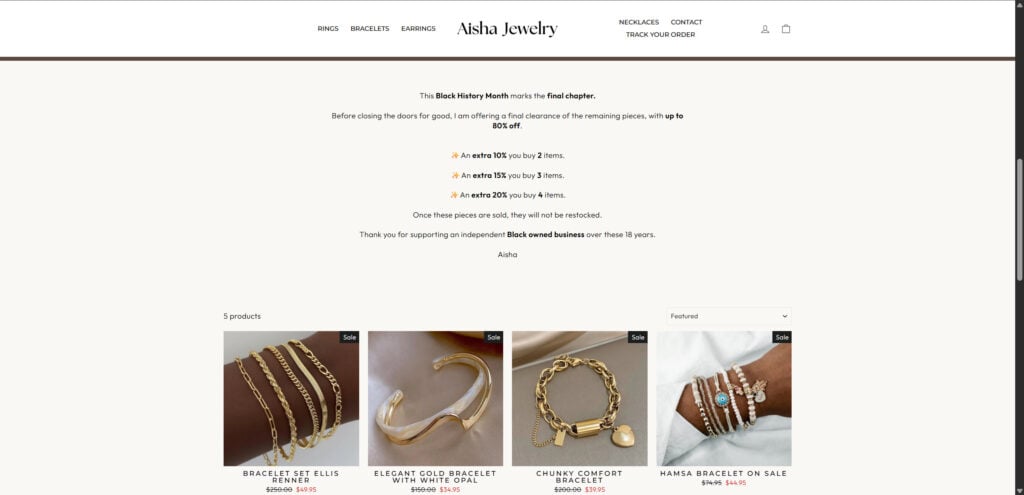
Aisha Jewelry heavily emphasizes extreme discounts like up to 80% off, plus extra discounts for buying multiple items.
That creates a strong urgency loop:
- Buy now before the sale ends
- Buy more to unlock another discount
- Buy quickly before items are “gone forever”
This is classic pressure-based sales design.
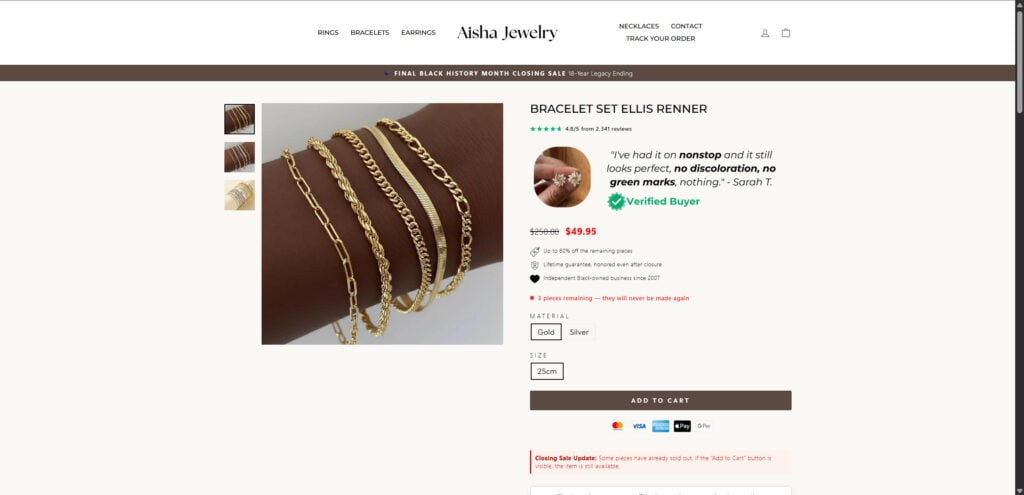
In scam-style jewelry operations, the original prices are often inflated anchor prices. A bracelet listed as “$250.00” and marked down to “$49.95” looks like a luxury bargain, but the real wholesale cost may be a small fraction of that.
The purpose of the price anchor is not to reflect market value.
It is to trigger the feeling of a rare opportunity.
That is why you often see nearly every product on the site discounted at the same time. It creates the illusion that the shopper is arriving at the perfect moment.
The “premium handcrafted jewelry” image can be misleading
The Aisha Jewelry presentation uses soft lighting, premium lifestyle photography, and product copy that suggests high-quality, carefully crafted pieces.
This is another important part of the pattern.
Many scam or low-quality jewelry storefronts position cheap imported jewelry as:
- Handcrafted
- Luxury-inspired
- Heirloom quality
- Tarnish-resistant
- Hypoallergenic
- Long-lasting
- “Designed with intention”
In reality, buyers in this category often report jewelry that feels very different once it arrives:
- Lightweight materials
- Plating that wears off quickly
- Clasps that feel flimsy
- Color that looks brassy or overly yellow
- Stones that look plastic-like
- Items that are smaller than expected
- Pieces that irritate skin
The gap between the product page and the delivered product is where the real problem shows up.
The site sells a visual promise. The package delivers something else.
“Lifetime guarantee” and “30-day returns” can be trust props
Aisha Jewelry prominently uses trust-building claims like:
- Lifetime guarantee
- 30-day return policy
- Free shipping
- Strong review counts
- Verified buyer language
These features are meant to reduce hesitation at checkout.
The challenge is that trust badges and policy claims are easy to display and much harder to enforce. Scammy stores know shoppers scan for these signals and assume they mean the store is safe.
But many buyers only discover the truth when something goes wrong.
A “30-day return policy” is not helpful if the store:
- Delays replies
- Avoids giving return instructions
- Requires shipping to China
- Makes the customer pay expensive tracked international shipping
- Offers only partial refunds instead of honoring a return
- Stops responding after a few emails
The same applies to “lifetime guarantee” language.
If the store disappears, rebrands, or ignores support requests, the guarantee is functionally worthless.
The review strategy is often part of the illusion
Aisha Jewelry also leans on review signals and credibility cues to speed up trust.
This can include:
- High review counts
- Product-specific ratings
- “Verified buyer” labels
- Testimonials mentioning durability and no discoloration
- Strong score summaries near the price
These details can be persuasive, especially when paired with an emotional founder story.
The problem is that review widgets and on-site testimonials are not necessarily independent proof. In scam and drop-shipping storefronts, reviews may be:
- Imported from unrelated products
- Reused across sites
- Selected to hide complaints
- Unverifiable outside the website
- Too generic to be useful
This does not mean every review is fake.
It means shoppers should not treat on-site reviews as the only source of truth, especially when the site is unfamiliar and heavily discount-driven.
The sale language is interchangeable across scam stores
One of the biggest warning signs is how reusable the sales script is.
The Aisha Jewelry site uses “closing sale” messaging, but the same operation style appears under many labels:
- Closing sale
- Anniversary sale
- Farewell sale
- Event sale
- Final collection
- Black History Month closing sale
- Legacy ending sale
- Retirement sale
The wording changes, but the structure is often identical.
That is important because it shows the business model is not tied to one authentic brand event. The sale theme is just a conversion angle.
Scammers and low-accountability stores test whatever story converts best for the audience they are targeting.
The likely fulfillment model behind stores like this
In many cases, stores like Aisha Jewelry are not operating as traditional jewelry brands with their own in-house production and inventory.
Instead, they often work like this:
- Build a polished storefront quickly
- Use emotional branding and urgency pricing
- Run ads on Facebook, Instagram, TikTok, and other platforms
- Collect orders rapidly
- Source products from low-cost suppliers, often in China
- Ship products with long delays and limited tracking clarity
- Handle complaints with scripted support and partial refund offers
- Rebrand if complaints grow too visible
This model can still look professional on the surface.
That is what makes it effective.
The storefront may have elegant branding, clean product pages, and strong sales copy. The issue is what happens after the payment goes through.
The common customer experience after checkout
When buyers run into problems with stores in this category, the same themes appear again and again.
Shipping delays and vague tracking
Many orders take much longer than expected.
Buyers often see:
- Slow dispatch
- Tracking numbers that do not update for days
- Confusing carrier handoffs
- Generic shipping responses from support
If the store presents itself as a U.S.-based handmade jewelry business, but the package is clearly coming from overseas, trust drops quickly.
Jewelry quality that does not match the brand story
This is usually the biggest complaint.
Customers expect jewelry that matches the premium visuals and handcrafted claims. Instead, they may receive items that feel mass-produced and lower quality than advertised.
This is where the store’s “brand story” stops helping.
Once the piece is in hand, the buyer is judging the actual product.
Return process friction
This is where scam operations try to protect their margins.
Instead of giving a simple return label and a clear refund timeline, support may respond with:
- Apologies
- Requests for photos
- Partial refund offers
- Delays
- Complicated return instructions
- Overseas return addresses
This approach is not accidental.
It is a strategy designed to keep as much of the payment as possible while reducing chargebacks.
Why Aisha Jewelry should be treated as high risk
Based on the storefront pattern, messaging style, pricing structure, and common tactics used by similar sites, Aisha Jewelry Closing Sale has multiple risk markers that justify caution.
These include:
- Emotional founder-based closing story
- Sitewide deep discounting up to 80%
- Extra discount stacking to increase basket size
- Luxury quality positioning at clearance pricing
- Heavy urgency language
- Strong trust and review signals that are hard to verify independently
- Sale event framing that matches known scam and drop-shipping templates
Even if some orders do arrive, that does not make the store low risk.
A high-risk store can still ship products. The problem is what gets shipped, how long it takes, and how hard it becomes to get a real refund when the product does not match expectations.
How The Scam Works
This kind of jewelry scam is not always a direct card theft operation.
More often, it is a manipulation and fulfillment scam.
The goal is to get you to buy a product under false or inflated expectations, then make the return process difficult enough that most people give up.
Below is the usual flow, using the Aisha Jewelry Closing Sale model as the example.
Step 1: The ad creates urgency before you can think
Most shoppers first encounter stores like Aisha Jewelry through ads, not through organic search.
The ad usually does three things very quickly:
- Introduces a personal story
- Announces a major sale
- Creates urgency
Examples include:
- “Final closing sale”
- “Everything must go”
- “18-year legacy ending”
- “Up to 80% off”
- “Last creations”
The wording is designed to trigger emotion first and research later.
The shopper is meant to feel they found a meaningful opportunity, not a random online store.
Step 2: The homepage reinforces trust with a personal identity
Once a visitor lands on the site, the homepage is built to immediately confirm what the ad suggested.
It often includes:
- A founder image
- A boutique-style logo
- A personal farewell note
- A mission-driven story
- Product photos with premium lighting
- A “track your order” link
- Trust icons like shipping and returns
This stage is about reducing skepticism.
The site looks organized, branded, and emotionally coherent. To many shoppers, that reads as legitimate.
But presentation is not proof.
Scam storefronts now invest heavily in appearance because good design dramatically improves conversion rates.
Step 3: The story replaces verification
A legitimate jewelry business can be verified through business records, long-term customer reviews, consistent history, and a real brand footprint.
A scam-like storefront tries to skip that process and replace it with narrative.
In the Aisha Jewelry pattern, the story itself becomes the evidence.
The customer is meant to think:
- “This feels real.”
- “This feels personal.”
- “This person has been in business a long time.”
- “This is probably a genuine farewell.”
That emotional trust can stop the shopper from checking basic things like:
- When the domain was created
- Whether the brand has third-party reviews
- Whether the product photos appear elsewhere
- Whether the return policy includes overseas returns
- Whether the listed business address is verifiable
This is why story-based scams work so well.
They reduce the odds that the buyer pauses to investigate.
Step 4: Price anchoring makes the deal feel too good to pass up
The pricing structure is one of the strongest psychological tools in this scam model.
Products are shown with a high original price and a dramatically reduced sale price, such as:
- $250.00 down to $49.95
- $150.00 down to $34.95
- $74.95 down to $29.95
Then the site adds more pressure with stacked discounts, such as:
- Extra 10% off for 2 items
- Extra 15% off for 3 items
- Extra 20% off for 4 items
This creates a powerful internal script in the buyer’s mind:
- “The deal is already big.”
- “If I buy more, I save even more.”
- “If I wait, I might miss out.”
That is exactly what the store wants.
The pricing system is engineered to increase order value before the customer has time to evaluate quality or legitimacy.
Step 5: Product pages use reassurance language to kill doubt
Once the buyer clicks into a product, the page often includes very specific trust signals.
In the Aisha Jewelry style, that can include:
- “Verified buyer” testimonials
- Review counts
- “No discoloration, no green marks” claims
- “Only 3 pieces remaining”
- “Lifetime guarantee”
- “Independent Black-owned business since 2007”
- “Closing Sale Update” notices
This is a sophisticated conversion layer.
The site is not just selling jewelry. It is answering objections before the shopper asks them.
For example:
- Worried about quality? Here is a glowing review.
- Worried about plating? Here is a “no green marks” quote.
- Worried about legitimacy? Here is a long business history.
- Worried about waiting? Here is a scarcity warning.
The page is designed to create emotional certainty, even if the underlying product quality does not support those claims.
Step 6: Checkout encourages speed over clarity
At checkout, stores like this often keep the experience simple and frictionless.
That sounds good, but it serves the seller more than the buyer.
Key details are often deprioritized:
- Actual shipping origin
- Real delivery time
- Return shipping conditions
- Refund limitations
- Restocking rules
- Return address location
Instead, the focus stays on conversion cues:
- Discounts
- Free shipping
- Order now language
- Payment icons
- “Secure checkout” signals
By the time a shopper reaches checkout, they often feel committed to the brand story and sale event. They are less likely to stop and read policy fine print.
Step 7: Orders are fulfilled through low-cost overseas suppliers
This is the point where the hidden business model starts to matter.
In many scam or drop-shipping jewelry stores, the website is not the manufacturer.
It is a marketing front end.
After checkout, the order may be routed to a supplier in China or another low-cost fulfillment region, where products are mass-produced and shipped internationally.
This creates several issues:
- Long shipping windows
- Inconsistent product quality
- Packaging that does not match the brand image
- Limited control over quality checks
- Harder returns
It also explains why the jewelry that arrives often feels disconnected from the luxurious, handcrafted presentation on the website.
The site is branding. The supplier is fulfillment.
Step 8: The product arrives and the mismatch becomes obvious
This is where many buyers realize they were sold a story, not the product they expected.
The most common complaints in this category include:
Materials feel cheap
Pieces may feel lighter than expected, with thin plating and lower-quality metal components.
Finish and color look different
Gold-tone jewelry may appear too bright, too yellow, or uneven compared to the photos.
Craftsmanship claims do not match reality
Instead of a handmade feel, the product may look like a standard mass-produced accessory.
Durability is disappointing
Clasps, links, or plating can show wear quickly, sometimes within days or weeks.
Product dimensions feel misleading
Photos can make pieces look larger or more substantial than they really are.
None of this is accidental from a scam perspective.
The site is optimized to make a cheap item look premium. That is the business model.
Step 9: Customer support starts the refund negotiation script
Once the buyer contacts support, the next phase begins.
This is where many stores in this category rely on a predictable script to reduce losses.
The support team may:
- Apologize and ask for photos
- Say they understand the concern
- Offer a partial refund
- Encourage the buyer to keep the item
- Increase the partial refund if the buyer pushes back
- Delay giving return instructions
Typical offers may include:
- 10% refund
- 20% refund
- 30% refund
- “Keep the item and we will make it right”
This sounds cooperative, but it is often a cost-saving tactic.
Why?
Because international returns are expensive for the seller and risky for the operation. A partial refund helps them keep part of the payment while lowering the chance of a chargeback.
Step 10: Full returns become difficult or expensive
If the buyer insists on a full refund, the store may introduce friction.
This can include:
- Return shipping at buyer expense
- Overseas return address
- Tracked shipping required
- Strict time limits
- “Inspect before refund” policy
- Delayed email responses
At this point, many customers do the math and give up.
If the jewelry cost $39.95 or $49.95 and return shipping to China costs a large amount, the buyer often accepts the partial refund just to end the process.
That outcome is built into the model.
The seller counts on return friction to protect profits.
Step 11: The store manages chargeback risk through delay tactics
Card issuers and payment processors are a threat to scam operations because too many disputes can get the merchant account flagged.
That is why support teams often respond quickly but unhelpfully.
Their goal is to appear responsive while delaying a real resolution.
Common tactics include:
- “Please wait a few more days”
- “We are checking with our warehouse”
- “We can offer a partial refund today”
- “Your issue is being escalated”
- “We need more photos”
This buys them time and increases the chance the customer will miss the dispute window or lose energy.
It also creates a record that they “responded,” which some payment processors consider when reviewing disputes.
Step 12: The brand may reappear under a new name
Even if a store eventually gets enough complaints to damage trust, the underlying model can continue.
The operator can reuse the same structure with a new brand name:
- New logo
- New founder story
- New sale theme
- Same template
- Same suppliers
- Same pricing tactics
- Same support scripts
That is why you may notice different jewelry sale websites that feel strangely similar.
The products, layout, and sale language may change slightly, but the operation behind them often follows the same formula.
What To Do If You Have Fallen Victim to This Scam
If you already placed an order on Aisha Jewelry or a similar jewelry closing sale website, the most important thing is to act early and stay organized.
Do not panic, but do not wait too long either.
The steps below will help you protect your payment method and build a strong case if you need a refund or chargeback.
1. Save everything immediately
Before the site changes, save your evidence.
Take screenshots of:
- The product page
- The listed price and discount
- The product description
- The “handmade” or quality claims
- The return policy
- The shipping policy
- The checkout confirmation page
- The order confirmation email
This matters because scam-style stores often change content, remove claims, or disappear.
Your screenshots can become the strongest proof later.
2. Check your card statement for the merchant name
The charge on your statement may not match “Aisha Jewelry” exactly.
Write down:
- Merchant name as shown on statement
- Charge amount
- Date of transaction
- Any additional charges
This helps when contacting your bank or PayPal.
It also helps identify whether the same merchant attempts another charge later.
3. Contact customer support in writing and be direct
Send a short, clear message by email.
Keep the tone calm and firm.
Use wording like this:
- “The item is not as described. I am requesting a full refund.”
- “Please provide the full return instructions and refund timeline.”
Avoid long emotional explanations.
The goal is to create a clean written record that shows you requested a proper resolution.
4. If the order has not shipped, request cancellation immediately
If you are still waiting for shipment confirmation, ask to cancel right away.
Use a direct line like:
- “I am requesting cancellation of my order and a full refund immediately.”
Some stores will claim the order is already “processing” and cannot be canceled.
Even if they say that, keep the request in writing and save their response.
That record is useful if you need to dispute the charge later.
5. If the item arrives, document the condition clearly
If the jewelry arrives and does not match the listing, take clear photos before doing anything else.
Photograph:
- The item itself in good lighting
- Packaging and labels
- Any defects or discoloration
- Clasps, stones, and details
- Side-by-side comparison with the product page screenshot (if possible)
Use “not as described” language in your complaint.
That phrase is stronger than “I do not like it” because it focuses on misrepresentation.
6. Do not let partial refund offers trap you
If support offers 10%, 20%, or 30% back to keep the item, understand what is happening.
They are trying to close the complaint cheaply.
If you want a full refund, reply clearly:
- “No partial refund. I am requesting a full refund.”
- “Please provide return instructions and the full refund timeline.”
Do not get pulled into a long negotiation unless you actually want to accept a partial refund.
7. Set a short deadline for a real resolution
If support keeps stalling, give them a clear deadline.
Example:
- “If I do not receive full refund confirmation or return instructions within 48 hours, I will dispute the charge with my payment provider.”
This shows you are serious and creates a timeline in writing.
Then follow through.
8. File a dispute with your card issuer if they stall or refuse
If the store delays, refuses a proper return, or sends a product that is clearly not as described, contact your bank or card provider.
Explain the issue clearly:
- The product was misrepresented
- The quality does not match the listing
- The seller is refusing a proper refund
- The return process is unreasonable or not honored
Provide your evidence:
- Screenshots
- Photos of the item
- Support emails
- Policy pages
- Order confirmation
Most banks have dispute deadlines, so act quickly.
Do not wait weeks while support keeps saying “please be patient.”
9. If you paid with PayPal, open a dispute inside PayPal
If you used PayPal, use PayPal’s dispute process directly.
Do not rely on only emailing the seller.
Inside the dispute, upload:
- Product screenshots
- Photos of what arrived
- Emails showing support delays or partial refund pressure
- The listing details and claims
The earlier you file, the better your chances.
10. Watch for small follow-up charges
Even if the issue seems limited to one order, monitor your payment method.
Check for:
- Small “test” charges
- Repeat charges
- Charges from unfamiliar names
- Subscription-like billing you did not authorize
If anything looks suspicious, contact your bank and consider replacing the card.
11. Keep all communication in writing
Do not rely on chat messages that disappear or verbal promises.
If the seller contacts you by email, keep the emails.
If they use a support portal, save screenshots.
Written records make chargebacks much easier to win.
12. Report the ad and the website
This will not get your money back directly, but it helps reduce harm to others.
Report the ad on the platform where you found it:
- TikTok
- Other ad platforms
You can also report the website to relevant consumer protection channels in your country.
This creates a paper trail and increases the chances the ad gets removed.
13. Do not click “refund” links from random follow-up messages
After shopping scams, some people receive fake texts or emails claiming to help with delivery issues or refunds.
Treat these as suspicious.
Do not click links in unexpected messages.
Go directly to:
- Your bank app
- PayPal account
- The official website of your card issuer
Scam operations sometimes attract follow-up scam attempts because they know the buyer is already dealing with an unresolved order.
14. Use the experience to create a future checklist
It helps to turn one bad purchase into a stronger buying habit.
Before buying from another unfamiliar jewelry sale site, check:
- Is the business verifiable outside its own website?
- Are reviews available on trusted third-party platforms?
- Does the return policy clearly state the return address country?
- Are the product photos unique?
- Is the discount realistic or extreme sitewide?
- Is the story doing most of the trust-building work?
A five-minute check can save hours of frustration.
The Bottom Line
The Aisha Jewelry Closing Sale Scam follows a pattern that has become very common in online shopping.
It combines an emotional founder story, extreme discounts, strong urgency language, and premium-looking jewelry imagery to create trust quickly and drive fast purchases. The real issues tend to appear after checkout, when buyers face long shipping times, jewelry that does not match the quality claims, and support teams that push partial refunds instead of honoring clean returns.
That does not mean every shopper will have the exact same experience.
But the overall structure carries enough warning signs that it should be treated as a high-risk purchase.
If you have not ordered yet, pause and verify the brand outside its own website before spending money. If you already ordered and something feels off, document everything and escalate early so you stay within your dispute window.









I just received my order from “Aisha” jewelry. What a joke! The rings are definitely cheaply made. I am so disappointed in the order. I should know better than to order anything from Facebook. It’s a shame that the app cannot protect it’s users from scam websites like this. Aren’t the algorithms smart enough to protect consumers Mark?
Hi Pamela, I’m sorry the order was disappointing. Fake “closing sale” jewelry ads often make cheap items look premium, then rely on social media traffic to keep bringing in new buyers. Your comment helps warn others before they order.
Hi Pamela, I’m sorry the order was disappointing.
Fake “closing sale” jewelry ads often make cheap items look premium, then rely on social media traffic to bring in new buyers. Your comment helps warn others before they order.
AISHA JEWELRY IS 100% SCAM!!! Do not purchase from them! They tricked me, but I hope they won’t trick you. The two rings I ordered arrived from a California return address, but they did not look anything like the rings in the photos on the website. The website displays handmade, high quality jewelry that supposedly cost a lot of money before the “going out of business Black History Month sale,” but what I received was total crap that was obviously mass-produced in a factory out of low quality metals. When I contacted the business to request a refund, they told me I could either keep the rings and get 10% back (what a joke!), or I had to pay a restocking fee and then pay the shipping and customs charges to return the rings to mainland China! I said the rings were sent to me from California, and I would only return them to the same location; they said their California store (which no doubt never existed) was now closed, and I had to deal with their “distribution partner” in China. Obviously there is not and never was a hardworking Black woman jewelry designer and maker involved. I am especially angry that they are impersonating a Black woman artist for their scam and thereby stealing money and customers from real Black women artists.
Hi Megan, thank you for taking the time to share this.
What you described matches a very common scam-store pattern: the site presents itself as a high-end independent jewelry brand with a moving backstory and steep “closing sale” discounts, but what arrives is cheap mass-produced jewelry that looks nothing like the photos. The refund process is then designed to push buyers into giving up, with token partial refunds, restocking fees, and unrealistic return demands involving China.
The part you mentioned about impersonating a Black woman artist is especially disturbing. That kind of fake branding does not just mislead buyers, it also exploits the identity and trust that real independent creators work hard to build.
Keep your order confirmation, photos of the rings, the packaging, and the seller’s refund emails. If you paid by card or PayPal, I would dispute it as item significantly not as described and seller using a misleading return process. Your comment should help warn others before they order.