

A store-closing sale can feel like lightning in a bottle.
One day you have never heard of the brand, and the next day the ads are everywhere. The website looks polished. The story feels personal. The discounts look dramatic, like you are catching the last chance before everything disappears.
That mix is powerful. It also creates the exact conditions scammers and shady drop-shipping networks rely on: urgency, emotion, and a checkout button that is only a scroll away.
If you found the Austin & Olivia Jewelry “Closing Sale” and felt that little mental tug of “I should grab this now,” slow down for five minutes. This guide breaks down what these sites typically are, why they spread so fast, what buyers tend to report afterward, and what to do if you already placed an order.
Scam Overview
The “Austin & Olivia Jewelry Closing Sale” pattern fits into a larger wave of social media storefronts that look like heartfelt small businesses but behave like short-lived, high-volume drop-shipping operations.
They are designed to convert quickly, not to build a real brand.
Many of these sites share the same structure:
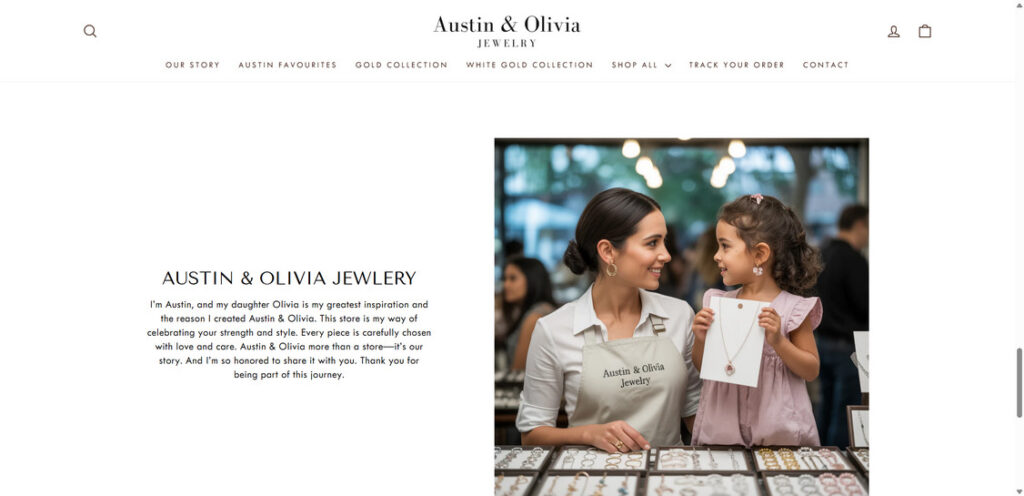
- A sentimental founder story (often parent-and-child, sisters, or a couple)
- “Closing sale” or “final collection” language to explain huge discounts
- A deadline hook like “free shipping today only” or “limited stock”
- High review counts that feel reassuring at a glance
- Product photos that look studio-perfect, sometimes too perfect
- A “track your order” page and a “30-day guarantee” badge to reduce hesitation
On the surface, it reads like a boutique saying goodbye.
In practice, the experience buyers describe across this category of sites is usually different:
- The items arrive much later than expected, often shipped from overseas
- The quality does not match the photos or the pricing story
- Materials and finishes feel cheaper than the product page implies
- Returns are difficult, expensive, or quietly discouraged
- Customer support responds with partial refund offers instead of a proper return
That last part is a major tell.
Legitimate retailers may offer partial refunds in rare, reasonable situations. But scammy or low-accountability stores use partial refunds as a strategy. It is cheaper than processing returns, and it reduces chargebacks because some buyers accept $10 back just to end the frustration.
Why the “closing sale” storyline works so well
A normal discount asks you to compare.
A closing sale asks you to react.
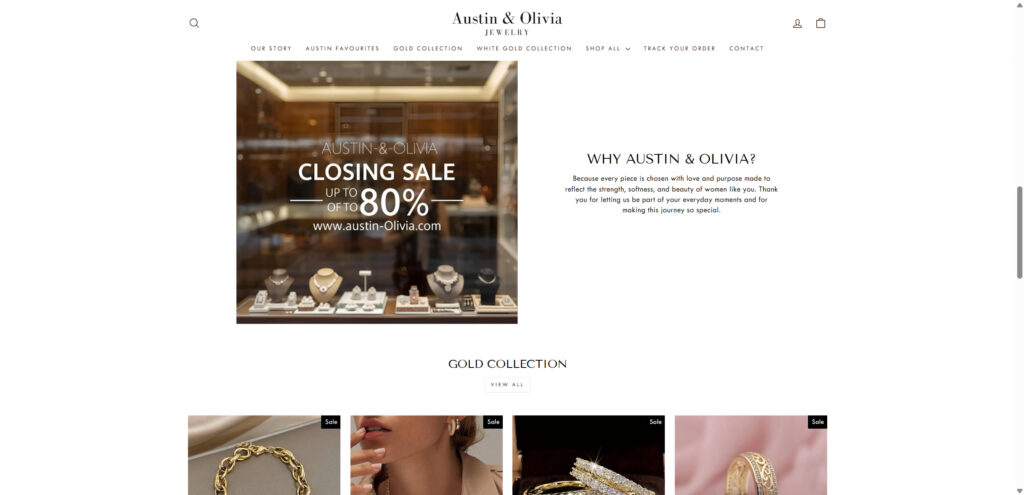
“Up to 80% off,” “final sale,” and “last chance” language pushes your brain into scarcity mode. You stop evaluating whether the brand is real and start evaluating whether you will regret missing the deal.
A founder story adds a second layer.
When a website says the brand was inspired by a daughter, or built with love, or created to celebrate everyday strength, it is aiming for trust through emotion instead of trust through proof.
It is not that every emotional brand story is fake.
It is that scam networks learned a simple lesson: a warm story converts faster than a boring business page.
The website tells you what it wants you to believe
From the page structure alone, you can often see the intent.
Common signals include:
- Massive price anchoring: items “was $275.00, now $55.00” across large parts of the catalog. Deep discounts happen, but a site-wide discount of that magnitude is unusual without a clear, verifiable reason.
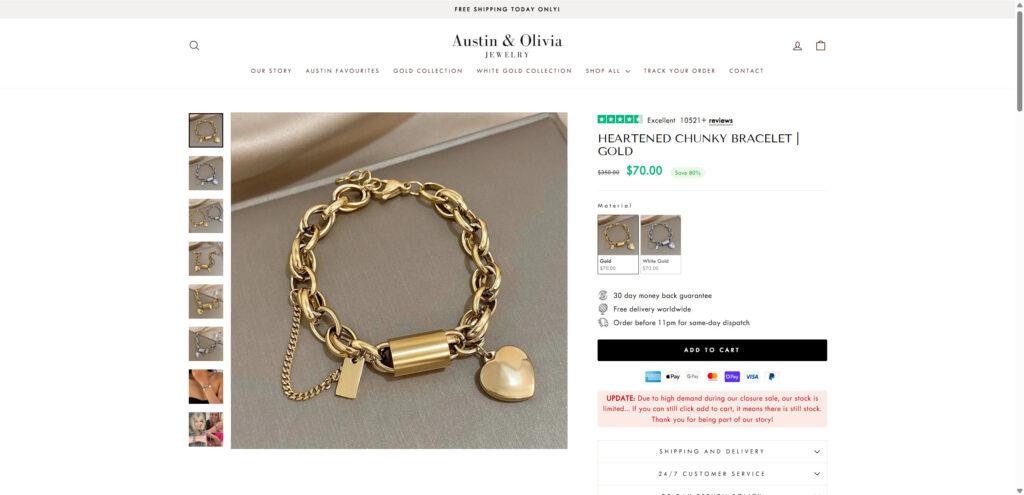
- High review counts with generic language: you might see “Excellent” with 10,000+ reviews. That number can be real on major platforms, but on a brand-new or unknown site it should make you ask where those reviews live and whether they are verifiable.
- Pressure banners: “Free shipping today only,” “high demand,” “stock is limited,” or “order before 11 pm.” These are conversion levers, not customer-friendly information.
- A clean template that looks familiar: many scam storefronts use the same Shopify-style layouts, the same icon sets, the same guarantee badges, and even the same phrasing.
What the product presentation can hide
A huge part of these scams is expectation-setting.
The product photos look like boutique jewelry photographed in controlled studio light. The pages describe “designed with love,” sometimes implying thoughtful craftsmanship. The price cuts imply you are getting premium items at clearance prices.
But when the product is sourced from a mass supplier, those signals can be manufactured:
- Photos can be copied from other listings, catalogs, or social media
- Photos can be generated or heavily edited to look premium
- The “brand” can be assembled in days: name, logo, story, template, and ads
- Inventory can be whatever a supplier can ship cheaply and quickly
That does not always mean nothing will arrive.
In many cases, something does arrive. It is just not what the buyer imagined when they clicked the ad.
A common outcome: “You can keep it, here’s 20% back”
If buyers complain, many of these stores steer the conversation away from returns.
Instead of providing a straightforward return label and refund timeline, they offer:
- 15% refund and keep the item
- 20% refund and keep the item
- 30% refund if you “close the case” or confirm you are satisfied
This is not random generosity.
It is damage control.
Returns cost them money. International returns can wipe out their margin. A partial refund keeps the money flowing and reduces the chance that the buyer files a chargeback with their bank.
A legitimate retailer can still use partial refunds, but the behavior is different:
- They do not fight basic return rights
- They do not make you beg
- They do not treat a refund like a negotiation tactic
Why these sites change names so often
Even when a specific brand name fades, the same structure returns under a new name.
That is because the business model is not “Austin & Olivia Jewelry” as a long-term company.
The model is:
- Launch a storefront.
- Run aggressive ads.
- Collect sales quickly.
- Handle complaints just enough to avoid platform bans and payment processor issues.
- Shut down or rebrand when reputation catches up.
Then the cycle repeats.
That is why you may see different “closing sale” boutiques that look strangely similar. Different names, same layout, same story beats, same product mix.
What this means for shoppers
You do not need a court case or a public investigation to protect yourself.
You just need to evaluate the site like a consumer investigator:
- Does the brand have a real footprint outside its own website?
- Can you find independent reviews that are not hosted by the store itself?
- Does the company have clear ownership, a verifiable address, and consistent contact details?
- Are the product photos unique to the brand, or do they appear across many sites?
- Do the policies read like a real retailer, or like generic copy pasted text?
If multiple answers feel vague, the safest move is to treat the site as a high-risk purchase.
How The Scam Works
This type of shopping scam is less about stealing your card instantly and more about engineering a purchase you regret, then making it hard to unwind.
Below is the typical flow.
Step 1: Social media ads create the first moment of urgency
Most buyers find these sites through ads, especially on:
- TikTok
- Pinterest style placements
The ad does not ask you to research.
It asks you to feel:
- “Final hours”
- “Store closing”
- “Everything must go”
- “Up to 80% off”
- “Free shipping today only”
The goal is to get you off the platform and onto the checkout page before you have time to compare.
Step 2: The landing page delivers trust cues fast
Once you click, the site tries to lock in credibility in the first screen:
- A polished hero image
- A brand name that sounds boutique
- A “designed with love” message
- A founder story that feels personal
- A sale banner that feels time-limited
Even the navigation helps.
You often see links like “Our Story,” “Track Your Order,” and “Contact.” Those links are not proof of legitimacy. They are comfort objects. They reduce friction.
Step 3: The story replaces real verification
A real brand earns trust through consistency and transparency.
A scammy storefront often earns trust through narrative.
A parent-and-child story is especially effective because it feels wholesome and specific. It makes buyers less likely to ask uncomfortable questions like:
- Who owns this company?
- Where is it based?
- How long has it been operating?
- Where are the reviews hosted?
- What is the return process, exactly?
A story is not a business record.
But it can feel like one when it is written well.
Step 4: Price anchoring makes the deal feel too good to ignore
This is where the conversion engine really kicks in.
Products show large “before” prices and dramatic discounts:
- $275.00 to $55.00
- $350.00 to $70.00
- “Save 80%”
Even if you are skeptical, the math creates a temptation: “If it’s decent, it’s still a steal.”
That is the point.
This is also where many stores inflate the “original” price. If the product is inexpensive wholesale jewelry, an “original” price of $275.00 is not a meaningful anchor. It is a psychological lever.
Step 5: Reviews and badges act as a shortcut for trust
Many shoppers do not read policies.
They scan for signals:
- “Excellent”
- 10,000+ reviews
- “30-day money-back guarantee”
- “24/7 customer service”
- Payment icons (Visa, Mastercard, Apple Pay)
These signals are easy to display and hard for consumers to verify quickly.
Some stores use review widgets that pull in generic or recycled reviews. Others display a review count without a clear source. Some show customer photos that may not match the actual product.
The result is the same: the buyer feels covered.
Step 6: Checkout is optimized for speed, not clarity
At checkout, these stores often:
- Offer multiple upsells
- Push bundle deals
- Emphasize “limited stock”
- Hide key details behind collapsible sections
- Present shipping timelines in vague terms
You might see phrases like:
- “Processing 1 to 3 business days”
- “Delivery times vary”
- “High demand may cause delays”
This creates plausible deniability later when shipping takes weeks.
Step 7: Fulfillment happens through overseas suppliers
In many cases, the store is not packing anything.
The order is routed to a supplier or a network of suppliers. The product ships from overseas, often with:
- Long delivery windows
- Limited tracking updates
- Tracking numbers that change mid-route
- Packages that arrive with unfamiliar labels
If the product is cheap jewelry, this supply chain can still be profitable even with partial refunds and complaints.
Step 8: The product arrives, and reality collides with the product page
This is the moment most complaints begin.
Common issues buyers report in this category include:
- The piece looks smaller than expected
- The finish looks dull or cheap
- The “gold” color looks brassy
- Stones look cloudy or plastic-like
- Clasps feel flimsy
- Items irritate skin (possible nickel content)
- The item does not match the photo details
To be clear: not every order will have every issue.
But the gap between expectation and reality is the recurring theme.
Step 9: Customer support becomes a negotiation loop
When buyers contact support, the conversation often follows a script:
- Apologize and ask for photos.
- Offer a partial refund to “make it right.”
- If the buyer insists on a full refund, introduce obstacles:
- Return shipping is at your expense
- The return address is overseas
- You must use tracked shipping
- Refund only after inspection
- Offer a slightly higher partial refund if you keep it.
This loop is designed to exhaust you.
Many people eventually accept the partial refund just to stop spending time on it.
Step 10: Chargeback pressure is managed through delays and “resolution” offers
Payment processors and ad platforms monitor disputes.
If chargebacks spike, stores lose the ability to process payments. So these operations often try to prevent chargebacks by:
- Responding quickly but not solving the problem
- Offering partial refunds
- Asking customers to wait “a few more days”
- Providing vague tracking updates
The goal is to keep the buyer from escalating to their bank.
What To Do If You Have Fallen Victim to This Scam
If you already ordered, focus on two priorities:
- Protect your payment method.
- Create a paper trail that supports a dispute.
Here is a practical, calm checklist.
- Save everything now
- Take screenshots of the product page, price, and description.
- Save the order confirmation page and confirmation email.
- Screenshot the return policy and shipping policy.
- Save any chat transcripts or support emails.
- Track the charge on your statement
- Look for the merchant name as it appears on your card statement.
- Note the date, amount, and any additional charges.
- Email customer support and request a clear outcome
Keep it short and direct. Example:- “I want a full refund. Please confirm the refund timeline and provide the return instructions.”
- Do not be pressured into a partial refund if you want a full refund
Partial refunds are often offered to end the complaint. If you are not satisfied, repeat your request:- “No partial refund. I am requesting a full refund.”
- If the item has not shipped, request cancellation immediately
Some stores will claim they cannot cancel once “processing” starts. Request it anyway, in writing, and save the response. - If the item arrives and is not as described, document it clearly
- Take photos in good light.
- Photograph packaging labels.
- Compare the item to the product page screenshots.
- Set a short deadline, then escalate
If support stalls, give a firm timeline:- “If I do not receive a full refund confirmation within 48 hours, I will dispute the charge with my bank.”
- File a dispute or chargeback with your card issuer
Contact your bank or card provider and explain:- The product was not as described, or the return was not honored.
- Provide screenshots and your communication.
- If you used PayPal, open a dispute in PayPal
PayPal disputes can be effective when filed early, especially with documentation. - Watch for follow-up scams
After shopping scams, some buyers receive:
- Fake “delivery problem” texts
- Fake “refund confirmation” emails
- Requests to “verify” card details
Do not click links from unexpected messages. Go directly through your bank or PayPal.
- Monitor your card for additional charges
Even if the site is “just a store,” it is still wise to:
- Watch for small test charges
- Consider replacing the card if anything looks off
- Report the ad
On the platform where you saw it, report the ad as misleading.
It will not fix your order, but it helps reduce reach and creates a platform record.
The Bottom Line
The Austin & Olivia Jewelry “Closing Sale” has the classic ingredients of a fast-moving shopping scam or, at best, a high-risk drop-shipping storefront dressed up as a heartfelt boutique.
The emotional founder story, the steep “up to 80% off” pricing, the urgency banners, and the oversized review signals are all optimized to get you to buy quickly. The biggest problems tend to show up later: slow overseas shipping, quality that does not match the photos, and customer support that tries to negotiate partial refunds instead of handling returns cleanly.
If you have not ordered yet, the safest choice is to pause and verify the brand outside its own website. If you already ordered, document everything and do not let delays push you past your dispute window.
FAQ
Is Austin & Olivia Jewelry legitimate?
This “closing sale” style site fits a common high-risk pattern: heavy urgency marketing, steep discounts, big review claims, and a sentimental founder story that replaces verifiable business details. That does not guarantee fraud in every single case, but it is enough that you should treat it as high risk until proven otherwise.
Is this a scam or just a drop-shipping store?
Often it behaves like a drop-shipping operation that uses boutique branding. The practical difference for buyers is the same: long shipping times, inconsistent quality, and difficult returns. If a store pushes partial refunds instead of honoring clear returns, that is a major warning sign.
Why are the discounts so extreme, like up to 80% off?
Extreme discounts are used to trigger urgency and reduce comparison shopping. In many questionable stores, the “original” prices are inflated, so the discount looks larger than the real value of the item.
Are the product photos real?
Sometimes they are generic supplier photos, heavily edited images, or images reused across multiple storefronts. A simple check is to reverse-image search a product photo. If the same image appears on many unrelated sites, that is a red flag.
Why does the site show thousands of reviews?
High review counts can be displayed without proving where they came from. Some sites use review widgets that are not independently verified. Look for reviews on trusted third-party platforms and check if the review text is specific, consistent, and dated over time.
Where do orders usually ship from?
In this category, orders often ship from overseas suppliers even if the site presents itself as a local boutique. That can mean longer delivery windows and limited tracking transparency.
How long does shipping typically take?
With overseas fulfillment, it can take 2 to 6 weeks, sometimes longer. Tracking may update slowly or show confusing handoffs between carriers.
What if my order never arrives?
First, document everything: order confirmation, product page, policies, and support messages. Then set a short deadline with support. If they stall or refuse a refund, file a dispute or chargeback through your card issuer or PayPal before your dispute window closes.
The item arrived but looks cheap or different from the photos. What should I do?
Take clear photos of the item, packaging, and labels. Compare it directly to screenshots of the listing. Then request a full refund in writing, using “not as described” language. If they offer 15% to 30% back to keep it and you want a refund, decline and escalate to a dispute.
Why do they offer a partial refund and tell you to keep the product?
Because returns cost them money and create payment processor risk. Partial refunds are a common tactic to reduce chargebacks and end complaints cheaply.
Can I return it for a full refund?
Some buyers are told they can, but the return process may be made difficult: overseas return address, customer-paid tracked shipping, and delays. If you decide to return, get the full return instructions in writing and keep proof of shipment.
What if the store refuses to cancel my order?
If it has not shipped, request cancellation immediately and save their response. If they refuse or delay, contact your card issuer and ask about disputing for non-delivery or failure to honor cancellation.
What should I say when contacting customer support?
Keep it short and firm:
- “The item is not as described. I am requesting a full refund.”
- “Please provide the refund timeline and return instructions.”
If they push partial refunds, repeat: “No partial refund. Full refund only.”
Should I contact my bank right away?
If you see stalling, refusal, or suspicious behavior, yes. Do not wait weeks. Dispute windows vary, and delays are often used to push you past the deadline.
I paid with PayPal. Do I have protection?
Often yes, if you open a dispute quickly and provide documentation. Do not rely on email promises. Use PayPal’s dispute process inside your account.
Could this be identity theft or card theft?
Many of these sites are focused on extracting purchases, not necessarily stealing identities. Still, you should watch your statement for unfamiliar charges, small “test” charges, or repeat charges. If anything looks off, replace the card.
How can I spot similar “closing sale” scams in the future?
Watch for clusters of these signals:
- Brand-new or hard-to-verify business history
- “Closing sale” plus massive discounts across the entire site
- Founder story with no external proof
- Vague address or generic contact details
- Policies that feel copy-pasted
- Support that negotiates partial refunds instead of honoring returns
- Product photos that appear on many unrelated sites

Join the discussion
0 commentsShare your experience or ask a question about this article.
Discussion
Start the conversation
Have a question or something useful to share? Add the first comment.