

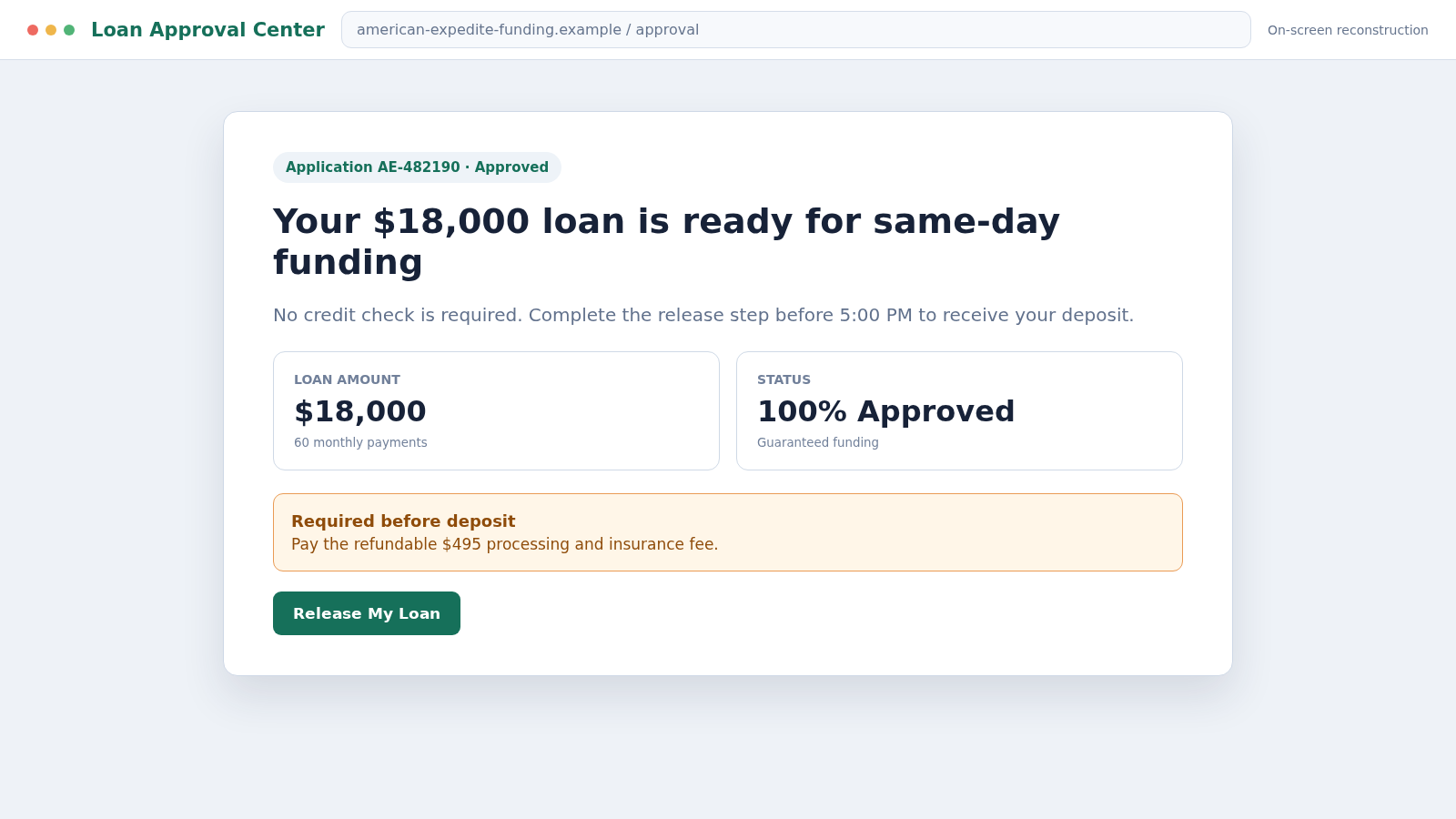
An unexpected lender says your application has been approved, even if your credit is damaged or you do not remember applying. The money can supposedly arrive today after one small processing payment.
That fee is the hinge of the American Expedite Loan scam. Everything before it is designed to make the approval feel real.
Overview
The offer uses the name American Expedite Loan
The American Expedite Loan scam is an advance-fee loan scheme. Fraudsters use the name in calls, texts, emails, social media advertisements, and copied lending websites to promise fast financing with little or no credit review.
The name may resemble an established business in another industry, but a familiar-sounding company identity does not make the lender real. The operation should be judged by its licensing, disclosures, contact details, and payment demands.
The loan is conditional on paying the scammer first
The victim is told that approval is complete, but funds cannot be released until a processing fee, insurance premium, tax, deposit, transfer charge, or credit-improvement payment is made.
After the first payment, another obstacle appears. The criminal may request several fees before stopping contact, while no loan is ever deposited.
Personal information can be as valuable as the payment
A fake application may request a Social Security number, driver’s license, bank login, routing and account numbers, employer details, pay stubs, and a selfie holding identification.
Common promises include:
- Guaranteed approval regardless of credit history
- Same-day funding after a small release fee
- No credit check or income verification
- A large loan available after buying “insurance”
- A refundable security deposit paid by gift card or crypto
- A bank verification step that requires online banking credentials
The Federal Trade Commission warns that legitimate lenders do not guarantee a loan before reviewing an application and then demand payment to deliver it. Paying for the promise is the central warning.
What Makes This an Advance-Fee Loan Scam
A real lender can disclose legitimate application, appraisal, or origination costs. The key distinction is that a criminal guarantees approval and says a separate payment must be sent before the promised money can be released.
The fee is often given an official-sounding name. “Loan protection insurance,” “state tax,” “fund verification,” and “transfer activation” are invented labels used to make the demand feel administrative.
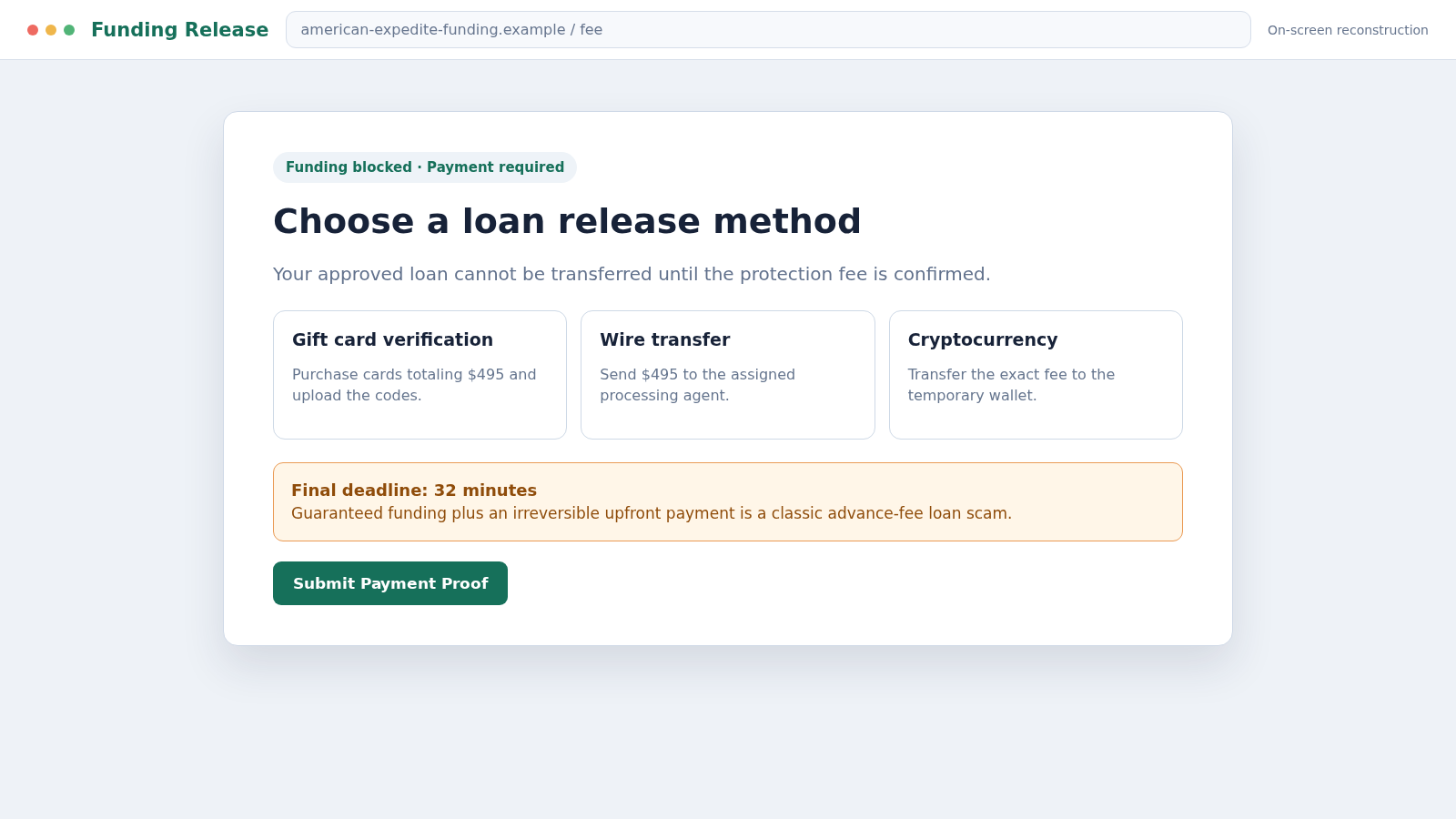
Payment is directed outside a normal loan closing. The supposed agent may request gift card numbers, cryptocurrency, a wire transfer, cash app payment, or a deposit into an individual’s account.
The fraud targets people who need money quickly and may have been declined elsewhere. Urgency makes it harder to investigate the lender or notice that the economics of the offer do not make sense.
A fake contract can be several pages long and include interest rates, repayment schedules, seals, and signatures. Documents produced by the sender prove only that the sender can create documents.
Even when no fee is paid, the application can create identity-theft risk. Complete financial profiles can be resold or used to open accounts and pursue other loan scams.
Warning Signs of the American Expedite Loan Scam
- You are approved before completing a meaningful application.
- The lender says bad credit cannot affect approval.
- A fee must be paid before funds are deposited.
- Payment is requested by gift card, crypto, wire, or personal account.
- The agent uses a free email address or messaging app.
- The website lacks verifiable state licensing information.
- A copied address belongs to an unrelated company or mailbox.
- The contract contains inconsistent names, amounts, or contact details.
- The caller pressures you to borrow the fee from someone else.
- Another payment is demanded immediately after the first.
No single business name should be treated as permanent. Advance-fee operators can rename the lender, copy a real company, rotate phone numbers, and move the same script to a new website.
A professional website and responsive agent do not prove lending capacity. The meaningful checks are registration, independent contact, transparent terms, and whether anyone demands money for guaranteed funding.
How the American Expedite Loan Scam Works
Step 1: The scammer finds people searching for credit
Fraudsters advertise on social media, place search ads, buy lead lists, send texts, or call people who recently completed online loan forms. A lead sold through several brokers can trigger many unrelated offers.
The approach may mention a requested amount or general credit concern. That detail can make the sender seem connected to a real application even when it is not.
Step 2: Easy approval removes the victim’s biggest worry
The agent says credit history is irrelevant, approval is guaranteed, and funds are reserved. The offer may be much better than anything available through regulated lenders.
This relief builds commitment. The victim starts planning how to use the money before verifying whether it exists.
Step 3: A fake application collects sensitive information
The form requests identity documents, employment records, income, address history, banking details, and Social Security number. It may display a padlock and claim that data is encrypted.
HTTPS does not prove that a lender is licensed or honest. It only protects the connection between the browser and whoever controls the site.
Step 4: A polished approval letter arrives
The victim receives a contract or certificate showing the principal, interest, and monthly payment. A signature from a fictional loan officer and a copied corporate address make it look complete.
The document may say the offer expires within hours. That deadline is designed to prevent calls to a regulator, bank, or trusted adviser.
Step 5: The first upfront fee is introduced
The agent explains that insurance, processing, tax, collateral, or transfer activation must be paid before funding. The amount is kept small relative to the promised loan.
A request for an irreversible payment method removes ordinary consumer protections. The supposed lender may even coach the victim on what to tell the bank or gift card cashier.
Step 6: A fake funding screen appears
After payment, an online portal may show the loan as pending, approved, or transferred. The balance is only text controlled by the scammer and does not represent money moving through a bank.
A fake transaction number or screenshot creates hope and gives the operation time to demand more money.
Step 7: New fees keep blocking the deposit
The criminal invents a tax mismatch, incorrect payment, anti-money-laundering hold, currency charge, or minimum balance. Each fee is described as the last requirement.
Victims who have already paid may continue because walking away makes the first loss feel final. The scammer deliberately exploits that sunk-cost pressure.
Step 8: The operation disappears or becomes a recovery scam
When the victim refuses another payment, the agent stops responding or threatens legal action. Websites, emails, and phone numbers can vanish quickly.
Later, another contact may promise to recover the lost fees for an additional charge. That person may be the same group using the information collected during the loan scam.
Company, Address, and Fulfillment Checks
Verify lending registration in your state
Search the official state banking or financial-services regulator, not a directory linked by the lender. Confirm the exact legal name, license number, and authority to lend where you live.
A registration for a different industry or state does not authorize consumer lending. Matching only part of a name is not enough.
Call the organization through an independent number
If the name resembles a real business, find that business through a trusted public record and ask whether it offers the loan. Do not use the number in the approval message.
Impersonators often copy a real company’s address and name while changing the website, email, and telephone number.
Inspect the address, domain, and loan documents together
Map the stated address, check whether it is a residence, mailbox, coworking location, or unrelated company, and compare it with the regulator’s record.
Look for inconsistent company names, generic email accounts, missing disclosures, and a recently created domain. One copied correct detail cannot repair several contradictions.
Confirm funding in the real bank account
A portal status, approval letter, or screenshot is not fulfillment. Loan proceeds exist only when the bank confirms cleared funds that the borrower can use.
Never send a fee because an on-screen balance says money is waiting. Contact the bank independently if a transfer is supposedly pending.
How a Legitimate Loan Process Normally Differs
A legitimate lender identifies the borrower, reviews creditworthiness, explains rates and fees, and provides required disclosures before making a firm offer. Approval is not guaranteed simply because someone answered a text.
The lender can be verified through state records and uses contact information tied to the same legal entity. Its website, privacy notice, and documents should consistently identify who is extending credit.
Normal loan costs are explained in the agreement and handled through traceable financial processes. A demand for gift cards or crypto is incompatible with ordinary consumer lending.
A real lender does not need an applicant’s online banking password or one-time code. Account and routing numbers can be used for legitimate deposits, but the request should occur only after the lender itself has been verified.
Take the agreement away from the sales conversation and compare the annual percentage rate, payment schedule, fees, default terms, and total cost. Pressure to prevent that review is a serious warning.
Ask how complaints are handled and which regulator oversees the lender. A legitimate representative should be able to provide a legal entity name and license information that matches an independent government record.
Read whether the contract authorizes automatic withdrawals and when they begin. Never give a stranger remote access to “connect” the bank account or let them watch you sign in during a video call.
Be cautious when one company claims to shop your application among many lenders. Lead-generation sites can share contact details widely, and a scammer may refer to a real application without representing the service that received it.
If the offer arrived after you posted publicly about debt or poor credit, assume the timing may be targeted. Financial hardship is not proof that a caller has special access to a legitimate loan program.
What to Do if You Have Fallen Victim to This Scam
- Stop all further payments. A new tax, insurance charge, or recovery fee will not unlock the promised loan.
- Contact the payment provider immediately. Ask a bank, card issuer, wire service, payment app, crypto exchange, or gift card company whether the transaction can be frozen or reversed.
- Tell your bank what information was exposed. Replace compromised accounts or cards and add verbal passwords or alerts where available.
- Freeze your credit. Contact Equifax, Experian, and TransUnion so new credit cannot easily be opened with the stolen identity.
- Report identity theft. Use IdentityTheft.gov to create a tailored recovery plan if a Social Security number or identification document was shared.
- Change exposed passwords. Secure email first, enable multifactor authentication, and update every account that reused the same password.
- Save the complete evidence. Preserve messages, advertisements, contracts, phone numbers, domains, payment receipts, wallet addresses, and names used by the agents.
- Report the lender. File a report at ReportFraud.ftc.gov and notify your state attorney general or financial regulator.
- Scan devices used for forms or downloads. If the portal installed a file or remote app, run a full Malwarebytes scan.
- Block malicious destinations. AdGuard can help block many phishing pages, deceptive advertisements, and tracking requests tied to scam funnels.
- Warn contacts if your accounts were used. Tell them not to trust loan messages, files, or payment requests sent from a compromised profile.
- Reject recovery offers. No unsolicited caller needs a fee or financial information to recover your loss. Work with payment providers and official agencies.
Frequently Asked Questions
Is American Expedite Loan a legitimate lender?
An offer using that name should not be trusted without independent licensing and identity checks. A guaranteed loan that requires an upfront release payment matches an advance-fee scam.
Can a legitimate lender charge an application fee?
Some legitimate costs can exist, but paying a fee must not guarantee funding. The FTC warns about lenders that promise approval and demand money before delivering the loan.
Why do scammers ask for gift cards or cryptocurrency?
Those payments can move quickly and are difficult to reverse. They also sit outside the normal, documented process a regulated consumer lender would use.
What if the loan appears in an online portal?
A portal controlled by the sender can display any balance. Only cleared funds confirmed through your real bank show that a loan was actually delivered.
Can the scammer use my documents if I did not pay?
Yes. Identity documents, banking data, and Social Security numbers can support account opening, impersonation, or future targeted scams. Take identity-theft precautions.
Can someone recover an advance fee for me?
Contact the payment provider and official authorities quickly. Do not pay an unsolicited recovery company, because victims are frequently targeted again with another advance-fee promise.
The Bottom Line
The American Expedite Loan scam offers financial relief first and places the dangerous condition afterward. A guaranteed approval becomes unavailable until the victim pays a fee that a real loan never needed.
Verify the legal lender before sharing documents, never pay for a promise of funding, and contact financial providers immediately if money or identity information has already been sent.

Join the discussion
0 commentsShare your experience or ask a question about this article.
Discussion
Start the conversation
Have a question or something useful to share? Add the first comment.