

Losing money to fraud leaves a person searching for any credible path back. Then an unexpected message arrives from someone claiming to represent a respected law firm, saying the funds have been found and a recovery file is ready.
That hopeful moment is the hook in the Ropes & Gray scam. Criminals misuse the identity of a genuine firm to approach people who may already have been victimized, then turn a promised recovery into another demand for money or personal information.
Overview
What the fake recovery message claims
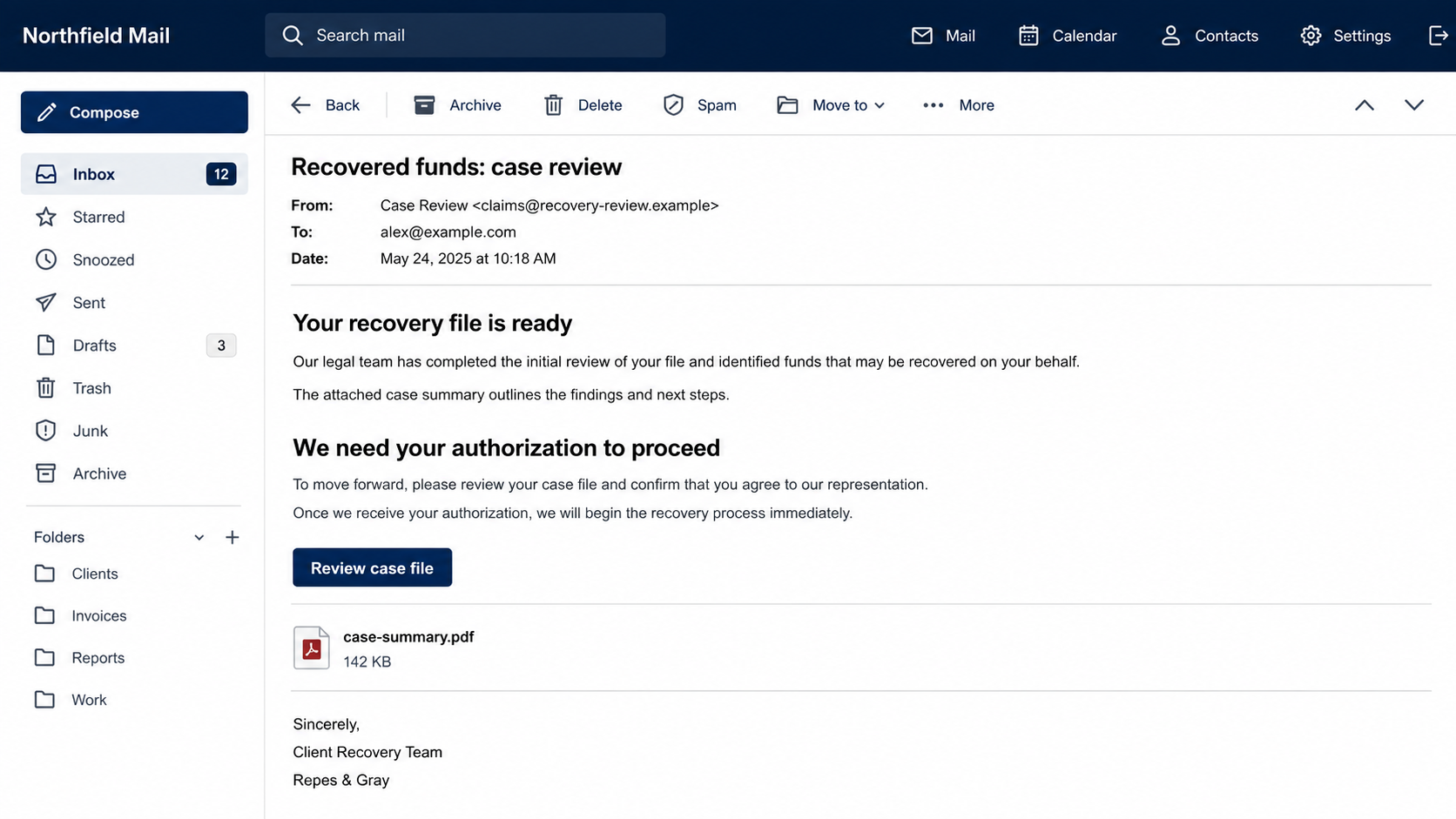
The sender says a legal team, regulator, liquidator, or investigation unit has identified money belonging to the recipient. The funds may supposedly come from a cryptocurrency fraud, investment platform, online trading scheme, or earlier payment scam.
The message may misuse the name Ropes & Gray, quote a case number, attach a professional-looking report, or link to a “client portal.” Some versions use names and profile details copied from genuine legal professionals.
What the scammers actually want
The recovery does not exist. The objective is usually an advance fee described as a processing charge, tax, insurance bond, court cost, release payment, or compliance deposit. Once one amount is paid, another obstacle appears.
The criminals may also request passports, driver’s licenses, bank statements, cryptocurrency wallet information, or online banking details. That data can support identity theft, account takeover, and more personalized fraud.
Why the Ropes & Gray name is used
Ropes & Gray is a real international law firm. The real organization is not connected to these fraudulent recovery approaches. The scammer uses an established name because victims are more likely to trust a legal-looking request than an unknown recovery business.
The Solicitors Regulation Authority has published warnings about communications that misuse the firm’s identity, including lookalike domains and false claims of a recovery service. An authentic name, registration detail, office address, or staff biography can be copied into a fraudulent message.
- You are contacted unexpectedly about money you did not know had been recovered.
- The sender guarantees a refund before verifying the case properly.
- The email domain resembles the firm’s name but is not its genuine domain.
- You must pay a fee before funds can be released.
- The representative discourages independent contact with the real firm.
- Payment is requested by cryptocurrency, wire transfer, gift card, or another hard-to-reverse method.
How the Ropes & Gray Scam Works
Step 1: The criminal obtains information about a previous loss
Recovery scams are most convincing when the sender knows that a person has already lost money. Details can come from stolen customer lists, compromised email accounts, public complaints, social media posts, or information shared with another fraudulent service.
Some victims are contacted only days after the first scam. Others hear from a supposed recovery team months later, when the surprise of the original loss has faded but the desire to get the money back remains.
The contact may include the name of the investment platform, an approximate loss, or a wallet address. Those facts make the approach feel like the result of an investigation, but criminals often share victim data among themselves.
Step 2: A prestigious legal identity creates authority
The sender claims to be a solicitor, case manager, compliance officer, or asset-recovery specialist. A copied logo, office address, staff photograph, and professional title are added to the signature.
Scammers sometimes quote a real regulator registration number. A valid number proves that the genuine organization exists; it does not prove that the person who emailed you works there.
The contact may use a lookalike domain with words such as international, legal, recovery, claims, or center. A single convincing web page can make the invented department appear established.
Step 3: The sender announces an implausibly successful recovery
The victim is told that investigators froze a wallet, a court approved restitution, or a trading platform released funds. The exact amount may match the previous loss or include a surprising profit.
There is rarely a verifiable case history. Instead, the message provides a reference number that works only on the scammer’s portal or with the same representative who made the claim.
A legitimate legal matter involves clear engagement terms, identifiable parties, verifiable filings where applicable, and time to obtain independent advice. A surprise guarantee of recovered money deserves immediate skepticism.
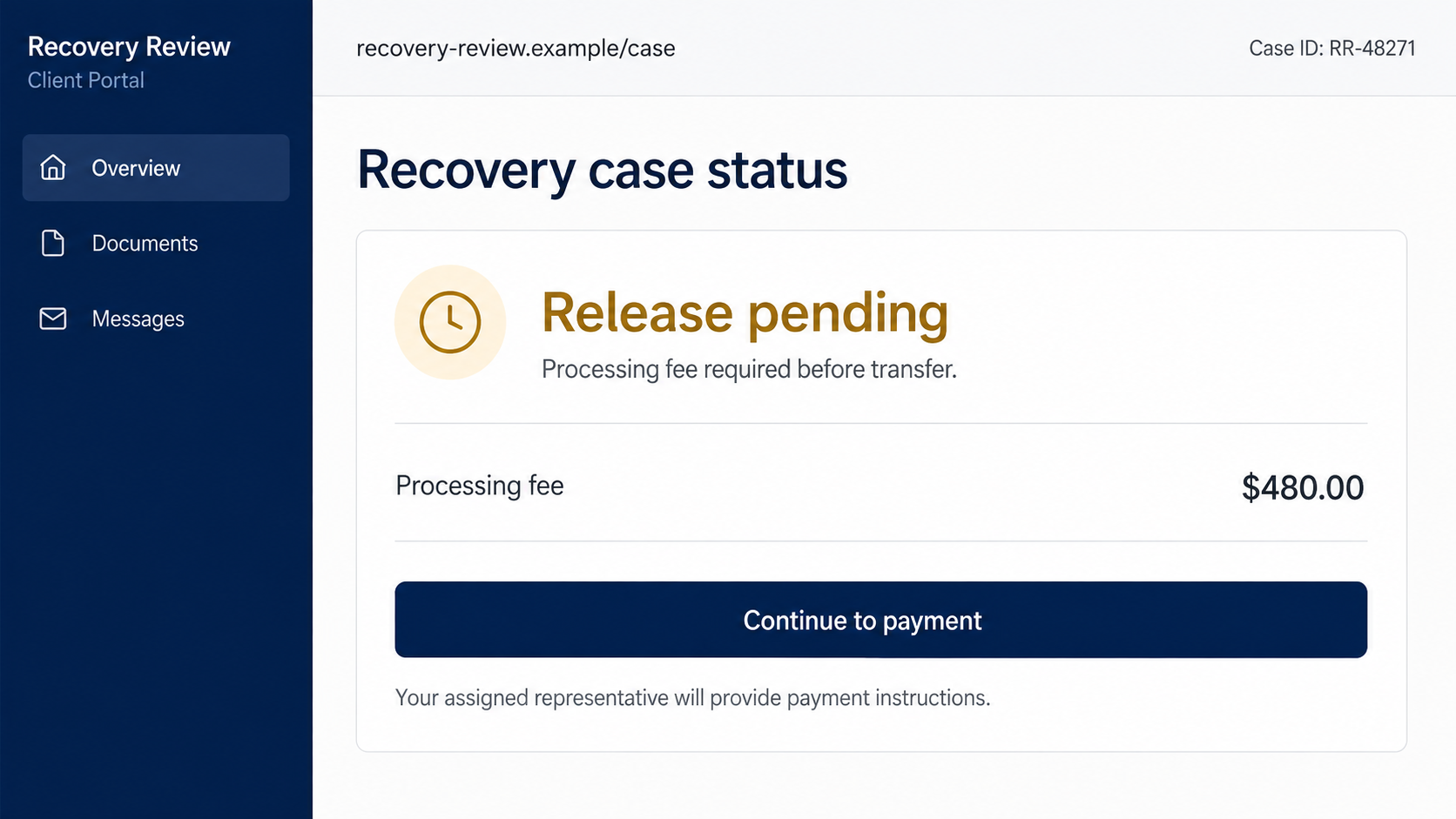
Step 4: A client portal makes the story feel tangible
The link opens a dashboard showing a case ID, documents, messages, and a “release pending” status. Seeing a balance or progress tracker can make the recovery feel real even though every number was placed there by the scammer.
The portal may request identity documents under the banner of know-your-customer compliance. It can also display a countdown, pending review, or approval stamp to suggest that a formal process is already underway.
Documents do not become authentic because they are delivered as PDFs. Letterheads, signatures, seals, barcodes, and regulator references can all be copied or fabricated.
Step 5: A fee appears just before the promised payout
The representative says the recovered money cannot be transferred until a processing fee, tax, bond, conversion charge, or legal cost is paid. The amount is often small compared with the supposed recovery.
The fee may be described as refundable or temporarily held. This framing encourages the victim to view it as the final practical step rather than another investment in an unverified claim.
The FTC’s guidance on refund and recovery scams identifies upfront payment for promised recovery as a major warning sign. Government agencies do not charge victims to obtain a refund, and a cold caller cannot guarantee that lost funds will be returned.
Step 6: Each payment creates another requirement
After the first fee, the transfer is allegedly blocked by a tax certificate, anti-money-laundering review, bank insurance requirement, or currency conversion. The criminal may even send a fake receipt showing the funds almost cleared.
This process continues as long as the victim pays. The scammer may reduce a fee, offer an installment plan, or claim to have personally covered part of the cost to build a sense of obligation.
Refusing can trigger threats that the claim will expire or that the victim could be investigated for abandoning funds. These statements are pressure tactics, not evidence of legal authority.
Step 7: Personal documents fuel additional fraud
Identity records submitted for “verification” can be combined with information from the original scam. Criminals may use them to open accounts, impersonate the victim, or make future approaches more convincing.
If remote-access software was installed for help with a transfer, the attacker may view bank accounts, saved passwords, files, and incoming security codes. They can also manipulate what appears on screen.
When the victim stops paying, the supposed lawyer may disappear. Another recovery group can then make contact, claiming it is investigating the first recovery service. That can begin the cycle again.
Search advertisements can create another entry point. A person looking for help may encounter a sponsored recovery result that leads to the same impersonation network. Prominent placement is advertising, not proof that a legal service has reviewed the loss or can retrieve the money.
Company, Address, and Fulfillment Checks
Verify the organization through an independent register
Search the relevant professional regulator’s official register and compare the organization name, reference number, website, and phone number. The Solicitors Regulation Authority’s record for the genuine firm can be checked independently.
Do not use a register link supplied by the sender. A fake page can imitate a regulator or show a copied entry without giving you an independent connection to the real organization.
Compare the exact email and website domains
The genuine firm’s public website uses ropesgray.com. The SRA has specifically warned about lookalike addresses used in fraudulent recovery communications and stated that the real firm is not connected to them.
Check every character after the @ symbol and the registered domain in each link. Added words, different endings, hyphens, and subdomains can create a resemblance without any ownership connection.
Contact the real firm using details you find yourself
Call a verified number from the firm’s official website and ask whether the person, department, and reference number are genuine. Do not let the unexpected caller transfer you to another extension as the only form of verification.
A scammer may warn that direct contact will violate confidentiality or delay the claim. A legitimate professional should understand why an unsolicited recipient wants to verify identity before sharing documents or money.
Demand an independently verifiable case and fee explanation
Ask who appointed the firm, what jurisdiction applies, what written engagement exists, how the funds were traced, and where any proceeding can be verified. Vague references to international regulators or blockchain investigations are not enough.
Never pay because a dashboard displays a balance. Seek independent legal advice before signing documents or transferring money, especially when the fee must be sent to an individual, crypto wallet, or company unrelated to the claimed firm.
Warning Signs of a Fake Fund-Recovery Approach
- Unsolicited good news: A stranger says funds were located without any prior engagement.
- Guaranteed results: The representative promises recovery before examining verifiable records.
- Copied credentials: Real staff names and regulator numbers appear beside an unrelated email domain.
- Advance fees: Money must be sent before the alleged settlement can be released.
- Unusual payment methods: The fee goes to cryptocurrency, a personal account, a money-transfer app, or gift cards.
- Secrecy and pressure: You are told not to contact the bank, regulator, police, or real firm.
- Remote access: The agent wants to control your computer while you sign in or transfer funds.
One warning sign is enough to pause. Several together strongly suggest that the recovery process was invented around information the criminals already had.
What to Do if You Have Fallen Victim to This Scam
- Stop all payments and contact. Do not pay a final tax or release fee, even if the sender says the earlier payments will otherwise be lost. Save messages, documents, domains, wallet addresses, and receipts.
- Contact the bank or payment provider immediately. Explain that the transaction was induced by impersonation and a recovery scam. Ask whether a transfer can be recalled, a card replaced, or the receiving account flagged.
- Report the impersonation to the genuine firm. Use contact details from its official website. This allows the organization to confirm the fraud and may help it warn other targets.
- Notify the appropriate regulator and law enforcement. Report solicitor impersonation to the relevant legal regulator. In the US, file with the FTC and local law enforcement; in the UK, use Report Fraud or the current national reporting service.
- Protect exposed identity documents. Contact credit bureaus or identity-protection services available in your country, place fraud alerts where appropriate, and monitor for new accounts opened in your name.
- Secure email and financial accounts. Change reused passwords, enable multifactor authentication, remove unfamiliar sessions, and inspect mailbox forwarding rules.
- Remove remote-access software. Disconnect the device from the internet if someone still has control. Uninstall the tool, run a full scan with a trusted product such as Malwarebytes, and seek hands-on technical help if necessary.
- Block malicious follow-up pages. A service such as AdGuard may reduce known scam redirects, but it cannot recover a transfer or make a compromised account safe.
- Expect another recovery pitch. Victim details are valuable. Treat anyone who promises guaranteed recovery for an upfront fee as a new risk, even if they know accurate facts about the loss.
Frequently Asked Questions
Is Ropes & Gray a real law firm?
Yes. Ropes & Gray is a genuine international law firm. The scam involves criminals misusing its name and copied details. The real firm is not responsible for fraudulent recovery messages sent by impostors.
Why would a scammer know how much I lost?
Fraud groups can share or sell victim lists. Information may also come from compromised accounts, public complaints, fake recovery forms, or data provided during the original scam.
Can a lawyer charge a fee for legitimate work?
Lawyers can charge for genuine services, but that does not validate an unexpected recovery claim. Verify the professional independently, understand the written engagement, and obtain separate advice before paying.
Does a regulator number prove the email is genuine?
No. Registration details are public and can be copied. Compare the sender’s exact domain and phone number with the regulator’s record, then contact the organization through independently sourced details.
Can cryptocurrency stolen in a scam be recovered?
Sometimes investigators or exchanges can freeze assets, but recovery is difficult and never guaranteed by a cold caller. Be highly skeptical of anyone asking for cryptocurrency to release cryptocurrency.
What if the recovery portal shows my real transaction?
A transaction hash and wallet balance are often public. Displaying them does not prove the sender controls recovered funds or represents a law firm. Verify the case outside the portal.
The Bottom Line
The Ropes & Gray scam uses a real firm’s reputation to sell an imaginary second chance. It is particularly cruel because it targets the hope and urgency left behind by an earlier financial loss.
Do not pay an upfront release fee or trust copied credentials. Verify the firm, professional, domain, case, and payment instructions through independent channels. If the recovery exists only inside an unexpected message and its matching portal, step away before the loss grows.

Join the discussion
0 commentsShare your experience or ask a question about this article.
Discussion
Start the conversation
Have a question or something useful to share? Add the first comment.