

A UK job offer can carry years of planning behind it. When a recruiter says the employer has selected you and only a Certificate of Sponsorship payment stands between you and the role, the request can feel like the last step in a long journey.
That is the pressure point used in the UK Certificate of Sponsorship scam. The paperwork looks official, the vacancy sounds realistic, and the deadline feels urgent. Before any genuine employment begins, however, the applicant is paying for a process that may not exist.
Overview
What the Certificate of Sponsorship scam promises
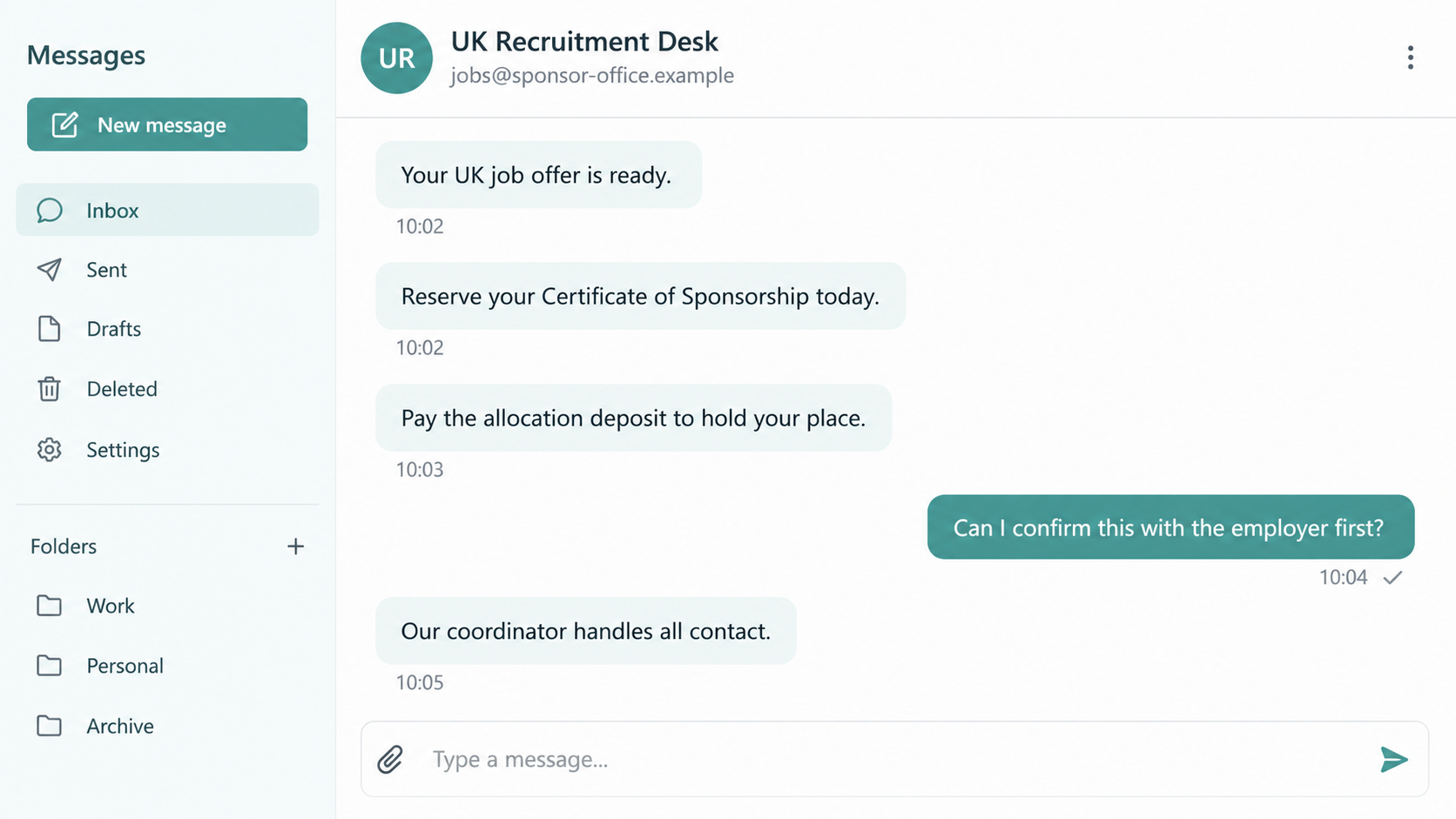
The applicant is offered a UK job with visa sponsorship, often without a normal interview. A recruiter then says a Certificate of Sponsorship, commonly shortened to CoS, has been approved, reserved, or allocated in the applicant’s name.
To secure it, the applicant must pay a deposit, administrative fee, sponsor charge, legal fee, visa reservation, or compliance cost. The scammer may promise reimbursement after arrival or deduction from future wages.
How the real sponsorship process differs
According to GOV.UK, a Certificate of Sponsorship is an electronic record assigned by a licensed sponsor. It is not a paper certificate that an independent recruiter can sell from a private stock of “allocations.”
The certificate has a reference number used for a visa application and contains information about the job and applicant. A real CoS does not guarantee that a visa will be granted, and a job offer does not remove the need to meet immigration requirements.
What the criminals want
The immediate goal is money. Criminals can collect repeated payments for a CoS, sponsor license, immigration skills charge, health surcharge, background check, travel reservation, or accommodation.
They also gather passports, national identity cards, addresses, bank statements, qualifications, and employment histories. Those documents can be reused for identity fraud or sold to other criminals.
- The job is offered with little or no meaningful interview.
- The recruiter guarantees sponsorship or visa approval.
- You are asked to buy or reserve a CoS.
- The employer cannot be found on the current register of licensed sponsors.
- Messages come from free email accounts or unrelated domains.
- Payment must go to a person, agent, cryptocurrency wallet, or money-transfer service.
- The recruiter refuses direct contact with the supposed employer.
How the UK Certificate of Sponsorship Scam Works
Step 1: A convincing vacancy reaches the applicant
The approach may start on a job board, social network, messaging app, recruitment group, or unsolicited email. Health care, hospitality, construction, warehouse, driving, and technology roles are common because they attract international applicants.
The advertisement can copy a real employer’s name, logo, address, and job description. Some scammers create an entire recruitment website and post several vacancies so the organization looks established.
The salary may be generous but not absurd. Benefits such as accommodation, flights, family visas, or rapid promotion are added to make the opportunity difficult to walk away from.
Step 2: The interview process is shortened or staged
The applicant may answer a few written questions or attend a brief text-only interview. The recruiter says the employer is hiring urgently and that the candidate’s CV already meets every requirement.
A more elaborate operation can arrange a video call, use a person posing as a hiring manager, or send a professional contract. These steps are still not proof that the named employer authorized the recruitment.
Pressure often increases once the offer is accepted. The applicant is told that many candidates are waiting and the sponsor allocation will be given to someone else unless payment arrives quickly.
Step 3: A fake offer letter and sponsorship document arrive
The paperwork may include a copied company number, sponsor license reference, official-looking crest, barcode, signature, and Home Office language. Details taken from a real business can make the document hard to challenge at first glance.
Some letters call the document a “CoS certificate,” “work permit,” or “sponsorship approval letter.” A real Certificate of Sponsorship is an electronic record assigned by the sponsor, not a decorative paper sold directly to the worker.
The applicant may receive a reference number that works only on a fake tracking page. A search box returning the name and a green “approved” status simply repeats data entered by the criminals.
Step 4: The applicant is told to reserve the CoS
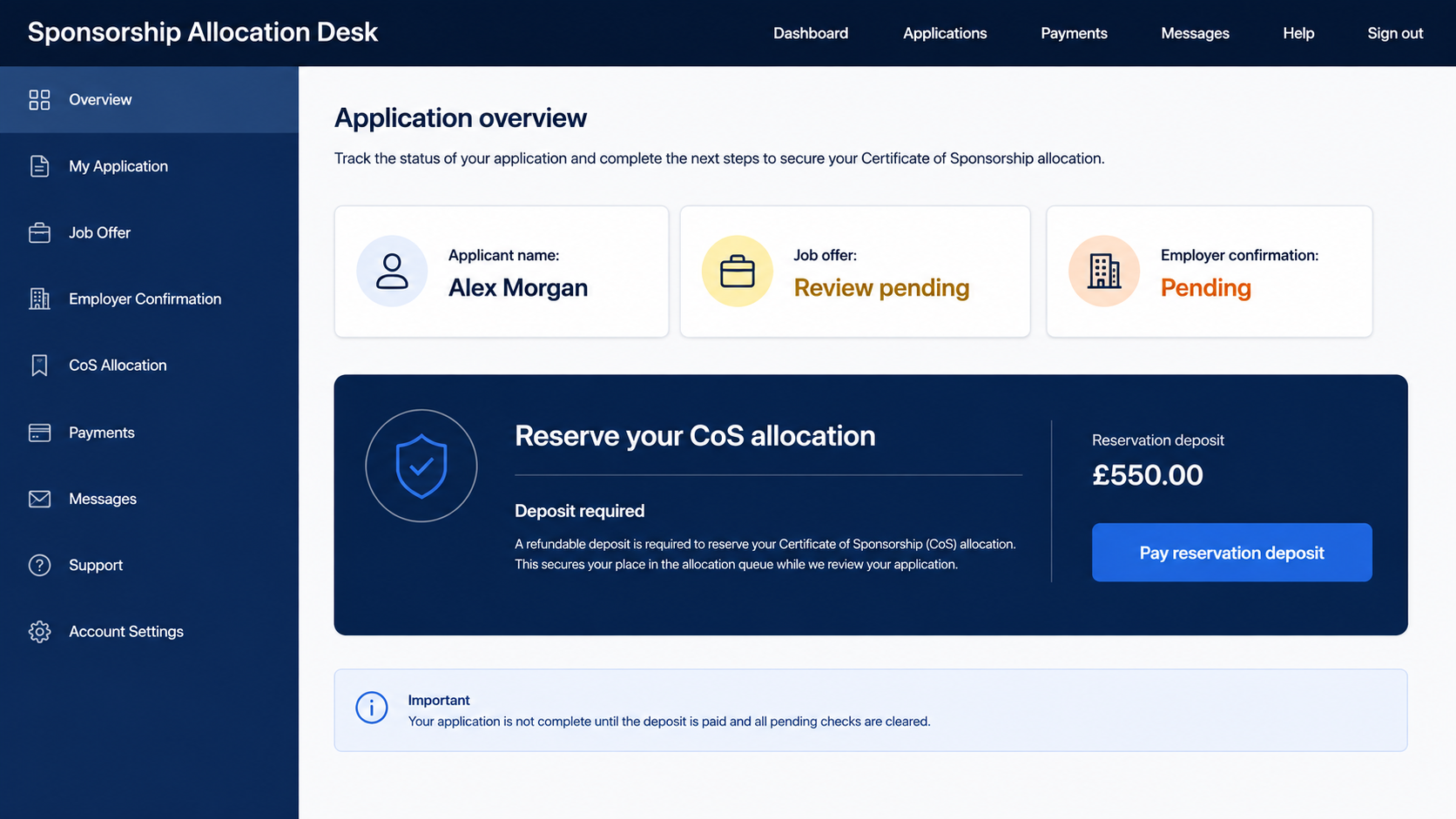
The scammer explains that the employer has a limited number of sponsorship places. A refundable deposit, perhaps £550 or more, is supposedly needed to hold one while checks are completed.
Other labels include allocation fee, sponsor fee, immigration skills charge, compliance deposit, document legalization, or solicitor retainer. The wording is designed to sound connected to real immigration administration.
GOV.UK guidance is clear that employers must pay certain sponsorship fees themselves. For applicable routes, asking the sponsored worker to pay the Certificate of Sponsorship fee can put the sponsor’s license at risk.
Applicants should not treat a recruiter’s payment demand as normal simply because an official fee exists somewhere in the process.
Step 5: Payment is directed away from the claimed employer
The money may be sent to a personal bank account, overseas agent, payment app, crypto wallet, or company with no clear relationship to the employer. The recruiter might say this is the authorized immigration desk.
Bank details can change without warning because the previous receiving account was frozen or reached a limit. That behavior is a serious warning sign, especially when the recruiter insists the transaction description should not mention a visa or job.
A genuine employer should be able to explain any lawful applicant cost in writing and through verifiable HR contacts. Secrecy around the beneficiary is inconsistent with a transparent recruitment process.
Step 6: New charges appear after each payment
Once the deposit is paid, the application allegedly reaches a new stage. The victim may be billed for a visa appointment, biometric priority slot, travel insurance, tuberculosis test, criminal-record check, courier service, or accommodation reservation.
Receipts and dashboards show progress to keep hope alive. If the applicant hesitates, the scammer warns that the job, deposit, and sponsor slot will be lost together.
The final promised document may never arrive. In other cases, the victim receives a forged visa or flight itinerary and discovers the fraud only when checking with the employer, airline, or border authorities.
Step 7: Stolen documents create longer-term risk
Recruitment naturally involves personal information, so victims may submit far more than they would to a random stranger. Passport scans, signatures, bank statements, proof of address, and family details can support identity theft.
Scammers may also ask the applicant to open a bank or cryptocurrency account for salary payments. The account can be used to move criminal funds, exposing the victim to additional financial and legal problems.
After the scheme ends, another agent may offer to recover the money or transfer the applicant to a different employer for a fee. That follow-up should be treated as a new, unverified approach.
Company, Address, and Fulfillment Checks
Check the sponsor on the current GOV.UK register
Search the official register of licensed sponsors and match the organization name, location, and worker route. The register changes, so use the current file published on GOV.UK rather than a screenshot supplied by the recruiter.
Being listed is only the first check. A scammer can impersonate a genuine sponsor. You must still confirm that the real employer issued the job offer and authorized the person contacting you.
This independent confirmation should happen before you share further documents, arrange travel, or make any payment.
Contact the employer through independently found details
Use the company’s official website, switchboard, and careers page. Ask HR whether the vacancy, recruiter, interview, offer letter, and sponsorship plan are genuine.
Do not let the recruiter act as the only bridge to the employer. Claims that direct contact is forbidden, confidential, or likely to cancel the application are designed to prevent verification.
Confirm that the immigration route is actually open
Rules can change. GOV.UK states that from July 22, 2025, the route for new overseas applications as care workers and senior care workers closed, while limited in-country transition arrangements continue until 2028.
A recruiter offering a brand-new overseas care worker application in 2026 may be using an outdated story. Check the current visa route, occupation code, salary threshold, employer eligibility, and application location on GOV.UK.
Separate lawful applicant costs from invented sponsor fees
Visa applicants may have legitimate government costs, but those should be paid through official GOV.UK processes at the correct stage. A private “CoS reservation” page is not a government payment channel.
Official health and social care recruitment guidance says applicants should not be charged recruitment fees and that the employer pays costs such as its sponsor license, Certificate of Sponsorship, and applicable immigration skills charge. Get independent advice if a contract tries to shift those costs to you.
Extra Warning Signs in Overseas Recruitment
- No real selection process: The job is awarded from a CV or a few chat messages.
- Guaranteed immigration result: The agent promises a visa regardless of your history or eligibility.
- Inconsistent contact details: The email, website, bank beneficiary, and named employer do not align.
- Fabricated urgency: A sponsorship slot must be reserved today with a deposit.
- Restricted communication: You cannot speak with HR or verify the recruiter independently.
- Requests for secrecy: The payment reference must avoid words such as job, visa, or sponsorship.
- Too many bundled promises: A single agent guarantees the job, visa, flights, housing, and family arrangements.
In July 2026, the UK government publicized the shutdown of a bogus recruitment company after victims reportedly lost more than £19,000. The case is a useful reminder that company registration and polished documents do not replace sponsor and employer verification.
What to Do if You Have Fallen Victim to This Scam
- Stop paying the recruiter. Do not send a final visa, tax, or release fee. Save chat histories, emails, offer letters, account details, receipts, phone numbers, and website addresses.
- Contact your bank or payment service immediately. Explain that the transfer was made because of a fraudulent job and visa representation. Ask about a recall, recipient-account report, or card replacement.
- Verify the supposed employer. Contact HR through details found independently and ask whether your documents reached the organization. This can confirm the impersonation and alert the business.
- Report the recruitment fraud. Use the UK’s current national fraud-reporting service and notify local police where appropriate. Report suspicious immigration communications through official GOV.UK channels.
- Protect your passport and identity. Tell the issuing authority if a passport copy may be misused, monitor financial records, and follow identity-theft guidance for your country.
- Secure your accounts. Change passwords used with the fake portal, starting with email. Turn on multifactor authentication and remove unfamiliar sessions or recovery contacts.
- Scan devices used with the portal. If you downloaded a file or installed an app, run a full scan with a trusted product such as Malwarebytes. Remove unknown extensions and remote-access software.
- Limit malicious follow-up links. A blocker such as AdGuard can reduce exposure to known fraudulent domains, though it cannot reverse payments or protect documents already submitted.
- Be ready for a second approach. Do not pay an agent who promises a replacement sponsor, priority visa, or guaranteed recovery. Verify every new contact from the beginning.
Frequently Asked Questions
Is a Certificate of Sponsorship a paper certificate?
No. GOV.UK describes it as an electronic record assigned by a licensed sponsor. The applicant receives a reference number for the visa application, not a decorative certificate sold by an agent.
Can a recruiter guarantee a UK work visa?
No recruiter can guarantee the government’s decision. A real job and CoS support an application, but the applicant must still meet the route’s requirements and receive approval.
Should a worker pay for a Certificate of Sponsorship?
The sponsor is responsible for the CoS fee, and official guidance restricts passing certain sponsorship costs to workers. Treat a demand to buy or reserve a CoS as a major warning sign.
Does appearing on the sponsor register prove the offer is real?
No. Criminals impersonate listed sponsors. Verify the vacancy and recruiter directly with the real organization using contact details you find independently.
Are overseas care worker sponsorship offers still valid?
New overseas applications for care worker and senior care worker roles closed on July 22, 2025. Limited in-country transition rules remain. Check current GOV.UK guidance before accepting any offer.
Can I recover money paid to a fake recruiter?
Recovery depends on the payment method and speed of reporting. Contact the bank or provider immediately and report the receiving account. Do not pay a recovery service that guarantees success for an upfront fee.
The Bottom Line
The UK Certificate of Sponsorship scam turns a real immigration term into a product that criminals pretend to sell. A professional contract, sponsor number, portal, or electronic signature can all be copied while the job itself remains fictional.
Verify the sponsor on GOV.UK, confirm the vacancy with the employer, check that the visa route is current, and question every fee. If a recruiter insists that money must be sent quickly to reserve a sponsorship allocation, pause the process before ambition is converted into loss.

Join the discussion
0 commentsShare your experience or ask a question about this article.
Discussion
Start the conversation
Have a question or something useful to share? Add the first comment.