

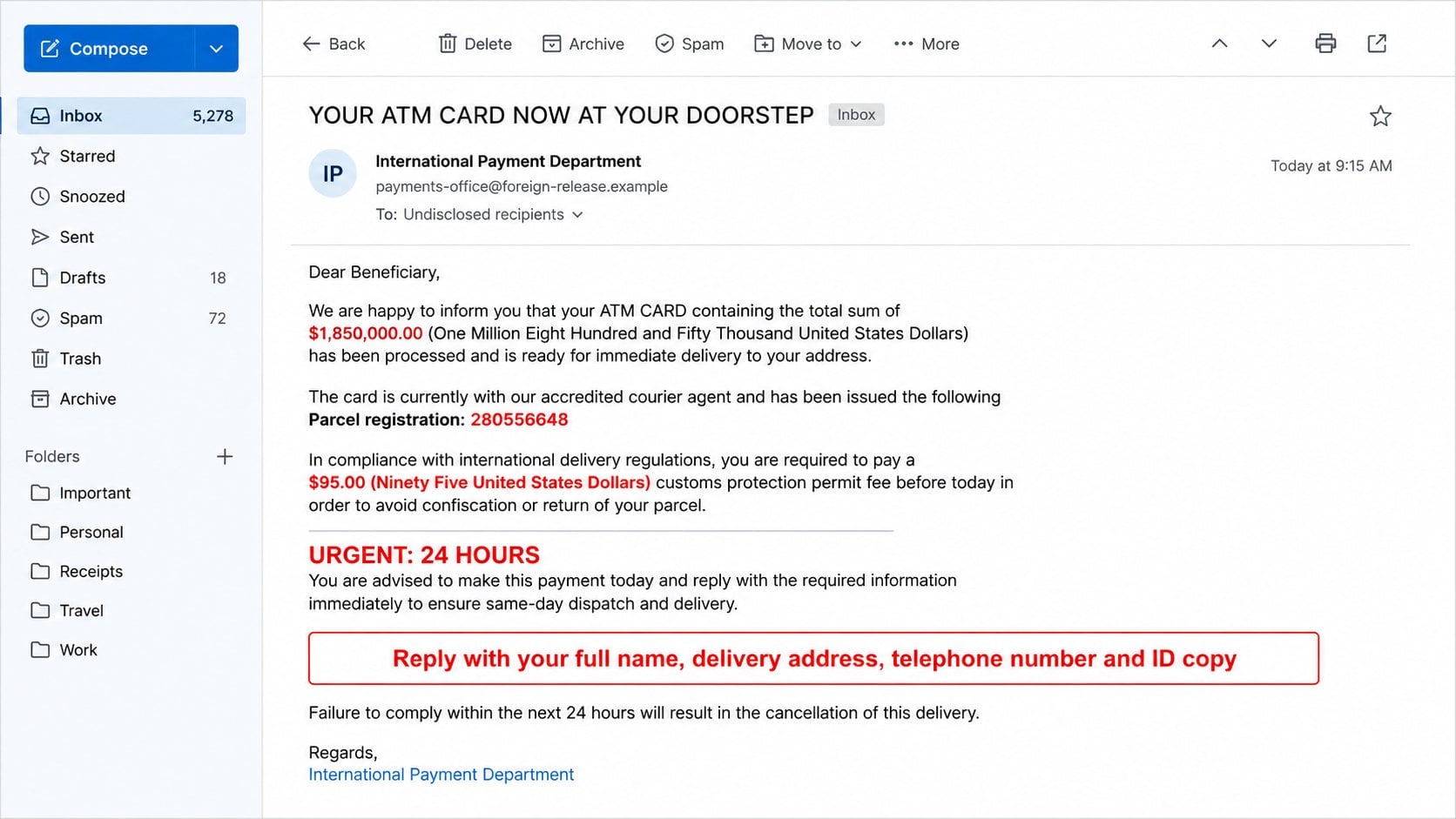
An email announcing that an ATM card loaded with $1.85M is ready for delivery is not a financial windfall. It is the opening promise in an advance-fee scam, carefully designed to make a small release charge feel insignificant beside an imaginary fortune.
The first request may be only $95, but paying it does not bring the card closer. It tells the criminals they have found someone willing to engage, and the next fee is already waiting.
Overview
What the ATM Card Ready message promises
The email claims a bank, government office, international organization, or delivery company is holding an ATM or debit card in the recipient’s name. The card supposedly contains compensation, inheritance, lottery proceeds, contract funds, or money recovered from an earlier scam.
A frequently reported version promises $1.85M and asks for a $95 permit or delivery fee. Other campaigns change the amount, official name, country, courier, and initial charge while keeping the same underlying story.
- A prepaid ATM card carrying a life-changing balance
- A government or bank officer assigned to release it
- A small permit, insurance, tax, or courier payment
- A deadline before the card is cancelled or returned
- A request for identity and delivery information
What the scammers are trying to obtain
The immediate objective is an advance fee. The criminals may request wire transfer, gift cards, cryptocurrency, mobile money, cash-transfer services, or payment to an individual. These methods are chosen because they are fast and hard to reverse.
The message also collects a full name, address, phone number, age, occupation, copy of an identity document, and sometimes bank details. That information can be used for identity fraud or to make later scam messages more convincing.
Why the scheme can continue for weeks
The promised fund is deliberately much larger than the fee. Once a victim pays $95, another official appears with a plausible obstacle: customs, anti-money-laundering clearance, insurance, card activation, currency conversion, or a final delivery stamp.
Each payment creates pressure to continue because walking away would mean admitting the earlier money is gone. The scammers exploit that sunk-cost feeling and repeatedly promise that the newest charge really is the last one.
How the ATM Card Ready Scam Works
Step 1: An authority figure announces unexpected funds
The email introduces a bank director, diplomatic courier, secretary of state, United Nations representative, compensation committee, or financial investigator. Names and job titles may belong to real people, but the sender has no connection to them.
The story says previous attempts to transfer the money failed, so officials converted it into an ATM card. This explanation is meant to answer why a stranger is suddenly contacting the recipient and why an unusual payment method is supposedly necessary.
Step 2: A huge balance makes a small fee feel reasonable
The email places $1.85M, $5M, or another enormous amount beside a modest initial charge. The contrast is the key persuasion device. A $95 payment appears trivial when the recipient is encouraged to imagine receiving millions.
Legitimate institutions do not choose random recipients for secret compensation cards, and an unknown official cannot lawfully load millions onto a card for a stranger based only on an email reply.
Step 3: The recipient is asked for personal information
To arrange delivery, the scammer requests the victim’s name, residential address, phone number, occupation, age, marital status, and identification. The questions imitate a basic customer-verification form.
Some messages already contain one correct detail, which may come from public data or a breach. That detail is used to make the recipient fill in everything else.
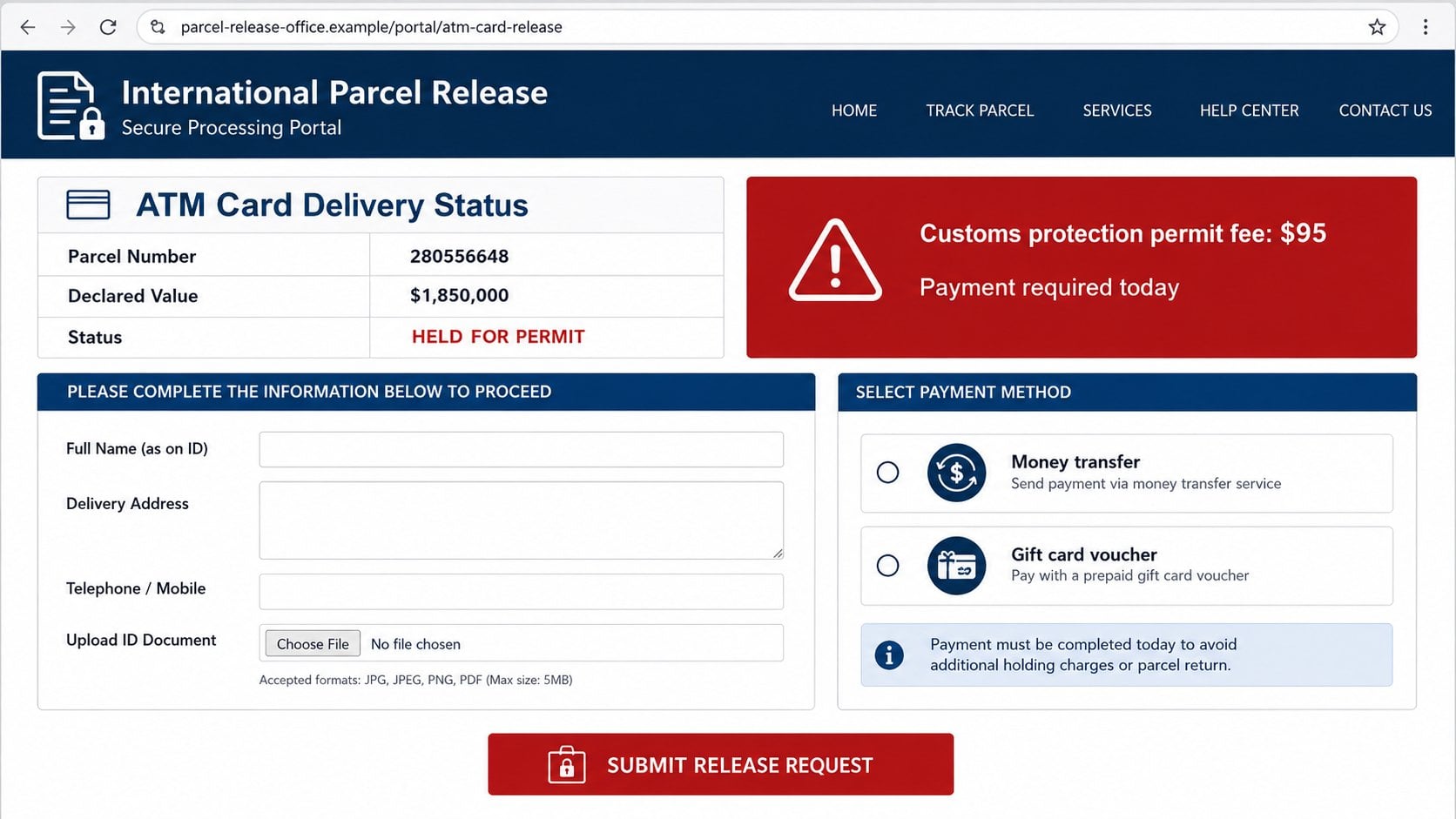
Step 4: A fake payment portal or agent collects the fee
The recipient receives payment instructions or a link to a supposed card-release portal. The page may display a case number, card status, balance, courier logo, and a list of completed verification steps.
The “pending” item is always the fee. Payment goes to an individual, a crypto wallet, a money-transfer account, or a card form controlled by the criminals. A receipt generated by the page does not represent a real government or banking transaction.
Step 5: New officials invent additional charges
After the first payment, the victim hears from a courier, customs agent, lawyer, bank compliance officer, or tax department. Each character may use a different email address but refer to the same case number and personal details.
The new demands can include $250 for insurance, $480 for activation, $1,200 for an anti-terror certificate, or a fee tied to the fictional balance. Documents, seals, signatures, and photographs are easy to fabricate.
Step 6: The promised ATM card never provides the money
No legitimate card loaded with the promised balance arrives. A package may contain a worthless plastic card, a card that cannot be activated, or paperwork created to keep the victim engaged.
When payments stop, the scammers threaten cancellation, arrest, tax penalties, or forfeiture. They may later return as recovery agents who claim they found the stolen fees and need one more payment to release them.
The Story Behind the $1.85M ATM Card Claim
The exact narrative has circulated for years because it can borrow almost any institution’s name. In one documented version, the sender falsely claimed to represent the U.S. Secretary of State and said an ATM card containing $1.85M would be delivered after a $95 fee.
The FTC warned consumers about that message and made clear that the Secretary of State was not emailing people with prepaid cards. Changing the official’s name or the amount does not make a newer version legitimate.
Similar emails may invoke the FBI, World Bank, International Monetary Fund, a central bank, or a deceased businessperson. Real logos and public officials are used as props. The recipient should verify the claim with the organization through independently located contact details, not the address in the email.
Warning Signs of an ATM Card Advance-Fee Scam
- You did not apply for, win, inherit, or earn the funds.
- A stranger says millions have been placed on an ATM card.
- A fee is required before the money can be released.
- The sender uses a free email address or an unrelated domain.
- Payment must go to an individual, crypto wallet, or transfer service.
- The message requests identity documents through ordinary email.
- The recipient is told to keep the arrangement confidential.
- Different agents introduce new fees after every payment.
- Threats begin when the victim asks for independent verification.
Professional formatting does not cancel these warning signs. Criminals can copy a government seal, write a plausible title, and create a tracking portal. The financial proposition itself must make sense.
Company, Address, and Fulfillment Checks
Verify the named institution independently
Find the organization through its official government or corporate website. Do not call a number printed in the email or in an attached letter. Ask whether the named office, program, and employee exist and whether the organization distributes funds in the described way.
A real official’s name can be impersonated. Confirmation must establish that the specific message and case are genuine, not merely that the person exists.
Examine the sender and physical address
Government offices and banks do not conduct high-value disbursements from free mailboxes. Compare the sender domain, reply-to address, signature, and website link with official records.
Look up every office and courier address independently. Scam letters often combine a real building, an unrelated institution, and a phone number controlled by the criminals.
Question the card and delivery process
Ask which regulated bank issued the card, what account backs it, why the recipient is entitled to the funds, and what legal documents created that entitlement. A vague compensation story cannot answer these questions.
Courier tracking should work on the carrier’s official site and describe a real parcel. A tracking page hosted on the same unfamiliar domain as the payment portal proves nothing.
Trace every requested payment
The payee should match the verified institution and transaction purpose. A request to pay a private individual, money mule, gift-card code, or crypto address is incompatible with the claimed official process.
Do not accept the explanation that an official account is unavailable or that secrecy requires a personal payee. These excuses are designed to bypass payment controls and eliminate recovery options.
Why Paying the First Fee Makes the Situation Worse
The first payment is both money and information. It tells the criminals which method the victim can use, how quickly they respond, and how strongly they believe the story. The victim may be placed on a list shared or sold among fraud groups.
After payment, the messages become more personalized. The next scammer may know the victim’s address, transfer amount, case number, and supposed card balance. This knowledge comes from the fraud operation, not an official database.
Victims should stop as soon as they recognize the pattern. Paying one more fee to recover the earlier payments increases the total loss and provides no path to the promised funds.
The criminals may encourage secrecy by saying that public discussion would violate banking rules or cancel the award. That instruction isolates the victim from friends, relatives, bank employees, and advisers who would recognize the story. A genuine financial entitlement can withstand independent legal and financial review.
If you are unsure, show the complete message to someone you trust before replying. Do not send them only the official-looking letter; include the sender address, payment instructions, and follow-up messages, because those details reveal how the operation actually behaves.
What to Do if You Have Fallen Victim to This Scam
- Stop every payment. Do not send the next tax, permit, insurance, activation, storage, or delivery fee. Tell trusted family members about the scam so the criminals cannot pressure you in isolation.
- Contact the payment provider immediately. Ask whether a transfer can be recalled, a card payment disputed, or a recipient account frozen. Gift-card issuers and cryptocurrency services may also accept urgent fraud reports, though recovery is not guaranteed.
- Notify your bank. Explain what personal and financial details were shared. Ask the fraud team whether accounts, cards, login credentials, or transaction limits need to be changed.
- Protect your identity. If an identity document, date of birth, address, or tax number was sent, contact the issuing authority and follow local identity-theft procedures. Monitor credit files and consider a fraud alert or freeze where available.
- Secure email and messaging accounts. Change reused passwords, end unknown sessions, remove forwarding rules, and enable two-factor authentication. Scammers may try to intercept recovery messages or impersonate you.
- Scan the device. If you opened an attachment, installed a courier app, or allowed remote access, disconnect from financial services and run a full Malwarebytes scan. Remove remote-control tools the scammer told you to install.
- Block related malicious pages. AdGuard can reduce exposure to known phishing, advertising, and tracking domains. Continue treating new case portals and payment pages as untrusted because scam domains change rapidly.
- Preserve all evidence. Keep full emails and headers, payment receipts, recipient names, bank details, wallet addresses, phone numbers, documents, tracking pages, and chat history. Write a timeline while events are fresh.
- Report the fraud. Notify the impersonated institution, email provider, payment service, and national fraud or law-enforcement authority. The FTC’s advance-fee guidance explains the broader pattern of paying first for money that never arrives.
- Ignore recovery agents who contact you. Scammers may promise to retrieve the ATM card or refund the fees. A demand for an upfront payment, recovery certificate, or private wallet transfer is another advance-fee scam.
Do not be embarrassed to report the loss. These operations use practiced scripts and emotional pressure. Quick reporting may help providers flag the receiving account and may protect other potential victims.
Frequently Asked Questions
Can a bank send millions on a prepaid ATM card?
Not through an unsolicited secret arrangement with a stranger. Large legitimate payments require documented entitlement, regulated account processes, identity checks, and traceable communication.
Why does the email ask for only $95?
A modest first fee lowers resistance and identifies responsive victims. Once it is paid, the scammers create additional charges that can grow into thousands.
What if the sender knows my name and address?
Personal details can come from public records, marketing lists, breaches, or earlier scams. Their presence does not prove that a card, fund, case, or official relationship exists.
Is a photograph of the ATM card proof?
No. Cards, envelopes, seals, and documents can be photographed, edited, or generated. Proof would require independent confirmation from the regulated issuer through an official channel.
Will paying the final delivery fee release the funds?
No legitimate funds have been established. The term “final fee” is used repeatedly. A new obstacle normally appears after each payment.
Can an online recovery company retrieve my payments?
Be extremely cautious. No company can guarantee recovery, and unsolicited agents demanding advance fees are often connected to the original fraud. Work with the payment provider and recognized authorities.
The Bottom Line
The ATM Card Ready scam turns an impossible financial promise into a series of increasingly expensive fees. A claimed $1.85M balance, official title, case number, or polished card-release portal does not create real funds.
Never pay to unlock an unexpected ATM card or send identity documents to an unsolicited sender. If you already engaged, stop paying, contact the payment provider and bank, protect your identity, preserve the complete record, and report the operation. The promised card is the bait; every fee is the real transaction.

Join the discussion
0 commentsShare your experience or ask a question about this article.
Discussion
Start the conversation
Have a question or something useful to share? Add the first comment.