

The pitch is wonderfully simple: plug a small box into the wall, leave it there, and watch the electric bill fall. No rewiring, no new appliances, and no change in how the household uses energy.
StopWatt advertising wraps that promise in technical language about stabilization and wasted electricity. The important question is whether the device can actually change the residential energy use recorded by the meter.
Overview
What StopWatt ads promise
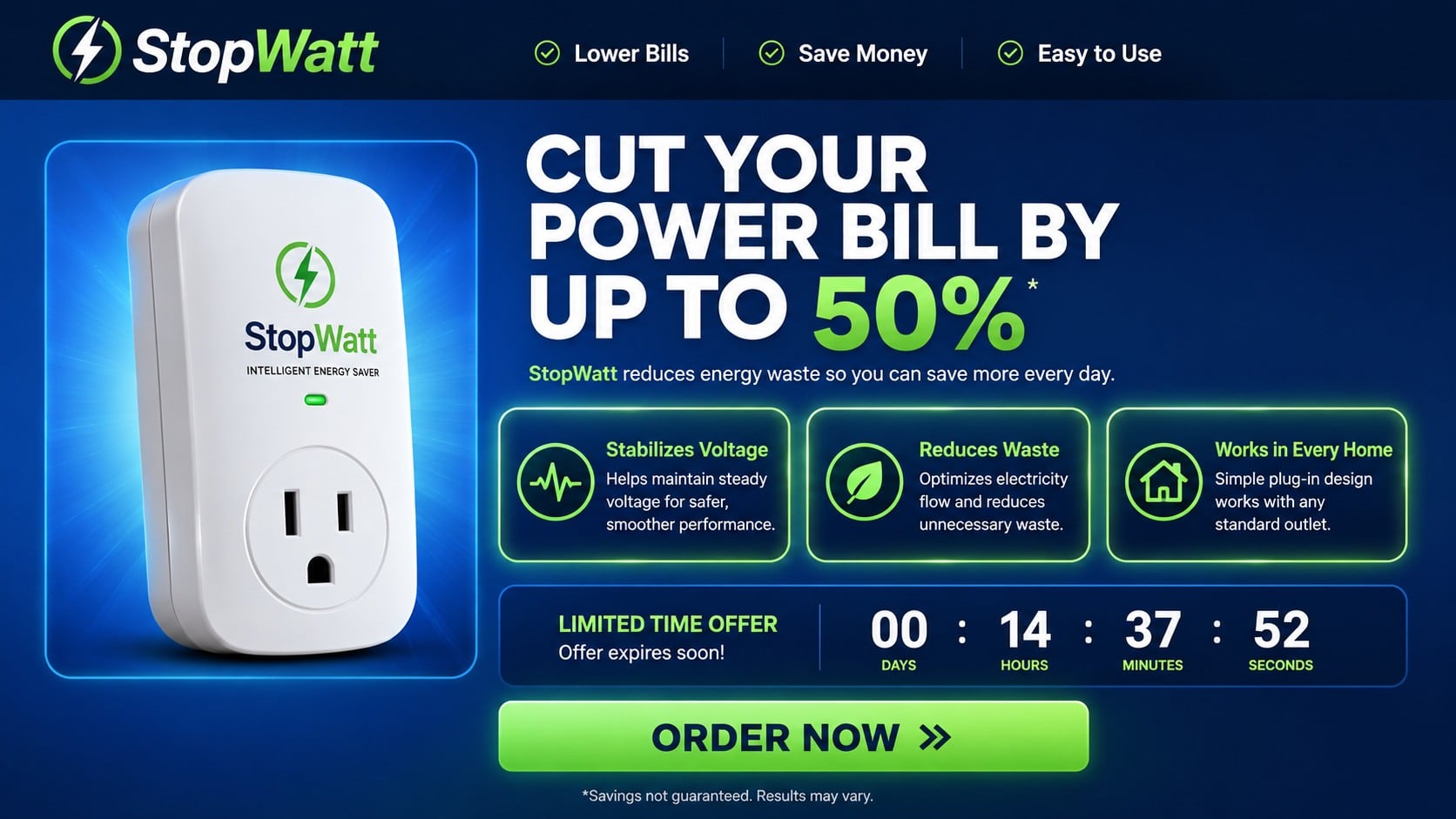
StopWatt is marketed as a plug-in energy-saving device that supposedly stabilizes voltage, reduces electrical waste, protects appliances, and produces a dramatic reduction in household power bills.
Versions of the offer may use different domains, prices, bundles, testimonials, and technical explanations. The central claim stays consistent: a small device plugged into one outlet is presented as a whole-home solution.
- Large savings without changing energy consumption
- Immediate installation with no electrician required
- Claims about voltage stabilization or power-factor correction
- Countdown timers and discounted multi-unit packages
- Testimonials that are difficult to verify independently
- A money-back promise that may be harder to use than the sales page suggests
Why the claimed savings deserve skepticism
Residential customers are generally billed for the electrical energy their homes consume, measured in kilowatt-hours. A device cannot make a heater, refrigerator, dryer, or air conditioner perform the same work with dramatically less billed energy merely by glowing in another outlet.
Electrical conditions are more complicated in commercial and industrial systems, where power-factor charges and large motor loads can matter. That does not validate a universal consumer claim or show that a tiny retail plug-in box will reduce an ordinary home’s bill.
What buyers are really evaluating
The issue is not whether the product lights up or contains electrical components. A powered box can do something internally while still failing to produce the advertised household savings.
Buyers need independent testing that measures energy use before and after installation under controlled conditions. Marketing diagrams, customer quotes, and a lower bill during a mild-weather month are not substitutes for that evidence.
The Electrical Claim in Plain Language
Your meter records energy consumed over time
A household appliance draws power while it operates. The utility meter accumulates that use over hours and days, producing the kilowatt-hour total on the bill.
Meaningful savings come from reducing operating time, improving efficiency, lowering heating or cooling demand, eliminating standby use, or generating energy. A passive device must demonstrate how it changes one of those measurable factors.
Voltage stabilization is not free energy
Sales pages may suggest that “dirty electricity,” spikes, or unstable voltage forces the home to buy excess power. Surge protection and voltage regulation are real engineering concepts, but they do not automatically create large energy savings.
A protective device should identify applicable ratings, standards, operating limits, and tested performance. Broad claims that one box protects every appliance and cuts the whole bill avoid those specifics.
Power-factor language can be used out of context
Some devices appear to contain a capacitor and claim to correct power factor. Capacitors can have legitimate uses in electrical systems, particularly where engineers size equipment for specific inductive loads.
That fact does not mean a generic capacitor plugged anywhere in a house will reduce the kilowatt-hours billed to a typical residential customer. The load, circuit, metering method, and device design all matter.
How the StopWatt Scam Works
Step 1: A dramatic savings claim catches attention
An ad promises that the device can cut a power bill by 30%, 40%, or even 50%. It may blame utilities, inefficient wiring, or hidden waste that supposedly affects every home.
The message is especially persuasive during periods of high electricity prices. It offers control without the cost of insulation, appliance replacement, thermostat changes, or professional energy work.
The FTC has warned marketers that energy-saving claims need scientific support and has told consumers to be skeptical of dramatic savings promises.
Step 2: Technical vocabulary makes the promise sound measured
The page uses terms such as voltage stabilization, power factor, harmonic filtering, surge absorption, reactive energy, or line conditioning. Each phrase may refer to a real concept, but the explanation often skips the measurement connecting that concept to the buyer’s bill.
A diagram may show chaotic electricity becoming smooth after passing the device. In reality, a box plugged into a branch-circuit outlet is not necessarily positioned to control every load in the building.
Ask for a complete test report from an independent laboratory, the exact model tested, the measurement method, and results for homes billed like yours. A general certificate or safety mark does not prove a claimed energy-saving figure.
Step 3: Testimonials replace reproducible evidence
Customer stories may claim a bill fell from $300 to $150 within weeks. Without usage data, weather normalization, rate changes, household occupancy, and appliance operating time, the comparison cannot isolate the device’s effect.
Photos and names can be stock material or copied from another campaign. Some pages present advertorials as independent reviews even though the review directs every reader to the same checkout.
Search exact testimonial sentences and reviewer images. Also look for disclosures showing that the page earns a commission from purchases.
Step 4: The countdown converts curiosity into a bundle order
The visitor is told the discount expires soon or the remaining stock is low. Package selectors may recommend three or five devices based on home size, raising the total before any result has been demonstrated.
Per-unit pricing can make a large package look inexpensive. The meaningful number is the complete amount charged after shipping, processing, warranties, and add-ons.
A repeated countdown is a useful test. If the timer restarts after revisiting the page, it is a pressure device rather than a genuine deadline.
Step 5: Checkout adds costs and captures personal data
The buyer submits contact, address, and card information, then may encounter preselected processing, shipping protection, or additional-unit offers. The receipt’s merchant name may not match StopWatt.
Review every line before submitting. A checkbox can add $14.95 or another fee while the headline continues emphasizing only the unit price.
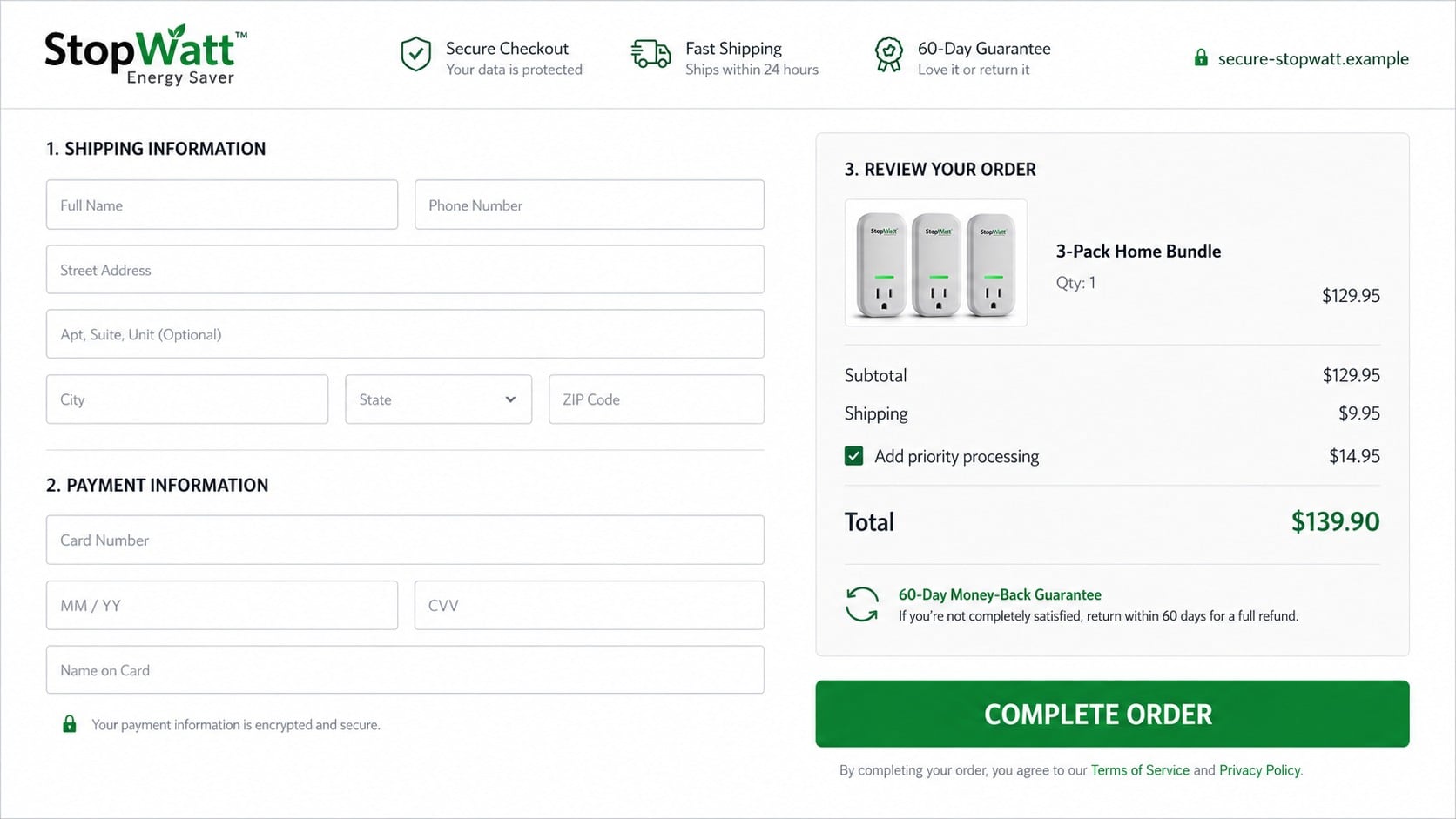
Keep the final checkout page and confirmation. If the total or package differs from what you selected, that record can be important in a dispute.
Step 6: Ordinary bill changes are credited to the device
Electricity use naturally moves with weather, billing-cycle length, rates, travel, and appliance use. A lower bill after installation can happen even when the device had no meaningful effect.
A proper comparison uses kilowatt-hours, not only the amount due. It also considers temperature, days in the billing period, major loads, and changes in household behavior.
The seller benefits from the delay because buyers may wait through several bills before deciding the claim did not hold up. That can consume much of the return period.
Step 7: The refund promise becomes a paperwork problem
Customers may be required to obtain authorization, pay return shipping, use unopened packaging, or send products to a different location. Support can offer partial refunds instead of honoring the prominent guarantee.
Document every request and deadline. A money-back badge on the landing page matters less than the precise policy, return address, and support performance after purchase.
Complaints about a product do not prove that every order has the same outcome. They do show why buyers should verify terms before relying on a guarantee as protection.
Company, Address, and Fulfillment Checks
The product name may not identify the merchant
StopWatt can appear as a product or campaign name while the legal seller uses another name in terms, receipts, or card statements. Those names should be recorded before purchase.
A mismatch is not automatically fraud, but an unexplained network of brands and processors makes accountability harder. The seller should clearly state which entity accepts payment and owes the refund.
The address may serve returns rather than operations
A warehouse, mailbox, or third-party fulfillment depot does not establish where the product was designed, tested, or manufactured. It only shows one point in the shipping chain.
Check whether the policy identifies a return address before ordering and whether authorization is required. Do not assume the address printed on the parcel accepts returns.
Support quality matters when the claim disappoints
Test the published phone and email with a technical question: Which independent laboratory measured the savings, and where is the complete report? A scripted response about customer satisfaction does not supply evidence.
After purchase, keep communication in writing. Phone promises are difficult to prove if the refund does not arrive.
The device needs a traceable technical record
Look for a model number, manufacturer, electrical ratings, applicable safety certification, patent claims that can be verified, and independent performance data. A marketing name alone is not a technical specification.
ENERGY STAR’s real home-management guidance focuses on certified equipment, controls, smart thermostats, lighting, and measured plug loads. A universal plug-in saver should not be assumed equivalent to a tested energy-management system.
How to Test an Energy-Saving Claim Without Guessing
- Read kilowatt-hours, not only the total charge. Rates and fees can change while energy use stays similar.
- Compare similar periods. Match billing-cycle length, temperature, occupancy, and major appliance use.
- Use a plug-in meter for individual loads. Measure an appliance with and without a device only when doing so is electrically appropriate.
- Ask the utility about billing. Confirm whether residential power factor affects your tariff before paying for correction.
- Demand model-specific evidence. Independent results should test the same device under relevant conditions.
- Do not open mains-powered equipment. Internal inspection can expose hazardous voltage and may damage the device. Leave electrical testing to qualified professionals.
Real savings measures are less magical but easier to verify. Weather sealing, insulation, efficient heating and cooling, thermostat control, LED lighting, appliance maintenance, and eliminating unnecessary operating time affect identifiable loads.
What to Do if You Have Fallen Victim to This Scam
- Stop adding more units. Do not buy another package because support says the home is too large or the first device needs companions. Ask for evidence before accepting any new explanation.
- Record the original promise. Save screenshots of the savings claim, package selection, countdown, checkout, guarantee, terms, confirmation, and card descriptor. Note the date the device arrived and when it was installed.
- Request cancellation and refund in writing. Quote the order number, amount, guarantee, and reason. Ask for the correct return address and authorization, then retain delivery proof for any return.
- Contact the card issuer if the seller does not resolve it. Explain any unauthorized add-on, duplicate charge, missing order, materially misleading claim, or unfulfilled refund. Ask about the dispute deadline and required documents.
- Unplug a device that is hot, damaged, or behaving abnormally. Do not keep using equipment with discoloration, odor, noise, loose fit, or signs of overheating. Consult a qualified electrician when there is a safety concern.
- Secure information entered on a suspicious site. Change reused passwords, monitor statements, and replace a card if the issuer recommends it. Be alert for follow-up energy, warranty, delivery, and refund messages.
- Scan unexpected downloads. If the order flow installed software or opened an unusual attachment, use Malwarebytes to check for malware and unwanted browser components. The physical product alone does not imply a computer infection.
- Block repeat advertising routes. AdGuard can reduce exposure to malicious ads, tracking, and known deceptive destinations. Continue checking claims independently because new sales domains may not yet be classified.
- Report evidence, not assumptions. Submit the ad, domain, merchant name, charges, and communications to the FTC, your state attorney general, advertising platform, and payment provider. Specific records are more useful than a general complaint.
- Avoid paid recovery promises. Do not send another fee to someone claiming they can guarantee a refund or expose the seller. Use your financial institution and official consumer-protection channels.
Frequently Asked Questions
Can StopWatt really reduce a residential bill by 50%?
A dramatic savings claim requires strong, independent, model-specific evidence under conditions matching the customer’s home and tariff. Technical-sounding marketing and testimonials do not establish that result.
Does a glowing light prove the device is working?
It proves the light receives power. It does not prove that the device changes whole-home kilowatt-hour consumption or creates the savings claimed in an advertisement.
What about power-factor correction?
Power-factor correction is real in appropriately designed electrical systems. Its value depends on the loads and billing method. A generic plug-in device should not be assumed to lower a typical residential bill without relevant measurements.
Can StopWatt protect appliances from surges?
Do not infer surge protection from words such as stabilization. Look for specific ratings, applicable certifications, installation instructions, and tested protective performance for the exact model.
How soon should I request a refund?
As soon as you decide the product or order does not match the representation. Written notice, return tracking, and early contact with the card issuer help preserve available options.
What energy-saving steps have clearer evidence?
Reduce identifiable loads through insulation, weather sealing, efficient equipment, thermostat settings, LED lighting, maintenance, and switching off unused devices. Utility or ENERGY STAR guidance can help prioritize changes.
The Bottom Line
The StopWatt scam concern is not resolved by a glowing box or impressive electrical vocabulary. The seller must prove that the exact device produces the advertised savings on the kind of residential meter and loads the customer actually has.
Until that evidence exists, a promise that one plug-in gadget can slash a whole-home bill should be treated with strong skepticism. Measure the claim, preserve the checkout terms, and rely on energy improvements whose effects can be independently verified.








