

Selling a valuable watch should end with money in your account, not another message asking you to be patient. Yet a friendly dealer, an impressive inventory, and a convincing sales update can make it surprisingly difficult to recognize when a consignment deal has gone wrong.
If someone has your Rolex and keeps moving the payment date, the paperwork matters more than the promises. Here is what to look at before handing over another watch or accepting another excuse.
Overview
What is a Rolex consignment scam?
In legitimate consignment, an owner gives a dealer permission to sell a watch under agreed terms. The dealer takes a commission and pays the owner the balance. A consignment scam abuses that arrangement: the watch, its sale proceeds, or both are diverted without the owner’s authorization.
This is different from buying a counterfeit Rolex or paying a fake outlet website. Your watch may be genuine, the dealer may have a real business, and a buyer may actually receive it. The missing part is the payment owed to you.
A documented case behind the warning
In January 2025, the U.S. Justice Department announced that Anthony Farrer, the former owner of The Timepiece Gentleman, received a 70-month prison sentence. He had pleaded guilty to wire fraud and mail fraud in a scheme involving luxury watches and at least $5.6 million in customer losses.
The Justice Department’s sentencing announcement documents a completed criminal case, not a new allegation against every watch dealer. Rolex was not the operator of that business. Other luxury watch brands can be caught in the same kind of dishonest arrangement.
Which warning signs deserve attention?
- The dealer cannot identify where your specific watch is being held.
- A sale is supposedly complete, but no agreed settlement arrives.
- Payment explanations change whenever you ask for supporting records.
- You are offered another customer’s watch instead of your money.
- The dealer wants additional inventory while earlier sales remain unpaid.
One late transfer does not establish fraud. The concern grows when a missed deadline comes with contradictory records, unauthorized transactions, or refusal to return property. Keep those distinctions in mind when describing the problem to a bank, attorney, or investigator.
How the Rolex Consignment Scam Works
Step 1: The dealer makes the handover feel routine
A seller usually wants a reasonable price without handling strangers, shipping disputes, and authentication questions. A specialist offers to take care of those details. That convenience can be genuine, which is why the initial offer does not necessarily sound suspicious.
The risk appears when the dealer’s personality becomes a substitute for verifiable terms. Social media followers, expensive surroundings, and pictures of inventory tell you little about how client property is recorded or whether sale proceeds remain available for their owners.
Before the watch changes hands, the agreement should identify the exact item, acceptable sale terms, commission, custody arrangements, and payment deadline. A conversation about what the dealer “normally does” leaves too much room for disagreement once the watch is out of your possession.
Step 2: Early results encourage a larger commitment
A successful first transaction can lower a seller’s guard. If one watch sold smoothly, sending several more may feel like a sensible shortcut. In fraudulent arrangements, that trust can allow the amount at risk to grow much faster than the seller intended.
Treat each handover as a fresh decision. A previous payment proves that a previous payment occurred; it does not prove that the next watch is protected. Avoid letting an unpaid balance accumulate simply because a dealer has been reliable before.
For a collection, keep a separate record for every serial number. A single spreadsheet total can hide the difference between a watch still available for sale, one sold awaiting settlement, and one the dealer cannot account for.
Step 3: Custody and permission begin to blur
A dishonest intermediary may treat a consigned watch as though it were business inventory owned outright. It could be sold below the agreed minimum, exchanged without permission, or used to satisfy another obligation. Those are different actions, and your written authorization matters.
Ask specifically whether the dealer can lend, pledge, transfer, or subcontract the watch. Do not assume that the word consignment automatically settles every issue. If the answer is unclear, request revised terms before surrendering the item.
Authentication documents also need context. A certificate might support a watch’s identity or condition, but it does not demonstrate the dealer’s right to dispose of it. Ownership, authenticity, insurance, and authority to sell are separate checks.
Step 4: A sale update replaces an actual settlement
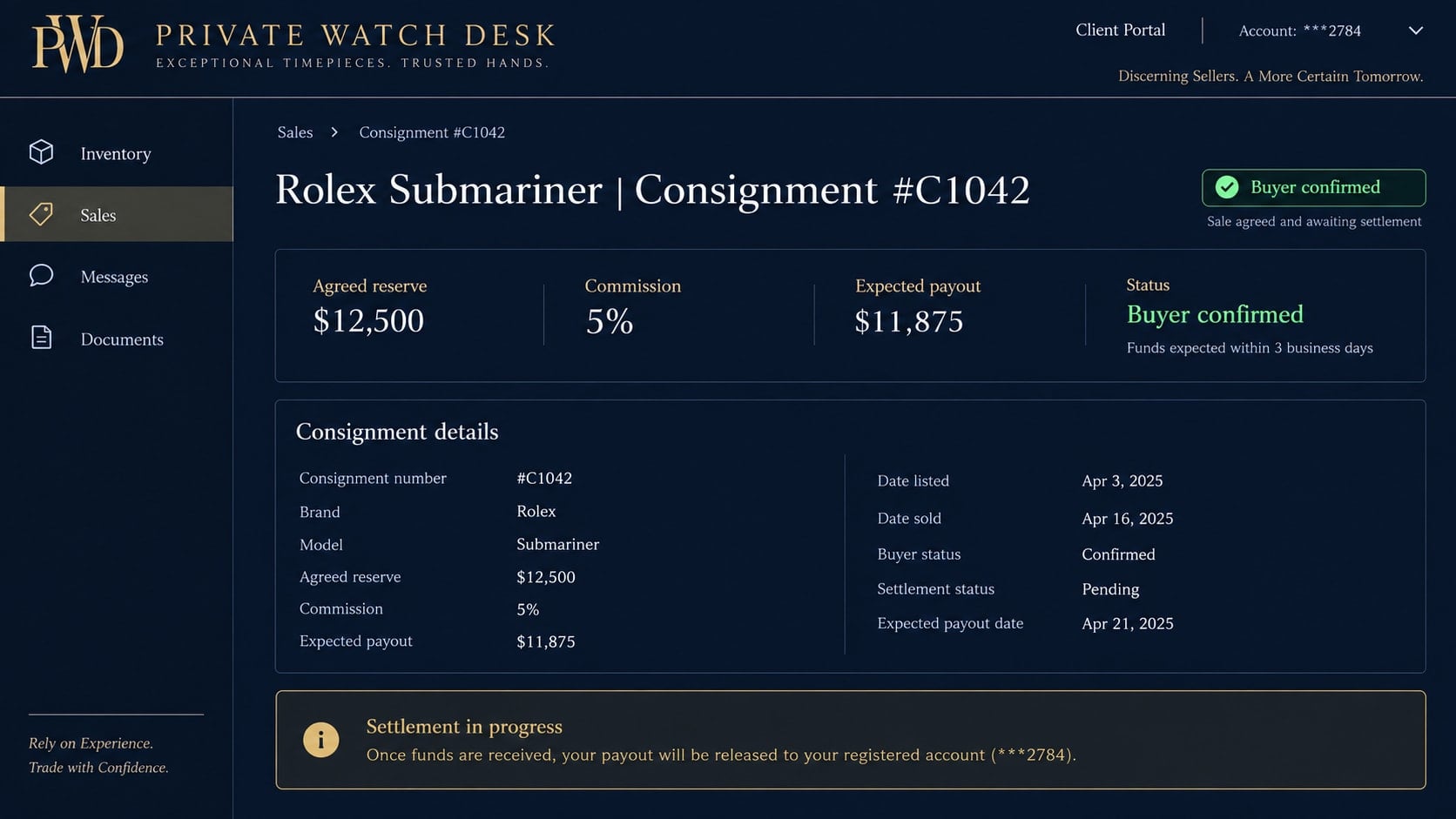
The seller hears that a buyer has been found. There may be an invoice screenshot, a portal marked sold, or an email saying the transfer is being processed. None of those items equals cleared funds in the seller’s own account.
The reconstructed screens in this article illustrate the difference between a status update and a completed payout. They are not screenshots from The Timepiece Gentleman, and the sample watch listing and payment messages are not evidence from that case.
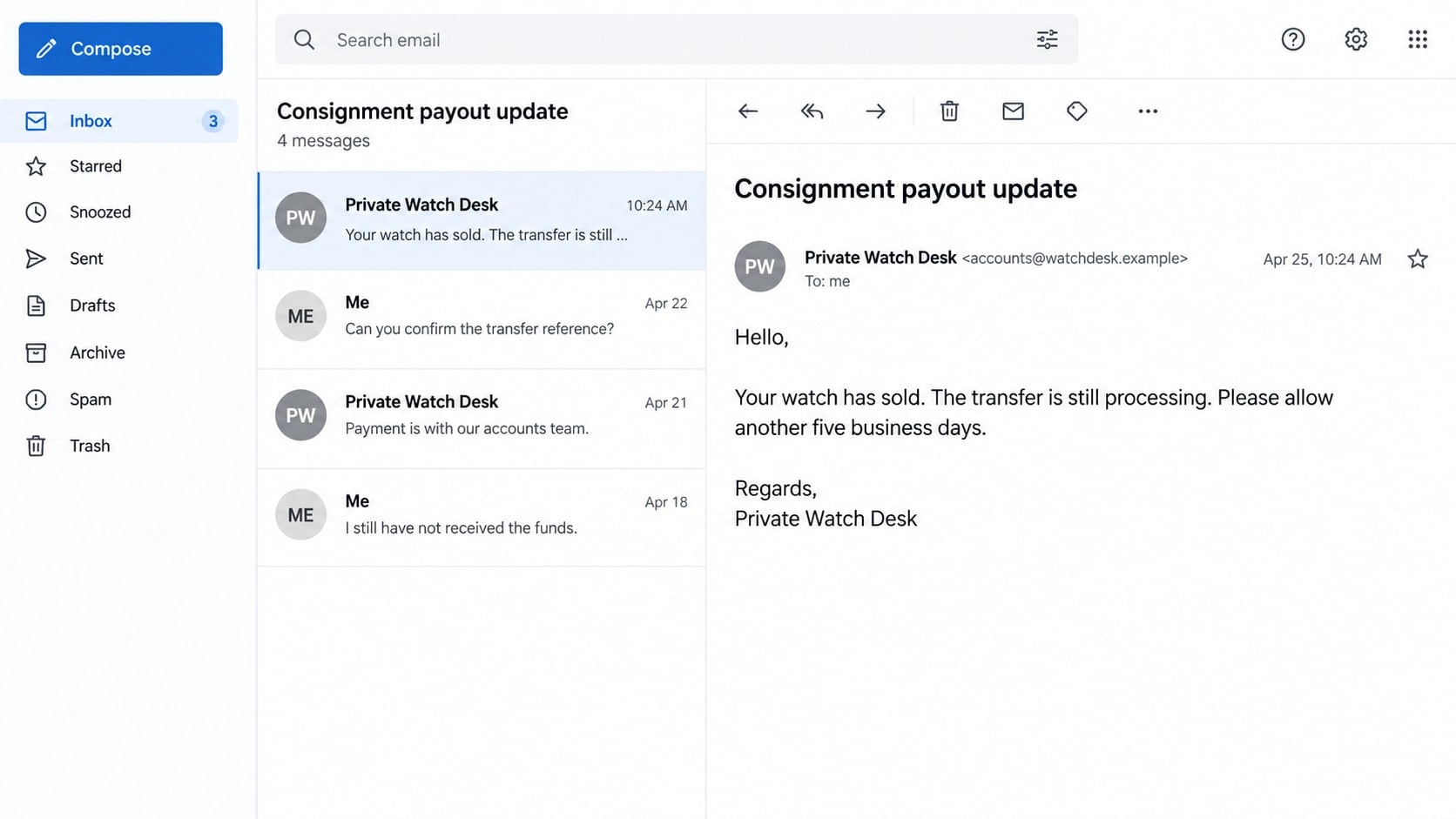
Check the actual settlement clause. Does the clock begin when a sale is agreed, when the buyer pays, or when a return period ends? A clear contract lets you ask a precise question instead of arguing about an undefined promise to pay soon.
Step 5: Delay creates pressure to accept a workaround
Once payment is overdue, the explanation may shift from a bank delay to a buyer problem, then to an accounting mistake. A seller who just wants the ordeal finished may accept an unfamiliar payment route or replacement item without checking the consequences.
Be especially cautious about receiving a watch whose ownership is uncertain. Replacing one unresolved obligation with someone else’s property can complicate the dispute. Ask for documentation and independent advice before signing anything that describes a substitute as full settlement.
Another dangerous proposal is to send a more valuable piece so the dealer can complete a larger deal and pay everything together. That increases your exposure while the original problem remains unresolved. Resolve the first obligation before considering another transaction.
Step 6: The seller has to reconstruct the missing trail
If communication stops, the useful questions become very concrete: which watch was delivered, who received it, what was authorized, and what happened next? A complete timeline makes those questions easier to investigate than a folder of disconnected screenshots.
Fraud and a commercial dispute are not interchangeable labels. Describe observable conduct accurately, including missed deadlines and contradictory statements. Investigators and qualified advisers can evaluate whether the evidence supports theft, fraud, a contractual claim, or another route.
Do not try to retrieve property through threats or an unannounced confrontation. A high-value loss understandably feels personal, but a safer recovery process protects you and preserves evidence that might otherwise disappear during an argument.
Identity, Contact, and Payment Checks
Identify the business responsible for your watch
Find the legal entity on the contract, not just the trading name on social media. Compare it with invoices, shipping instructions, and payment details. Ask who is responsible if the individual salesperson leaves or the storefront closes.
A business registration establishes a record of an entity; it is not a government guarantee of honesty. Use it to check consistency. A contract naming one company while a transfer goes to an unexplained individual deserves clarification before you proceed.
Verify custody and insurance separately
Obtain a dated intake receipt with the model, serial number, condition, accessories, and agreed value. Keep photographs from before shipment. Confirm that the delivery address belongs to the intended recipient and that the shipping arrangement covers the actual contents.
Ask what insurance applies while the watch is held and whether exclusions affect consigned goods or dishonest acts. Do not interpret a statement that the store is insured as proof that every possible loss to your property will be covered.
Make the payout calculation unambiguous
A hypothetical $12,500 sale with a 5% commission leaves $11,875 before any separately agreed charges. Write down which costs are included, who can approve a price reduction, and when the final balance must reach you.
Request an itemized settlement for each sale. If the amount differs, ask for the calculation rather than accepting a round-number explanation. Keep your bank confirmation beside the settlement so that a promised transfer is never recorded as received money.
Use independent contact routes for changes
Payment instructions can also be hijacked by an unrelated impersonator. If an email changes the destination account, verify through a phone number you already know. Do not use the replacement number supplied in that same message.
For an unresolved consignment, keep communications in writing where possible. After a phone call, send a factual summary of what was agreed. Avoid sharing serial numbers publicly in full; provide complete identifiers privately to appropriate investigators and insurers.
What to Do if You Have Fallen Victim to This Scam
- Stop adding property or money to the arrangement.
Do not consign another watch, pay an unexplained release fee, or approve a new trade merely to unlock an old payment. Ask for the current status of each existing item without authorizing additional disposal.
If several watches are involved, separate them by serial number and outstanding amount. That prevents a partial payment on one item from being mistaken for settlement of the entire collection.
- Preserve your ownership and delivery records.
Save purchase receipts, photographs, service records, the signed agreement, intake paperwork, shipping confirmation, and complete message threads. Export messages where possible, keeping dates and sender information intact rather than relying only on cropped images.
Create a timeline with the handover date, agreed sale terms, claimed sale date, payment deadline, and actual receipts. Mark assumptions as assumptions. A clear record is more useful than an emotional summary, even when the frustration is entirely understandable.
- Request a written accounting or return.
Identify exactly what is missing and refer to the relevant agreement. Ask for a response through a traceable channel. Keep the request concise, and retain proof that it was delivered.
For a valuable collection or a proposed settlement, seek advice from a qualified attorney before signing a release. The right approach depends on the contract, location, and facts; a generic online letter cannot determine your legal position.
- Contact the relevant financial and insurance providers.
If you sent a recent payment connected to the deal, promptly ask the provider whether a recall, dispute, or other protective step is possible. Explain the transaction truthfully. A voluntary transfer and an unauthorized card charge are not the same situation.
Notify any insurer that may cover the loss and ask about its documentation and reporting requirements. Do not assume coverage or reimbursement. Keep claim numbers and the names of representatives who explain the next steps.
- Report suspected fraud with a complete evidence package.
Contact local law enforcement where appropriate and submit relevant online-fraud information through the FBI’s Internet Crime Complaint Center. Include known business identifiers, payment references, and watch details without speculating about unrelated people.
Tell investigators if you learn that the watch was resold, but do not attempt to pressure a possible buyer yourself. Ownership and recovery questions can become complicated when property has passed through several hands.
- Address any separate digital exposure.
If the dealer or a supposed recovery agent sent software that you installed, remove untrusted access tools and scan with Malwarebytes. Change exposed passwords from a clean device. These steps address device compromise, not the missing watch or an unpaid contractual balance.
AdGuard can reduce exposure to some misleading ads and tracking while you research dealers or recovery services. It cannot authenticate a consignment business or guarantee that a search result is safe. Verify the person behind any offer independently.
- Be wary of paid recovery promises.
Someone who contacts you after a public complaint may claim to know the buyer or have a special connection with investigators. Demand independently verifiable credentials, and do not pay for a guaranteed recovery.
Keep sensitive documents out of public comment threads. A useful warning can describe your documented experience without publishing account details, identity documents, or an accusation against someone whose involvement has not been established.
Frequently Asked Questions
Is selling a Rolex on consignment always risky?
Consignment is a legitimate sales arrangement, but it places valuable property in another party’s custody. Clear terms, item-level records, verified insurance, and controlled exposure make the arrangement easier to assess. No reputation score removes the need for those checks.
Does a genuine watch prove the dealer is trustworthy?
No. Authenticity concerns the item. Consignment fraud concerns what someone does with property or proceeds entrusted to them. A genuine watch can still be sold without authorization, and the rightful owner can still be left unpaid.
Is every delayed payment evidence of a scam?
No. Processing delays and disputes happen. Compare the delay with the contract, request supporting records, and look for inconsistencies. Repeatedly changing explanations or an inability to account for the watch is more concerning than one explained administrative delay.
Should I accept a different watch instead of payment?
Not without checking ownership, value, condition, and the settlement terms. A replacement may carry another person’s claim or leave part of your original loss unresolved. Independent professional advice is sensible before accepting a high-value substitute.
Can a bank reverse the sale of my watch?
A bank cannot simply retrieve physical property. It may be able to address a related financial transaction, depending on the payment method and circumstances. Report the facts promptly and pursue property recovery through the appropriate legal and investigative channels.
What was the outcome of the Timepiece Gentleman case?
The Justice Department announced Farrer’s 70-month sentence in January 2025 following his guilty plea. That historical outcome supports a warning about consignment abuse, but it does not establish wrongdoing by unrelated dealers or guarantee compensation for individual victims.
The Bottom Line
A Rolex consignment scam can start with a real watch and a believable business relationship. The practical safeguard is to keep control of the details: identifiable property, limited written permission, a clear settlement deadline, and proof of actual payment.
If the watch or money cannot be accounted for, stop increasing your exposure. Preserve the trail, seek an independent assessment, and use formal reporting channels. Another reassuring message should never replace a verifiable answer.








