

A rare Rolex offered below market price creates a particular kind of pressure. The buyer knows another collector could appear at any moment, and the seller seems to have an answer for every concern.
That combination of scarcity, prestige, and high value attracts sophisticated scams. Some revolve around a counterfeit watch. Others sell a watch that never existed, using a fake dealer, invoice, and escrow service to make the transfer feel protected.
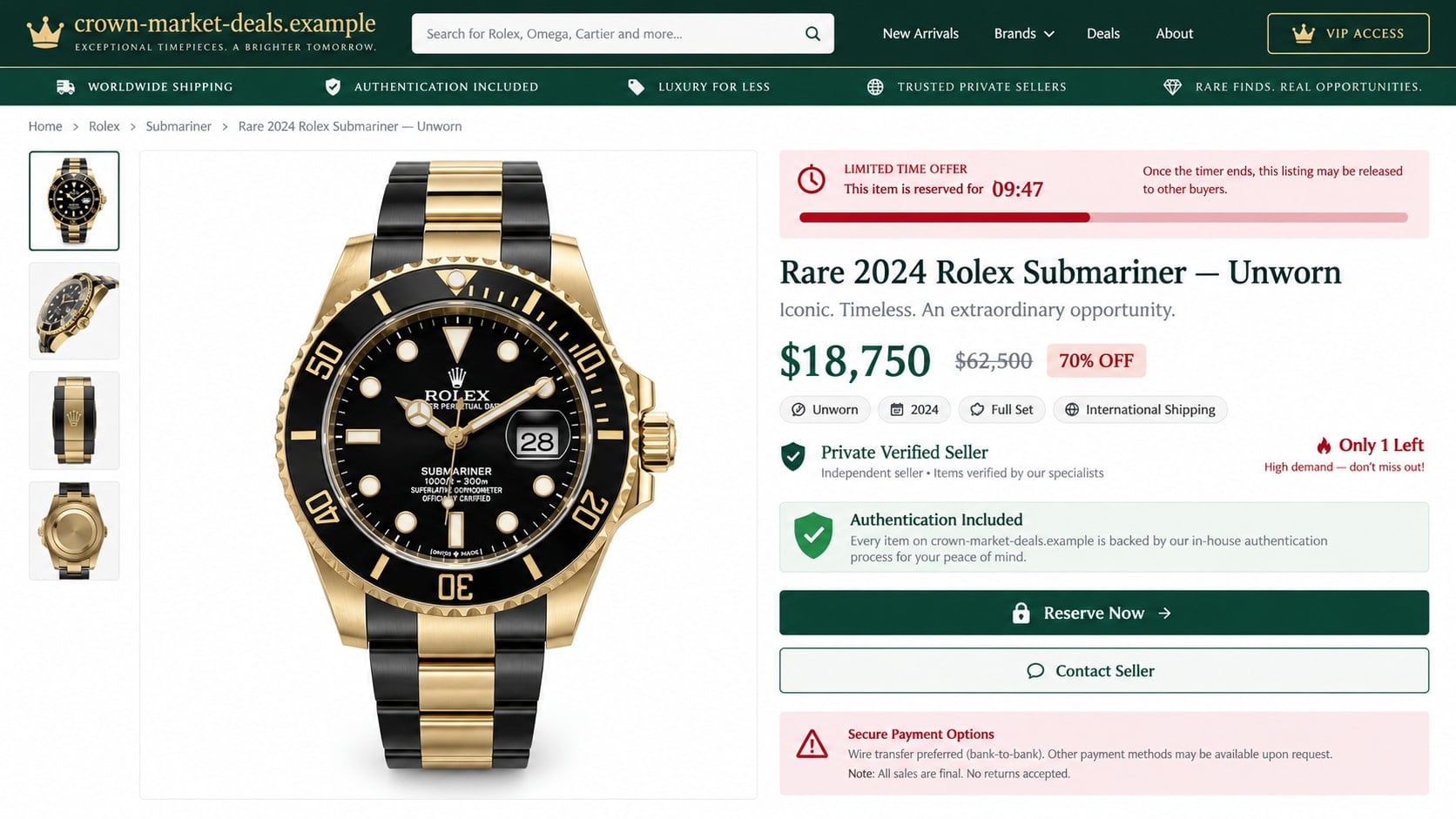
Overview
The scam may involve a fake watch, fake seller, or both
A buyer can encounter a complete counterfeit, a genuine watch fitted with non-genuine parts, a stolen watch, or a listing copied from someone else’s sale. In advance-payment scams, no watch is available at all.
The seller’s goal is to move the conversation away from a marketplace with safeguards and toward a payment that is difficult to reverse.
Professional documents make the transaction feel legitimate
Fraudsters create invoices, serial-number reports, appraisal certificates, videos, and supposed authentication results. A matching box and papers can also be counterfeit or belong to a different watch.
A polished presentation proves only that the seller prepared convincing material. The watch and the person offering it still need independent verification.
Losses can be much larger than the advertised price
A deposit may be followed by insurance, customs, authentication, or release fees. Buyers can also expose identity documents and banking details while trying to satisfy a fake dealer’s compliance process.
The risks include:
- A wire transfer for a watch that is never delivered.
- A counterfeit or altered watch sold as authentic.
- A stolen watch that may later be seized.
- Identity theft using documents sent to the seller.
- Account compromise through a fake marketplace login.
- Additional fees demanded by a fraudulent escrow service.
Why Rolex Transactions Attract Elaborate Fraud
High demand and uneven availability create a market where buyers accept private sellers and remote transactions. That environment gives criminals room to explain why the watch cannot be viewed locally or why payment must happen quickly.
Models, references, years, and condition affect value. A scammer can use enough correct terminology to sound knowledgeable without owning the watch. Product details can be copied from auction archives and dealer listings.
Rolex states in its official frequently asked questions that new and genuine watches are sold exclusively through official Rolex jewelers. The company also says only Rolex can confirm the authenticity of a Rolex watch.
Pre-owned buying involves a different market, but verification still matters. Rolex Certified Pre-Owned watches are authenticated through an official program and sold by participating official retailers. A private certificate designed by the seller is not equivalent.
Price is another clue. A legitimate seller may accept a reasonable discount for speed, condition, or missing accessories. A rare model offered far below every comparable listing is more likely to hide a problem than a secret opportunity.
How the Rolex Watch Scam Works
Step 1: The seller posts a desirable watch at an attractive price
The listing appears on a marketplace, social platform, collector group, or standalone luxury site. It uses sharp photographs, a specific reference, and a story about an urgent sale, inheritance, business need, or unwanted gift.
Images may be stolen from a real dealer or previous owner. A reverse image search can reveal the same watch photographed years earlier in another country.
Step 2: The seller builds authority and personal trust
The account may show years of history, positive reviews, or collector discussions. Compromised accounts are valuable because they carry someone else’s established reputation.
The seller answers technical questions and provides an identity document. That document may be stolen, altered, or borrowed from another victim who was asked to verify themselves during an earlier transaction.
Step 3: Scarcity moves the conversation off-platform
The buyer is told that several people are interested and a deposit is needed to hold the watch. The seller suggests email, text, or a messaging app because the marketplace supposedly charges high fees or delays communication.
Leaving the platform removes moderation, transaction records, and payment protection. It also makes it easier for the seller to send links to a fake escrow or authentication site.
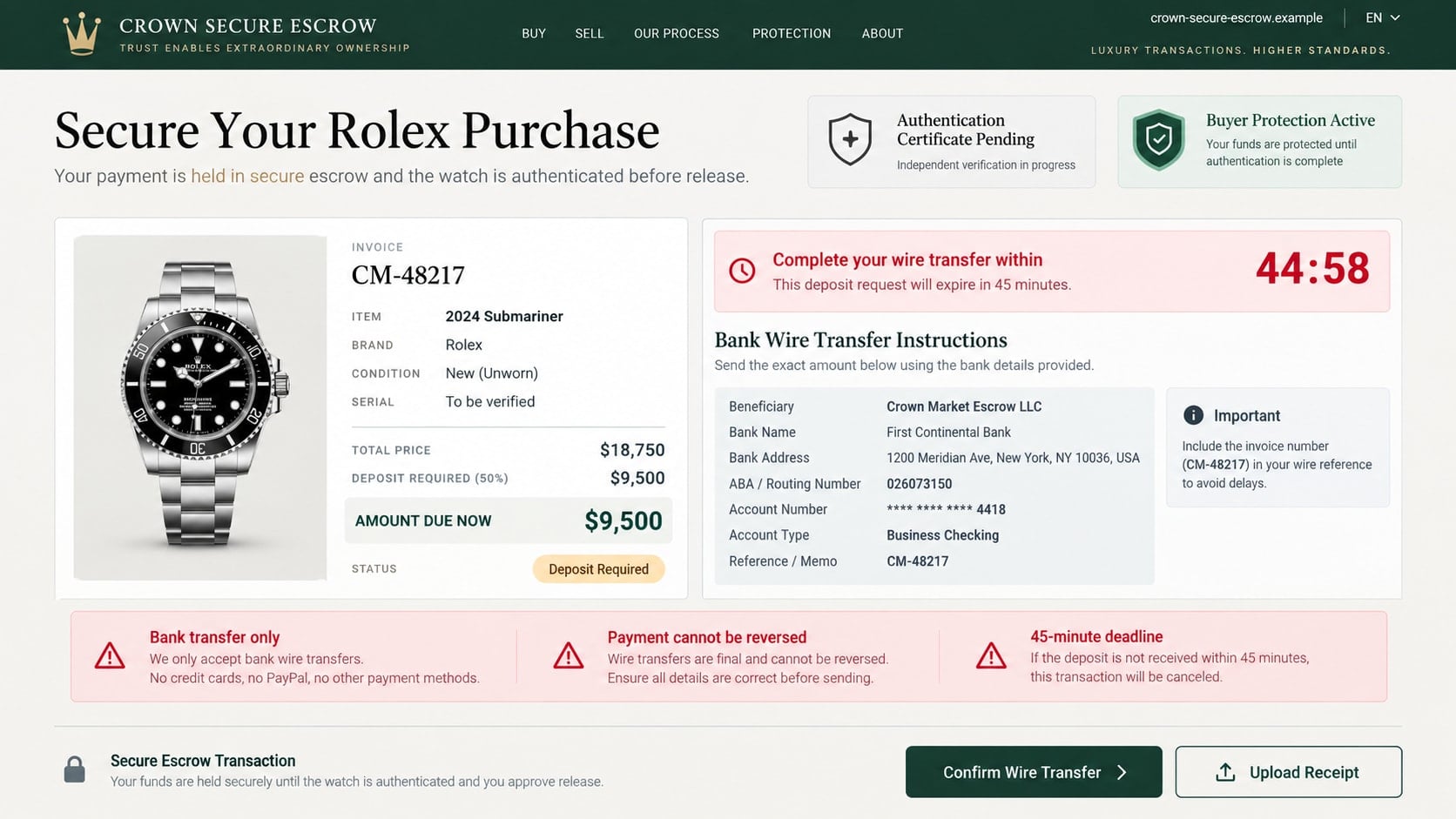
Step 4: A fraudulent escrow service requests the money
The buyer receives an invoice from a professional-looking service. It says funds will remain protected until the watch is authenticated and approved, but the website and bank account are controlled by the same criminals.
The wire destination may be a newly formed company or a money mule. Logos, encryption, and a support telephone number do not create real escrow protection.
Step 5: New fees appear after the deposit
Once the first transfer arrives, the seller says the watch is with a courier or authentication center. Release now requires insurance, import duty, ownership registration, or a refundable anti-fraud bond.
Each payment is framed as the final obstacle. The operators know that someone who has already sent a large amount may pay more rather than accept the first loss.
Step 6: The seller vanishes or delivers a problem watch
In a pure advance-fee scam, the accounts and websites disappear. In a counterfeit scheme, a parcel may arrive, but the watch fails inspection or contains a mixture of genuine and non-genuine parts.
The seller can point to a no-return policy, claim the buyer swapped the watch, or block communication. A fake authentication certificate becomes useless because no independent organization stands behind it.
Identity, Contact, and Payment Checks
Verify the seller beyond the marketplace profile
Search the seller’s name, business, telephone number, email, and photographs separately. Check whether the account recently changed its name or suddenly switched from ordinary posts to expensive watch sales.
For a dealer, confirm a physical showroom, business registration, and history that can be verified outside its own site. Call through a number you found independently.
Arrange independent inspection of the actual watch
Ask to meet at an official Rolex jeweler or a respected watchmaker willing to inspect the piece. For a remote sale, use a well-established platform or professional chosen independently by both parties.
A photograph of a time-setting request can show that the seller has some watch, but it cannot prove authenticity, ownership, or that the same item will be shipped.
Check ownership, provenance, and serial concerns
Compare reference details, service history, purchase documents, and the seller’s explanation. Do not publish or send full serial numbers casually, since criminals can reuse them in other counterfeit listings.
Ask the inspecting professional about non-genuine components and signs of alteration. A watch can contain genuine parts and still be misrepresented as factory-original.
Control the payment and escrow choice
Do not use an escrow service introduced through an unsolicited link. Research the company independently, confirm licensing or registration where applicable, and call a verified number before sending money.
A bank wire, cryptocurrency transfer, or friends-and-family payment offers little recourse. For a high-value purchase, the extra cost of a reputable dealer or protected platform is part of the safety budget.
Red Flags in a Rolex Listing or Dealer
- The price is far below comparable examples without a credible reason.
- The seller will not meet at a qualified independent professional.
- Photographs appear in older listings under another seller’s name.
- A deposit is required immediately because another buyer is waiting.
- The conversation must move off the marketplace.
- The seller provides an ID but resists a live verification call.
- Payment must go to an individual or unrelated company.
- The escrow domain was recently created or has no independent history.
- Authentication is supported only by a certificate selected by the seller.
- Additional insurance or release fees appear after payment.
- The seller guarantees that a wire is fully refundable.
- Return terms disappear once questions become specific.
One unusual detail may have an innocent explanation. Several combined with urgency and irreversible payment are a strong reason to walk away, even when the watch itself looks convincing.
Video calls are useful but not decisive. A fraudster can show a borrowed watch, a counterfeit, or a recording. Ask for live actions chosen during the call and still require an independent examination before releasing funds.
Be cautious when a seller treats ordinary verification as an insult. High-value transactions justify careful questions. A professional dealer should be able to explain provenance, inspection, payment, shipping, and returns without turning skepticism into a crisis.
How to Buy a Rolex More Safely
For a new watch, use an official Rolex jeweler located through Rolex’s own site. Do not rely on a dealer list copied onto another website.
For pre-owned purchases, decide how much risk you are willing to accept before shopping. Established dealers and protected platforms cost more because they provide inspection, reputation, and a dispute process.
Request fresh, high-resolution photographs and a live video showing the watch, paperwork, and a detail you choose. Use those only as screening evidence, not a replacement for physical authentication.
Read every protection term. Some marketplace guarantees cover non-delivery but exclude authenticity disputes after a short window. Others require payment and messaging to remain entirely on-platform.
Never let a bargain force a rushed decision. A seller who refuses time for professional inspection is asking the buyer to assume a risk that the price rarely justifies.
Insurance does not repair a fraudulent transaction automatically. Confirm who purchases the shipping coverage, what evidence a claim requires, and whether loss, theft, and misrepresentation are treated differently under the policy.
Record the watch’s condition and package opening when it arrives. An uninterrupted video is not perfect proof, but it can support a dispute when the parcel contains a different item or arrives damaged.
What to Do if You Have Fallen Victim to This Scam
- Stop further payments. Do not send insurance, authentication, customs, or recovery fees. A promise that one more transfer releases the watch is a common way to expand an existing loss.
- Contact the bank or payment provider immediately. Ask the fraud team whether a wire recall, receiving-bank alert, card dispute, or account freeze is possible. Speed matters, although recovery cannot be guaranteed.
- Preserve the complete transaction. Save the listing, profile, messages, email headers, invoices, escrow domain, bank instructions, wallet addresses, telephone numbers, shipping records, and images. Do not delete the conversation after the seller blocks you.
- Have any delivered watch examined. Keep the packaging and do not alter the item. Obtain a written assessment from a qualified independent professional describing authenticity, non-genuine components, or differences from the listing.
- Protect exposed identity documents. If you sent a driver’s license, passport, tax number, or bank statement, follow a recovery plan at IdentityTheft.gov. Consider credit freezes and warn the document issuer where appropriate.
- Secure compromised accounts. Change reused passwords, begin with email, review active sessions, and enable multi-factor authentication. If you logged into a marketplace through a link from the seller, assume the credentials may be stolen.
- Check devices used for files or remote access. Remove suspicious invoice viewers, chat applications, or support software. Run a full Malwarebytes scan to look for information stealers and remote-access tools.
- Reduce access to known malicious domains. AdGuard can filter many phishing pages and harmful advertisements, though a newly created escrow site may not be recognized immediately. Continue manual verification.
- Report the fraud. Notify the marketplace, receiving bank, domain host, and local police for a significant loss. Submit the transaction details to IC3.gov and ReportFraud.ftc.gov.
- Reject private recovery offers. People who promise to hack the money back, recover crypto, or release escrow funds for a fee often target victims whose details were shared by the first group.
Frequently Asked Questions
Can I authenticate a Rolex from photographs?
Photographs can reveal obvious problems, but convincing counterfeits and altered watches require physical examination. Rolex states that only Rolex can confirm the authenticity of a Rolex watch.
Does a box, warranty card, and matching serial prove authenticity?
No. Packaging and papers can be counterfeited, altered, or paired with a different watch. They are part of provenance, not a substitute for independent inspection.
Is a bank wire safe when an escrow company is involved?
Only if the escrow company itself is real, independently verified, and actually controls the transaction under clear terms. A fake escrow site can send legitimate bank instructions for an account controlled by criminals.
Why does the seller want to leave the marketplace?
They may claim it saves fees, but it can also remove monitoring, records, dispute rights, and payment protection. Keep communication and payment on the platform when its protection requires it.
What is a watch with aftermarket parts?
It is a watch that contains components not supplied as original Rolex parts, such as a dial, bezel, bracelet, or stones. Sellers must describe such changes accurately because they affect authenticity, value, and service options.
Can my bank reverse a wire transfer?
Sometimes a bank can request a recall or freeze remaining funds, especially when notified quickly. Wires are difficult to reverse, and success depends on timing and the receiving institution.
The Bottom Line
A Rolex watch scam can be much more than a crude counterfeit. Fake sellers combine stolen images, compromised profiles, forged documents, and fraudulent escrow sites to make an irreversible transfer appear protected.
Verify the seller, arrange independent inspection, and control the payment method yourself. If the deal cannot survive those checks, the supposed bargain is asking you to risk far more than its discount is worth.








