

MindWake presents a familiar promise in a polished package: clearer thinking, stronger recall, and a simple daily routine for people worried about memory.
The product page looks reassuring at first glance. The less visible policies tell a more complicated story about pricing, returns, identity, and accountability.
Overview
What MindWake is selling
MindWake is marketed as a brain-support supplement for memory, concentration, mental clarity, and healthy cognitive aging.
The website lists familiar ingredients, including Ginkgo biloba, phosphatidylserine, Bacopa monnieri, Alpha GPC, L-glutamine, and N-acetyl L-carnitine.
Ingredient familiarity does not prove that this exact formula delivers the advertised results. Dose, purity, interactions, manufacturing, and finished-product testing all matter.
The sales path strongly favors larger packages. Its highlighted six-bottle option costs $294 and displays a claimed $780 saving.
Why the offer needs closer inspection
The current sales domain was registered on September 8, 2026. A recent domain can belong to a new legitimate business.
It provides little history for assessing a seller promoting customer ratings, testimonials, broad safety language, and an established-looking operation.
The checkout also identifies CartPanda as the reseller while assigning advertising and product claims to an unnamed supplier.
That division matters. Buyers need to know which entity markets the capsules, charges the card, ships the order, handles returns, and answers safety complaints.
The key findings from our review
MindWake appears to be an orderable product, not merely a nonexistent page. That does not resolve the important concerns surrounding the offer.
- The storefront uses aggressive multi-bottle discounts and large crossed-out totals.
- The domain has a very short public history.
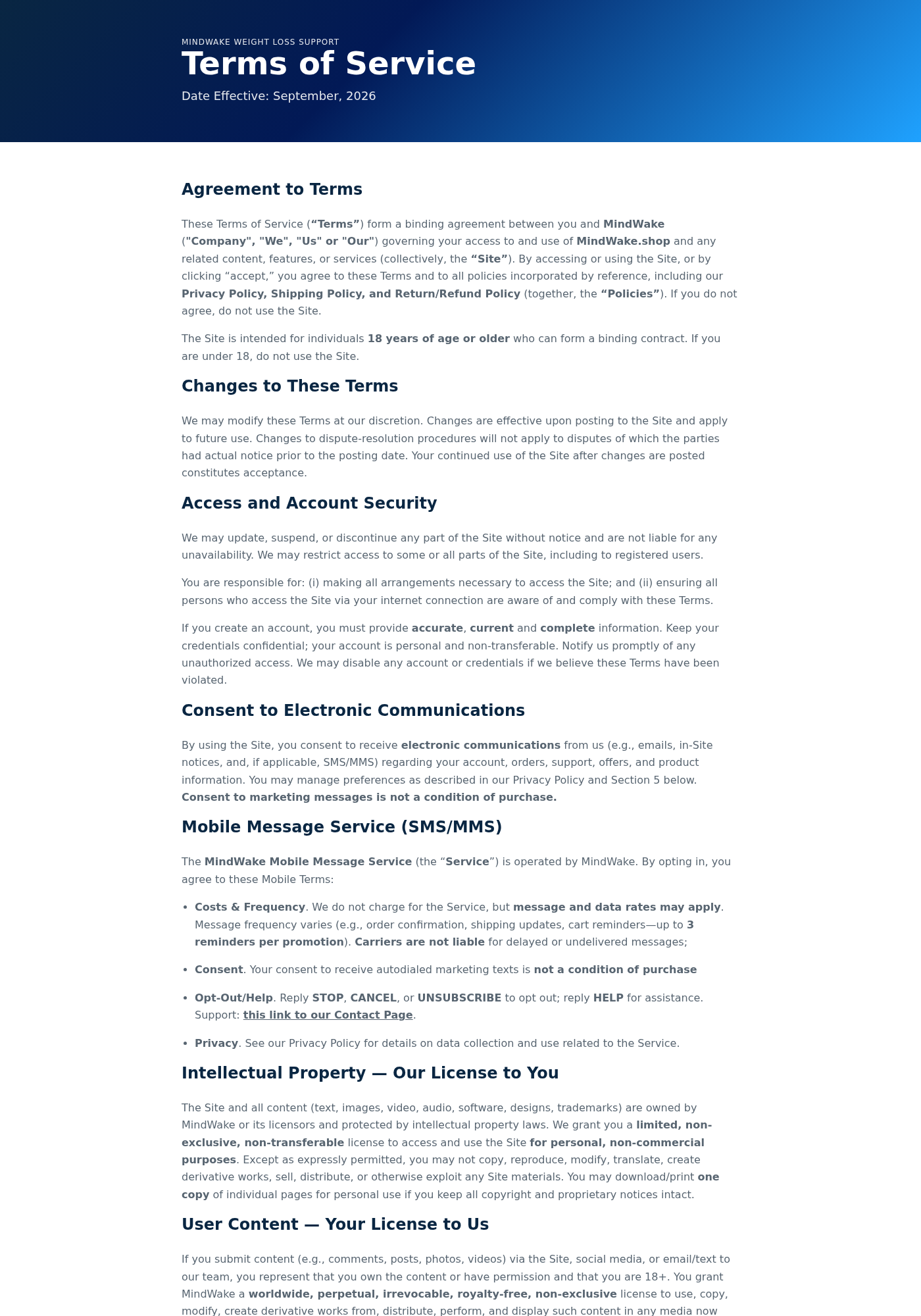
- The terms refer to MindWake.shop while the reviewed storefront operates on MindWake.store.
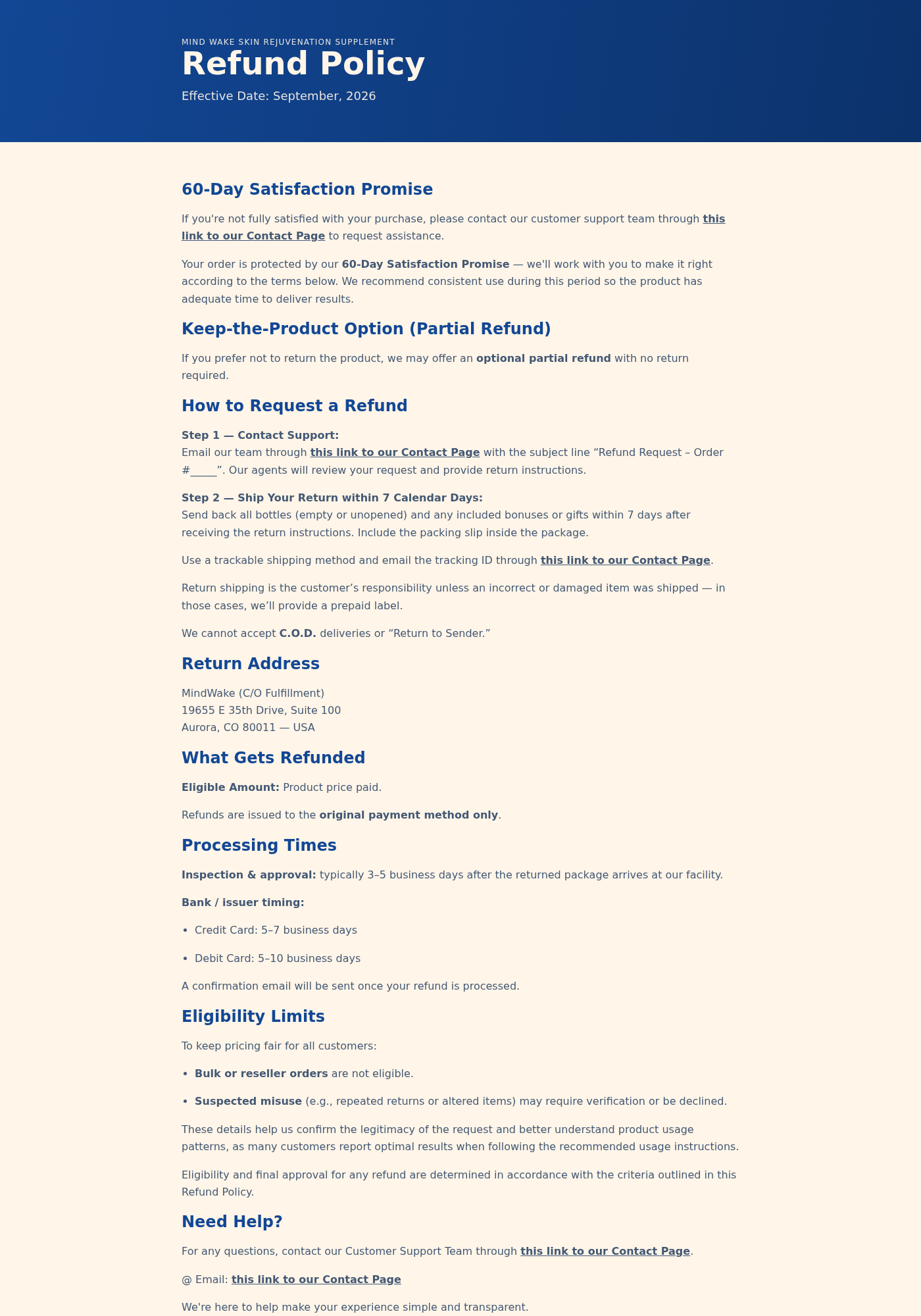
- One policy labels the product a skin-rejuvenation supplement.
- Another labels it weight-loss support, although MindWake is marketed for cognition.
- The advertised 60-day promise has detailed return conditions and a possible processing fee.
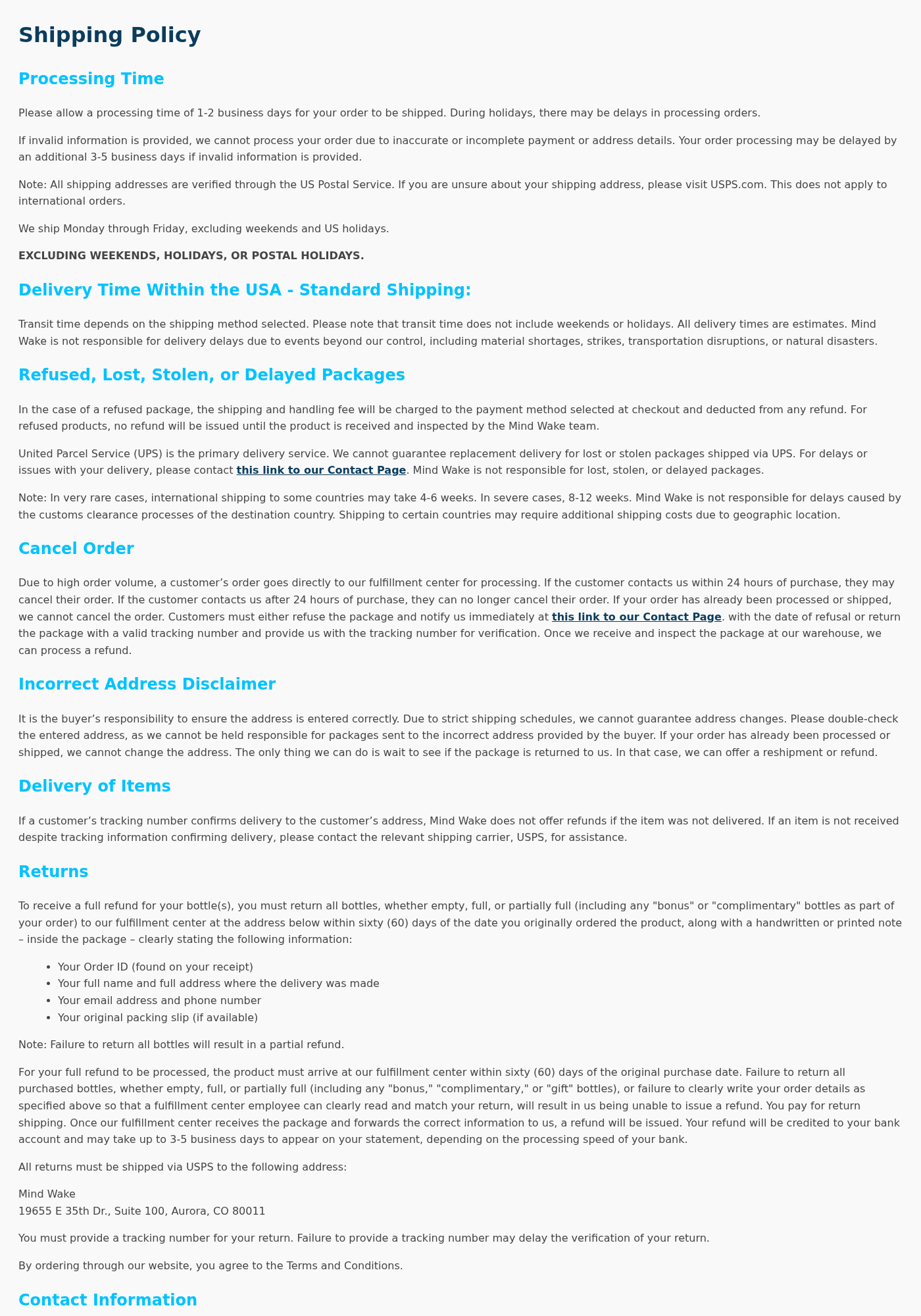
- The return address is shared by numerous unrelated supplement brands.
- The website makes sweeping safety statements that should not replace individual medical advice.
These are concrete commercial and editorial problems. They justify caution without pretending we laboratory-tested the capsules or proved every buyer receives the same experience.
Is MindWake Legit or a Scam?
MindWake has a functioning storefront, package choices, policies, contact details, and a third-party reseller checkout.
Those features distinguish it from a completely fabricated store that takes payment and sends nothing.
However, a real checkout does not make the marketing reliable or the purchase low risk.
Our review found contradictions that would be unacceptable for a careful supplement seller, especially one targeting older adults concerned about cognitive health.
The policy templates describe three different product categories: cognitive support, skin rejuvenation, and weight loss.
That suggests pages were copied or repurposed without adequate review. It also makes customers reasonably question which terms were written for their actual order.
The refund language varies by page. The headline promise sounds simple, while the operative conditions introduce timing, authorization, return, and fee requirements.
We therefore consider MindWake a high-risk supplement offer with misleading and inconsistent presentation.
Consumers should not buy until the seller clearly identifies itself, reconciles its policies, and supports its health claims with product-specific evidence.
The Memory Claims Need Context
Studied ingredients do not validate the bottle
Several listed ingredients have appeared in research involving cognition, circulation, stress, or age-related changes.
Research findings vary by dose, preparation, population, duration, endpoint, and study quality. Results cannot be transferred automatically to every commercial blend.
A finished product needs evidence connecting its exact composition to the benefits advertised for that product.
The reviewed sales page did not provide a published clinical trial demonstrating that MindWake itself improves memory or reverses cognitive decline.
Words such as “science-backed” can describe ingredient selection without establishing that the capsule produced the promised real-world outcome.
Seller-controlled testimonials are not clinical evidence
The page features older customers describing better recall, sharper thinking, and renewed confidence. Their names and ages make the stories feel personal.
We could not verify those experiences as independent purchases or confirm whether the photographs represent the quoted individuals.
Testimonials cannot reveal how many customers saw no benefit, stopped because of side effects, or requested refunds.
A displayed 4.9 rating also needs a transparent collection method, total review count, moderation policy, and access to negative feedback.
Broad safety claims can mislead vulnerable buyers
The FAQ says MindWake can be combined with other supplements “without any issue” and states that no adverse effects have been reported.
Elsewhere, the page advises people using prescriptions or managing conditions to consult a doctor. The caution is more responsible than the blanket assurance.
No supplement is automatically appropriate for every user. Ginkgo and other ingredients may be relevant to medication interactions or individual conditions.
Only a qualified clinician or pharmacist with the complete label and medication list can assess a specific person’s risk.
Memory symptoms deserve real evaluation
Forgetfulness may be related to sleep, stress, depression, hearing loss, medication effects, thyroid problems, nutritional deficiencies, or neurological disease.
A supplement advertisement cannot diagnose the cause. Delaying evaluation may postpone treatment for a reversible or serious condition.
Sudden confusion, weakness, speech difficulty, severe headache, or rapid mental changes require urgent medical attention.
Do not stop prescribed medication or replace professional care because testimonials make a capsule sound safer or simpler.
Pricing and the Six-Bottle Push
The largest package is designed to feel inevitable
The storefront shows two bottles at $79 each, three at $69 each, and six at $49 each.
The six-bottle selection displays a total of $294 beside a much larger crossed-out amount and a claimed $780 saving.
It also says 97% of customers choose six bottles. That statement adds social pressure to the economic pressure.
We found no independent sales data supporting that percentage. It should be treated as seller-controlled marketing.
A lower unit price creates a larger refund problem
Buying six bottles reduces the displayed price per bottle, but it nearly doubles the initial charge compared with the two-bottle option.
The customer also receives more items that may need to remain accounted for during a return.
MindWake’s policy requires customers to return all bottles, including opened and empty containers, along with bonuses.
A buyer who discards an empty bottle may unknowingly make a later refund request harder.
The crossed-out totals need a real comparison
A claimed saving is meaningful only if the reference price reflects a genuine price at which the product was regularly offered.
Large crossed-out figures can make a bundle feel temporary and unusually valuable, even when the discount exists continuously.
Focus on the actual total leaving the account, not the amount the page says has been saved.
Screenshot the selected package and final checkout before payment. The record is useful if the quantity or total later differs.
How the MindWake Offer Works
Step 1: The advertisement meets an emotional concern
Memory advertising often reaches people already worried about names, appointments, concentration, or an older relative’s independence.
The message offers hope without the discomfort of medical testing. A daily capsule feels private, familiar, and easy to begin.
That emotional context can reduce skepticism before the visitor reaches the sales page.
Step 2: The page borrows authority from ingredients
The formula combines recognizable compounds with phrases such as cognitive support, mental clarity, healthy aging, and science-backed benefits.
Visitors may interpret research on individual ingredients as proof that MindWake’s entire formula has been clinically demonstrated.
The page does not adequately explain the difference between ingredient research and evidence for the finished product.
Step 3: Testimonials make the outcome feel typical
Stories from older customers help readers imagine returning to conversations, hobbies, and daily tasks with greater confidence.
The narratives are persuasive because they resemble ordinary life rather than formal advertising.
Without independent verification, consumers cannot know whether those accounts are representative, compensated, edited, or connected to verified orders.
Step 4: Bundle design steers buyers toward $294
The steepest per-bottle discount sits on the six-bottle package. A 97% popularity claim suggests nearly everyone makes that choice.
This layout transforms caution into apparent waste. Choosing fewer bottles can feel like rejecting both savings and the crowd’s judgment.
The pressure is especially effective when the buyer expects cognitive supplements to require months of use.
Step 5: A reseller processes the purchase
The order route reaches a storefront using CartPanda. Its disclosure identifies CartPanda as the reseller.
The same disclosure says the supplier, not CartPanda, creates the advertising, product claims, and promotional materials.
That distinction can confuse buyers seeking help. Payment processing, product claims, shipping, and returns may involve different parties.
Step 6: The simple guarantee becomes conditional
The sales page promotes a 60-day satisfaction promise. The policy pages introduce an authorization process and detailed return requirements.
Customers may need to return every bottle and bonus, pay return shipping, and act within a short period after receiving instructions.
The terms also mention a processing fee of up to 20%, while other policy language is less clear about that deduction.
Step 7: Inconsistent templates complicate disputes
One policy calls MindWake a skin-rejuvenation supplement. Another describes weight-loss support. The actual sales page markets cognitive support.
The terms reference MindWake.shop, while the current order pages operate through MindWake.store and use a .shop support email.
These mismatches give customers legitimate reasons to question which entity and policy govern the transaction.
The 60-Day Refund Promise Explained
The starting date is not stated consistently
The sales presentation describes 60 days from the original purchase. The terms describe a period counted from delivery.
That difference can be significant when shipping is delayed or the customer begins using the product after arrival.
Ask support to confirm the exact deadline in writing before ordering. Do not rely on the largest guarantee badge.
Authorization and a short return window matter
The refund policy tells customers to request instructions and return authorization before shipping the package.
It then requires the return to be sent within seven calendar days after those instructions are provided.
A customer who waits for a convenient mailing day could miss that operational deadline despite still being inside the advertised period.
Every bottle and bonus may be required
The policy says all bottles must be returned, whether full, opened, or empty, along with any bonuses received.
Customers commonly discard empty supplement containers. That ordinary behavior can conflict with the stated refund conditions.
Keep the packaging, bottles, shipping label, insert, and bonuses until the refund has appeared and the dispute period has passed.
Fees can reduce the amount recovered
Return shipping is assigned to the customer. Original shipping may also be nonrefundable under the terms.
The terms mention a processing fee up to 20%. The visible refund page does not explain that possible deduction as prominently.
There is also language allowing a 30% to 40% partial refund without a return in some circumstances.
That option may save postage, but it also leaves the customer absorbing most of the purchase price.
Subscription and Billing Questions
The reviewed page says purchases are one-time unless a customer deliberately selects an optional subscription during checkout.
We did not find evidence that every MindWake order automatically creates recurring billing.
That distinction matters. Similar-looking supplement funnels do not prove that this specific order renews.
Still, inspect every checkbox, toggle, discount, continuity statement, and delivery schedule before pressing the final payment button.
Save the confirmation page and receipt. They should state whether the order is one-time and identify the merchant descriptor.
Monitor statements after delivery. Contact the issuer promptly if a charge appears that you did not authorize.
Do not rely solely on telephone assurances. Written cancellation confirmation creates a better record for a later dispute.
Company, Address, and Fulfillment Checks
The legal supplier remains unclear
The checkout names CartPanda as reseller but says the supplier controls product claims and advertising.
The reviewed pages do not make that supplier’s full legal identity equally clear to an ordinary customer.
“MindWake” is a brand. It is not enough for checking corporate records, regulatory history, ownership, or legal responsibility.
The Aurora address is a shared fulfillment location
The return policy uses 19655 E 35th Drive, Suite 100, Aurora, Colorado 80011.
The same address appears in return instructions for numerous unrelated supplement brands, including products marketed for memory, weight, and general wellness.
That pattern indicates a shared fulfillment or returns operation. It does not prove that the warehouse owns MindWake or created its advertising.
A warehouse can receive packages for many sellers while knowing nothing about a capsule’s formulation, research, or customer promises.
Support details should survive a simple test
The site lists support@mindwake.shop and an SMS number ending in 6319.
Before purchasing, ask for the supplier’s legal name, billing descriptor, manufacturing country, subscription status, return deadline, and possible fees.
Useful support should answer each question directly. Silence, scripts, contradictory replies, or pressure to accept store credit are warning signs.
Traceability matters more than attractive packaging
Check the bottle for a complete Supplement Facts panel, lot number, expiration date, domestic contact, country of manufacture, and responsible distributor.
Ask whether an independent laboratory tested the exact finished batch for identity, potency, microbes, heavy metals, and undeclared compounds.
Unknown mass-produced supplements may contain inconsistent doses, contaminants, allergens, or ingredients unsuitable for a buyer’s medications.
A slick storefront and efficient warehouse do not establish manufacturing quality. Evidence must follow the product from formula to finished lot.
What to Do if You Bought MindWake
- Preserve the complete order record. Save the advertisement, package selection, checkout, receipt, policies, delivery label, card descriptor, and every support message.
- Keep every container and bonus. Do not discard opened or empty bottles while a refund remains possible. The policy says all containers may be required.
- Check your return deadline. Ask support whether 60 days starts at purchase or delivery and request the answer in writing.
- Obtain authorization first. Request the required return instructions, case number, destination, fee breakdown, and deadline before mailing anything.
- Use tracked shipping. Photograph the contents and sealed parcel. Keep the receipt, tracking history, delivery confirmation, and exact returned weight.
- Review health safety. Stop using the product and contact a clinician if symptoms appear. Report serious reactions through FDA MedWatch.
- Challenge unauthorized billing. If quantities or later charges were not approved, contact the card issuer and provide your screenshots and written cancellation request.
- Protect the checkout device. Scan with Malwarebytes if redirects behaved suspiciously. AdGuard can reduce malicious advertising and tracking on future browsing.
Remain calm and specific. A short written timeline with amounts, dates, screenshots, and tracking evidence is stronger than repeated undocumented calls.
Frequently Asked Questions
Is MindWake a real product?
MindWake has a functioning storefront and checkout. Our concerns involve evidence, policy contradictions, seller identity, pricing pressure, and return conditions.
Is MindWake clinically proven?
We found ingredient-based claims, but no published product-specific trial showing that the exact MindWake formula delivers the advertised memory benefits.
Does every MindWake purchase create a subscription?
The page says orders are one-time unless an optional subscription is selected. Check the final checkout and receipt because those documents govern your selection.
Can I get a full refund within 60 days?
Eligibility depends on authorization, timing, returning all bottles and bonuses, shipping, and possible deductions. The policy pages do not describe every detail consistently.
Why is the product called skin or weight support in policies?
Those labels appear to be template or editing errors. They weaken confidence that the published terms were carefully prepared for the cognitive product.
What is the biggest MindWake red flag?
The largest concern is the combination of aggressive bundle marketing with conflicting policy templates and an unclear supplier behind the product claims.
The Bottom Line
MindWake may ship a bottle, but that alone does not resolve its evidence, safety, identity, pricing, and refund concerns.
The contradictory policies and shared fulfillment trail make this a high-risk purchase. Wait for clear answers and independent proof before trusting the offer.








