

A social media ad promises an entire pallet of returned electronics for less than the price of one ordinary purchase. The photos show boxed products, a countdown is running, and the comments appear full of delighted buyers.
It looks like a rare warehouse opportunity that could vanish at any moment. The offer becomes much less impressive once the seller, checkout, and delivery claims are examined.
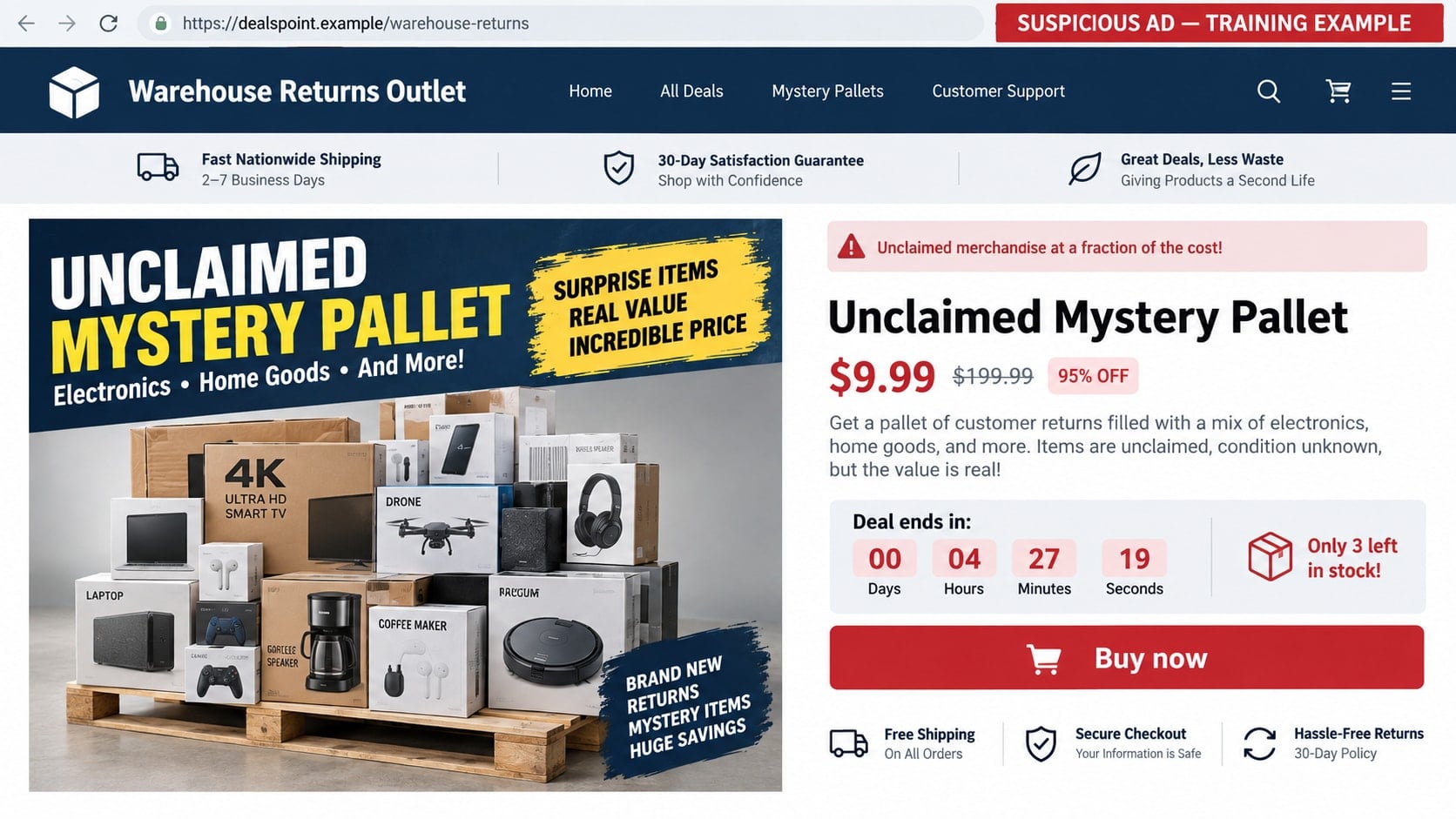
Overview
The advertisement repackages a real retail concept
Retailers and liquidation companies do sell returned or surplus goods in bulk. Amazon pallet scams exploit that real practice while pretending that ordinary shoppers can buy a valuable mystery load through a simple social media checkout.
The scam is not made legitimate by warehouse photos, delivery labels, or claims about overstock. Those elements can be copied, generated, or taken from an unrelated liquidation business.
The price is designed to overpower normal caution
Ads may offer a pallet supposedly worth thousands for $29, $49, or $99. They explain the price with a warehouse closure, unclaimed parcels, excess returns, or a need to clear storage space before a deadline.
A timer, low-stock counter, or “one pallet per household” rule makes the promotion feel both exclusive and urgent. The buyer is encouraged to pay before asking how a heavy commercial load could be inspected, transported, and delivered for such a small amount.
The checkout is controlled by an unrelated operator
The ad usually leads to a newly created store that has no verified relationship with Amazon. It can collect card details, add recurring charges, or accept payment and disappear without sending the advertised goods.
Victims may encounter:
- No delivery after the payment is processed.
- A tiny low-value item sent instead of a pallet.
- Counterfeit, broken, or unusable merchandise.
- Unauthorized card charges or recurring subscriptions.
- Identity theft using checkout and account information.
- Fake tracking updates that delay a dispute.
- Refund forms that collect another card number.
What the Amazon Pallet Offer Looks Like
The promotion often appears as a sponsored Facebook, Instagram, TikTok, or search advertisement. It may use Amazon colors, delivery boxes, warehouse aisles, or a headline about returned electronics being cleared after 30 or 90 days.
Some ads lead with an emotional explanation. A supposed warehouse employee says the company cannot store unclaimed parcels, while a fake news story claims local residents are getting premium products through a hidden program.
The landing page presents several tiers, such as standard, premium, and electronics pallets. Higher-priced options display smartphones, computers, game consoles, or appliances even though the seller provides no inventory manifest.
Manufactured comments and reviews
Below the ad, accounts say they received expensive items and post photographs of perfect boxes. The comments may be part of the advertisement itself, meaning they are not connected to real social media profiles and cannot be verified.
A fake store can also copy reviews from another website or generate a large number of five-star comments on the same date. Repetition, vague praise, and no discussion of damaged goods are warning signs for a liquidation offer.
Timers, quizzes, and mystery-box games
Some pages ask the visitor to answer three questions or choose a box on screen. The buyer always “wins” access to a discounted pallet, making a predetermined sales funnel look like a lucky result.
A countdown may restart whenever the page is refreshed. Stock can also fall from 17 units to one without any real connection to inventory.
Misleading shipping promises
A real pallet is large, heavy, and expensive to move. It may require freight delivery, a loading dock, a liftgate, storage space, and clear terms about damaged merchandise.
When a website promises free nationwide delivery within two days for a small checkout total, the logistics do not match the product. That contradiction is one of the strongest clues.
How the Amazon Pallet Scam Works
Step 1: A sponsored ad targets bargain hunters
The campaign uses photographs of high-demand electronics, branded boxes, and crowded warehouse shelves. Broad targeting allows the ad to reach shoppers interested in reselling, side income, clearance sales, or popular gadgets.
Paid placement does not mean a platform has verified the inventory or seller. The FTC warns that social media ads are not necessarily vetted. A scam ad can collect many payments before reports cause it to be removed.
Step 2: The landing page invents a clearance event
The store says unclaimed parcels, customer returns, or a warehouse closure created an unusual surplus. It claims the products cannot be returned to stock and therefore must be sold at a dramatic discount.
The explanation avoids specific questions. There may be no warehouse address, auction terms, condition grading, manifest, freight policy, or legal business name.
Step 3: Social proof makes the deal feel safe
The page displays a high review score, purchase notifications, and comments from supposed recent customers. A message may say someone nearby just bought the last premium pallet even while the item remains available.
Logos for payment security, couriers, and consumer organizations can be simple images with no connection to those services. Clicking them often does nothing.
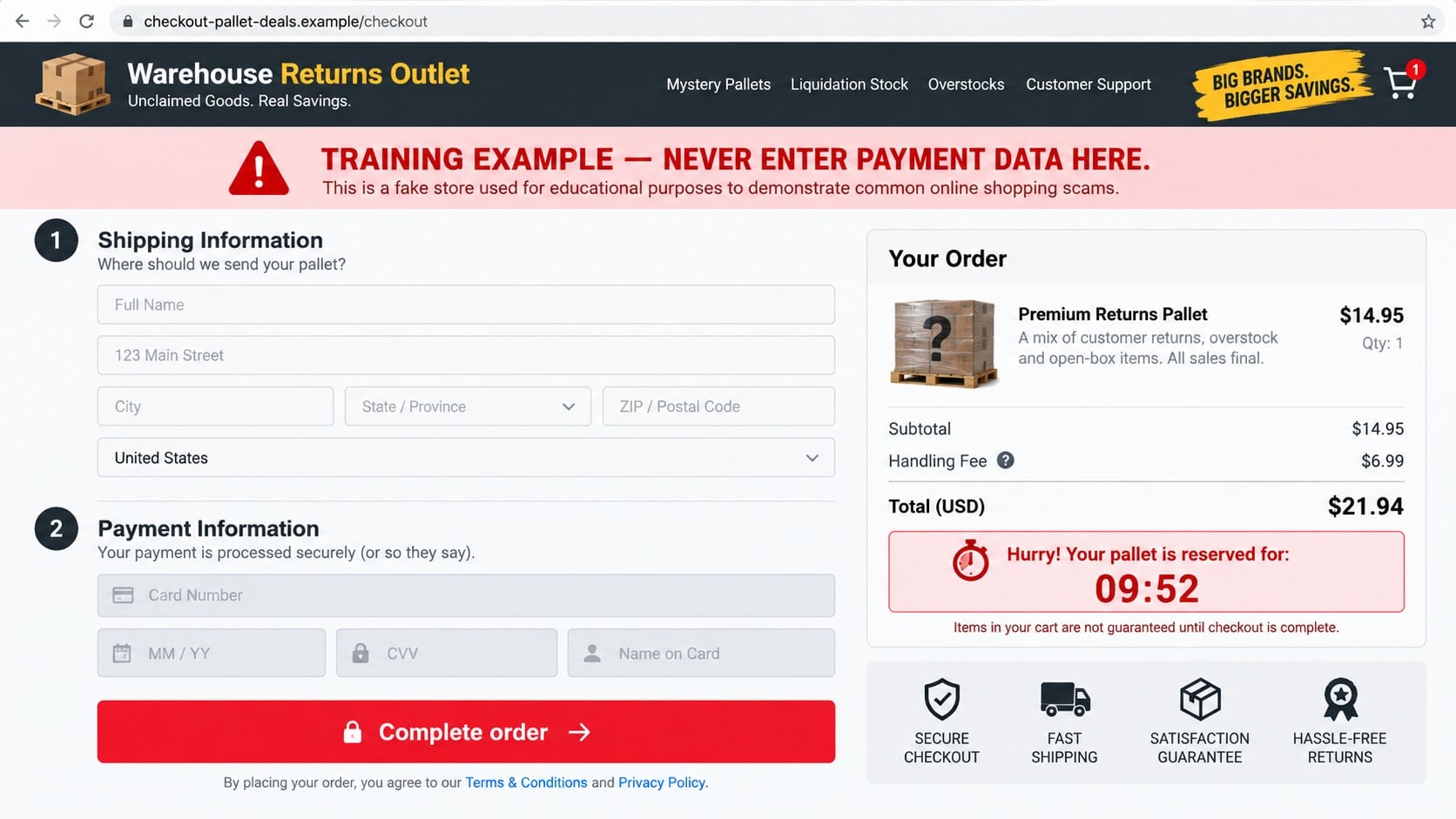
Step 4: The checkout captures payment and identity data
The buyer enters a name, home address, phone number, email, and card details. The page may add a small shipping charge or optional warranty after the advertised price has created commitment.
Some stores quietly enroll the buyer in a recurring membership. Others transmit the card details directly to criminals or process the purchase under a different merchant name.
Step 5: Fake tracking delays the charge dispute
After payment, the victim receives a confirmation and a tracking page that moves through generic stages. The updates may not correspond to a real carrier shipment.
Another tactic is to send a cheap envelope or small item so a tracking number shows delivery to the buyer’s area. The seller then points to that record when the victim disputes the charge.
Step 6: Support creates new reasons to pay
When the pallet does not arrive, support may claim customs, insurance, redelivery, or warehouse release costs are outstanding. Each payment is presented as the final obstacle.
A refund page can ask for card details again or request a one-time code. Instead of returning money, it may authorize another payment or help the attacker access the victim’s account.
Identity, Contact, and Payment Checks
Identify the actual seller
Look for a legal business name, verifiable address, working phone number, and company registration that match each other. A page titled “Amazon Warehouse Pallets” does not prove Amazon operates it.
Search the business name and domain with terms such as scam, complaint, refund, and reviews. Give more weight to independent records than testimonials published by the seller.
Inspect the domain and store history
Read the full address carefully. Extra words, odd spelling, or a domain unrelated to the displayed brand should end the purchase. Search for the domain’s creation history and archived versions where available.
A store created recently but claiming years of liquidation experience has a credibility problem. A polished layout can be installed in hours and is not evidence of an established business.
Demand realistic inventory and freight details
A serious liquidation listing should explain whether goods are returns, shelf pulls, salvage, or overstock. It should describe condition grading, quantity, manifest availability, inspection rules, buyer premiums, and delivery terms.
Ask for the pickup location, pallet weight, dimensions, carrier, and who pays freight. Vague answers or promises of nearly free express shipping are major warnings.
Use a payment method with dispute rights
A credit card generally provides stronger protections than a wire, gift card, cryptocurrency transfer, or payment sent to a stranger through an app. The FTC’s online shopping guidance also recommends checking unfamiliar sellers and using safer payment methods.
Before paying, save the listing, refund policy, advertised contents, and delivery promise. Those records help show what was offered if the seller changes or removes the page.
Why “Mystery” Does Not Remove the Seller’s Responsibility
A mystery pallet naturally carries uncertainty about individual items, but that does not excuse false statements about its source, size, value, condition, or delivery. Random contents and nonexistent contents are not the same thing.
A disclaimer that “results vary” cannot make a fictional warehouse relationship true. Nor can it justify showing premium electronics if the seller routinely sends one low-value accessory.
Read the refund language before purchase. Scam stores often state that clearance items are final, require an expensive overseas return, or allow refunds only within a period shorter than the promised delivery window.
Red Flags in an Amazon Pallet Advertisement
- The price is far below realistic freight and handling costs.
- The domain is not owned by the brand named in the promotion.
- The seller provides no manifest, grade, weight, or pallet dimensions.
- A countdown resets or stock messages repeat on every visit.
- Reviews appear inside the page and cannot be opened independently.
- Contact information is limited to a generic form or free email address.
- Policy pages name a different company or product category.
- The only payment options are difficult or impossible to reverse.
- Support demands customs or insurance fees after checkout.
- Tracking shows delivery but no freight shipment arrived.
The presence of an Amazon logo, sponsored label, or HTTPS padlock does not cancel these problems. Verify who receives the payment and what evidence connects that business to the inventory.
Safer Ways to Buy Liquidation Inventory
Use an established auction or liquidation marketplace with a public history, clear seller identity, condition grading, buyer terms, and a documented dispute process. Begin with an amount the business can afford to lose.
Whenever possible, inspect inventory or use a local pickup. Compare the expected resale value after freight, damaged goods, testing, storage, platform fees, and disposal costs.
Do not assume every returned item is new or functional. A legitimate deal can still be financially poor, but it should provide enough information for the buyer to estimate that risk.
What to Do if You Have Fallen Victim to This Scam
- Preserve the entire offer. Save screenshots of the ad, product page, checkout, order confirmation, policies, messages, and tracking. Record the domain, social media account, merchant descriptor, amount, and date.
- Contact the card issuer or bank now. Explain that the goods were misrepresented or never delivered and that the seller may be fraudulent. Ask about blocking the card, disputing the charge, and stopping pending or recurring payments.
- Do not pay a release or refund fee. Customs, insurance, warehouse, and redelivery demands are often the second stage. A legitimate refund does not require sending more money to an unknown party.
- Review the statement carefully. Look for small test charges, a different merchant name, and subscription billing. Continue monitoring because stolen card details may be used weeks later.
- Change reused passwords. If the fake store account used a password found elsewhere, replace it on every affected service. Start with email, financial accounts, and major shopping profiles.
- Secure any compromised shopping account. If credentials for Amazon or another retailer were entered, change the password through the genuine site, sign out unknown sessions, review addresses and payment methods, and enable multi-factor authentication.
- Scan downloaded files. If the seller provided an invoice, tracking app, or browser extension, remove it and run a complete Malwarebytes scan. Do not open the file again to gather evidence.
- Block the malicious page. Report the advertisement to the platform and consider AdGuard to reduce exposure to known scam domains. Continue checking addresses manually because filters cannot catch every new store.
- Report the seller. File reports with the FTC, the advertising platform, the payment provider, and the legitimate brand being impersonated. Provide the saved domain and merchant information.
- Prepare for follow-up scams. Ignore messages from supposed refund agents, investigators, or shipping companies that request another fee. Scammers may reuse the order details to make the next approach sound convincing.
Frequently Asked Questions
Does Amazon sell mystery pallets directly through social media ads?
An advertisement using Amazon branding is not proof of an Amazon program. Verify the offer within Amazon’s official site and identify the actual seller before paying.
Are all return-pallet businesses scams?
No. Legitimate liquidation businesses exist, but they provide verifiable identity, condition information, terms, and realistic freight arrangements. The fake promotion hides those details.
Why did the seller send a cheap item?
A low-value shipment can generate a tracking record and make a dispute harder. Keep the packaging, label, weight, and photographs to show that it was not the advertised pallet.
Can social media platforms guarantee sponsored sellers?
No. Paid ads can lead to fraudulent stores. Treat advertising as a way to discover an offer, then verify the seller and domain independently.
What payment method is safest for liquidation goods?
A credit card normally offers stronger dispute options, but no method makes an implausible seller trustworthy. Never use an irreversible payment merely to secure a discount.
What if the tracking page says delivered?
Ask the named carrier to confirm the destination, package weight, and service level when possible. Provide that information and photographs of anything received to the card issuer during the dispute.
The Bottom Line
The Amazon pallet scam combines a real liquidation concept with fictional inventory, impossible pricing, manufactured reviews, and a checkout controlled by an unrelated seller. The word “mystery” is used to hide problems that a genuine wholesale buyer would never ignore.
Verify the business, domain, manifest, condition, and freight terms before paying. If the economics do not cover the cost of moving the pallet, the bargain is likely designed to move money in only one direction.








