

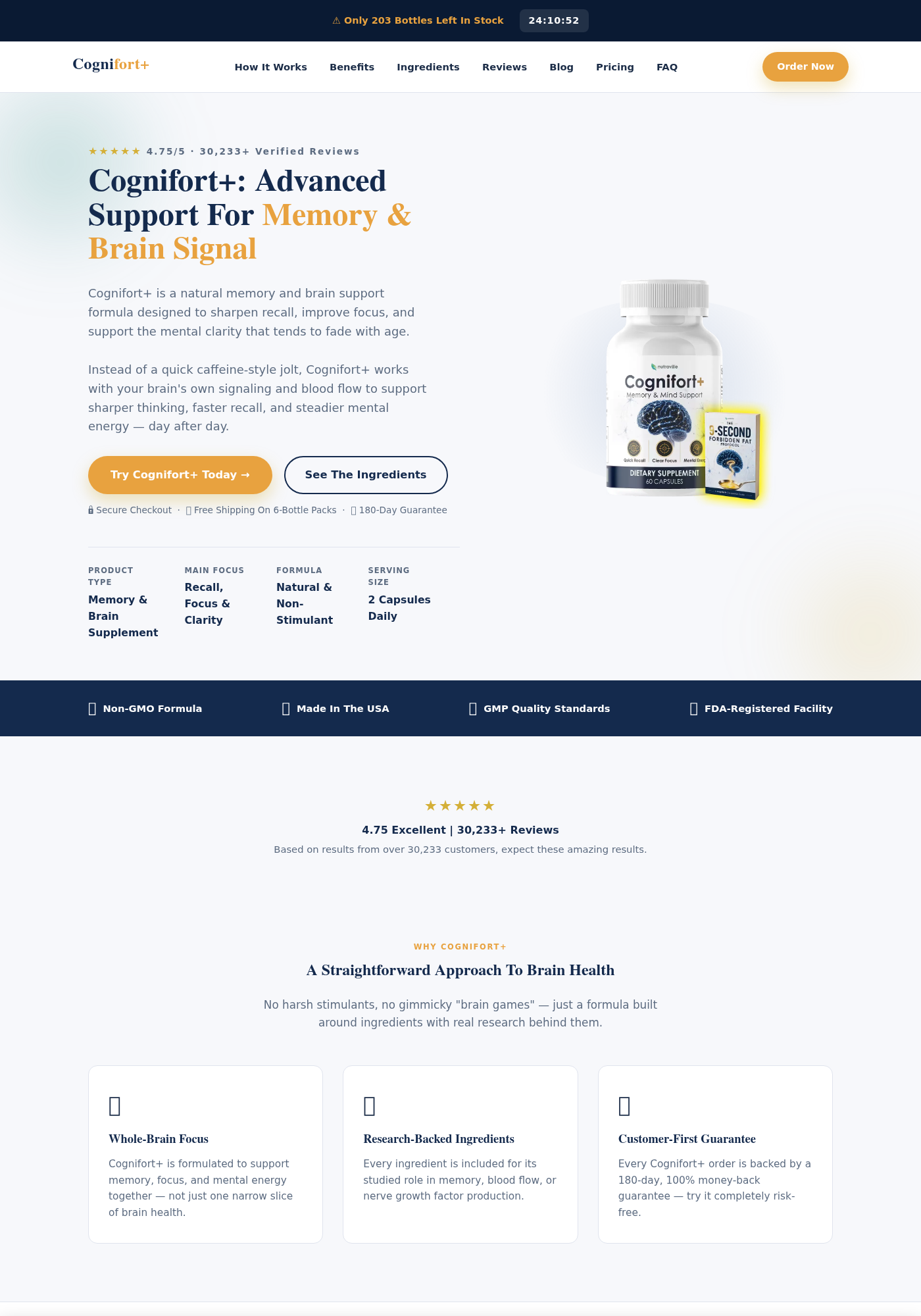
Cognifort+ arrives with the familiar look of a polished brain-support offer. Bottles, badges, discounts, and enthusiastic review numbers create an immediate sense of popularity.
The details become much less comfortable when the pages are read together. Several clues tell a different story from the confident sales presentation.
Overview
What Cognifort+ promises
Cognifort+ is marketed as a dietary supplement for memory, concentration, mental sharpness, and clearer thinking.
The page presents capsules containing familiar supplement ingredients and describes the formula as a convenient answer to brain fog and forgetfulness.
Visitors are encouraged to buy several bottles at once. The largest package is positioned as the preferred choice and carries the lowest advertised price per bottle.
The promotion also uses scientific language, laboratory-style badges, customer statistics, and a long refund promise to reduce hesitation.
Why the offer deserves careful scrutiny
None of those presentation techniques proves that the product is fraudulent. Problems emerge from contradictions between the promotional claims and the supporting pages.
The reviewed homepage claimed more than 30,233 verified reviews. Another section on the same site displayed a zero rating based on zero verified reviews.
The domain was registered on August 13, 2026. That short history sits awkwardly beside the enormous customer count presented as established social proof.
The page also moves between Cognifort+, Cognifort Plus, and a separate domain identified as the official website.
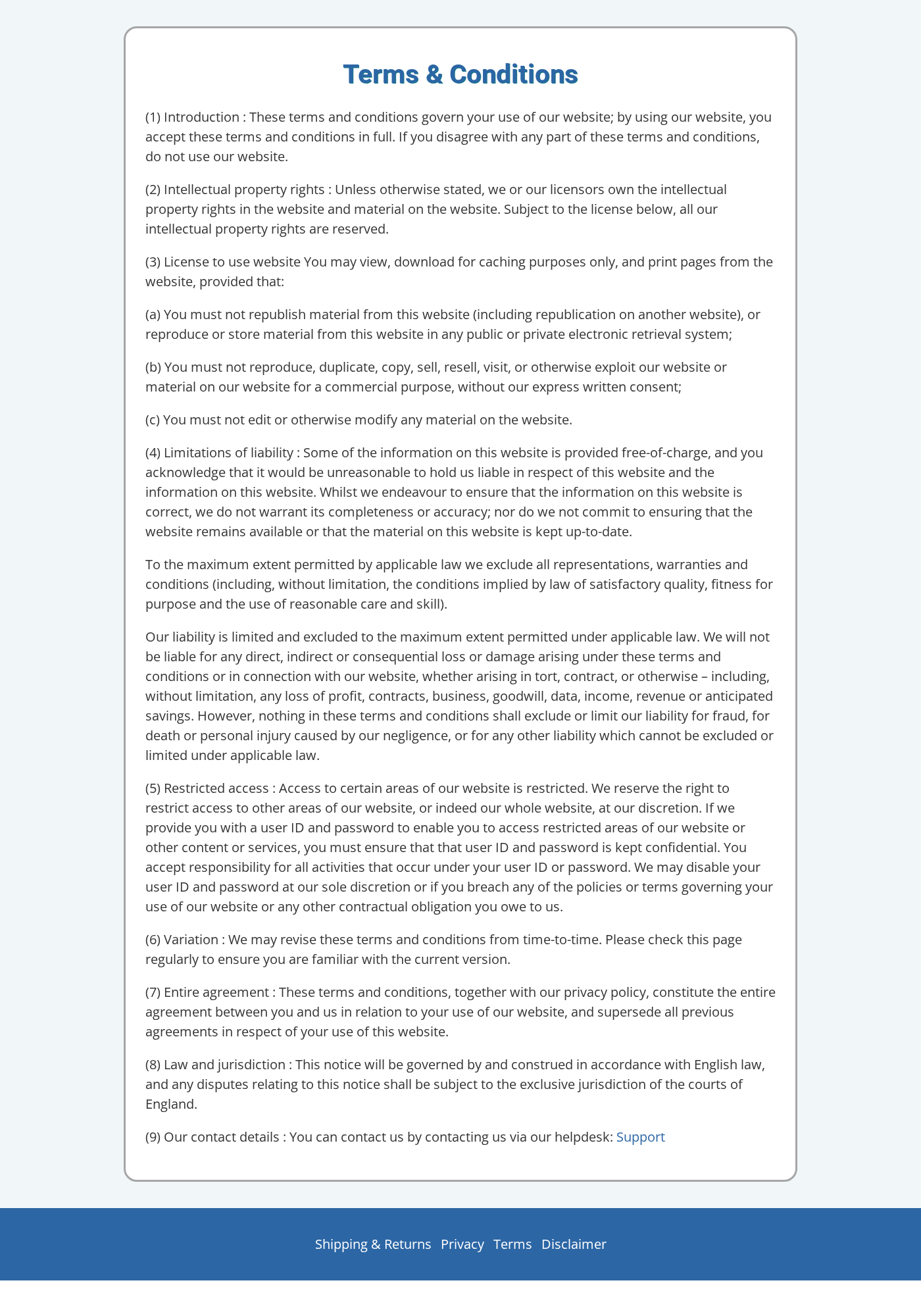
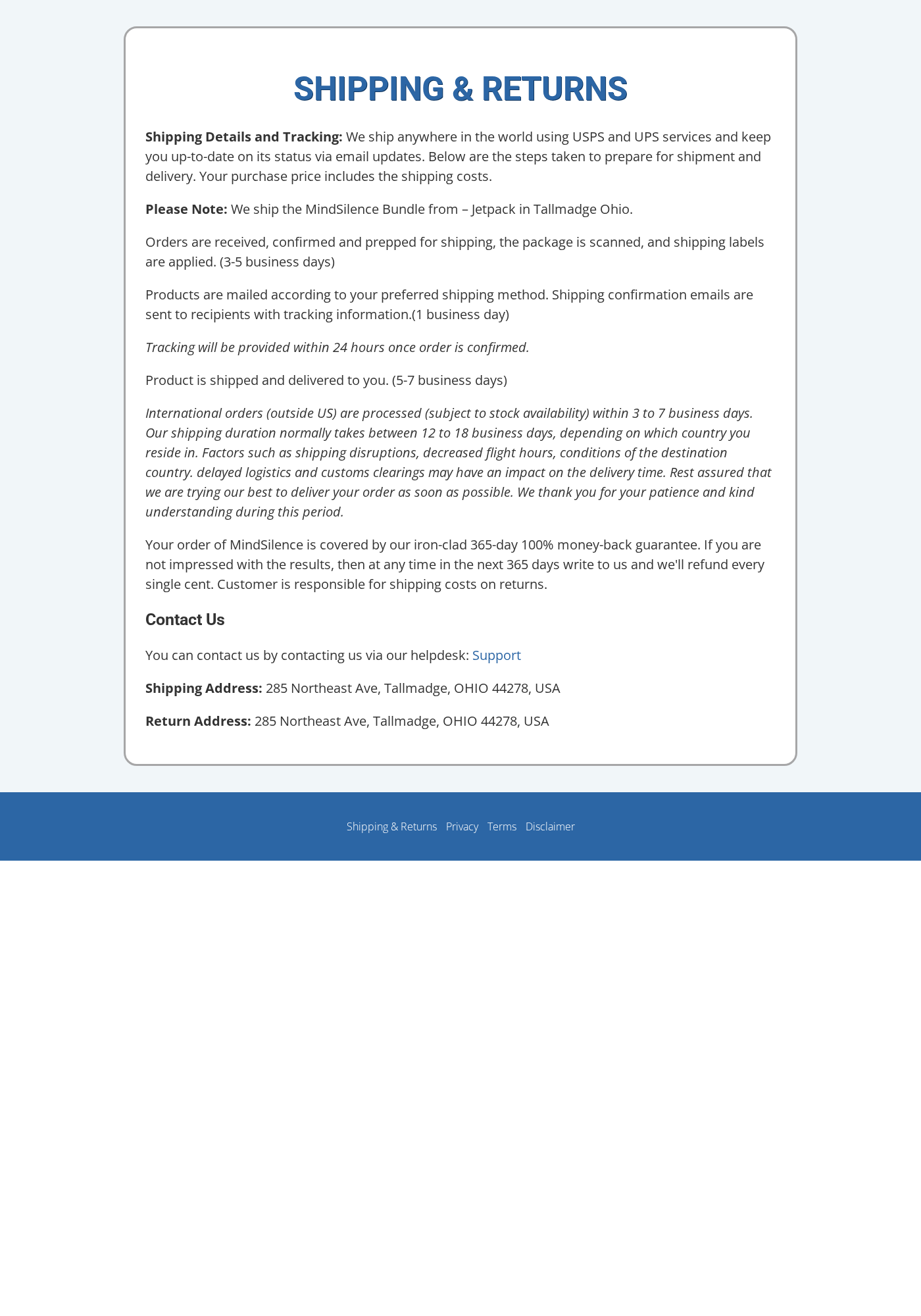
Most importantly, a shipping page on the order domain discusses an entirely different product named MindSilence.
What our investigation found
The evidence points to a rapidly assembled direct-response sales funnel with reused pages, unverifiable review claims, and incomplete company transparency.
- The reviewed domain had existed for only a little over one month.
- The page claimed 30,233 reviews while another rating component showed zero reviews.
- A countdown said only 203 bottles remained, without explaining how inventory was measured.
- The checkout route moved visitors onto a second Cognifort domain.
- The shipping policy named MindSilence instead of Cognifort+.
- No clear legal seller identity appeared across the reviewed sales and policy pages.
- Medical-sounding claims were not supported by accessible product-level clinical evidence.
These findings do not reveal what every capsule contains. We did not purchase or laboratory-test a bottle.
They do show that buyers are being asked to trust a sales system whose own pages fail basic consistency checks.
Is Cognifort+ Legit or a Scam?
We could not verify Cognifort+ as an established supplement sold by a clearly identified, accountable company.
The product may physically exist, and an order may produce a shipment. That alone would not make the advertising reliable or the purchase low-risk.
A trustworthy supplement seller should identify the legal business, publish coherent policies, and explain where the product is manufactured and tested.
It should also use review figures that visitors can inspect. Cognifort+ provides large numbers, but no independent review archive supporting them.
The MindSilence references are especially damaging. They indicate that important pages may have been copied from another funnel without proper correction.
That creates practical uncertainty. A buyer cannot know which guarantee, shipping promise, or support process actually governs the Cognifort+ purchase.
For those reasons, we consider the current Cognifort+ offer high risk and recommend avoiding it unless the seller supplies verifiable answers.
The Review Claims Do Not Withstand Scrutiny
A new domain claims an enormous customer history
The homepage displays more than 30,233 verified reviews and a 4.75 rating. Those numbers suggest a mature product with extensive sales history.
However, the domain registration dates to August 13, 2026. The short timeline does not automatically disprove every sale or imported customer relationship.
It does make the claim unusually difficult to accept without documentation. Thirty thousand verified reviews should leave a substantial, inspectable trail.
The site does not provide review dates, order verification details, moderation rules, or a complete archive that readers can independently examine.
The same page also reports zero verified reviews
Lower on the site, a rating component states zero out of five and says it is based on zero verified reviews.
That is not a minor wording difference. It directly conflicts with the large social-proof figure shown near the offer.
A legitimate explanation might involve a broken widget or an unfinished template. Even then, the seller should correct it before requesting payment.
When contradictory ratings remain live, buyers cannot determine whether any displayed testimonial count reflects real purchases.
Stock pressure is impossible to verify
The page announces that only 203 bottles remain. Scarcity messages encourage shoppers to act before researching the product or reading every condition.
No inventory source, timestamp, warehouse total, or refresh method is provided. The figure may simply be a static marketing element.
Try revisiting urgency claims in a private browser or on another day. If the same number returns, the message may not represent live stock.
The Product Story Raises More Questions
Precise promises need product-specific evidence
Cognifort+ uses neuroscience vocabulary and presents its ingredients as a coordinated answer to memory decline and mental fatigue.
Individual ingredients may have research in particular contexts. That does not establish that this exact mixture delivers the advertised result.
Reliable evidence would identify doses, study participants, methods, outcomes, funding, and the specific finished formula tested.
The reviewed pages did not provide a peer-reviewed clinical trial for the finished Cognifort+ product.
Facility badges are not product approval
The sales material uses phrases involving GMP standards and an FDA-registered facility. These phrases often sound more meaningful than they are.
Facility registration does not mean the FDA evaluated Cognifort+ for effectiveness. Dietary supplements are not preapproved like prescription medicines.
GMP language concerns manufacturing practices. It does not independently verify every marketing claim, ingredient amount, testimonial, or expected result.
Buyers should request a current certificate of analysis tied to the lot number they will receive.
The hearing references look misplaced
Parts of the page compare the offer with hearing aids and say Cognifort+ supports clear hearing.
Those references do not fit naturally within a memory-support presentation. They resemble content carried over from another health-product template.
Template contamination matters because it suggests the seller may not have carefully reviewed its own medical and product explanations.
If basic copy belongs to another category, confidence in more complex scientific passages should fall accordingly.
How the Cognifort+ Offer Works
Step 1: The page begins with a familiar health worry
The funnel focuses on forgotten names, reduced concentration, and the fear that ordinary lapses signal worsening cognitive health.
That framing makes the decision feel urgent and personal. It shifts attention from seller verification toward the hope of quick reassurance.
Step 2: A discovery story makes the formula feel exclusive
The copy describes a hidden or overlooked explanation for memory problems. It implies that conventional approaches miss something simple.
This story gives an ordinary supplement a sense of novelty. The reader is invited to believe the formula offers knowledge others suppressed or ignored.
Step 3: Large review totals manufacture confidence
Thousands of supposed buyers appear to confirm the product before the visitor has examined the formula or company.
The word “verified” is powerful because it implies completed transactions. The page does not show the system used to verify those transactions.
Step 4: Scarcity discourages comparison shopping
A low-stock counter creates the feeling that waiting may eliminate the opportunity. That pressure can shorten the buyer’s normal research process.
Consumers may skip domain checks, policy pages, medical advice, and price comparisons when a countdown makes delay feel costly.
Step 5: The largest bundle receives the strongest push
The one-bottle option costs $49 plus $9.99 shipping. Three bottles cost $117, while six are advertised for $174.
The six-bottle option is marked as the popular choice, and the page says 96% of customers select it.
That statistic encourages buyers to treat a high-quantity order as normal. It also increases the amount at risk before the product is tried.
Step 6: The customer crosses into another domain
The purchase route leaves the promotional domain and moves toward Cognifortplus.com. Domain changes can be legitimate, but they require extra checking.
Buyers should confirm that the product name, seller, guarantee, quantity, and final total remain identical after every redirect.
Step 7: Generic policies create uncertainty after payment
The terms do not clearly identify the legal entity responsible for the transaction. The shipping page discusses MindSilence and a different guarantee.
If an order goes wrong, those inconsistencies can complicate a refund request or card dispute.
Pricing, Bundles, and the Guarantee
The lowest headline price requires the biggest commitment
The advertised $29 price is per bottle within the six-bottle package. It is not the amount needed to place a complete order.
A shopper clicking from an advertisement may expect a $29 purchase, then discover a total of $174 before any applicable tax.
Always evaluate the complete transaction amount. Per-bottle figures can make a large commitment appear smaller than it is.
The guarantee language is inconsistent
The main promotion refers to a 180-day promise. The shipping page discusses a 365-day guarantee for MindSilence.
Those cannot both reliably describe the same Cognifort+ transaction without further clarification.
Before ordering, obtain written confirmation showing the exact refund window, return destination, required bottles, authorization process, and shipping responsibility.
“Risk free” rarely means cost free
A refund promise may exclude original shipping, return postage, taxes, expedited handling, or packages sent without authorization.
Customers may also need to return every bottle, including opened or empty containers. Missing packaging can become a reason to delay processing.
Keep screenshots of the offer and policy pages as they appeared on the purchase date.
The claimed popularity should produce an outside footprint
A supplement with tens of thousands of verified reviews would normally generate substantial independent discussion, retailer records, and customer-service history.
The seller-controlled number is not matched by an equally visible trail that shoppers can evaluate away from the checkout funnel.
That absence does not mathematically disprove every sale. It does make the review claim a poor basis for spending money.
Give greater weight to detailed, dated experiences that include ordering, delivery, usage, cancellation, and refund outcomes.
Company, Address, and Fulfillment Checks
The legal seller is not clearly disclosed
A brand name is not necessarily a company. Cognifort+ appears prominently, but the reviewed pages did not clearly name the contracting legal entity.
That omission makes it harder to research registration records, complaints, litigation, and accountability.
The address points to fulfillment activity, not proof of ownership
The shipping page lists 285 Northeast Avenue in Tallmadge, Ohio. That address is associated with fulfillment activity used by multiple product campaigns.
A warehouse can receive returns without owning, manufacturing, or scientifically validating the supplement.
The support trail is too thin
The policy routes customers toward a helpdesk instead of providing a clearly identified corporate office and complete escalation path.
Before paying, ask support to state the legal seller, return rules, guarantee length, recurring-billing status, and exact statement descriptor.
The supply chain remains unclear
The page does not let a shopper independently trace the finished product from ingredient sourcing through manufacturing and lot testing.
Some online supplements are private-label products sourced through mass-production networks. That model is not automatically unsafe or deceptive.
It becomes risky when the seller withholds the manufacturer, laboratory evidence, and accountable business identity.
What to Do if You Bought Cognifort+
- Save the entire transaction record. Keep the advertisement, landing page, checkout, confirmation, invoice, policy pages, tracking details, and every support message.
- Check the quantity and total immediately. Compare the receipt with the package selected. Report extra bottles or unexpected fees before the order ships.
- Ask for the governing policy in writing. Request confirmation of whether the 180-day or 365-day language applies to your Cognifort+ order.
- Request return authorization promptly. Do not mail bottles to an address found elsewhere. Obtain the approved destination and return instructions from support.
- Use tracked shipping. Photograph the bottles, packing slip, and sealed parcel. Keep the carrier receipt and delivery confirmation until the refund settles.
- Contact your card issuer when necessary. Explain any unauthorized quantity, undisclosed recurring charge, refused cancellation, or unprocessed eligible return using saved evidence.
- Speak with a medical professional. Stop using the supplement and seek advice if you experience symptoms or take medicines that may interact with ingredients.
- Secure the device used for payment. Run a Malwarebytes scan if the route involved suspicious downloads. AdGuard can reduce exposure to aggressive advertising and malicious redirects.
Frequently Asked Questions
Is Cognifort+ a proven memory treatment?
No product-level clinical evidence reviewed by us established Cognifort+ as a treatment for dementia, Alzheimer’s disease, or another medical condition.
Are the 30,233 Cognifort+ reviews genuine?
The site did not provide an independently inspectable archive supporting that figure. Its separate zero-review display makes the claim less credible.
Why does the shipping page mention MindSilence?
The likely explanation is reused or incorrectly adapted policy content. Regardless of intent, it prevents buyers from knowing which promises govern Cognifort+.
Does Cognifort+ enroll buyers in automatic refills?
We did not confirm a clearly disclosed autoship program in the reviewed checkout path. Buyers should inspect every checkbox and monitor statements after purchase.
Is the Tallmadge address the Cognifort+ headquarters?
No evidence reviewed by us established that. The address appears to function as a shipping or returns location, not proof of corporate ownership.
Can a 180-day guarantee make the purchase safe?
No. A guarantee matters only when its terms are coherent, the responsible company is reachable, and the seller actually processes qualifying refunds.
The Bottom Line
Cognifort+ combines persuasive health language with review totals, stock pressure, bundle pricing, and a lengthy guarantee.
The contradictory review counts, recent domain, unclear seller, and MindSilence policy references make the current offer too unreliable to recommend.
Do not let a polished bottle or large discount replace basic verification. Until the seller resolves these conflicts, keeping your money is the safer choice.








