

A fitted sheet that promises deeper sleep, less pain, and faster recovery sounds gentler than another pill, device, or complicated nighttime routine.
BareEarth packages that idea beautifully. The important questions begin after the calming imagery, when the health claims, product details, and return conditions are compared.
Overview
BareEarth is a real conductive bedding product
BareEarth sells sheets woven with cotton and conductive silver fibers. A cord connects the fabric to the ground port of a compatible wall outlet.
This is not a fictional product category. Grounding mats, mattress pads, pillowcases, and sheets are widely sold by numerous companies at very different prices.
The physical concept is measurable. Whether a sheet is conductive can be tested. Whether sleeping on it produces the advertised health outcomes is a separate question.
The marketing moves well beyond ordinary bedding
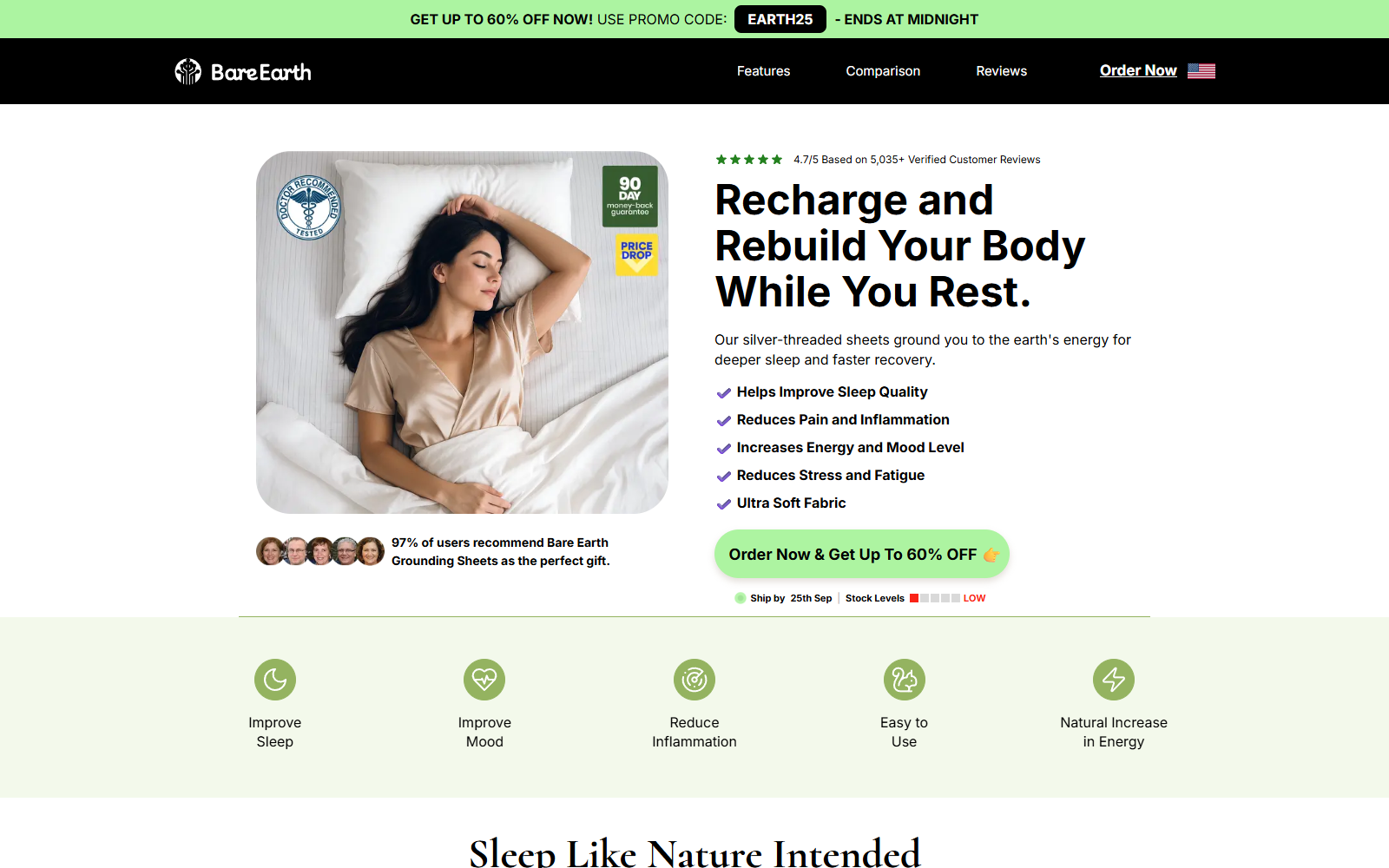
The sales page claims better sleep, reduced pain and inflammation, increased energy and mood, lower stress, and faster recovery.
It also uses phrases such as “Recharge and Rebuild Your Body” and “Sleep Deeper. Heal Faster.” Those statements create a stronger medical impression than simple comfort language.
Cleveland Clinic says earthing claims are not supported by high-quality research. Existing studies are often small, poorly controlled, or too preliminary for confident conclusions.
The return promise contains important restrictions
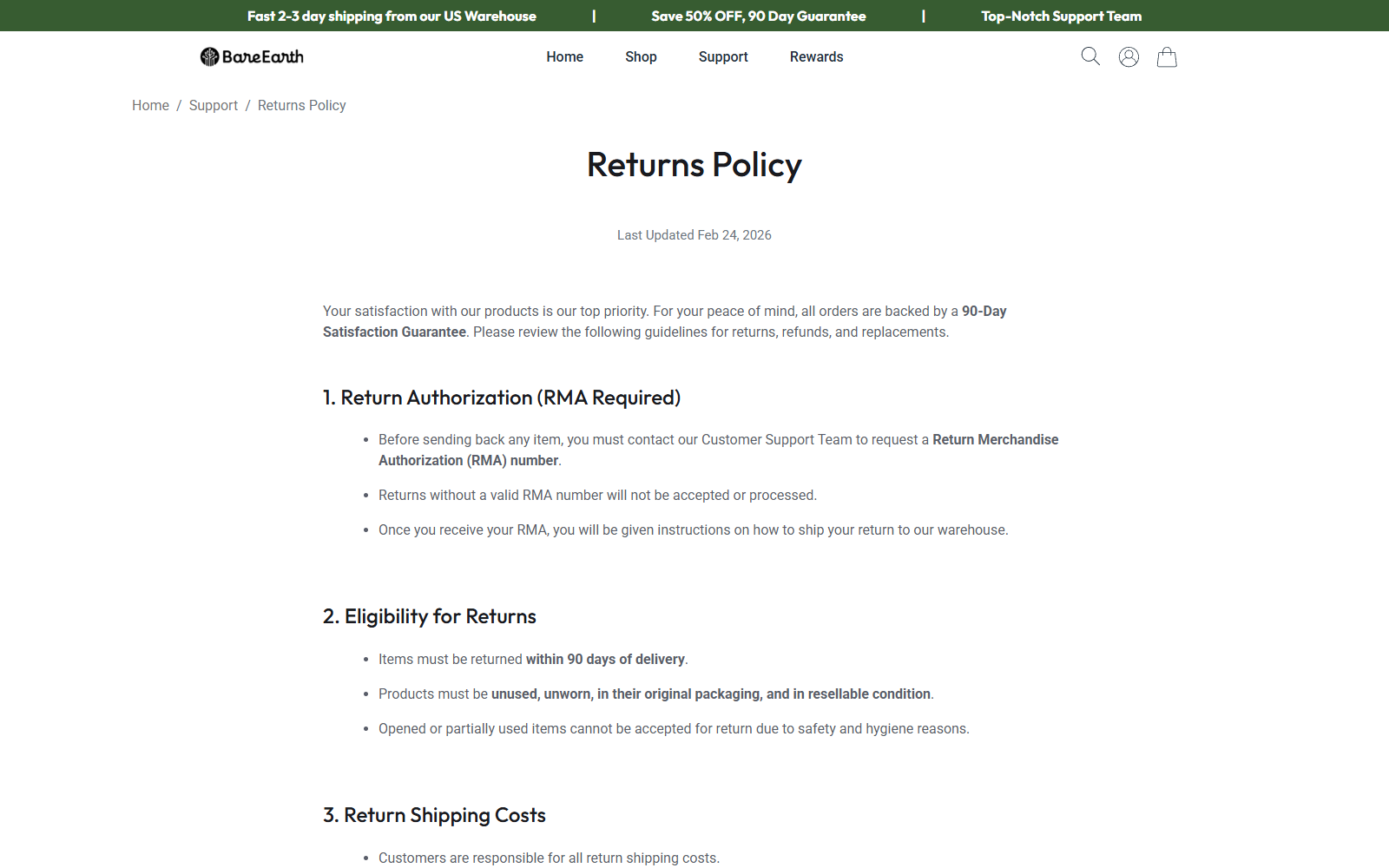
The storefront prominently advertises a 90-day money-back guarantee. The written policy says products must be unused, unworn, in original packaging, and resellable.
Opened or partially used products are excluded for safety and hygiene reasons. Customers also pay return shipping and must obtain a Return Merchandise Authorization first.
- The trial language sounds broader than the written eligibility rules.
- Using the sheet can remove normal return eligibility.
- Returns without an RMA will not be processed.
- A restocking deduction of up to 25% may apply.
- Damaged-item replacement requests must be made within seven days.
What BareEarth Grounding Sheets Are Supposed to Do
The sheet contains conductive material that touches the sleeper’s skin. Its cord connects to the grounding contact in a properly wired electrical outlet.
Supporters call this practice grounding or earthing. They believe contact with Earth’s electrical potential can influence inflammation, stress, sleep, recovery, or other biological processes.
The seller says the sheet uses 95% organic premium cotton and 5% conductive silver woven fabric. It advises avoiding bleach and fabric softener.
BareEarth also says direct skin contact is needed. Placing thick ordinary bedding over the conductive surface may reduce or prevent the intended connection.
A correctly installed grounding cord should not supply household current to the sheet. However, the outlet must be wired correctly, and damaged accessories should not be used.
People unfamiliar with electrical outlets should use an outlet tester or consult a qualified electrician. Never improvise adapters or insert connectors into uncertain sockets.
The product’s physical function does not automatically prove the health claims. Conductivity can be real while promised clinical effects remain uncertain.
This distinction is where many wellness reviews become unhelpful. They either dismiss the entire object or treat every biological claim as established because a meter detects continuity.
A responsible review separates construction, electrical connection, comfort, clinical evidence, advertising, customer service, and refund terms.
What the Research Can and Cannot Show
Small earthing studies have reported changes in sleep, pain, stress, recovery, or physiological markers. These findings are interesting but do not settle the question.
Study size matters. A result involving a small, selected group may not repeat in a larger population with different health conditions, homes, outlets, and expectations.
Blinding is difficult because participants can sometimes guess whether a grounding setup is active. Expectations can influence self-reported sleep, soreness, and mood.
Electrical grounding also varies between buildings. Soil conditions, wiring quality, equipment, moisture, and contact can change the physical environment.
Cleveland Clinic’s review notes that even promising evidence remains too limited for firm conclusions. Earthing should not replace evidence-based diagnosis or treatment.
BareEarth’s product page is more confident. It says multiple studies support reduced inflammation, improved sleep, and a calmer nervous system, calling the sheet “built on proven science.”
That wording overstates what the current evidence can establish for this specific branded product. No independent clinical trial of the exact BareEarth sheet was located.
Testimonials are not a substitute. Sleep changes naturally, pain fluctuates, and buyers who expect improvement may interpret ordinary variation as a product effect.
How the BareEarth Offer Works
Step 1: Social ads frame the sheet as a health breakthrough
Short advertisements focus on insomnia, chronic soreness, inflammation, fatigue, or recovery. These concerns reach far beyond whether a sheet feels comfortable.
Polished bedroom scenes and enthusiastic users make the product appear established. The origin of promotional models and testimonials is not independently documented on the page.
Attractive imagery is not evidence of fabrication, but it also does not prove that a pictured person bought the product or experienced the quoted result.
Step 2: The sales page stacks broad wellness benefits
Visitors encounter claims about sleep, pain, inflammation, energy, mood, stress, fatigue, and recovery in one compact section.
This stacking encourages buyers to imagine several problems improving at once. The page does not provide product-specific clinical data for each promised outcome.
A “doctor recommended” badge is displayed near the hero image, but the visible page does not identify the doctor, qualification, evidence review, or endorsement terms.
Step 3: Urgency pushes the shopper toward checkout
The page displays a promotion that ends at midnight, a low-stock indicator, a projected ship date, and discounts of up to 60%.
These devices make delay feel costly. Yet shoppers should compare the current price with conductive sheets from established retailers before accepting the reference discount.
A countdown or low-stock meter cannot answer whether the size, materials, connector, evidence, or policy fits the buyer.
Step 4: Affiliate pages blur which site is official
The product appears across multiple “official” review and promotional pages. Some are paid advertorials or affiliates that earn commissions when visitors purchase.
The BareEarth page itself discloses that it participates in affiliate marketing and names BareBranding Limited as an authorized marketing partner.
Buyers should identify which entity receives payment, which policy governs, and which contact handles returns. Similar branding across domains does not guarantee identical terms.
Step 5: The guarantee reduces hesitation
A 90-day satisfaction guarantee sounds like permission to sleep on the sheet and decide whether it helps. The actual policy creates a narrower path.
Opened or partially used items cannot be accepted for return. That makes a meaningful health-benefit trial difficult because testing the product requires opening and using it.
This tension should be disclosed beside the guarantee, not discovered after a buyer decides the sheet did not meet expectations.
Step 6: Returns depend on procedure and condition
Customers must request an RMA before shipping. The item must reach the specified warehouse with proof of purchase and in acceptable condition.
The customer pays return postage. Damage, use, missing parts, or lack of resellable condition can lead to a deduction of up to 25%.
These terms do not prove BareEarth is a scam. They do mean “money back” should not be interpreted as an unrestricted home trial.
Customer Complaints Deserve Serious Weight
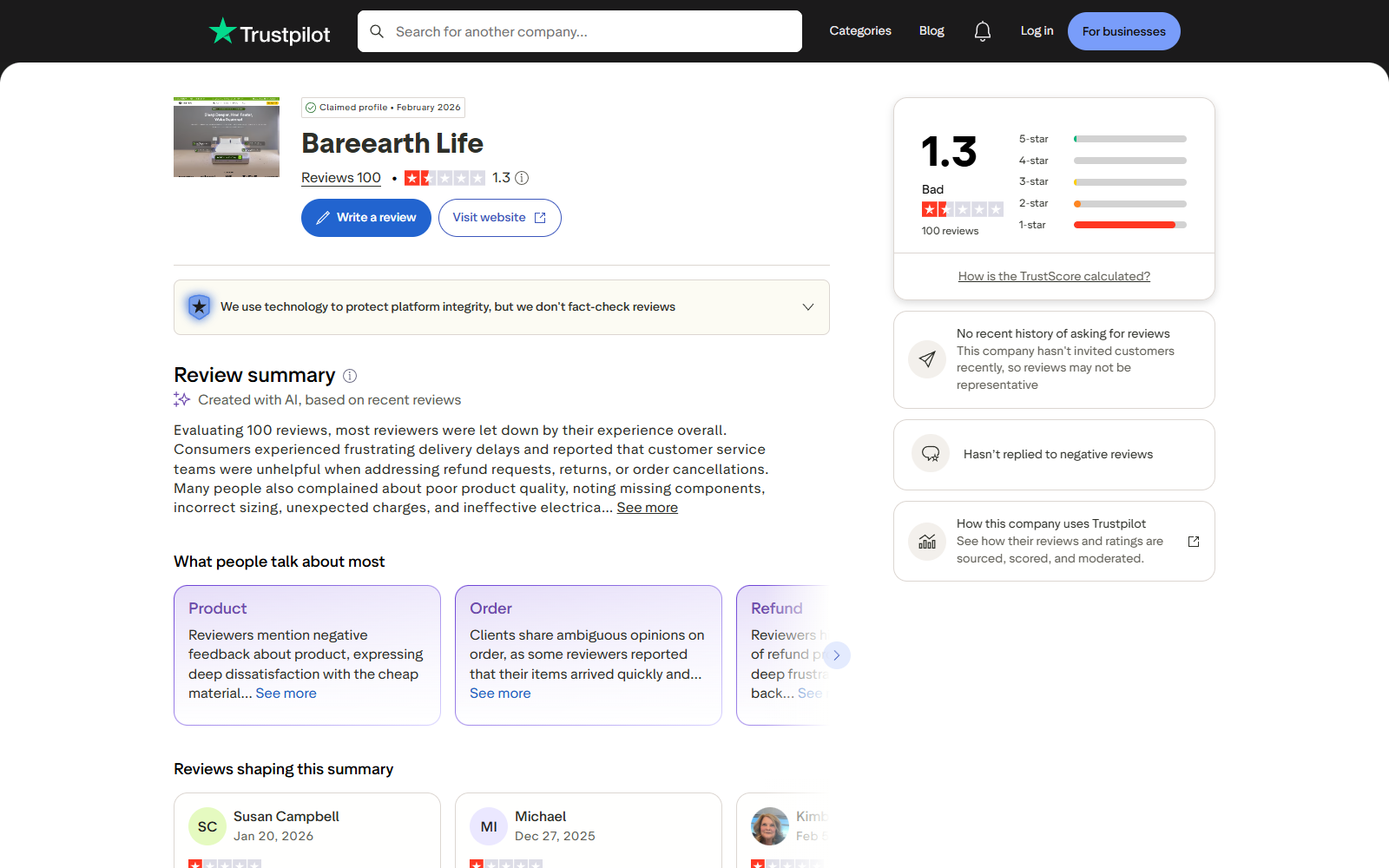
At the time of our review, Bareearth Life’s Trustpilot profile showed a 1.3 rating based on 100 reviews. Trustpilot notes that it does not fact-check individual reviews.
Reviewers reported delivery delays, product-quality problems, missing components, incorrect items, unexpected charges, poor communication, and difficulty obtaining refunds or cancellations.
Individual reports are allegations, not court findings. However, repeated complaints about the same operational problems are relevant when the store presents a frictionless guarantee.
Some reviewers said cables or connectors failed continuity checks. Others said components detached after washing or that the delivered color differed from the order.
Several complaints focus on return expense and policy interpretation. Those accounts align with written terms requiring customer-paid postage and excluding opened bedding.
A low review score does not prove every order fails. It does show buyers should document the product immediately and test all components before deadlines expire.
Company, Address, and Fulfillment Checks
The storefront names BareEarth, but not a clear legal entity
The contact page identifies “BareEarth” at 7233 Freedom Ave NW, North Canton, Ohio 44720. The visible terms repeatedly use the brand name.
A brand name is not necessarily the legal company accepting payment. Check the order confirmation and card statement for the precise merchant entity.
The address is a returns and logistics location
The return policy names “DLX Logistics Returns c/o AffiliateBrands” at the same address. That indicates a warehouse or fulfillment role.
A logistics address can legitimately process packages, but it does not establish the corporate headquarters, product designer, or textile manufacturer.
Contact channels exist, but timing matters
BareEarth publishes (330) 642-4364 and an email contact, with stated weekday hours. Use email for any material return or refund request.
Damaged-item replacement requests must be made within seven days. Photograph the unopened parcel, labels, sheet, cord, connector, and any visible defect immediately.
The manufacturing chain remains incomplete
The page describes cotton and silver fibers but does not clearly identify the textile factory, country of manufacture, independent electrical testing laboratory, or batch-level quality records.
Do not assume the sheets are made in China or any other country without evidence. The missing issue is traceability, not nationality.
Ask for the manufacturer, model number, material certification, electrical safety documentation, outlet requirements, and a method for testing conductivity after washing.
What to Check Before Ordering
- Confirm the exact legal merchant and statement descriptor.
- Ask whether opening the package ends return eligibility.
- Request the RMA procedure and return address in writing.
- Price tracked return shipping before purchasing.
- Verify the sheet size, pocket depth, color, and included adapter.
- Ask whether an outlet tester is included.
- Request the manufacturer, model, and independent safety documentation.
- Do not buy the sheet as a replacement for medical care.
The best time to resolve an ambiguous policy is before payment. A written answer can become important if the delivered item differs from the advertisement.
What to Do if You Have Fallen Victim to This Scam
- Photograph everything immediately. Capture the shipping box, label, packaging, sheet, connector, cord, adapter, color, size tag, and any damage.
- Test before extensive use. Follow the instructions and use an appropriate outlet tester. Do not use damaged cords or uncertain electrical connections.
- Read the current return policy. Save a dated copy showing the 90-day window, unused requirement, RMA rule, return postage, and possible deduction.
- Request an RMA in writing. Describe the problem, order number, delivery date, and desired resolution. Do not ship until instructions arrive.
- Use tracked shipping. Photograph the packed return, save the receipt, and monitor delivery. Keep proof that the warehouse received it.
- Monitor the refund deadline. The policy says approved refunds are typically processed within seven to ten business days after receipt.
- Contact the card issuer when necessary. If the merchant does not honor written terms, provide the advertisement, policy, correspondence, tracking, and photographs.
- Address unexpected billing. Ask the merchant and issuer about any charge you did not authorize. Review the order for rewards or added items.
- Check the device after suspicious redirects. Run Malwarebytes if the ad triggered downloads or browser changes. AdGuard can reduce repeated aggressive advertising.
- Report dangerous defects. Stop using the item and notify appropriate consumer-safety authorities if a cord, connector, or adapter creates an electrical hazard.
Stay calm and work from documents. A clear timeline, photographs, and written policy are more useful than an angry phone call with no record.
Do not misrepresent the item’s condition. Explain exactly when it was opened, tested, washed, or used, then challenge any policy contradiction with evidence.
Frequently Asked Questions
Are BareEarth Grounding Sheets a scam?
BareEarth appears to sell a real conductive sheet, so a blanket fake-product label is not justified. The health claims, restrictive returns, and complaint pattern raise serious concerns.
Do grounding sheets improve sleep or reduce inflammation?
Current research is limited and not strong enough to guarantee those outcomes. No independent clinical trial of the exact BareEarth product was located.
Can I test BareEarth for 90 days and return it?
The written policy says returns must be unused, unworn, unopened, and resellable. That sharply limits the practical meaning of a 90-day satisfaction trial.
Who pays for a BareEarth return?
The published policy assigns return shipping costs to the customer. It also requires tracked shipping and an RMA obtained before the parcel is sent.
Where are BareEarth returns shipped?
The policy lists DLX Logistics Returns c/o AffiliateBrands, 7233 Freedom Ave NW, North Canton, Ohio 44720. Obtain current written instructions before shipping.
Is it safe to plug the sheet into a wall outlet?
A proper grounding cord uses only the ground connection, but the outlet and accessory must be correct. Test the outlet and stop if anything is damaged or uncertain.
The Bottom Line
BareEarth is a real product wrapped in marketing that runs ahead of the evidence. Conductive fabric does not prove broad benefits for pain, inflammation, sleep, mood, or recovery.
The purchase risk becomes sharper at the return policy. Buyers expecting a 90-night trial may discover that opening and using the sheet removes ordinary refund eligibility.
Buy only after pricing the return, checking electrical requirements, documenting the seller, and accepting that the promised health improvements are not guaranteed.








