

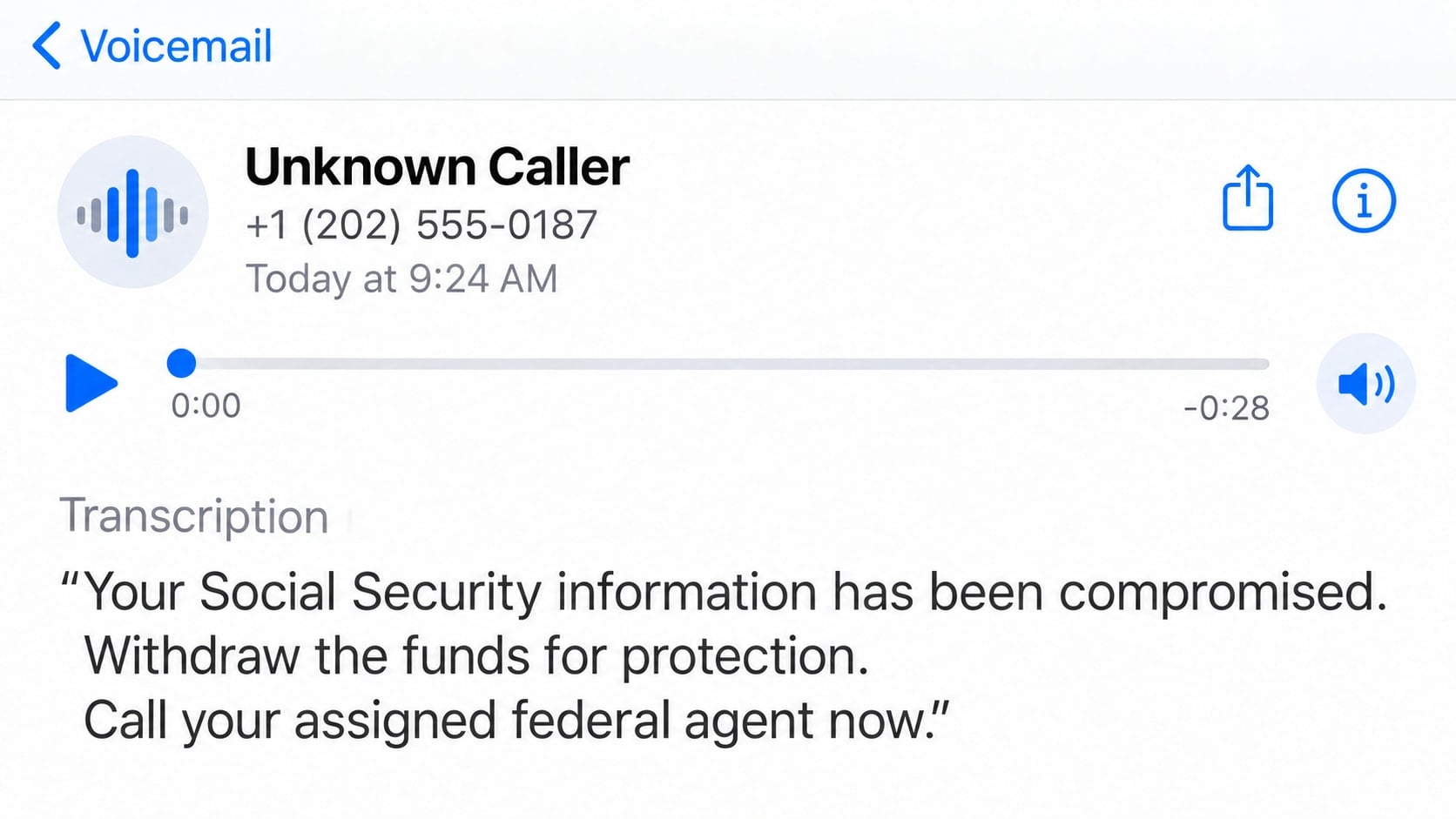
The caller says your identity has been compromised and federal authorities are already involved. There is one way to protect your savings, the voice insists: withdraw the money and follow the assigned agent’s instructions.
In Brighton, New York, that story moved beyond the telephone. A victim was directed to meet another person and hand over cash for a supposed new Social Security number.
Overview
The scam begins with a fake federal investigation
The Brighton federal agent scam starts when someone claims the victim’s Social Security number, bank account, or identity has been linked to criminal activity. The caller may pose as a federal investigator, Social Security official, or member of an identity-protection unit.
The contact can arrive by telephone, voicemail, text, or email. A badge number, case ID, official-sounding department, and personal details are used to make the invented investigation feel specific.
Moving the victim’s money is presented as protection
The impersonator says criminals can reach the bank account or that authorities are about to freeze it. To prevent loss, the victim must withdraw cash, buy gold, transfer funds, or place money in a temporary government-controlled location.
There is no protective account or lawful cash transfer. The instruction removes money from the safeguards of the banking system and places it directly under the criminal’s control.
An in-person courier can make the deception physically dangerous
Brighton Police reported that an unknown suspect impersonating a federal agent told a victim to withdraw funds and meet a second suspect near 2300 Elmwood Avenue. The cash was supposedly payment for a new Social Security number.
A meeting does not make the operation more legitimate. Federal authorities, the FTC, and Social Security officials warn that government employees do not send couriers to collect cash, gold, or other assets for safekeeping.
- An unexpected caller says your identity or Social Security number is tied to crime.
- You are told to keep the investigation secret from family and bank employees.
- The caller orders you to withdraw cash or move savings for protection.
- A badge image, employee number, or official caller ID is offered as proof.
- A courier or “agent” will collect money at your home or a meeting point.
- The caller claims payment is required to issue a new Social Security number.
What Happened in the Brighton Case
The Brighton Police Department listed the September 17, 2026 incident as grand larceny and criminal impersonation. According to the department’s public alert, the first unknown suspect claimed to be a federal agent.
The victim was instructed to withdraw money and meet another unknown suspect. The exchange took place in the area of 2300 Elmwood Avenue in Rochester, New York.
The supposed purpose was to pay for a new Social Security number after the victim’s information was described as compromised. That explanation conflicts with how Social Security records and replacement cards are actually handled.
The incident illustrates an important change in government impersonation fraud. The criminal may no longer stop at a wire, gift card, or cryptocurrency transfer. A second participant can appear in person to take cash or another asset.
How the Brighton Federal Agent Scam Works
Step 1: A caller announces an identity emergency
The scammer claims the victim’s Social Security number was found in an investigation, used to open fraudulent accounts, or connected to money laundering and drug trafficking. The story creates fear before the victim can evaluate its details.
Sometimes the first caller pretends to be from a bank, retailer, or technical-support company. The conversation then escalates and is “transferred” to a supposed federal agent who can protect the victim.
Step 2: Fake credentials make the caller sound official
The impersonator provides a name, badge number, case number, and office location. Caller ID may show an agency name or a real government telephone number because the displayed information can be spoofed.
Photos of credentials, formal letters, seals, and legal language may arrive by text or email. The Social Security Administration warns that federal law enforcement will not send pictures of badges or credentials to demand payment.
Step 3: The victim is isolated from anyone who could interrupt
The caller says the investigation is confidential and warns that telling relatives, bank employees, or local police could compromise the case. The victim may be ordered to stay on the telephone throughout the withdrawal.
Isolation serves a practical purpose. A teller, family member, or officer would recognize that a government agent does not protect money by asking a citizen to remove it from the bank.
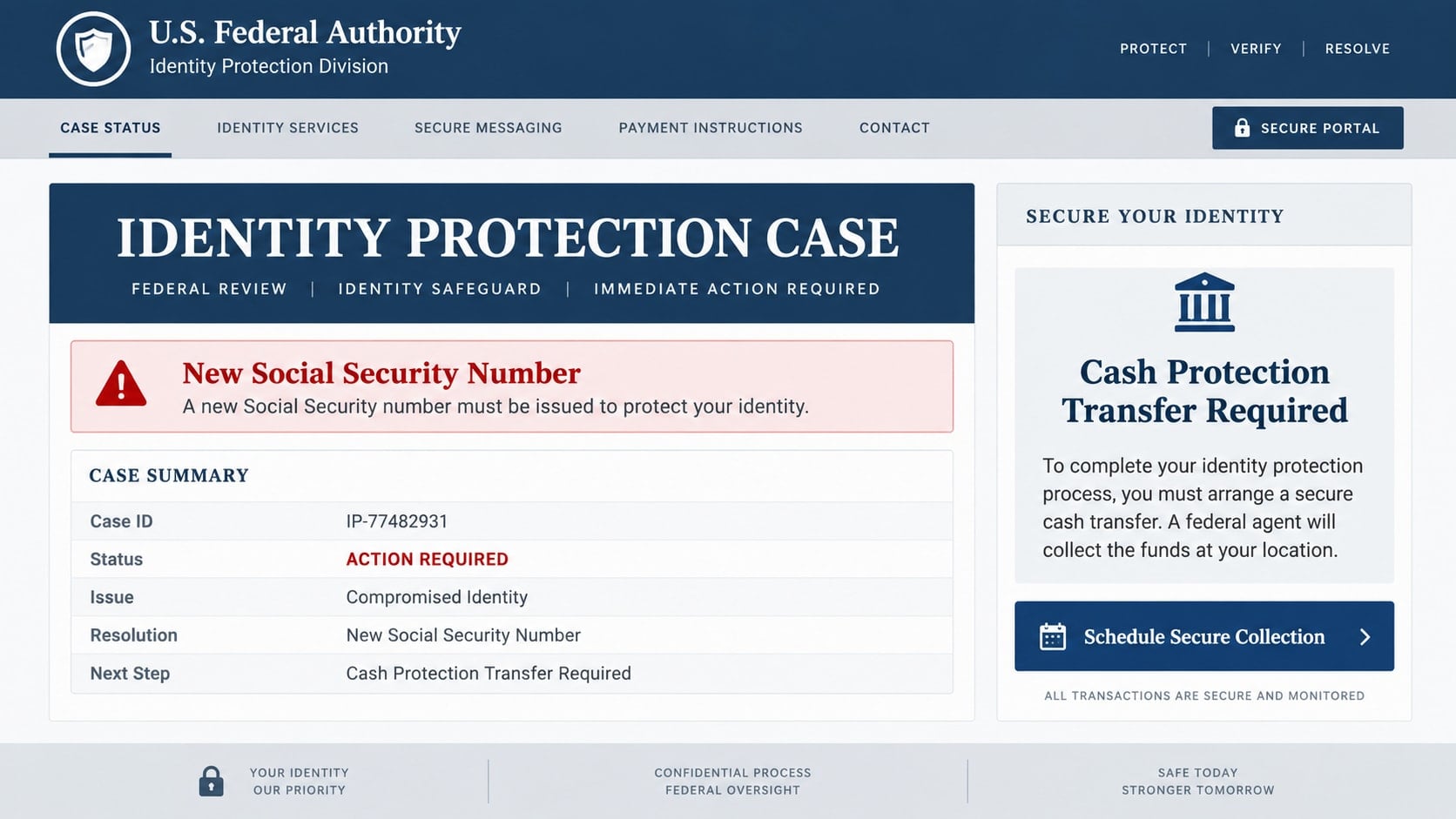
Step 4: A fake portal or document creates a protection plan
The victim may receive a link showing an identity-protection case, compromised account list, or transfer instructions. The page can use flag colors, official typography, a lock symbol, and an invented federal authority.
It may say a new Social Security number has been authorized after a cash protection transfer. A webpage controlled by the caller can display any case status or approval; it does not connect the victim to a government record.
Step 5: The victim withdraws money for a physical handoff
The caller instructs the victim to request cash without explaining the true reason to the bank. A cover story such as a home project, vehicle purchase, or family expense may be supplied if a teller asks questions.
A second suspect then meets the victim at a parking area, residence, or agreed location. The courier may know a code word or case number given by the caller, making the exchange appear coordinated and secure.
Step 6: The criminals delay discovery and may demand more
After collecting the cash, the impersonator promises replacement documents, a protected account, or confirmation from another department. The victim is told to wait and remain silent while the case is processed.
Another call may claim that a second account is compromised or that taxes are due on the protected funds. The first loss becomes evidence that the victim can be pressured again.
Identity, Contact, and Payment Checks
End the contact and verify the agency separately
Do not use a number, link, or extension supplied by the caller. Hang up, find the agency through USA.gov or its official .gov site, and call a published number yourself.
If the caller claims to be handling a local matter, contact the police department directly. Brighton Police can be reached through contact information published on its official government site, not through an incoming call.
Treat caller ID and badge images as unverified claims
A call can display the real name or number of a government office while originating elsewhere. A badge image can be copied, altered, or generated, and a real employee’s name can be borrowed from a public page.
Verification must occur through an independent channel. Do not ask the suspected impersonator to transfer you to a supervisor because that person can be another member of the same operation.
Reject every request to move money for safekeeping
The FTC states that government employees will not tell people to transfer money to protect it, withdraw cash, buy gold, or give assets to someone. The FBI likewise says federal agencies do not demand money while threatening arrest.
This rule applies even when the caller says the transfer is temporary or refundable. Money handed to a courier has left your control regardless of the label placed on the envelope.
Confirm Social Security issues through SSA channels
The SSA says that if there is a problem with a Social Security number or record, it typically sends a letter. It does not suspend an SSN or require cash payment for a new one.
Open a personal my Social Security account by navigating to SSA.gov yourself, or call the administration through its published number. Never give an unexpected caller a password, security code, or full SSN to perform that check.
Why the Cash Courier Changes the Risk
A remote payment can be dangerous, but an in-person exchange adds a physical safety concern. The victim does not know who will arrive, whether that person is carrying a weapon, or who else may be watching the location.
Do not confront or follow a courier. If a meeting has been arranged, move to a safe location and contact local police. Tell the dispatcher that an unknown person is expected to collect cash as part of a government impersonation scam.
Do not attempt to stage a private recording, retrieve the money, or hold the suspect. Preserve the messages and follow law-enforcement instructions.
Bank employees may ask questions when a customer makes an unusual cash withdrawal. The scammer often anticipates this and supplies a lie. Honest answers can give the bank an opportunity to pause the transaction and contact its fraud team.
Claims About a New Social Security Number
A stolen identity can create real problems, but paying a caller does not erase or replace the underlying number. Social Security number changes are limited, formal matters handled directly by the SSA under specific conditions.
A government employee does not sell a new number, require a protection deposit, or send a stranger to collect the fee. A replacement Social Security card also does not require handing cash to an investigator.
If identity information was exposed, the appropriate response is to secure accounts, review credit, report identity theft, and contact the SSA through official routes when its records are affected.
Criminals use the promise of a new number because it seems like a complete solution. In reality, the victim receives no protection and may reveal enough personal information to enable additional fraud.
What to Do if You Have Fallen Victim to This Scam
- Get to a safe place and contact local police. If a courier is nearby or a meeting is scheduled, do not confront anyone. Tell police where the exchange occurred or is expected and follow their instructions.
- Call the bank immediately. Explain that cash was withdrawn because of a federal-agent impersonation scam. Ask the fraud team to secure the account, flag unusual activity, and preserve withdrawal records or relevant branch video.
- Preserve every identifying detail. Save voicemail, texts, email, portal URLs, telephone numbers, case IDs, names, vehicle descriptions, meeting instructions, and the location and time of the handoff. Write down details while they are fresh.
- Report the federal impersonation. File reports with the FTC and FBI’s Internet Crime Complaint Center. For Social Security-related claims, use the SSA Office of the Inspector General reporting process.
- Protect credit and identity records. If the caller received an SSN, driver’s license, birth date, or other identity data, place fraud alerts or security freezes and create a recovery plan through IdentityTheft.gov.
- Secure email, banking, and government accounts. Change exposed or reused passwords from a trusted device, enable multi-factor authentication, sign out unfamiliar sessions, and review recovery settings.
- Tell institutions about security codes. If any one-time code was shared, read its original message to the bank or agency. It may have approved a login, transfer, password reset, or digital-wallet enrollment.
- Run a full Malwarebytes scan. If the fake agent directed you to a portal, download, browser extension, or remote-support program, update Malwarebytes and scan the device. Remove confirmed threats before using it for sensitive accounts again.
- Use AdGuard as an additional phishing barrier. AdGuard can block many known scam domains, malicious advertising routes, and deceptive redirects. It cannot identify a person at a cash meeting, so independent verification remains essential.
- Warn trusted relatives about recovery attempts. Criminals may call again as police, attorneys, or asset-recovery specialists. Do not pay an upfront fee or reveal details to anyone who contacts you unexpectedly and guarantees recovery.
Frequently Asked Questions
Did Brighton Police confirm this federal agent scam?
Yes. Brighton Police publicly reported a September 17, 2026 grand larceny and criminal impersonation incident involving a fake federal agent, a cash withdrawal, and an in-person handoff near Elmwood Avenue.
Will a federal agent tell me to withdraw cash for protection?
No. Federal agencies do not protect funds by ordering cash withdrawals or sending a courier. End the call and independently contact the claimed agency or local police.
Can the government issue a new Social Security number for a cash fee?
No legitimate agent collects cash for a new SSN. Social Security number matters are handled directly through the SSA under formal rules, not through a caller and street-level exchange.
What if caller ID showed a real government number?
Caller ID can be spoofed. Hang up and place a separate call using contact information from an official .gov website. Do not use a number the caller sends afterward.
Should I meet the courier so police can catch that person?
Do not arrange or conduct a private confrontation. Contact local police, explain the scheduled meeting, and follow their safety instructions.
Can I recover cash already handed to a fake agent?
Cash recovery is difficult, but report the incident immediately. Detailed timing, location, communications, descriptions, and banking records may help investigators identify the people involved.
The Bottom Line
The Brighton federal agent scam combines a frightening identity story with an order to withdraw savings and hand the cash to another person. Official-looking credentials and a coordinated courier do not turn that demand into a government procedure.
No real federal agent will sell a new Social Security number or collect money for safekeeping. End contact, verify through official channels, and call local police if any in-person exchange has been arranged.








