

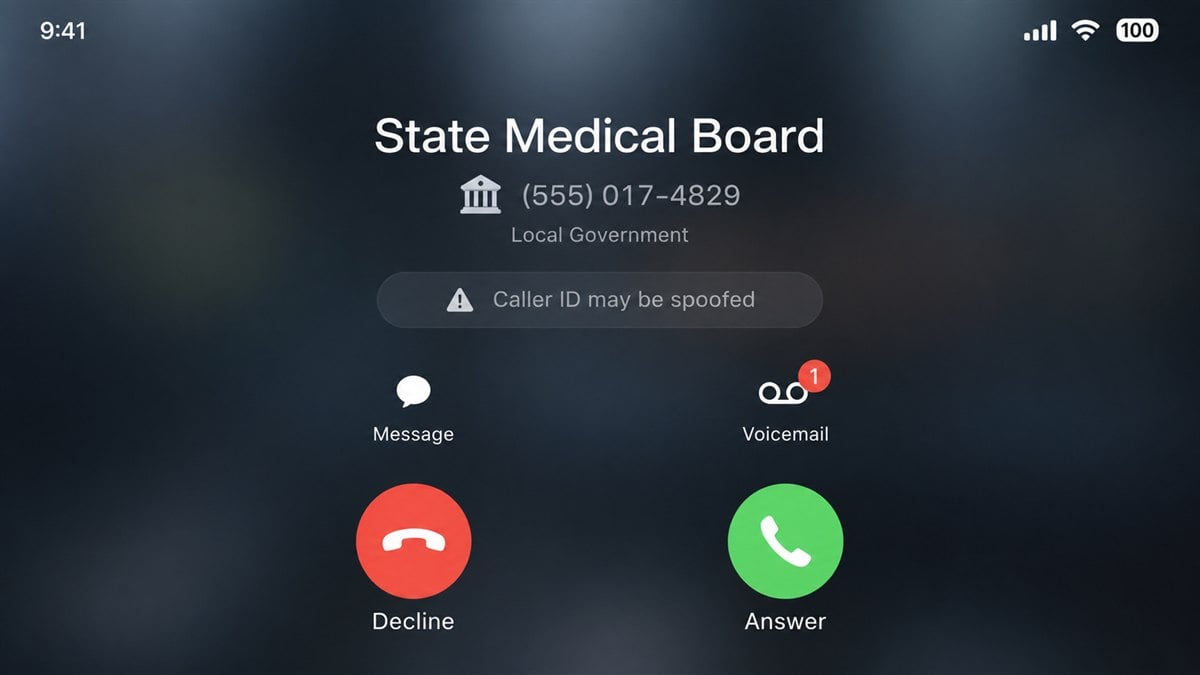
The caller knows your profession, license type, and perhaps the number printed beside your name in the state registry. He says the credential is expiring, suspended, or connected to a criminal investigation.
Then the choice is framed in brutal terms: cooperate now and protect your career, or hang up and lose the right to work.
The caller ID, badge number, and official language may look convincing. The demand that follows is where the story reveals its real purpose.
Overview
The FBI confirmed a large professional-license extortion problem
The FBI says scammers impersonating government and law-enforcement officials are targeting medical practitioners and other licensed professionals. The caller may claim a license is expiring or was used in a crime, then threaten revocation unless money is paid.
Between January 2025 and July 2026, the FBI’s Internet Crime Complaint Center received 3,322 complaints involving this targeted type of fraud. Reported losses exceeded $37 million.
Public license data makes the call sound private
Many professional registries show a practitioner’s full name, credential, license number, status, issue date, employer, city, or disciplinary history. A criminal can read those records during the call.
Knowledge of the license is not proof that the caller works for the board. It proves only that the caller found information intended for public verification.
The payment method exposes the lie
The operator demands prepaid cards, cryptocurrency, a wire, cash through a kiosk, or money collected by a courier. The payment is described as a bond, penalty, renewal, security deposit, or temporary escrow.
- A spoofed call appears to come from a board or police agency.
- The caller quotes real public licensing information.
- An invented violation or criminal case creates fear.
- The victim is told to stay on the phone and remain silent.
- A fake notice or badge supports the story.
- Immediate payment supposedly prevents suspension or arrest.
- Additional fees appear after the first transfer.
A genuine regulator may contact a license holder about a real matter. It will not force an unverified payment through gift cards, cryptocurrency, or a courier while forbidding independent confirmation.
How the Professional License Extortion Scam Works
Step 1: A licensed professional is selected
Doctors, nurses, pharmacists, therapists, dentists, veterinarians, accountants, attorneys, contractors, and other regulated workers are attractive targets because a license is tied directly to income and reputation.
Public registries and business pages help the criminal choose someone whose workplace, specialty, and credential can be discussed accurately.
Step 2: Caller ID is spoofed
The call may display the real number of a licensing board, sheriff, police department, federal agency, or courthouse. Caller ID information can be forged and is not a secure identity check.
The operator may invite the victim to search the number while remaining on the line. That search confirms the agency’s real number, not the location of the person currently using it.
Step 3: A serious allegation is introduced
The caller says the license expired, a renewal failed, controlled substances were ordered in the practitioner’s name, or the credential appeared in money laundering, prescription fraud, or another crime.
The story is chosen to make the victim defend both legal innocence and professional competence. Ordinary questions can then be portrayed as refusal to cooperate.
Step 4: The caller isolates the victim
The target is told not to speak with coworkers, family, a lawyer, the bank, or local police because the matter is confidential. The caller may insist that the line remain connected while the victim drives to a bank or cryptocurrency kiosk.
Isolation prevents the short outside conversation that would expose the scam. It also lets the criminal hear whether a teller, colleague, or family member intervenes.
Step 5: Fabricated documents make the case visible
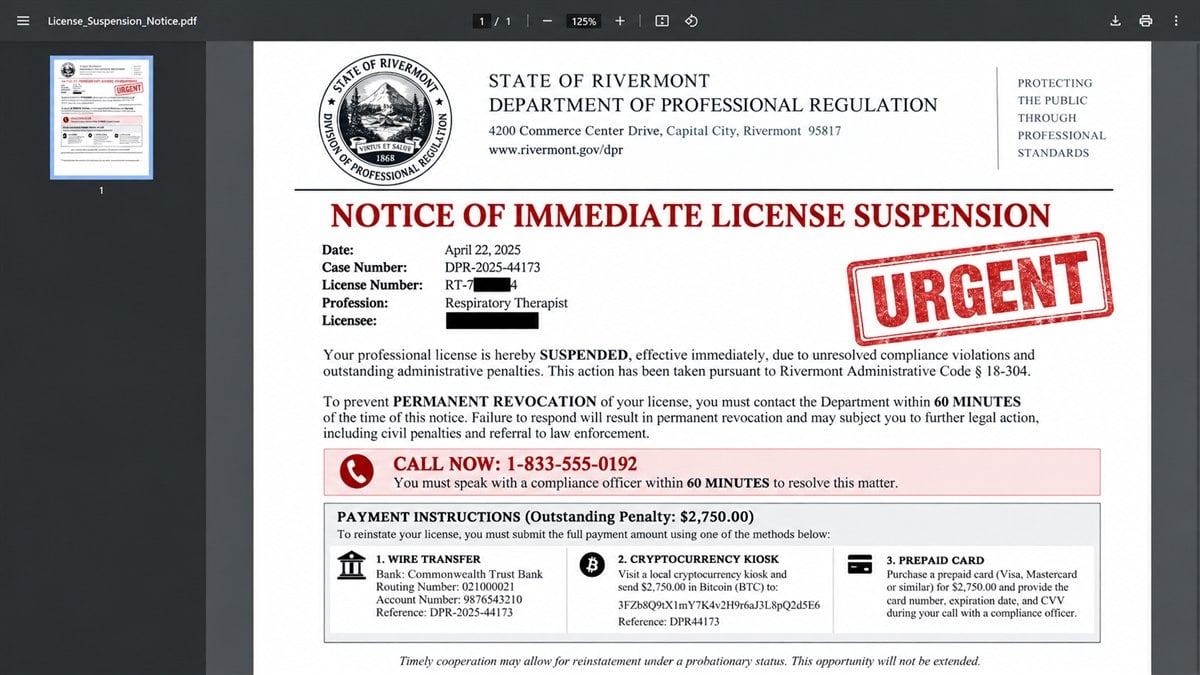
A PDF can show a state seal, license number, case reference, official address, signatures, and a notice of immediate suspension. Video callers may wear uniforms or sit in a mock government office.
The FBI warns that criminals use artificial intelligence and staged environments to strengthen government impersonation. A polished document or video is still a claim that must be verified outside the call.
Step 6: A temporary payment supposedly protects the license
The money may be described as a refundable bond, credential safeguard, renewal payment, court deposit, or proof that the professional is cooperating. The caller promises that it will be returned after the investigation.
Payment methods favor speed and poor reversibility. Prepaid cards, cryptocurrency kiosks, wires, and cash couriers are not normal emergency tools for resolving a license case.
Step 7: The first payment creates a second emergency
After money is sent, another official may call with a new fee. The transfer was supposedly coded incorrectly, tax is due, the bond must cover another jurisdiction, or the victim must pay to keep the matter sealed.
The criminal relies on sunk cost and fear. Paying again feels like protecting the first payment and the career, but it only increases the loss.
The Scale of the Confirmed Government Impersonation Campaign
The professional-license scheme sits inside a much larger extortion problem. In its September 17, 2026 public service announcement, the FBI reported nearly 61,000 complaints about law-enforcement or government impersonation between January 2025 and July 2026.
Those complaints represented more than $1.6 billion in reported losses. The FBI says unsolicited phone calls are the main contact method, although text messages and emails are also used.
Scammers spoof phone numbers, email addresses, employee names, and credentials. They speak urgently, refuse to discuss the matter with anyone except the target, keep the victim on the phone, and demand secrecy.
The targeted medical-professional variant is especially damaging because it combines a criminal accusation with the threat of losing a livelihood. The $37 million in reported losses shows that this is not an isolated prank call.
The FBI’s rule is clear: government and law-enforcement officials will not demand payment or sensitive information by telephone or text. They will not request prepaid cards, cryptocurrency, or a courier.
Company, Address, and Fulfillment Checks
The agency number must be dialed independently
Hang up. Find the licensing board through an official state government website and call the published number yourself. Do not press a key to transfer and do not call a number in a PDF or text sent by the operator.
If the caller warns that hanging up means arrest or suspension, that pressure is itself evidence that the independent check is necessary.
The license record must be checked in the official portal
Sign in through a bookmarked or independently typed state portal. Review status, expiration, renewal history, messages, and any disciplinary action.
Do not let the caller guide the login or watch through remote-access software. A real account check should remain under your control.
The employee and case must exist outside the call
Ask the board or agency to confirm the employee name, badge or staff number, case reference, office, and delivery method. A criminal can invent a number or borrow the name of a real official.
Formal action should have a traceable record and lawful notice process. It should survive verification after the incoming call ends.
The payment recipient and method must be legitimate
A regulator does not protect a license by sending a professional to a retail cryptocurrency kiosk or asking for prepaid-card numbers. A personal wire beneficiary or cash pickup is equally incompatible with an official proceeding.
Call the bank before moving money. Fraud staff recognize government impersonation patterns and may stop a transfer that fear has made difficult to evaluate.
Why Professionals Still Get Caught
Expertise in medicine, law, finance, or another licensed field does not include immunity to a well-timed threat. The scam targets a responsibility the professional takes seriously and introduces unfamiliar legal procedure under pressure.
The victim may also fear that asking coworkers for help will disclose an allegation that later harms reputation. Confidentiality language turns professional caution into isolation.
Public data creates a false sense of access. When the caller knows a license number and workplace, it is easy to assume the information came from an internal case file. In reality, the same details may be visible to any patient, client, employer, or criminal.
The staged escalation is carefully designed. A calm investigator begins the call, an aggressive supervisor adds consequences, and a payment officer explains the alleged solution. Multiple voices make the operation feel like an institution.
A similar pressure pattern appears in fake arrest-warrant messages. The safest response is the same: end the contact and verify through a channel the sender did not provide.
Warning Signs of a Fake License Board Call
- The call is unexpected and immediately threatens suspension, revocation, or arrest.
- Caller ID matches a real agency, but the caller resists a callback through the official switchboard.
- Public license information is presented as proof of inside access.
- You are ordered to stay on the line.
- The caller says the investigation is secret and cannot be discussed with anyone.
- A PDF or video meeting replaces normal written notice and appeal procedures.
- A refundable bond must be paid before verification.
- The payment uses crypto, prepaid cards, a wire, cash, or a courier.
- You are told to mislead a bank teller about the purpose of the withdrawal.
- Another official calls immediately when you hesitate.
No badge number, official seal, or accurate license detail cancels those warning signs. Authentication must happen through the agency’s independent records.
If the Caller Has Not Asked for Money Yet
Do not wait for the payment demand to decide whether the call is real. Early questions may collect a date of birth, Social Security number, home address, banking relationship, or information used to reset professional accounts.
End the call before confirming or correcting personal details. Contact the board, employer security team, and relevant law-enforcement agency through known channels.
Preserve voicemail, texts, email, PDFs, call time, caller ID, and the words used in the allegation. Investigators can use that record without requiring you to continue the conversation.
What to Do if You Have Fallen Victim to This Scam
- Stop contact and payment. Do not send the next bond, tax, correction, or release fee, regardless of what the caller threatens.
- Contact the real licensing board. Use its official state website. Confirm your current license status and report the impersonation.
- Notify the payment provider. Call the bank, wire service, gift-card issuer, cryptocurrency exchange, or kiosk operator immediately and request any available hold or recall.
- Report to law enforcement. File with local police and the FBI at IC3.gov. Include telephone numbers, wallet addresses, wire recipients, documents, and communications.
- Protect professional accounts. Change exposed portal, email, prescription, billing, and cloud passwords. End unknown sessions and enable strong multifactor authentication.
- Tell the employer or practice. A security, compliance, or legal team can protect related systems and warn other staff who may receive the same call.
- Secure identity data. If Social Security, driver’s license, or financial information was shared, place suitable fraud alerts or credit freezes and monitor accounts.
- Remove remote access. Disconnect any remote-control tool installed at the caller’s request. From a clean device, change passwords and run a complete Malwarebytes scan.
- Block malicious follow-ups. AdGuard can reduce known phishing pages and scam advertising, but it cannot identify a spoofed voice call or replace board verification.
- Get legal advice when needed. If the scammer filed documents, accessed patient or client data, or created a real compliance issue, consult qualified counsel promptly.
Frequently Asked Questions
Can a licensing board call about a real problem?
It may contact a license holder, but an incoming call should be verified through the board’s official switchboard and portal before information or money is provided.
Why did the caller know my license number?
Professional license numbers and status details are often public. Knowing them does not prove the caller has access to a confidential case.
Does a real agency number on caller ID prove anything?
No. Caller ID can be spoofed. Hang up and dial the agency number found independently on an official government website.
Would a real board ask for a refundable bond?
Not through gift cards, cryptocurrency, a personal wire, or a courier during an unexpected call. Verify any legitimate fee in the official portal.
Should I stay on the line while I verify the caller?
No. The caller may overhear or disrupt the verification. End the call and use a separate device and independently sourced contact details.
What if the threat mentions a genuine criminal case?
Do not discuss or pay through the caller. Contact the named agency and your licensing board independently, and seek legal counsel if a real matter exists.
The Bottom Line
Fake license-board calls turn public professional information into a private-looking threat. The FBI’s complaint and loss figures confirm that criminals are using the tactic at scale.
Do not be embarrassed by how specific the story sounds. The license details may have been copied from the same registry patients and employers use. Treat secrecy, constant phone contact, and irreversible payment as evidence of manipulation, not as features of a special investigation.
Your career is best protected by ending the call, checking the official license record, and contacting the real board. A legitimate process can be verified after you hang up. An extortion scam depends on preventing that moment.








