

A vacuum backpack looks like the perfect answer to airline limits. One quick pump appears to turn a bulky wardrobe into a neat carry-on.
SpaceVac Pro rode that visual appeal through short videos and dramatic capacity claims. The product is real, but the offer needs more context.
Overview
Vacuum compression backpacks are genuine products
SpaceVac Pro is not an impossible invention. The bag combines an expandable backpack with a sealable compartment that can be compressed using a small pump.
Removing air reduces the volume of soft clothing. It does not reduce weight, protect every item, or guarantee that an expanded bag meets airline limits.
Similar designs appear under many marketplace names. The underlying concept is widely sold and is not exclusive to one viral storefront.
The viral brand was difficult to separate from generic inventory
The reviewed campaign presented SpaceVac as a distinctive travel innovation. Current marketplace listings use the same name for products described as generic or sold by unrelated merchants.
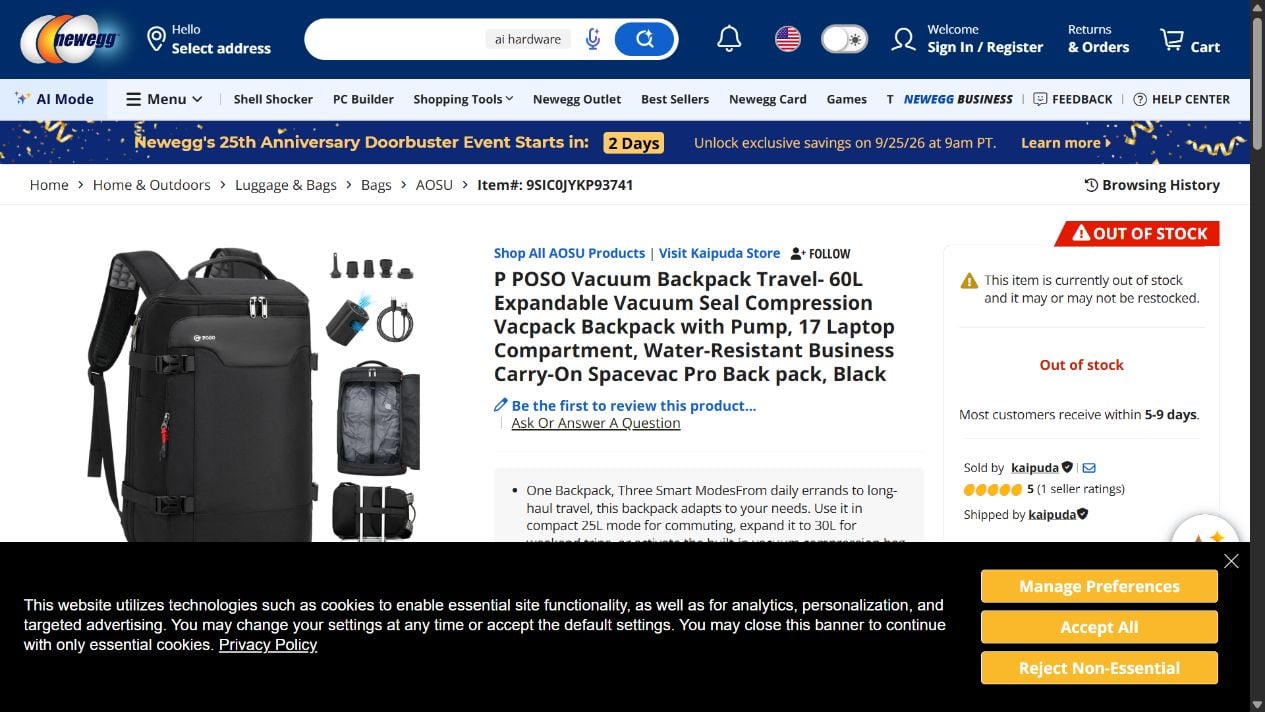
One current Newegg listing identifies the item as P POSO, references Spacevac Pro in the title, and names a marketplace seller rather than a dedicated manufacturer.
This does not prove counterfeiting. It shows why buyers should evaluate the actual seller, specifications, and return coverage instead of trusting the viral name alone.
The original seller presence has become unstable
A previously indexed Concepta product page advertised SpaceVac with a 30-day return promise. That domain no longer resolved during our live check.
An Amazon listing found in search results also returned a missing-page screen when opened. Other marketplace listings remain, often with different capacity and price claims.
Disappearing product pages make support and warranty enforcement harder. They do not establish fraud by themselves, but they increase after-sale risk.
- The vacuum-compression concept is real and mechanically plausible.
- Compression reduces bulk, not luggage weight.
- Many sellers use similar names and images.
- Capacity claims vary between roughly 25L and 60L.
- The former direct-store page was unavailable during review.
- Marketplace protection depends on the specific listing and seller.
Is the SpaceVac Pro Backpack a Scam?
Calling every SpaceVac Pro backpack a scam would be inaccurate. Real vacuum backpacks exist, and current marketplace listings show physical products with pumps and compression chambers.
The more defensible warning concerns white-label marketing. Similar bags are sold under changing names, by different merchants, at widely different prices.
A buyer can therefore receive a working bag while still being disappointed by materials, pump strength, usable capacity, airline fit, or return support.
Some viral stores present ordinary marketplace goods as exclusive breakthroughs. That framing can inflate perceived value and hide the importance of seller identity.
The name also overlaps with an established industrial high-level cleaning brand. Those professional SpaceVac systems are unrelated to a consumer travel backpack.
No evidence justifies accusing that industrial company of involvement in the travel-bag campaign. Shared wording can simply confuse search results.
Our conclusion is practical. SpaceVac Pro describes a real product type, but buyers face brand ambiguity, unstable sales pages, variable specifications, and uncertain support.
What Vacuum Compression Actually Does
Clothing contains trapped air between fibers and folds. A one-way valve and pump remove part of that air, shrinking the sealed compartment.
Compression works best with sweaters, jackets, and other soft items. Shoes, electronics, toiletries, and rigid objects gain little from vacuum sealing.
The bag may become denser and less flexible after compression. A compact-looking backpack can still exceed an airline’s weight limit.
Advertised liters can also be misleading. Some sellers quote expanded external volume, while others describe the compressed chamber or total bag capacity.
A claim that 50% more fits inside does not mean every traveler gets that result. Fabric type, folding, pump seal, and compartment layout change the outcome.
Vacuum pressure can wrinkle clothing and strain zippers. A failed valve or punctured liner may eliminate the signature feature during a trip.
Airline carry-on rules vary by carrier and ticket. A seller cannot truthfully guarantee acceptance on every route, aircraft, or fare class.
How the SpaceVac Pro Marketing Funnel Works
Step 1: A dramatic packing demonstration stops the scroll
Short videos show a large stack of clothing entering one bag. The user closes a seal, activates a pump, and watches the volume collapse.
The before-and-after image is immediately understandable. It delivers a stronger sales impression than measurements or material specifications.
Viewers may not see editing, precompressed garments, omitted weight, or the bag’s final dimensions after every compartment is filled.
Step 2: The product is framed as an airline-fee solution
Sales pages promise more packing space and fewer checked-bag charges. This connects the backpack with a clear financial pain point.
Compression may help organization, but airlines measure external dimensions and weight. A dense 60L load is unlikely to become acceptable merely because air was removed.
Travelers should compare the fully packed measurements with their carrier’s current rules, including handles, straps, and bulging pockets.
Step 3: Large capacity numbers create a premium impression
Listings describe 25L, 30L, 40L, 50L, or 60L modes. Those figures are difficult to compare without a standardized test.
One seller may measure every compartment at maximum expansion. Another may repeat a supplier description without independently verifying it.
The exact dimensions, empty weight, zipper quality, pump specification, and warranty are more useful than a headline liter figure.

Step 4: Scarcity and social proof reduce comparison shopping
Viral product stores often use countdowns, limited stock notices, and large view totals. These elements encourage an immediate decision.
Testimonials may praise the bag’s capacity without discussing months of zipper use, airline enforcement, pump reliability, or return experience.
Because near-identical bags exist elsewhere, pausing to compare listings is particularly valuable. Urgency mainly benefits the seller.
Step 5: Bundles and accessories increase the final charge
The bag may be offered with a pump, upgraded pump, lock, packing cubes, protection plan, or extra units.
A low headline price can rise after selecting the version shown in the advertisement. Some listings exclude the electric pump from the cheapest configuration.
Read the included-components field and final cart. Confirm color, size, pump, charger, cable, and quantity before payment.
Step 6: After-sale rights depend on the merchant
A marketplace, direct store, and social-media checkout can sell similar bags under different rules. The product name does not create one universal warranty.
The current Newegg listing directs buyers to the marketplace seller for warranty information and shows a 30-day return period.
If a direct-store domain disappears, customers may lose the easiest support route. Payment records and marketplace protection then become more important.
The White-Label Question
White-label products are manufactured for resale under multiple names. This business model is common and is not inherently deceptive.
Problems arise when a seller claims exclusive invention, invents a dramatic origin story, or hides that equivalent products cost much less elsewhere.
SpaceVac-style backpacks appear through generic marketplace listings with similar dimensions, pumps, colors, photographs, and descriptions.
That pattern suggests buyers are comparing sellers and quality-control arrangements, not choosing between fundamentally different technologies.
A responsible seller should identify the manufacturer, model, materials, testing, warranty provider, and replacement-pump availability.
If those details are absent, the safest assumption is that branding alone does not guarantee better construction.
Quality and Travel Risks Buyers May Miss
The vacuum liner is a wear component. Sharp objects, overloaded seams, rough zipper use, and repeated folding can damage the seal.
An electric pump adds another failure point. Travelers should know its voltage, battery capacity, charging connector, and airline rules for spare lithium batteries.
A backpack holding compressed clothing may become unusually heavy. Thin shoulder straps and weak stitching matter more when the bag carries a dense load.
Water-resistant fabric does not make zippers, seams, electronics, or the vacuum chamber fully waterproof. Marketing often blurs those categories.
A TSA-style lock on a bag does not mean the entire product is approved by the Transportation Security Administration.
Finally, a 60L expanded pack usually exceeds common personal-item dimensions. Even carry-on acceptance must be checked against the airline’s exact limit.
The pump also occupies usable space and adds another item to charge. A manual valve may require a compatible vacuum when the electric unit fails.
Compressed clothes expand when the chamber opens. Travelers need enough room to repack the bag before the return journey.
Warranty coverage should include seams, valves, pumps, and liners separately. A broad one-year warranty can hide exclusions for vulnerable components.
Company, Address, and Fulfillment Checks
The direct seller’s current identity is difficult to verify
The indexed Concepta page offered SpaceVac and published a support email. During our live check, the domain no longer resolved.
A vanished storefront does not prove every order failed. It means the direct seller’s current support, company, and warranty status cannot be confirmed there.
Marketplace listings identify sellers, not one universal manufacturer
The Newegg page names kaipuda as seller and shipper while the title begins with P POSO. Other listings describe the product as generic.
Buyers should record the merchant shown on their exact listing. A shared product name does not make different sellers responsible for one another.
Addresses and warehouses may change between listings
Marketplace fulfillment, seller registration, and return warehouses can be in different places. The listing should state who handles returns and where the item ships.
Do not infer origin from a `.com` domain, $ pricing, or familiar storefront design. Request the manufacturing country if it matters to the purchase.
The industrial SpaceVac company is a separate business
Search results also show SpaceVac International, which sells professional high-level vacuum-cleaning systems and carbon-fiber poles.
We found no evidence connecting that industrial company with the viral compression backpack. Consumers should avoid sending travel-bag complaints to an unrelated business.
What to Check Before Ordering a SpaceVac Pro Backpack
Confirm the fully expanded exterior dimensions, empty weight, realistic capacity, fabric composition, zipper brand, liner material, and maximum recommended load.
Verify whether the electric pump is included. Ask about voltage, charging port, battery type, replacement availability, and airline carriage rules.
Compare identical-looking listings using photographs, dimensions, and component layouts. Do not compare only the brand names.
Read the seller’s return conditions for used luggage. Testing the vacuum chamber may affect whether the item is considered new.
Ask who pays return shipping for size disappointment, pump failure, torn seams, or a listing that differs from the delivered product.
Check independent reviews for long-term zipper, valve, liner, and strap performance. First-day packing demonstrations cannot reveal durability.
Use a payment method with dispute rights. Save the listing because social-media stores and marketplace pages can disappear.
Test the packed bag at home before travel. Walk with it fully loaded and confirm that seams, straps, and the compressed chamber remain stable.
Keep a backup compression bag or packing method. A broken pump should not leave clothing impossible to repack during the return journey.
What to Do if You Have Fallen Victim to This Scam
- Document the listing immediately. Save the seller name, product title, dimensions, included pump, quantity, price, return window, warranty, and promised delivery date.
- Photograph the unopened parcel. Capture the shipping label, package condition, weight, seals, and every item before testing the bag.
- Compare delivered specifications. Measure the bag, identify the pump, count accessories, and record any branding or model number on the labels.
- Test cautiously. Avoid overfilling. Record video of a leaking valve, failed pump, broken zipper, or liner that cannot hold compression.
- Contact the actual seller. Use the marketplace order page or receipt, not an unrelated SpaceVac company found through search.
- Request return authorization. Ask who pays postage, whether testing affects eligibility, where the parcel goes, and when the refund will be issued.
- Escalate through the platform. If the merchant stops responding, open the marketplace claim before its deadline and provide your evidence.
- Contact the card issuer when justified. Report non-delivery, unauthorized quantity, or materially different goods accurately and within the dispute period.
- Protect your browser. Scan with Malwarebytes after suspicious downloads. AdGuard can block malicious ads, pop-ups, trackers, and repeat redirect funnels.
Frequently Asked Questions
Does the SpaceVac Pro backpack really compress clothing?
Yes. A sealed compartment and pump can remove air from soft clothing. Results depend on the seal, fabric, packing method, and bag quality.
Does vacuum compression reduce luggage weight?
No. It reduces volume, not mass. Fitting more clothing into the bag can make it heavier and more likely to exceed airline limits.
Is SpaceVac Pro one identifiable brand?
The name appears across generic and marketplace listings from different sellers. Buyers should identify the exact merchant, model, and manufacturer.
Will every airline accept it as carry-on luggage?
No seller can guarantee that. Acceptance depends on the bag’s packed dimensions, weight, airline, aircraft, route, fare, and enforcement.
Why did the original product page disappear?
The previously indexed direct-store domain no longer resolved during review. We cannot determine from that fact alone why the storefront became unavailable.
Is the travel backpack connected to SpaceVac industrial cleaners?
We found no evidence of a connection. The industrial company sells professional high-level cleaning systems, not viral compression travel bags.
The Bottom Line
SpaceVac Pro is a real type of vacuum-compression backpack, not imaginary technology. It can reduce clothing bulk when the seal and pump work.
The risk lies in unstable storefronts, generic sourcing, variable specifications, exaggerated airline claims, and support that changes with each seller.
Compare the actual model, measure before flying, and preserve the listing. Buy the merchant and return policy, not only the dramatic packing video.








