

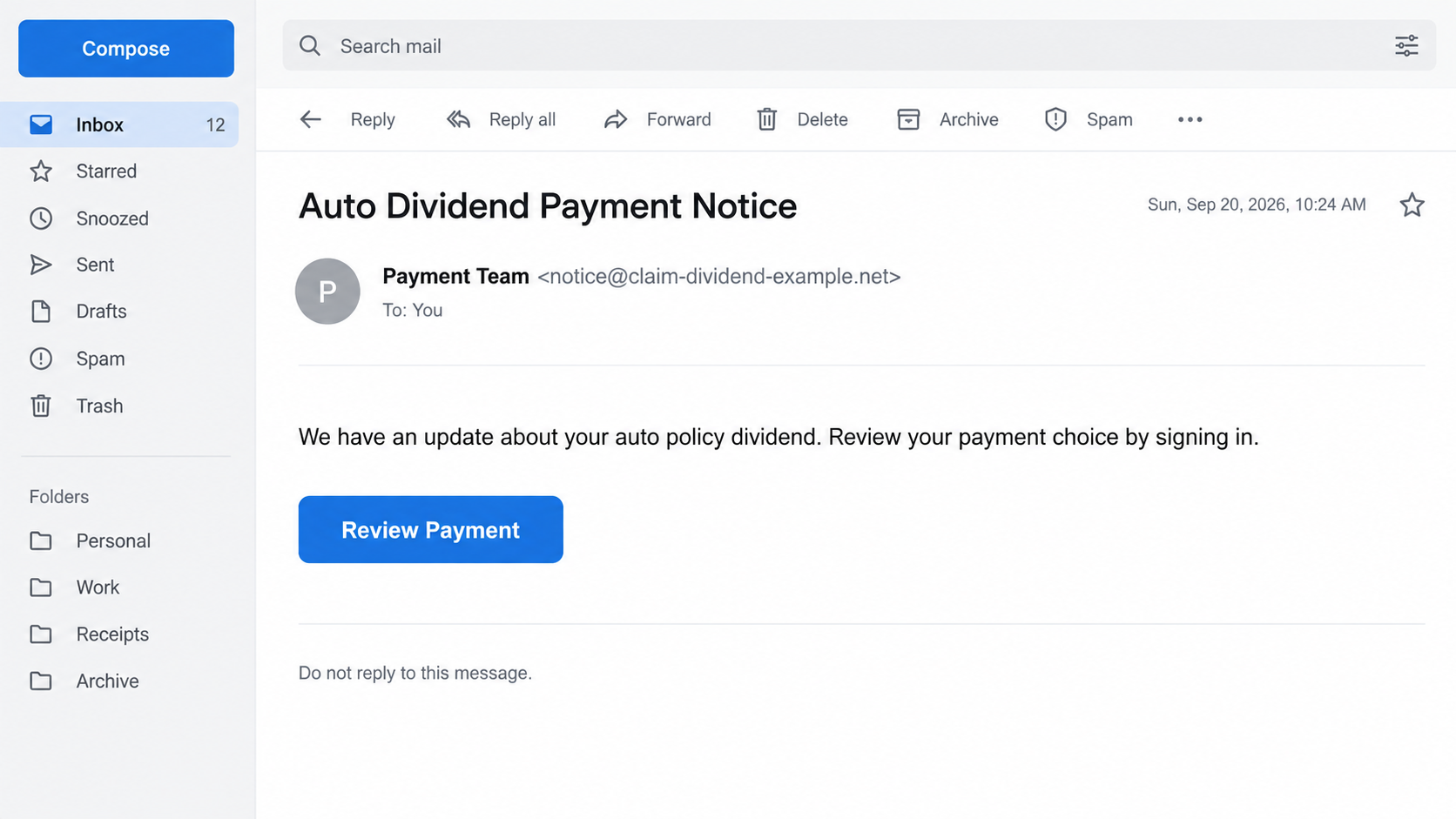
A payment notice from your car insurer is the sort of email you might open before finishing your coffee. State Farm really is sending some auto customers a dividend, which makes a message about choosing how to receive it unusually believable.
That is also what makes the lookalike notices worth a closer look. A familiar name, a plausible payout, and a convenient button can lead to two very different places.
Overview
The State Farm dividend is real, but impostor messages are circulating
State Farm Mutual announced a $5 billion cash-back dividend for qualifying auto customers in February 2026. The company later began issuing payments. A real payment program creates an opening for criminals: people are primed to expect a notice and may dismiss an unusual-looking message as part of the rollout.
The company’s announcement describes an average of about $100 per eligible vehicle, with amounts varying by state and premiums. That is background information, not a guarantee that every reader qualifies or that an email in their inbox is genuine.
The dangerous copy points to a lookalike payment route
State Farm’s security page specifically warns about phishing emails and calls impersonating the third-party dividend administrator. It also identifies statefarmdividend.com as a fraudulent lookalike of the legitimate sfdividend.com portal.
One extra word changes the destination. A recipient who scans only for “State Farm” and “dividend” can miss it, especially on a small screen or inside a button that hides the underlying address.
The goal is information or money, not a dividend
The fraudulent route can ask for bank details, personal information, account credentials, or a supposed processing payment. State Farm says it will not charge a fee to deliver the dividend or ask for personal email, banking, or digital-wallet passwords.
Keep these distinctions in mind before taking any action:
- A real dividend program does not authenticate an individual email.
- The real payment portal is identified on State Farm’s own security page.
- The lookalike domain named by State Farm is not an approved dividend site.
- A fee to release a payment is a warning sign, not a normal payout step.
- A sender name or logo alone cannot establish who sent the message.
Why This Payout Makes an Effective Phishing Hook
Most phishing emails invent a crisis. This one can borrow a true news story. If you heard about the dividend through a friend, an agent, or a news headline, a follow-up email feels less surprising than a random prize notification.
The timing adds to the effect. Some customers are receiving legitimate communication by email, while others may receive a mailed check. People understandably compare notes, but different delivery paths do not mean that every message carrying the right theme came from State Farm.
State Farm says qualifying customers with an email address on file can receive a payment-selection email from donotreply@e.sfdividend.com. It also says the legitimate administrator’s portal is sfdividend.com. Those details help, but they should be checked on the company’s own website rather than copied from a social post or forwarded message.
Even an apparently correct sender line is not conclusive. Display names are trivial to imitate, and some mail interfaces collapse long addresses. A safer habit is to leave the message unopened or close it, then reach State Farm through a bookmark, the official app, or an agent number you already trust.
How the State Farm Dividend Scam Works
Step 1: The message arrives when a genuine payment is expected
The first contact may be an email, text, or phone call saying a dividend is ready. It can refer to an auto policy, a one-time payout, or a payment preference. The request sounds administrative rather than sensational, which is exactly why it deserves a deliberate check.
A fraudulent email may be broad enough to reach people who never held an eligible policy. Other versions may use stolen names or public details to look more personal. Neither personalization nor a recognizable amount proves that the sender has access to State Farm’s systems.
Step 2: Branding and familiar language lower suspicion
The message can imitate an insurer’s colors, mention a dividend administrator, and use ordinary phrases such as “payment selection” or “confirm your preference.” A polished design is cheap to reproduce. The meaningful question is who controls the destination and what information it requests.
Criminals may avoid obvious spelling errors. They do not need a clumsy message when a real payout is already in the news. Treat professional formatting as presentation, not verification.
Step 3: A button hides the lookalike destination
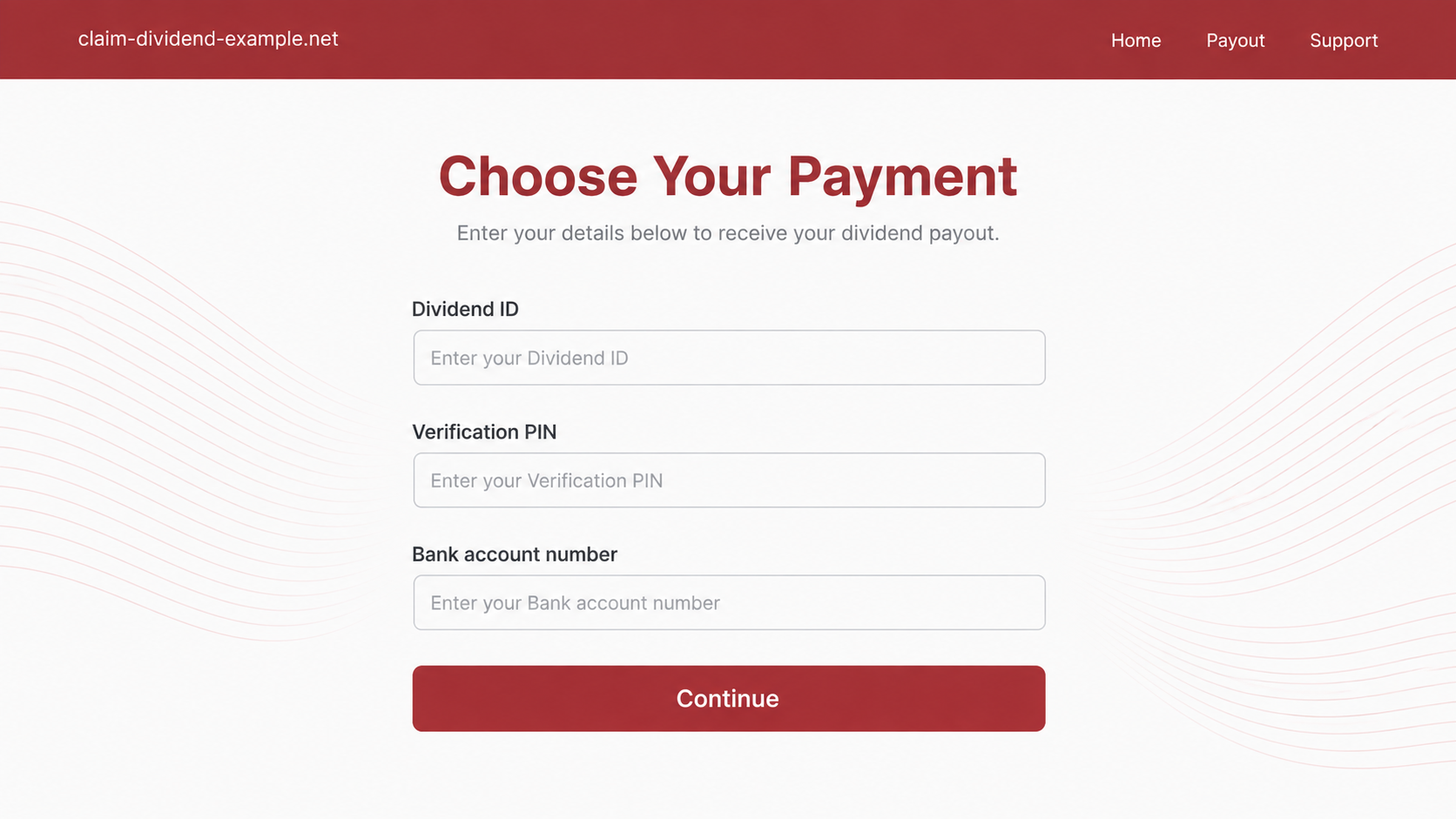
“Review payment” and “Choose payment option” buttons can point away from the legitimate portal. State Farm has identified the specific lookalike statefarmdividend.com. It closely resembles the real name but is not the approved destination.
Other domains could appear later, so memorizing a single bad address is not enough. A shortened link, an extra word, a hyphen, or a different ending can all change who receives your information. Start from State Farm’s official website instead of testing a suspicious link.
Step 4: The portal asks for details the scammer can use
A fake site may present fields for a dividend ID, PIN, bank account, card, policy number, or identity documents. Some information is part of the real payment process, which makes a lookalike form harder to judge by its fields alone. The domain and the path by which you reached it matter.
If the form asks for your State Farm password, email password, bank password, or a verification code received during an unrelated sign-in, stop. State Farm explicitly warns that it does not request personal passwords to deliver the dividend.
Step 5: A fee or follow-up call extends the theft
Some impostor journeys add a “processing” or “identity verification” charge. Others give a phone number and connect the victim to someone posing as the payment administrator. The caller can ask questions the website did not, including banking information or a one-time security code.
State Farm says there is no fee to receive the dividend. A request to pay first reverses the direction of the transaction: the supposed payer is now collecting from you. That is a decisive reason to stop, regardless of how accurate the email looked.
Step 6: The attacker uses the data or keeps the conversation alive
Once details are entered, a fake portal may show a confirmation and promise a check or deposit. That screen does not prove a transfer is underway. The information may be used for attempted account access, card charges, identity fraud, or more targeted calls.
The scammer can also claim the payment failed and ask the victim to try again. Repeated “verification” steps may collect additional data. Save the page address and messages if you need to report the incident, but do not submit another form to test whether it works.
Identity, Address, Contact, and Payment Checks
The real insurer and the sender are different questions
State Farm is a real insurer, and the announced dividend is real. A suspicious message is not necessarily from it. Verify the communication through State Farm’s own security page or an agent reached independently. A copied logo, genuine press release, or accurate payout statistic does not make the sender legitimate.
The domain must match the approved payment path
The two names in State Farm’s warning are easy to confuse: sfdividend.com is the authorized portal, while statefarmdividend.com is the identified fraudulent lookalike. Do not treat a search-result ad, social comment, or email button as the authority for which site is safe.
Support numbers must come from State Farm
The company lists its dividend contact center on its official security page. If a message tells you to call a different “urgent” number, do not use it merely because it appears beside a logo. Look up the number yourself through the official site or ask your known local agent.
The payment request must fit a dividend
A legitimate dividend pays the customer. It does not require a gift card, crypto transfer, card fee, or password. If the process introduces a charge, a remote-support session, or a request to disclose an unrelated account’s login, the request no longer fits the purpose of the payment.
How to Check a Dividend Notice Without Using Its Link
First, take a breath. There is no need to resolve a payout from the same message that announced it. Open a new browser window and type statefarm.com yourself, or use the official State Farm app you already have installed.
Check any secure account notification or dividend information there. If you cannot confirm it, contact your agent at a number from your policy documents or the official site. A genuine representative can explain your options without directing you back to a questionable URL.
Review the exact address before entering anything. A padlock indicates an encrypted connection to that site; it does not prove the site belongs to State Farm. Criminals can also obtain certificates for lookalike domains.
If the message claims you must act immediately or lose the money, treat that pressure as another warning. A caller who discourages you from checking with your agent is asking you to surrender the one independent test that matters.
What to Do if You Have Fallen Victim to This Scam
- Stop the conversation and preserve the evidence. Close the suspicious page, end the call, and do not send another payment. Keep the email, text, URL, screenshots, transaction records, and any name or number used by the caller. Record when you entered information and exactly what you supplied.
- Contact your bank or card issuer immediately if financial details were entered. Use the number on your card or banking app, not one in the message. Ask about blocking the card or account, disputed charges, and monitoring for attempted transfers. If money was sent, explain the method and timing so the institution can assess recovery options.
- Secure the accounts whose credentials you exposed. If you typed a State Farm, email, bank, or wallet password, change it through the genuine site from a trusted session. Use a new, unique password, enable multifactor authentication, and review recent sign-ins. Tell the provider if a one-time code was also shared.
- Notify State Farm through a verified route. Forward the suspicious email to abuse@statefarm.com as directed on its security page. Call your local agent using a known number and explain whether you entered details or paid anything. Ask for help checking your policy and account activity.
- Protect your identity if personal documents or identifiers were disclosed. Review credit reports and consider a fraud alert or freeze with the major credit bureaus. In the United States, IdentityTheft.gov can guide a recovery plan based on the information taken.
- Check the device only if you downloaded or installed something. A web form and a malicious attachment create different risks. If you opened a file or installed an app, run a reputable scan such as Malwarebytes and remove anything you do not recognize. AdGuard can help reduce exposure to malicious ads and known scam pages, but it cannot reverse a submitted password or bank transfer.
- Report the fraud and watch for recovery impostors. File a report with the FTC if you are in the United States. If someone later promises to retrieve your dividend or stolen funds for an upfront fee, do not pay them. Recovery offers often target people who have already been deceived once.
Frequently Asked Questions
Is the $5 billion State Farm dividend itself a scam?
No. State Farm announced the dividend publicly. The scam is the impersonation of that real program through lookalike sites, emails, and calls. Eligibility and amount should be checked with State Farm, not inferred from an unsolicited message.
Is sfdividend.com a real State Farm payment portal?
State Farm identifies sfdividend.com as the legitimate payment portal operated with its administrator. Reach it through State Farm’s official site or verified communication, and recheck the address before entering information.
What is wrong with statefarmdividend.com?
State Farm explicitly identifies that longer domain as fraudulent and says it is not the legitimate payment website. Do not enter personal, banking, or Microsoft account information there.
Will State Farm charge a processing fee for the dividend?
No. The company’s security guidance says customers will not be asked to pay a fee, make a payment, or send money to receive their dividend.
What if I clicked the link but entered nothing?
Close the page and verify the notice through State Farm directly. If a download started, remove it and scan the device. Keep an eye on later emails or calls that refer to the visit, but do not assume a click alone transferred all your account information.
What if I supplied my bank account number?
Contact the bank through its official app or card number immediately and tell it the details were entered on a suspected phishing page. Ask about account monitoring and the safest replacement or restriction options for your situation.
The Bottom Line
The State Farm dividend is genuine, but criminals are using it as cover. The decisive difference is not the size of the payout or the design of the email. It is whether the message takes you through a verified State Farm route.
Do not pay to receive a dividend, disclose unrelated passwords, or trust a lookalike domain. Open State Farm independently, confirm the offer there, and act quickly if you already shared information.








