

SnugPouch turns an ordinary fleece hoodie into something instantly shareable: a built-in pocket where a small dog or cat can ride against your chest.
The idea is charming, and the page understands that perfectly. Before buying, however, pet owners need answers that cute photographs cannot provide.
Overview
The product is sold through a domain created only weeks ago
Public registration data shows SnugPouch.shop was created on August 30, 2026. We examined the website less than one month later.
A recently opened store can be legitimate, but it has had little time to establish a reliable fulfillment and refund history.
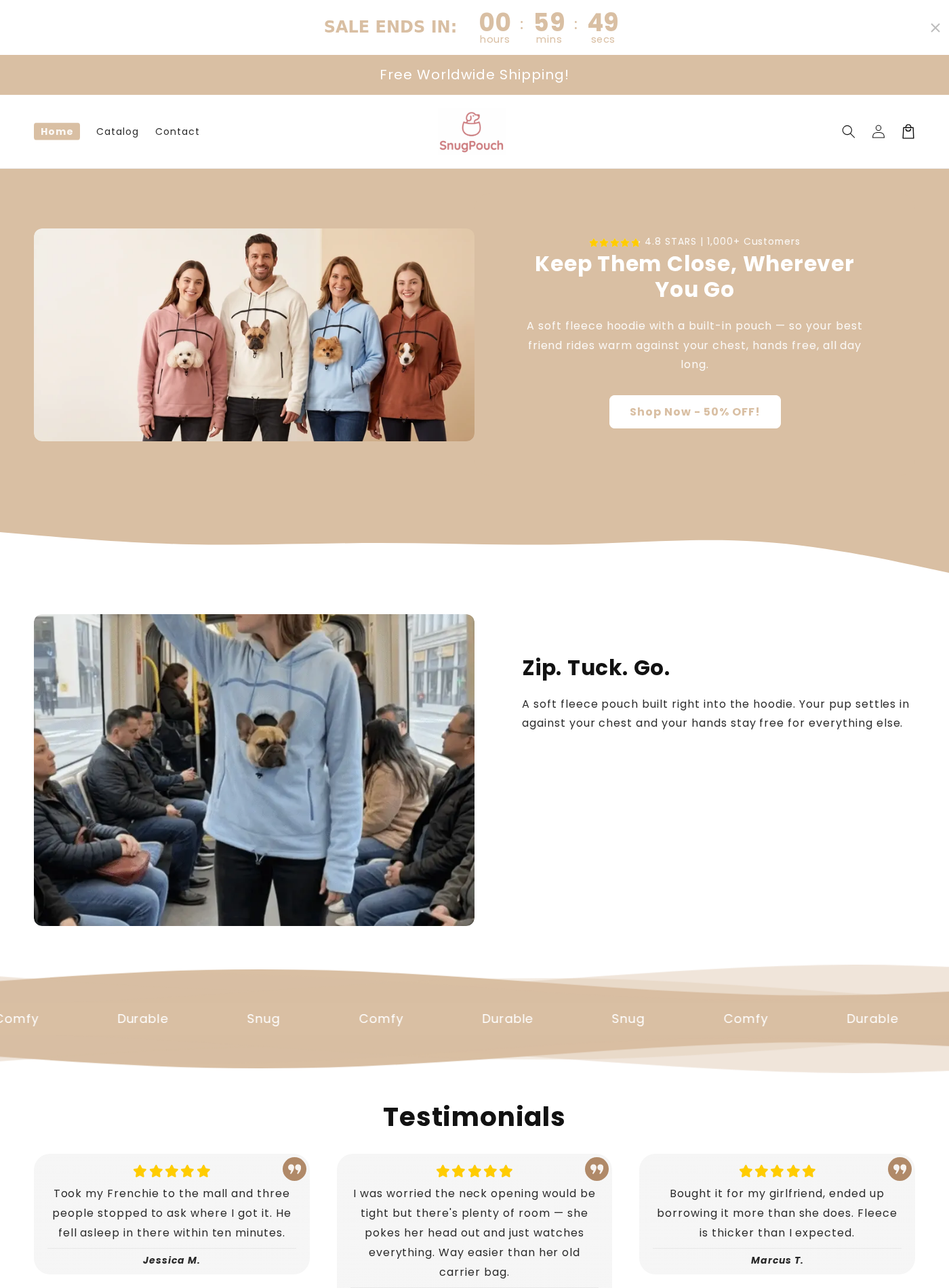
Despite that brief existence, the homepage announces a 4.8-star rating and more than 1,000 customers without naming an independent review platform.
The figure may refer to another sales channel, earlier brand activity, or an internal claim. The site does not provide evidence allowing verification.
Shoppers should not treat numbers printed by the merchant as proof that one thousand completed orders produced satisfied customers.
The page relies on urgency and emotional pet imagery
A countdown at the top says the sale ends within approximately one hour, while the main button advertises 50% off.
Photographs show relaxed people carrying calm small dogs in soft hoodies on outings and public transport.
The visual message is closeness, convenience, warmth, and hands-free companionship rather than a detailed assessment of animal restraint or sizing.
Testimonials praise comfort and attention from strangers, but the page does not identify a traceable review source or verification method.
Emotion can make the product appealing before the buyer checks whether the pouch suits a particular animal safely.
Key policies and business details are difficult to find or absent
During our review, expected policy addresses for refunds, terms, shipping, and privacy did not provide normal accessible policy pages.
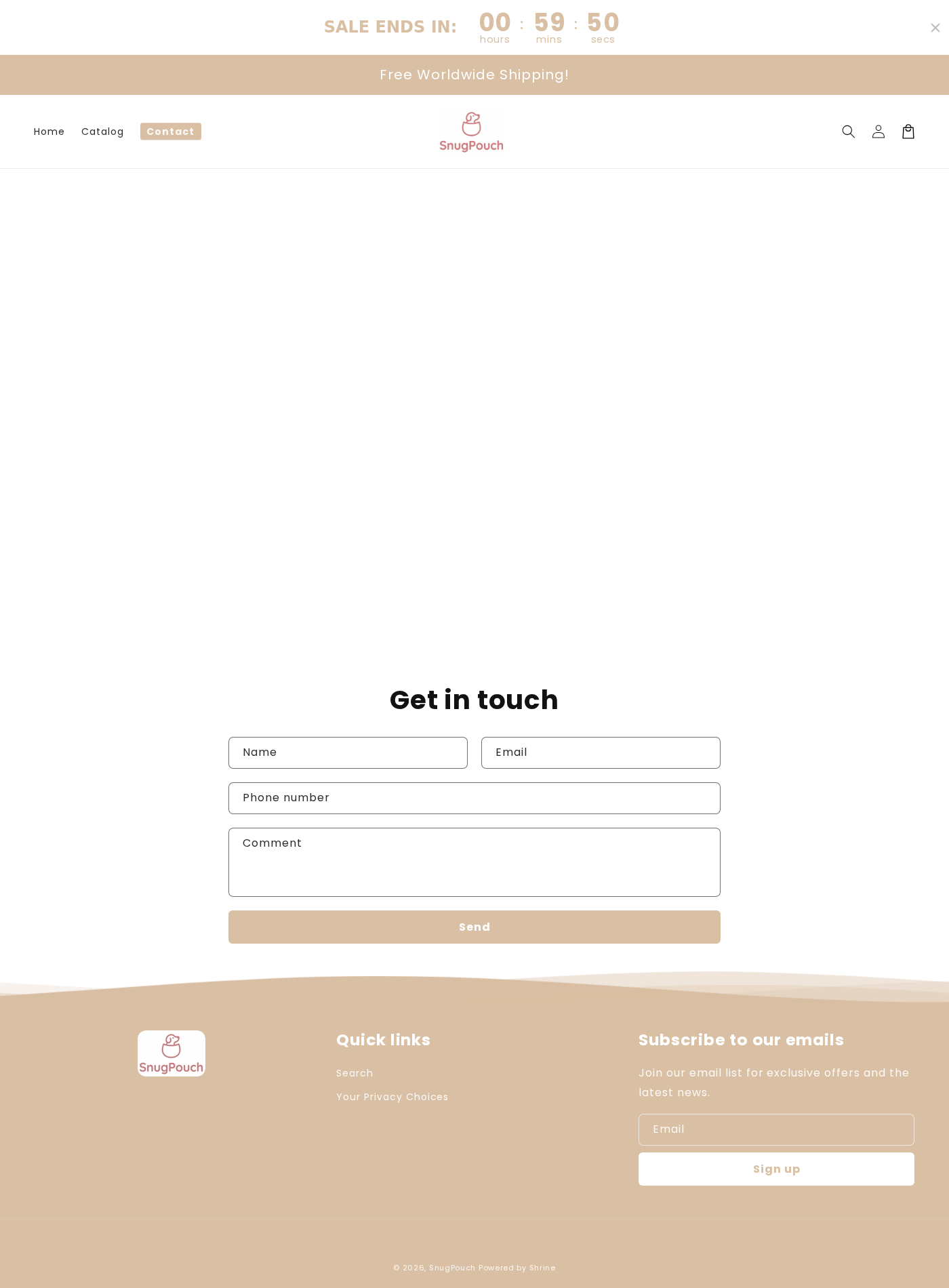
The public contact page offered a form requesting a name, email, phone number, and comment. It displayed no direct support email.
We also found no clear legal company, physical address, telephone number, manufacturer, or country of fulfillment on that page.
Those omissions prevent buyers from judging return cost, delivery timing, consumer jurisdiction, and the operator responsible if a pet product fails.
A store accepting payment should explain those basics before asking customers to trust a countdown and an unfamiliar brand.
- SnugPouch.shop was registered on August 30, 2026.
- The site claimed 1,000+ customers almost immediately.
- Its displayed 4.8-star rating lacked an independent source.
- The offer used a repeating countdown and 50% discount.
- The contact page showed only a form.
- Core return, shipping, legal, and safety information was not clearly accessible.
How the SnugPouch Pet Hoodie Sales Funnel Works
Step 1: A cute social video turns pet closeness into an instant need
The offer is naturally suited to short social videos because a dog’s face emerging from a hoodie pocket communicates the idea without explanation.
Viewers picture errands, cold walks, travel, or cuddling at home, and the emotional response arrives before practical questions.
The product seems to solve two desires simultaneously: comfortable clothing for the owner and constant proximity for the animal.
A brief clip cannot show prolonged weight distribution, fabric durability, escape risk, overheating, or how an anxious pet behaves.
It also cannot establish that the seller’s photographs show the exact construction customers will receive.
Pet owners should pause because safety depends on the individual animal, garment fit, pouch structure, and circumstances of use.
Step 2: The landing page manufactures quick social confidence
Visitors immediately encounter five stars, a 4.8 rating, and the statement “1,000+ Customers” beside the product headline.
Lower on the page, named testimonials describe dogs relaxing inside the pouch and owners receiving compliments in public.
The store does not show dates, order identifiers, an external review profile, or a methodology connecting those statements to verified purchases.
On a domain less than one month old, a four-figure customer total deserves especially clear substantiation.
Seller-selected praise can describe desired product outcomes while omitting returns, sizing failures, delayed orders, and pet discomfort.
Until independently confirmed, every testimonial on the checkout path remains a marketing claim controlled by the merchant.
Step 3: A short timer and large markdown discourage deeper inspection
The upper banner counts down from one hour, creating the feeling that the 50% price will disappear during research.
Countdown urgency is powerful because shoppers fear losing both the discount and a product that feels unusually personal.
If the timer resets after expiry or on another device, it does not represent a fixed public sale deadline.
The crossed-out price also needs history. A reference amount typed by the seller does not establish ordinary market value.
Buyers should compare identical hoodie seams, pouch shape, drawstrings, logo placement, and product images across marketplaces.
A timer should never prevent checking the operator, materials, measurements, animal limitations, shipping origin, and return destination.
Step 4: Checkout proceeds without a complete contractual picture
The storefront can collect an order while leaving the customer uncertain about shipping time, dispatch country, returns, and the responsible company.
The contact form requests the shopper’s information but does not reveal an address or direct support channel in exchange.
A working payment page or padlock protects transmitted data. It does not prove merchandise quality, policy fairness, or operator identity.
The card statement may display an unfamiliar billing descriptor, which becomes important if the order needs to be disputed later.
Customers should record the selected size, color, quantity, price, currency, delivery promise, and merchant name before authorizing payment.
They should abandon checkout when the return country and eligibility rules cannot be obtained in writing.
Step 5: Fulfillment may reveal a generic product rather than a documented design
The website does not identify a manufacturer, model number, test standard, material specification, or production location for the hoodie.
That makes it difficult to distinguish a proprietary SnugPouch product from a supplier item sold under temporary branding.
The delivered fleece could vary in thickness, stitching, sizing, color, pouch depth, reinforcement, and hardware from polished photographs.
A functional hoodie can still be materially disappointing when construction or fit does not support the advertised pet-carrying use.
If goods ship internationally, tracking may involve several carriers and a longer timeline than the social advertisement implied.
Pet owners should inspect every seam and attachment before placing an animal inside, regardless of the product’s marketing name.
Step 6: The missing policy framework makes resolution uncertain
An ordinary return requires a deadline, eligibility rules, authorization route, destination, postage responsibility, and refund timing.
Those terms were not clearly available through expected policy links during our investigation of SnugPouch.
The buyer may therefore discover essential conditions only after contacting an unidentified operator through the web form.
If support is slow, the customer cannot know whether an unseen return clock is already running.
Sending the hoodie to a parcel-label address can fail because fulfillment warehouses often do not process customer returns.
A purchase guarantee has limited value when shoppers cannot identify who provides it or where an eligible return must arrive.
What Our SnugPouch Investigation Found
The customer count is not supported by visible evidence
Reaching more than 1,000 customers within weeks is possible for a heavily advertised product, but it would usually create an external footprint.
The site does not link its rating to Trustpilot, Google, Shop, a marketplace, or another platform where reviewers can be examined.
No review dates appear beside the homepage testimonials, making it impossible to align them with the domain’s creation date.
A brand can also count email subscribers, visitors, buyers from another store, or unverified submissions as “customers.”
Without a definition and source, the impressive number should not influence a safety or purchasing decision.
The pet-carrying claim needs far more technical detail
A pouch holding a living animal is not equivalent to a decorative sweatshirt pocket. Weight, movement, ventilation, support, and escape prevention all matter.
The page should specify maximum animal weight, pouch dimensions by size, reinforcement, closure design, washing limits, and prohibited activities.
Owners also need warnings about breathing restriction, jumping, falls, heat, drawstrings, crowded transit, and animals that resist confinement.
The cheerful photographs do not show independent veterinary review, product testing, or a recognized carrier-safety standard.
Absence of that evidence does not prove the hoodie injures pets. It means shoppers should not infer safety from staged use.
The business is less transparent than the branding
SnugPouch has a coherent logo, colors, product name, polished sections, and testimonial cards. Those elements create a complete visual identity quickly.
The legal identity is much thinner. We found a contact form but no prominent company name, physical office, phone, or direct customer-service email.
The footer contained only limited links, while normal legal and commercial policies were not readily available.
Professional design can be installed in hours through a theme. Accountability requires information that survives beyond the theme.
Buyers should prioritize the latter when a product involves both money and an animal’s physical wellbeing.
External warning scores add concern but do not settle the case
Automated reputation services have flagged SnugPouch.shop as risky or suspicious, and one security report noted a limited engine detection.
Such tools can produce false positives and should never be treated as courtroom proof that an online store is fraudulent.
They are most useful when combined with direct observations: very recent registration, unsupported popularity, absent policies, and hidden operator details.
Those first-party facts already justify avoiding an order until the website becomes transparent and develops verifiable customer history.
There is no need to exaggerate uncertain malware claims when the commercial warning signs are visible on the store itself.
Pet Hoodie Safety and Buying Checklist
Match the animal, not just the owner’s sweatshirt size
Measure the pet’s weight, body length, chest, and resting position, then compare those numbers with published pouch dimensions.
A larger sweatshirt does not necessarily provide safer support because the pouch may sag, twist, or place weight unevenly.
Animals with breathing, spinal, mobility, cardiac, or anxiety concerns should be evaluated carefully before any wearable carrier is used.
When uncertain, ask a veterinarian about the activity and use a purpose-built carrier with known specifications.
Inspect construction before first use
Pull gently on seams, lining, drawstrings, zipper areas, and pouch attachments while the hoodie is empty.
Check for loose threads, sharp pieces, weak stitching, small detachable parts, chemical odors, or fabric that blocks airflow.
Begin indoors near the floor for a brief supervised test. Stop if the animal pants, struggles, freezes, vocalizes, or attempts to leap.
Never use an unfamiliar pouch while driving, cycling, cooking, climbing, exercising, or entering another hazardous environment.
Verify the merchant before testing the merchandise
Ask for the legal seller, support email, telephone number, dispatch country, return address, and complete policy before ordering.
Request written confirmation that opening the package and conducting a careful fitting does not automatically void return rights.
Use a credit card and avoid purchasing multiple sizes solely because a timer claims the sale will end.
Save the seller’s response with the advertisement in case product safety or material description later becomes disputed.
Company, Address, and Fulfillment Checks
No clear legal operator appears beside the brand
The SnugPouch name and logo identify the marketing concept, but they do not identify the registered entity accepting contractual responsibility.
We found no visible company number, jurisdiction, proprietor, or principal office on the captured homepage and contact page.
Without that information, buyers cannot search corporate records or determine where a formal consumer complaint should be directed.
The name appearing on an eventual invoice or card statement may differ, so customers should preserve every version.
A brand can be replaced quickly. The legal seller is the party that must remain accountable after the advertisement ends.
The contact form reveals more about the customer than the merchant
Visitors are asked to submit a name, email, phone number, and comment through the website.
The same page did not display a direct support email, mailing address, customer-service telephone line, or named department.
That imbalance makes pre-sale verification difficult and leaves no alternative channel if the form stops working.
Do not include payment-card details, passwords, identity documents, or unnecessary personal information in a general contact form.
Take a screenshot after submitting a complaint because some forms provide no durable copy to the sender.
Fulfillment and returns may involve unseen third parties
A young one-product store may use a manufacturer, sourcing agent, fulfillment warehouse, shipping consolidator, and last-mile courier.
None of those companies necessarily owns SnugPouch or has authority to approve a refund.
The sender address printed on a parcel may be a processing facility that discards unauthorized consumer returns.
Ask which country dispatches the hoodie and which address accepts approved returns before paying.
If support refuses to answer, assume the practical remedy may be expensive or unavailable and choose another seller.
Unknown pet products deserve stronger caution than ordinary apparel
The hoodie supports an animal’s weight close to the wearer’s moving body, so construction failure can have consequences beyond a torn garment.
The site should identify materials, weight limits, reinforcement, testing, warnings, manufacturer, and traceable batch information.
Mass-produced merchandise can vary between batches even when photographs remain unchanged across listings and storefronts.
Stop use immediately after seam movement, fabric tearing, closure failure, overheating, distress, or any behavior suggesting insecurity.
Keep the item and packaging if an incident occurs, and report a suspected dangerous product to the appropriate safety regulator.
What to Do if You Have Fallen Victim to This Scam
- Save every promise. Capture the 4.8 rating, customer count, 50% offer, timer, photographs, safety claims, checkout, confirmation, and any available policies before they change.
- Verify the charge and quantity. Compare your receipt with the size, color, units, shipping, currency, discount, and total you actually approved.
- Request cancellation immediately. Use the contact form and any address in the confirmation. Record the submission and ask for a written refund commitment before dispatch.
- Film the package opening. Show the sealed label, hoodie, pouch, stitching, materials, sizing marks, damage, accessories, and differences from the listing continuously.
- Do not place a pet inside a questionable garment. Inspect reinforcement first. Stop permanently if seams, closures, airflow, or fit appear unsafe.
- Demand a complete return route. Request the legal seller, physical destination, recipient, authorization, deadline, postage responsibility, and refund timeline in writing.
- Use your card protections. Dispute non-delivery, unauthorized billing, defective merchandise, or material misdescription with organized screenshots and a factual chronology.
- Report any injury or dangerous defect. Contact a veterinarian when necessary and notify the relevant consumer-product authority while preserving the hoodie, label, and packaging.
- Protect your browser and device. Run Malwarebytes, remove unfamiliar extensions, and use AdGuard to reduce repeated exposure to aggressive pet-product ads and malicious redirects.
How To Recognize Similar One-Product Pet Stores
A viral demonstration replaces complete specifications
The advertisement shows an adorable outcome in seconds but never explains weight limits, testing, failure modes, or unsuitable activities.
Pause the video and identify every physical component responsible for restraining or supporting the animal.
Search the product image without its invented brand name to find supplier listings, manuals, and buyer photographs.
A pet’s safety should never depend on assumptions created by a short edited clip.
Popularity appears immediately on a very new domain
Large customer totals and nearly perfect ratings can be inserted into a template before the first genuine order ships.
Look for independent dated reviews, varied experiences, owner responses, delivery details, and criticism that a real sales history naturally produces.
Compare the dates with the domain record. An extraordinary launch requires extraordinary supporting evidence.
Treat seller-controlled testimonials as promotional copy until another source verifies the purchase and reviewer.
The store has a personality but no company
A memorable logo, soft color palette, mascot, and friendly language can make a temporary storefront feel like a stable brand.
Search the policies for the legal entity, physical address, governing law, support channels, return destination, and fulfillment origin.
Missing or broken pages matter because they remove the rules governing your money after the purchase.
Choose the merchant whose accountability is clearest, even when another seller’s creative advertisement is more charming.
Frequently Asked Questions
Is SnugPouch definitely a scam?
We cannot prove that every payment results in non-delivery. We did not order a hoodie or test its construction.
The very new domain, unsupported popularity, absent legal details, inaccessible policies, urgency, and pet-safety gaps make the purchase unacceptably risky.
How old is SnugPouch.shop?
The domain was registered on August 30, 2026. Our review occurred less than one month afterward.
That timeline makes the claim of more than 1,000 customers especially important to verify independently.
Are the SnugPouch reviews real?
The homepage displays testimonials and a 4.8 rating, but it does not identify an external platform or provide enough data to authenticate purchases.
Until traceable evidence appears, shoppers should regard those reviews as claims published by the seller.
Is a pet pouch hoodie safe?
Safety depends on construction, fit, animal size, health, behavior, ventilation, supervision, and the activity being performed.
SnugPouch does not provide enough visible independent testing or detailed limitations for us to endorse its use as an animal carrier.
Can I return a SnugPouch hoodie?
We could not access a complete, clear return policy through the expected public pages during the investigation.
Do not order until support supplies the window, eligibility rules, return country, full address, postage responsibility, and refund timing in writing.
What should I buy instead?
Use a pet carrier from an established manufacturer that publishes dimensions, weight limits, materials, safety instructions, and traceable customer support.
Choose a retailer offering practical returns, independent reviews, and enough technical detail to match the carrier to your animal.
The Bottom Line
SnugPouch succeeds as an advertisement because the product looks warm, clever, and affectionate. Those qualities do not answer who built it, tested it, or stands behind it.
A weeks-old domain, unverifiable customer figures, reset-style urgency, hidden operator, missing policies, and weak safety documentation make this hoodie an avoidable gamble for owner and pet.








